Agricultural Carbon Markets in 2026: What Remains, What They Pay, Whether It's Worth It
Agricultural carbon markets in 2026 are more mature, but they are still highly conditional. Farmer returns depend on acreage, baseline practices, verification costs, and contract terms, so the practical question is whether a carbon program creates meaningful net value for a specific farm.
By Dawood Atta, Ph.D. · University of FloridaUniversity||4 min read|50 reads
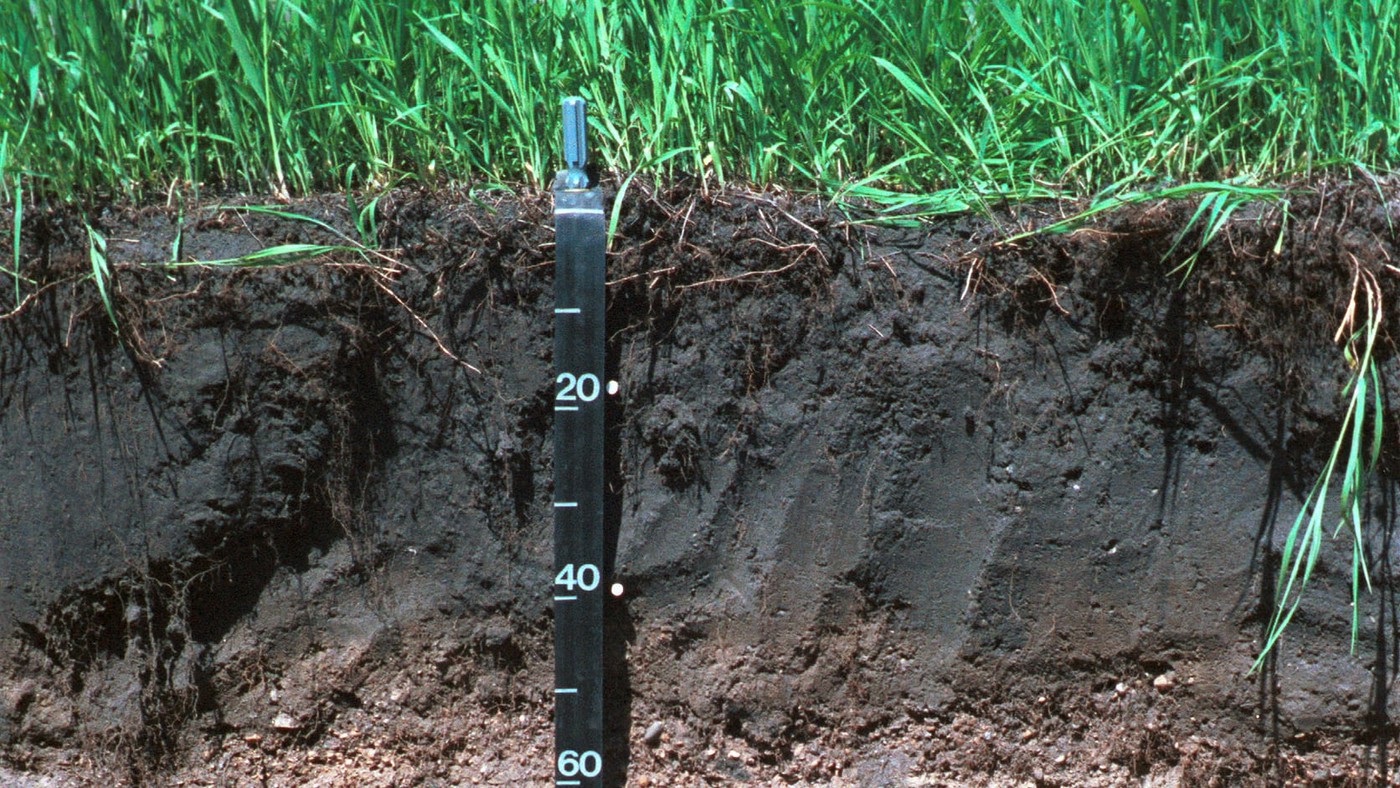
A soil profile under permanent grass cover, showing dark carbon-rich surface soil. Photo courtesy USDA Agricultural Research Service.
What changed
Agricultural carbon markets in 2026 look very different from the early years of enthusiasm. Awareness is high; participation is not. In a Trust In Food (Farm Journal) survey of crop and livestock producers — cited in USDA’s 2023 assessment of agriculture in carbon markets — about 93% of producers were aware of carbon markets, but only around 3% were participating. Interest, clearly, has not translated into a consistent business case.
Figure
High awareness, low participation
Aware of carbon markets
93 % of producers
Actually participating
3 % of producers
Trust In Food (Farm Journal) producer survey, cited in USDA's 2023 assessment of agriculture in carbon markets.
Click to expand
The market has also been through a shakeout. Nori, a Seattle marketplace that sold soil-carbon “Regenerative Tonnes,” shut down entirely in September 2024, its CEO citing a stagnant voluntary market. CIBO Technologies did not close but pivoted away from farmer-facing credits toward enterprise emissions software, and was folded into a new company, Terion, in 2026. Across the whole voluntary market, transaction value fell roughly 29% in 2024. The sector is more cautious than it was at the peak of the hype.
What farmers can actually earn
The question most growers ask now is not whether carbon markets exist, but what they pay after costs. Headline per-ton prices can look appealing — premium, directly soil-sampled credits from a developer like Indigo Ag have sold to corporate buyers for as much as $60–$80 per ton. But that is the very top of the range, not the going rate, and it is not what reaches the farm.
The agriculture-sector average gross price was about $8 per ton in 2024 (Ecosystem Marketplace). After verification, program fees, and buffer-pool withholding, farmers have historically received roughly $9–$25 per credit. Translated to the field, independent ag-economics modeling lands at a net return of about $4–$20 per acre per year — useful for practices you were going to adopt anyway, but rarely a reason on its own.
What a soil-carbon program actually pays
Gross credit price (ag soil carbon): ~$8/ton sector average; $10–$30 for good-quality credits; up to $60–$80 for premium single projects
What farmers actually received: ~$9–$25 per credit
Credits generated: ~0.3–0.4 tons CO₂e per acre per year (no-till / cover crops)
Typical deductions: ~15% program fee + ~25% buffer-pool withholding — a farmer often keeps only about 60% of the credits generated
Headline price vs. the going rate (ag soil carbon)
Premium single project
70 $/ton
Good-quality credit
20 $/ton
2024 sector average
8 $/ton
Bars show typical values; actual ranges are $60–80 (premium), $10–30 (good-quality), and ~$8/ton (2024 sector average). Sources: Ecosystem Marketplace 2025; Indigo Ag reporting.
Click to expand
What matters most
For row-crop systems with enough acreage, carbon markets can still be worth exploring — but mainly when the farm already runs compatible practices and can absorb the documentation burden. The economics improve when carbon revenue stacks with other incentives. That is why the 45Z Clean Fuel Production Credit matters. Created by the Inflation Reduction Act and active since January 2025 (extended through 2029 by 2025 legislation), 45Z rewards low-carbon-intensity feedstocks — and climate-smart practices like cover crops and no-till can lower the carbon-intensity score of corn and soybeans headed for biofuels.
One important caveat for 2026: the pathway to actually credit those practices under 45Z is not finished. As of mid-2026, USDA and DOE were still finalizing the models that translate on-farm practices into carbon-intensity scores — so the practice benefit is real in principle but not yet bankable.
The current reality
A more accurate way to think about carbon markets is as a conditional opportunity, not a universal solution. Some farms — especially those that can enroll with little added cost — will find the payments worthwhile. Many others will find the complexity outweighs the benefit. It is also worth remembering that the federal landscape shifted: USDA cancelled the $3.1 billion Partnerships for Climate-Smart Commodities program in April 2025 and replaced it with a narrower “Advancing Markets for Producers” effort, while the durable cost-share routes — EQIP and CSP — remain through NRCS. The market is more credible than it was during the hype cycle. It is still uneven, uncertain, and highly dependent on farm-specific conditions.
The expert’s view
Focus on net value, not headline promises. Before assuming a program will pay, ask whether it fits your acreage, your baseline practices, your tolerance for a 5- to 20-year contract, and your capacity to handle the data and verification. The market may be climbing out of its trough — but for most farms it is still not yet a dependable income stream.
Source material for every claim in this article, plus a citation-ready record for reference managers and scholarly indexes.
Cite this
Reference this work
SHE-ART-2026-0026
Dawood Atta, Ph.D. (2026). Agricultural Carbon Markets in 2026: What Remains, What They Pay, Whether It's Worth It. Soil Health Exchange. SHE-ART-2026-0026. https://soilhealthexchange.com/cite/SHE-ART-2026-0026
Soil Health Exchange assigns a stable identifier to every published answer and article. Citations keep working even if the URL changes later.
Cite this articleShow formatsHide
Cite this article
Citation-ready record
APA
Ph.D., D. A. (2026). Agricultural Carbon Markets in 2026: What Remains, What They Pay, Whether It's Worth It. Soil Health Exchange. https://soilhealthexchange.com/blog/agricultural-carbon-markets-in-2026-what-remains-what-they-pay-whether-its-worth-it
More citation formats
MLA
Ph.D., Dawood Atta,. "Agricultural Carbon Markets in 2026: What Remains, What They Pay, Whether It's Worth It." Soil Health Exchange, 2026-07-04, https://soilhealthexchange.com/blog/agricultural-carbon-markets-in-2026-what-remains-what-they-pay-whether-its-worth-it.
Chicago
Ph.D., Dawood Atta,. "Agricultural Carbon Markets in 2026: What Remains, What They Pay, Whether It's Worth It." Soil Health Exchange. Published 2026-07-04. https://soilhealthexchange.com/blog/agricultural-carbon-markets-in-2026-what-remains-what-they-pay-whether-its-worth-it.



Discussion
No comments yet. Be the first to share your thoughts!