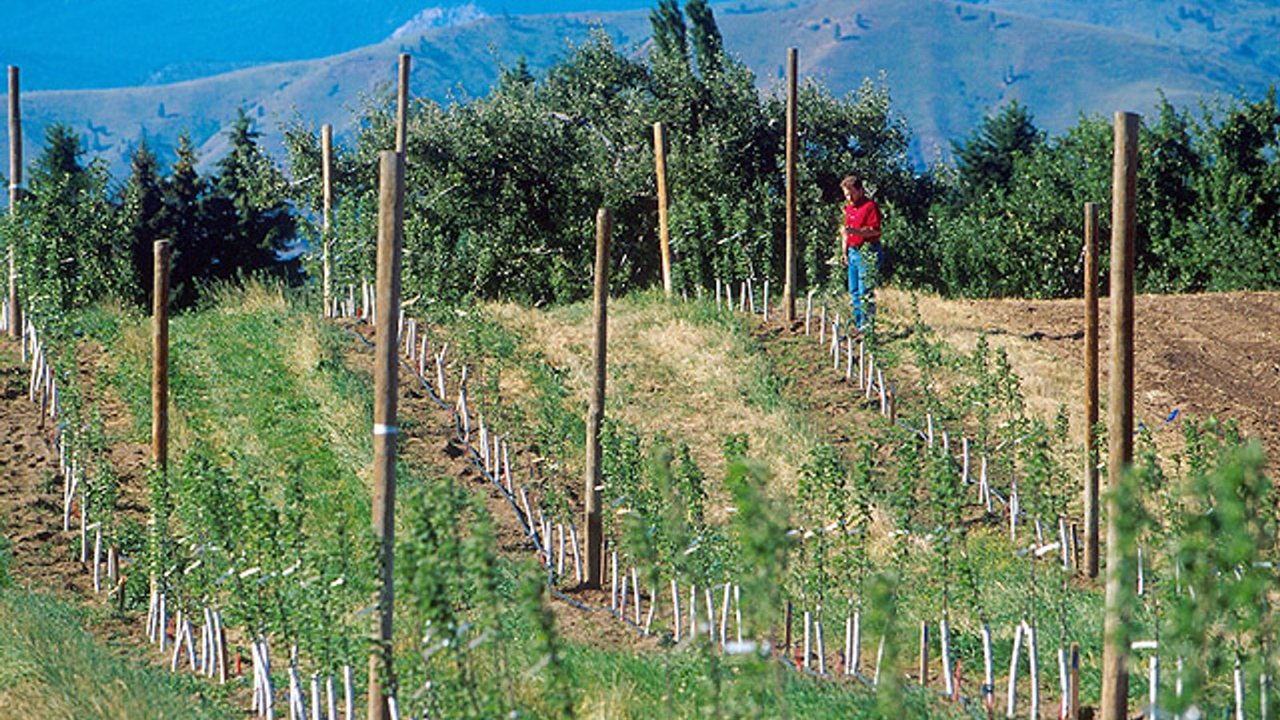
A replant orchard asks young roots to establish in soil shaped by the previous orchard. When root growth remains weak, the cause may be apple replant disease, nematodes, compaction, drainage, fertility, planting quality, or several problems together. The safest time to separate those risks is before the trees are ordered and the new rows are marked.
What apple replant disease is
Apple replant disease, or ARD, is a biologically driven disease complex associated with repeated apple production on the same ground. Research has implicated interacting groups of fungi, oomycetes, and plant-parasitic nematodes. The organisms and their importance differ among sites, which helps explain why one treatment or rootstock does not perform the same everywhere [1][2][3].
Typical effects include poor feeder-root development, uneven growth, delayed canopy fill, and lower early production. These symptoms are not unique to ARD. Waterlogging, drought, compaction, nutrient imbalance, root injury, poor planting, and other diseases can create a similar appearance [3][4]. A visual diagnosis after planting is therefore late and uncertain.
Build a site map before choosing a treatment
- Mark the previous tree rows, drive lanes, alleys, wet areas, eroded areas, and locations where the old orchard was weak or missing.
- Record the age, rootstocks, tree losses, known soilborne diseases, herbicide strips, irrigation pattern, and how old roots and stumps were removed.
- Map soil type, depth, drainage, compaction, pH, organic matter, and nutrient patterns. Sample contrasting zones separately.
- Collect nematode samples at the depth, season, and handling conditions recommended by the diagnostic laboratory [5].
- Note whether new rows will fall in old tree rows, old alleys, or a mixture. Use this map when locating diagnostic comparisons and treatment strips.
Test the constraints that can change the plan
A preplant diagnostic set
| Question | Evidence to collect | Decision it can change |
|---|---|---|
| Is the soil physically suitable? | Profile inspection, drainage, compaction, texture, depth, irrigation uniformity | Drainage work, ripping where appropriate, row location, or whether to plant |
| Is soil chemistry limiting roots? | pH, salinity where relevant, organic matter, phosphorus, potassium, calcium, magnesium, and local orchard tests | Preplant amendments that need incorporation or time to react |
| Are plant-parasitic nematodes present? | Species and counts from a qualified laboratory using correct sampling procedures | Rootstock and treatment choice |
| Is there a site-specific replant response? | Local diagnostic bioassay or a specialist-supported soil comparison where available | Need and intensity of preplant treatment |
| Can the treatment be implemented? | Label, legal requirements, temperature, moisture, irrigation, equipment, time, and cost | Treatment selection and planting date |
Broad soil-health scores can describe physical, chemical, or biological conditions, but they should not be presented as a validated ARD diagnosis unless the test has been calibrated for that purpose. Michigan State Extension recommends using soil-health assessment as part of a broader site evaluation rather than treating one indicator as the disease test [6].
Choose rootstock and soil treatment together
Rootstock affects vigor, precocity, anchorage, disease susceptibility, cold hardiness, and response to replant soil. Some Geneva-series rootstocks have shown greater tolerance than susceptible standards under replant conditions, but performance is genotype- and site-dependent [3][7][8]. A rootstock should also fit the scion, training system, soil, climate, fire-blight risk, nursery supply, and market plan. Replant tolerance is one selection criterion.
Compare treatment pathways by their requirements
| Pathway | Evidence and fit | Main requirements or limits |
|---|---|---|
| Labeled soil fumigation | Can suppress replant pathogens and nematodes and has a long commercial record | Registration, applicator requirements, buffers, soil preparation, moisture, temperature, cost, and planting interval |
| Brassica seed meal | Washington trials have shown strong growth responses with specific formulations and protocols | Correct meal formulation and rate, incorporation, moisture management, material supply, cost, and phytotoxicity interval |
| Anaerobic soil disinfestation | Can suppress parts of the disease complex; field response has been variable | Suitable carbon source, incorporation, saturation, plastic or water management, temperature, time, and oxygen exclusion |
| Row relocation or rotation | May reduce exposure by moving roots away from the old tree row or interrupting apple production | Land and layout constraints; survival of pathogens and roots means it is not a guaranteed cure |
| Tolerant rootstock plus site preparation | Reduces risk and supports establishment as part of a combined plan | Does not correct drainage, compaction, severe nematode pressure, or every microbial complex |
In commercial-scale Washington trials, a Brassica seed-meal treatment produced tree growth equal to or greater than fumigation at the sites studied, while anaerobic soil disinfestation was more variable [9][10]. Those results support consideration of the methods. They do not make a single protocol portable to every orchard. Soil, pathogen complex, material, application, and climate all influence the outcome.
Budget the establishment years, not only the treatment
Washington State University estimates that, in its production context, ARD can reduce returns by roughly $70,000 to $150,000 per acre during the first four years after planting [10]. This is a regional scenario, not a universal loss estimate. Tree density, cultivar, price, training system, yield curve, treatment cost, financing, and the severity of the untreated problem will change the number.
A partial budget for replant decisions
| Budget item | What to include |
|---|---|
| Preplant preparation | Testing, old-root removal, drainage, ripping where appropriate, lime or nutrients, and row-layout changes |
| Treatment | Material, freight, application, irrigation, plastic, labor, equipment, compliance, and planting delay |
| Trees and system | Rootstock price and availability, tree density, support, irrigation, and training |
| Establishment performance | Tree survival, trunk growth, canopy fill, labor, replacement trees, and first bearing year |
| Revenue | Yield by year, packout, fruit size and quality, price, and discount rate |
| Risk | Poor treatment response, delayed planting, uneven blocks, and the cost of limited rescue options |
Use a treated strip as an orchard learning tool
Where the orchard plan and treatment rules allow, retain a clearly mapped comparison that is large enough to manage and harvest. Measure tree survival, trunk cross-sectional area, shoot growth, canopy fill, yield, packout, and management cost. Place comparisons within the same soil and drainage zone. A badly located untreated strip can confuse soil variation with treatment response.
Monitor after planting
- Check planting depth, graft-union height, root condition, irrigation delivery, and soil moisture before attributing weak growth to ARD.
- Map dead, weak, and strong trees by old row, alley, soil zone, rootstock, and treatment.
- Inspect roots and submit symptomatic material when disease or nematodes are suspected.
- Record growth and yield for several years. Early visual differences may widen, narrow, or shift as trees begin bearing.
- Keep the treatment map with the orchard record so future performance can be traced to the preplant decision.
WSU's long-term soil-health and replant work is continuing to follow orchard responses over time [11]. That is an important reminder for farm comparisons: the treatment decision is made before planting, but its value is measured across establishment, bearing, fruit quality, and orchard life.