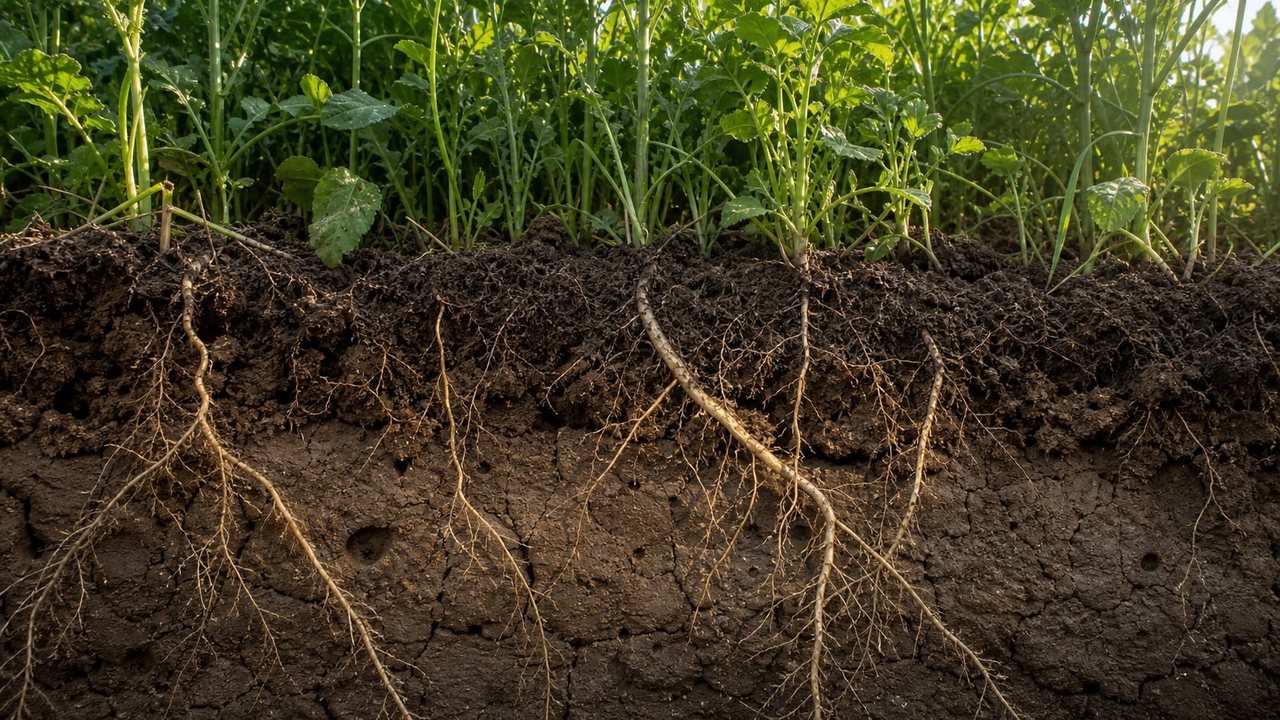
The Promise and the Problem
If you have been farming for any length of time, you have probably heard someone say: "Just plant radishes. They will drill right through your hard pan."
It sounds too good to be true. And in a way, it is. But not entirely. The story of cover crops and soil compaction is one of the most misunderstood topics in modern agriculture. Seed companies, extension bulletins, and well-meaning neighbors often oversell what a radish root can do underground. Meanwhile, farmers who try it and see no improvement in their yields or soil conditions are left scratching their heads.
This article sets the record straight. Cover crops have real, documented benefits, but compaction is one place where the details matter. When a farmer spends money on seed, fuel, and time, they deserve to know what they are actually buying.
The short version? Cover crop roots can punch holes through compacted soil. But holes are not the same thing as fixing compaction. The soil between those holes stays just as dense as it was before. And that distinction matters a great deal.
What Cover Crop Roots Actually Do
The strongest evidence for "biological drilling" comes from the University of Maryland, where researchers Guihua Chen and Ray Weil spent years studying how different cover crop roots behave in compacted soil. Their work, published in Plant and Soil (2010) [1][1] and Soil and Tillage Research (2011) [2][2], showed something genuinely impressive. When they created compacted layers in the field using wheel traffic and then planted cover crops, forage radish ("Daikon" type) pushed more than twice as many roots into the compacted zone at 15–50 cm depth compared to cereal rye. Rapeseed fell somewhere in between. The key finding: under high compaction, rye roots gave up, but radish roots kept pushing. Their root counts showed no negative relationship with increasing soil strength [1][1] — meaning radish roots are remarkably stubborn.
What happens next is even more interesting. After the radish winterkills and the big fleshy taproot decomposes, it leaves behind an open channel — a hole running from the surface down into the subsoil. The following spring, when corn or soybean roots encounter that channel, they use it like a highway. In the follow-up maize study, Chen and Weil found roughly twice as many corn roots in the compacted subsoil after radish compared to cereal rye, and both cover crops performed better than bare fallow [2][2].
This is real. It is well documented. And in drought years, when every bit of subsoil moisture counts, these root channels can make the difference between a decent crop and a failed one. In a separate soybean study, Williams and Weil noted that yield responses were most pronounced at the site with the worst drought and most severe compaction, where soybean roots threaded through the channels left by decomposed cover-crop roots to reach water that was otherwise locked away below the hard pan [3][3].
How Deep-Rooted Cover Crops Compare
Table 1 ranks the three species by how their roots behave once they hit a compacted layer (high-compaction treatment, root counts at 15–50 cm).
| Cover crop species | Root type | Root penetration at 15–50 cm under high compaction (vs cereal rye) | Behavior as soil strength increases |
|---|---|---|---|
| Forage radish ('Daikon' type) | Thick taproot | >2x as many roots as rye | Root count did not decline with rising penetration resistance ('stubborn') |
| Rapeseed | Taproot (less fleshy) | Intermediate, between radish and rye | Penetrates better than rye |
| Cereal rye | Fibrous | Baseline (1x) | Roots strongly suppressed by high compaction |
Note: Under uncompacted conditions, all three species showed similar root penetration. The advantage of tap-rooted species appears only when roots encounter resistance [1][1].
Where the Story Falls
Here is where we need to be careful. Creating a root channel is not the same thing as remediating compaction. Think of it this way: if your road has a hundred potholes, and someone drills one nice smooth hole through it, you have not fixed the road. You have made one path through it. The rest of the surface is still ruined.
That is essentially what happens in compacted soil. A radish root punches a channel through the hard layer. Great. But the millions of soil pores surrounding that channel — the macropores, mesopores, and the entire connected network that allows water to drain, air to move, and fine roots to explore — remain crushed. Bulk density stays high. Saturated hydraulic conductivity stays low. Air permeability stays poor.
The Belgian Evidence
Some of the most important recent evidence comes from Belgium, where researchers at ILVO (the Flanders Research Institute for Agriculture) and Ghent University ran a direct side-by-side comparison of subsoiling versus biological remediation using fodder radish and alfalfa. This study, by Vanderhasselt, Steinwidder, D'Hose and Cornelis, was published in Soil and Tillage Research in 2024 [4][4]. They worked on a sandy loam soil with a heavily compacted layer at 30–50 cm depth — exactly the kind of situation farmers deal with. Their findings were sobering. Yes, both fodder radish and alfalfa roots did physically penetrate the compacted subsoil. The roots got through. But when they measured the actual soil physical properties — penetration resistance, bulk density, porosity, plant-available water capacity, air capacity, air permeability — the bio-subsoilers did not significantly improve them [4][4].
Mechanical subsoiling, on the other hand, did disrupt the compacted layer. But even that had problems: recompaction remained a serious problem under a standard fodder crop rotation, with the loosened soil tightening up again as traffic continued. The Belgian team concluded that cover crops were most useful as a complement to mechanical subsoiling — to help stabilize the loosened soil and slow recompaction [4][4]. Not as a replacement for mechanical disruption, but as a follow-up to protect the investment.
The Big Review: 98 Studies, One Uncomfortable Answer
If you are wondering whether the Belgian result was a one-off, it was not. In 2020, Humberto Blanco-Canqui and Sabrina Ruis at the University of Nebraska reviewed 98 peer-reviewed studies on cover crops and soil physical properties [9][9]. Their findings, published in the Soil Science Society of America Journal, are worth every farmer's attention: cover crops reduced compaction by 0–29% (averaging just 5%), reduced bulk density in only about a third of studies (no effect in the rest), and delivered improvements almost entirely in the topsoil rather than the subsoil where compaction does the real damage [9][9].
What the 98-study review found cover crops actually change
| Measure | Value |
|---|---|
| Avg reduction in compaction (effect size) | 5 % |
| Share of studies showing lower bulk density | 31 % |
| Share of studies showing no bulk-density change | 69 % |
A more recent global meta-analysis covering 225 studies (Geoderma, 2025) reached the same place from a much larger dataset. Yan and Arthur found cover crops reduced bulk density by an average of 3.2% and penetration resistance by 11.8% — statistically significant, but a roughly 3% drop in bulk density is not going to transform a compacted field. The same analysis found no meaningful gain in air permeability or saturated hydraulic conductivity — two parameters that matter enormously for root growth and drainage [10][10]. Worth noting: the gains it did find were at the surface — water-stable aggregates up 15.9%, porosity up 6.1%, infiltration up 37.2% — which is exactly the topsoil-not-subsoil pattern the 98-study review described [10][10].
The Stubborn Compaction
To understand why cover crops cannot fix subsoil compaction, you need to understand how long compaction lasts. The answer is uncomfortable: a very, very long time.
A landmark 1994 review by Inge Håkansson and Randall Reeder concluded that subsoil compaction at depths greater than 40 cm is "virtually permanent," even in clay soils with annual freeze-thaw cycles. At a 10-metric-ton axle load, compaction typically penetrates to about 50 cm; with heavier loads, it can reach a meter deep [5][5]. The upper subsoil, to roughly 40 cm, may recover over about a decade — but below that, the damage essentially stays.
Table 2 gathers the long-term field evidence behind that claim.
| Study | Soil / setting | Depth affected | Persistence finding |
|---|---|---|---|
| Håkansson & Reeder 1994 | Synthesis of high-axle-load experiments | To ~50 cm at 10 Mg axle load; to ~1 m at higher loads | Compaction below 40 cm is 'virtually permanent' even in clay soils with annual freeze-thaw; upper subsoil (to 40 cm) recovers in ~10 yr |
| Berisso et al. 2012 | Loamy soil, southern Sweden (heavy sugar-beet harvester, 4 passes) | Detectable to ~0.9 m | Pore-size distribution and gas transport still impaired about 14 years after compaction |
| Keller et al. 2021 | Loamy soil, controlled compaction experiment | 0.1 and 0.3 m | Bulk density and penetration resistance showed no recovery within 2 years; air permeability and gas transport (which fell most under compaction) began to rebound |
| Keller, Büchi & Or 2025 (PNAS) | Global no-till cropland model | Subsoil | Compaction accumulates under no-till because recovery is slower than the harvest-traffic interval; ~40% of global no-till land at high risk (esp. Canada, US, Brazil) |
A 2025 study published in the Proceedings of the National Academy of Sciences (PNAS) put a fine point on it. Keller, Büchi, and Or showed that in no-till systems — which avoid regular soil disturbance — subsoil compaction can actually accumulate over time. Why? Because heavy harvest machinery still passes over the field every year, and the compaction it causes takes far longer to heal than the interval between harvests. The same study estimated that about 40% of global no-till cropland faces a high subsoil-compaction risk, concentrated in the heavily mechanized US, Canada, and Brazil [8][8] — a pointed warning for US no-till farmers who assume that skipping tillage automatically protects the subsoil. Damage in seconds, recovery in decades. That is the fundamental asymmetry farmers are up against.
What Should a Farmer Actually Do?
Step 1: Confirm the problem and its depth
Before spending money on any remedy, confirm the diagnosis. Grab a penetrometer and walk your field. Take readings every 5 cm down to 50 cm, at consistent soil moisture (near field capacity works best). If you consistently hit 2.0 MPa or more at a certain depth, that is your compacted layer. Better yet, dig a pit. You will see it: platy structure, roots bending sideways, gray or blue coloring from poor aeration. That visual diagnosis is worth a hundred guesses.
Step 2: Prevention is better than cure
The single most impactful thing any farmer can do is stop making the problem worse. Every pass of a heavy machine on wet soil undoes years of biological or mechanical recovery. Schjønning and colleagues proposed a practical "50-50 rule": at field capacity, keep vertical soil stress below about 50 kPa at 50 cm depth [13][13]. In plain language: lighter loads, lower tire pressures, and stay off the field when it is wet. If you can, drop your tire pressure. Even going from roughly 1.5 bar to 0.8 bar makes a meaningful difference in how deep the stress penetrates.
Step 3: If repair is needed, use the right tool first
If a compacted layer at 30–50 cm is confirmed, a subsoiler or deep ripper under dry-ish conditions (the soil should fracture, not smear) is the most effective short-term remedy. But this comes with a warning: subsoiling alone does not last. Keller et al. (2021) put a number on it — two years after compaction, bulk density and penetration resistance showed no recovery at all, even though the gas- and water-transport properties had begun to rebound [7][7]. The Belgian trials likewise saw loosened soil recompact under a standard rotation as traffic continued [4][4]. So do not subsoil and walk away.
Step 4: Then let the roots stabilize
This is where cover crops genuinely earn their place. After mechanical disruption, planting a deep-rooted cover crop — radish, turnip, chicory, alfalfa, depending on your climate and rotation — helps stabilize the loosened soil. The roots grow into the fractured zone, reinforcing the new pore network, slowing recompaction, and adding organic matter. The Belgian study found that combining subsoiling with deep-rooted cover crops gave the best protection against recompaction [4][4].
Think of it like surgery and rehabilitation. The subsoiler is the surgeon. The cover crop is the physical therapy afterwards. You need both. Physical therapy alone cannot set a broken bone, and surgery without rehab does not hold.
Step 5: Organic matter is the silent hero
Over 5–10 years of consistent cover cropping and residue retention, topsoil organic matter gradually increases. Blanco-Canqui and colleagues at Nebraska showed that this makes the surface soil more resistant to future compaction — higher organic carbon lowers the maximum bulk density the soil can be compressed to (the Proctor density) [9][9]. The soil becomes springier, more forgiving. This does not fix existing deep compaction, but it means the next time someone drives across the field, the damage goes less deep. A clean US field example underlines both the limits and the variability: on Nebraska silt-loam production fields, Irmak and colleagues found that cover crops produced no statistically significant change in soil-water holding capacity, field capacity, permanent wilting point, bulk density, or saturated hydraulic conductivity versus controls — a reminder that these surface responses are real but often modest and inconsistent [15][15].
The honest bottom line
Table 3 lays out the honest ledger — what cover crops can and cannot do for compaction, with the evidence behind each claim.
| What cover crops CAN do | Evidence | What cover crops CANNOT do | Evidence |
|---|---|---|---|
| Punch root channels (biopores) through a compacted layer | Chen & Weil 2010: radish >2x rye roots at 15–50 cm [1] | Lower bulk density / penetration resistance of the bulk subsoil meaningfully | Blanco-Canqui & Ruis 2020: compaction −0–29%, avg 5%; BD unchanged in most studies [9] |
| Leave channels that following crops reuse for subsoil water in dry years | Chen & Weil 2011: corn ~2x roots after radish [2]; Williams & Weil 2004: soybean yield gain under drought [3] | Restore subsoil air permeability or saturated hydraulic conductivity | Yan & Arthur 2025 (Geoderma): no meaningful gain in air permeability or Ksat, 225 studies [10] |
| Build topsoil organic matter and surface aggregation over years, raising resistance to future compaction | Blanco-Canqui & Ruis 2020 [9]; Yan & Arthur 2025: +15.9% water-stable aggregates [10] | Remediate already-compacted subsoil on their own (vs a subsoiler) | Vanderhasselt et al. 2024: bio-subsoilers penetrated but improved no physical parameter [4] |
| Stabilize loosened soil and slow recompaction AFTER subsoiling | Vanderhasselt et al. 2024: best result = subsoiling + deep-rooted cover crop [4] | Reverse decades-old, deep (>40 cm) compaction quickly |
Compaction builds over years, and there is no quick cure that reverses deep soil damage in a single season. Cover crops are not a magic fix the moment they are planted. But they are still worth the effort, because their benefits - biopores that following roots can reuse, slower recompaction after subsoiling, and a tougher, more forgiving topsoil over the long run - are genuine and well documented. The key is to use them for what they actually do.