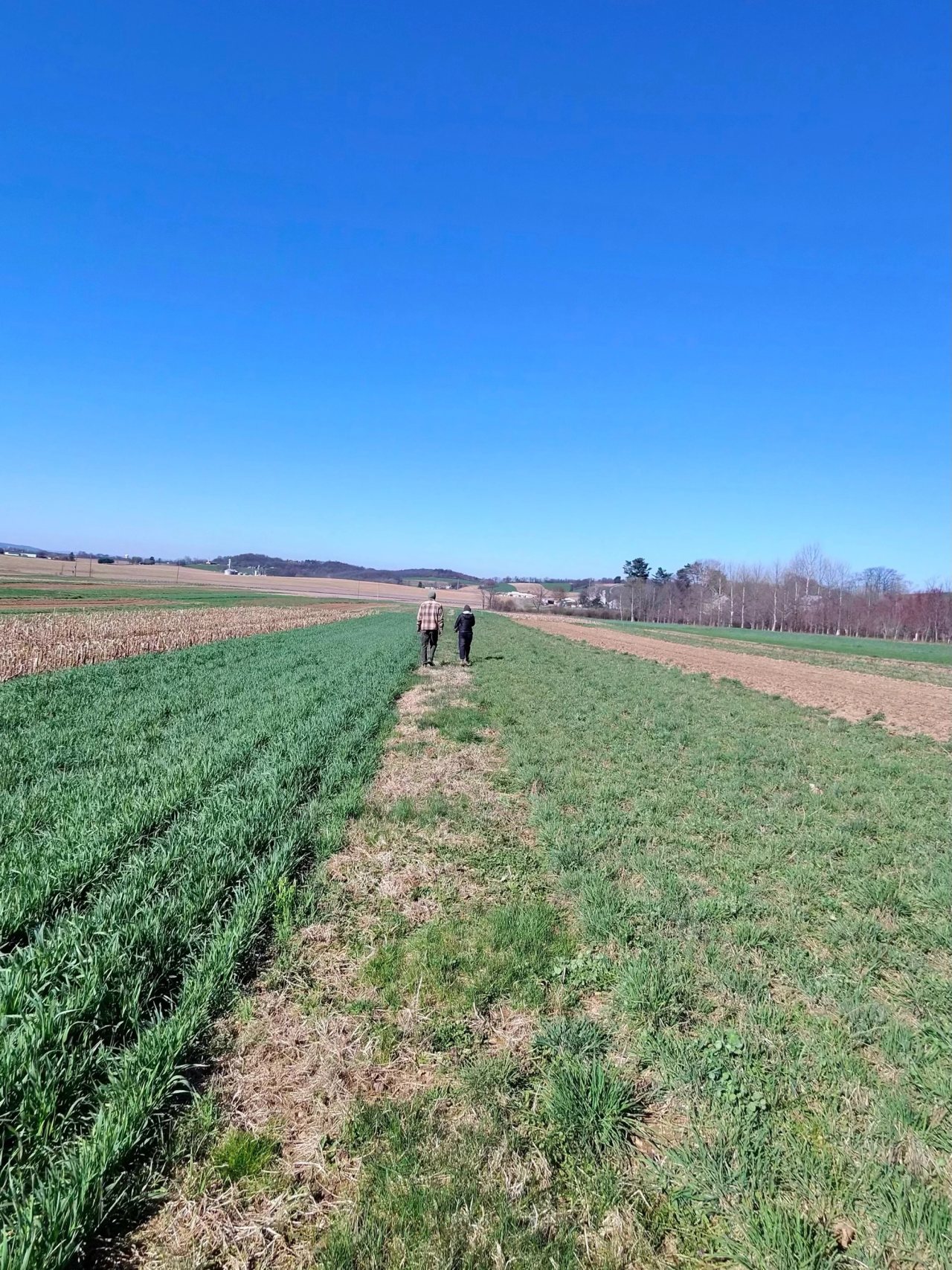
Cover crops keep living roots and protective residue in fields between cash crops. Depending on the species and management, they can reduce erosion, retain nutrients, suppress weeds, improve water infiltration, add organic matter, provide nitrogen, and produce forage. These benefits explain much of the interest in cover crops, even though each benefit develops on a different timeline and does not always appear as immediate cash income.
Adoption is growing, although cover crops still occupy a small share of U.S. cropland. The 2022 Census of Agriculture recorded 17.99 million cover-crop acres, which was 17% more than in 2017 and equal to 4.7% of total cropland. Adoption differs substantially by region because climate, soils, cropping systems, and public programs affect whether a cover crop fits. USDA Economic Research Service.
The economic question begins with the difference between a biological benefit and a cash return. Erosion control, nutrient retention, improved trafficability, forage, and cash-crop yield can all affect value, but the farm may receive them in different years. Costs also vary widely with species, seeding rate, establishment method, termination, and end use.
U.S. cover-crop acreage increased between the last two censuses
| Measure | Value |
|---|---|
| 2017 | 15.39 million acres |
| 2022 | 17.99 million acres |
The most current multi-year farm dataset comes from 41 Minnesota farms that reported consistent data from 2022 through 2024. Direct cover-crop costs ranged from $14 to $277 per acre, with a $42 median. The larger project includes 124 farms in Minnesota, Wisconsin, and South Dakota. Whether the crop was used for soil cover, forage, feed, or seed was the main source of cost variation. Environmental Defense Fund, 2025.
Yield evidence is also mixed. Two large remote-sensing studies found small average corn and soybean yield penalties after recent adoption, while farmer surveys report modest gains with more years of use. The 2025 field study also found a resilience benefit during the wet spring of 2019, when fields with cover crops were about half as likely to experience prevented planting. The studies use different populations, methods, time periods, and definitions of success, so their results should be read within those boundaries.
- +17%
- U.S. cover-crop acreage, 2017–2022
- 4.7%
- Share of U.S. cropland in cover crops, 2022
- $14–$277
- Observed direct cost range, 2022–2024
- $42
- Median direct cost in the same farm cohort
What farms are spending
In the EDF three-year cohort, farmers with the most profitable cover-crop fields usually harvested the crop for feed, forage, or seed and controlled establishment costs. Among farms receiving cost share, payments covered 54% of total cover-crop costs, although only 27% of the cohort received a payment. EDF three-year analysis.
Published cost observations, not national benchmarks
| Evidence | Population and period | Reported figure | What it includes |
|---|---|---|---|
| EDF three-year analysis | 41 consistent Minnesota farms, 2022–2024 | $14–$277/ac; $42 median | Direct cover-crop costs; systems ranged from soil-health covers to harvested forage and seed |
| EDF 2023 analysis | 141 Minnesota and Wisconsin farms | $14–$285/ac; $60 average; $48 median | Seed, establishment, termination, labor, and management reported by participating farms |
| Kansas custom-rate survey | Kansas, 2024 | $19.22/ac regular-till drilling; $25.43/ac no-till drilling | Custom machinery charge, not seed or termination |
The earlier EDF cohort provides a useful one-year comparison: 129 Minnesota farms and 12 Wisconsin farms reported 2023 direct costs of $14–$285/acre, with a $60 average and $48 median. EDF 2023 analysis.
Seed prices are a moving input
A public seed-price snapshot available in August 2026 listed estimated prices of $0.25/lb for cereal rye, $0.29/lb for oats, $0.22/lb for wheat, $1.46/lb for crimson clover, $1.99/lb for hairy vetch, and $1.83/lb for radish. These are platform estimates, not a USDA national price series, and exclude differences in variety, germination, treatment, inoculant, freight, and order size. Indigo species-price explorer.
Seed cost per acre is price multiplied by the locally appropriate seeding rate. Broadcast and aerial systems commonly use more seed than drilling because establishment is less consistent. A Nebraska experiment reported 13% emergence for hand-broadcast rye into standing corn, but that result came from a specific 2016–2018 field experiment and is not a universal broadcast-emergence rate. Nebraska Extension.
Species and seeding rate can change seed cost severalfold
| Measure | Value |
|---|---|
| Cereal rye, 60 lb/ac | 22.2 $/acre |
| Cereal rye, 120 lb/ac | 44.4 $/acre |
| Hairy vetch, 40 lb/ac | 98 $/acre |
| Hairy vetch, 80 lb/ac | 196 $/acre |
Warm-season species also span a wide range. A Mississippi State Extension budget listed seed-only establishment examples from $24/acre for one sorghum-sudan hybrid to $51.60/acre for a premium BMR hybrid at 30 lb/acre. Hairy vetch was substantially more expensive in the Nebraska example above. These figures come from different regions and price periods, so they describe the scale of variation rather than a direct market comparison. Mississippi State Extension.
What the yield and profitability studies show
Why credible studies reach different results
| Source and evidence type | Main result | Important limitation |
|---|---|---|
| Deines et al. 2023; satellite-based econometrics | Average yield effects of -5.5% for maize and -3.5% for soybean on fields with at least three years of recent cover-crop use | Study could not observe species, biomass, termination timing, or field-level nutrient management |
| Lobell et al. 2025; more than 100,000 fields | Average yield effects of about -3% for corn and -2% for soybean; planting was delayed 4 and 2.5 days, respectively | Average effects were heterogeneous across weather, soils, and management |
| SARE/CTIC 2015–2016 survey regression | Farmer-reported five-year yield differences of +3% for corn and +4.96% for soybean | Self-reported, self-selected survey data; not a randomized or nationally representative yield trial |
| USDA-ERS ERR-353; national farm survey analysis | No statistically significant aggregate productivity effect for cover crops alone; combined no-till and cover-crop use was associated with higher technical efficiency | Association at farm scale does not isolate the causal return from one practice |
The 2025 study adds an important mechanism. It estimated that eliminating cash-crop planting delays would reduce the observed yield penalty by roughly 50% for corn and 90% for soybean. It also found that cover-cropped fields were about half as likely to experience prevented planting during the wet spring of 2019, while dry conditions increased downside risk. Lobell et al. 2025.
Average planting delay associated with recent cover-crop adoption
| Measure | Value |
|---|---|
| Corn | 4 days |
| Soybean | 2.5 days |
A planting delay does not have one national yield-loss rate. The effect depends on the crop, calendar date, location, weather, and yield environment. Minnesota long-term research provides one regional example of how the rate becomes steeper later in the planting window. University of Minnesota corn guidance; University of Minnesota soybean guidance.
Minnesota example: yield potential lost for each day of delayed planting
| Measure | Value |
|---|---|
| Corn, Apr 30–May 20 | 0.5 % per day |
| Corn, May 20–30 | 1 % per day |
| Corn, after May 30 | 1.2 % per day |
| Soybean, May 20–early June | 0.5 % per day |
| Soybean, mid-June onward | 1 % per day |
The SARE figures describe a different population: several hundred farmers who had comparable covered and uncovered fields and chose to answer the survey. SARE explicitly notes that the data were self-reported and that individual results ranged from losses to no change to gains. SARE yield-over-time analysis.
Regional evidence: strong signals and large gaps
Corn Belt
The two largest field-scale studies cover much of the Corn Belt and show small average yield penalties after recent adoption. Their clearest explanation concerns the timing of cash-crop planting. The EDF farm records show a different part of the picture. In its 2022–2024 Minnesota cohort, corn fields following cover crops were more profitable than the regional comparison, while soybean fields were less profitable. The result is observational and applies to that cohort, but it shows that cover-crop outcomes can differ by cash crop within the same region.
Great Plains and other water-limited systems
Water competition can dominate the economics. A Colorado Plateau study found an average 48% wheat-yield penalty after fall-planted cover crops and a $176/ha reduction in net returns, which is about $71/acre, in the studied rotations. When the authors assigned forage value to 50% of cover-crop biomass, returns improved enough to reverse the result in some fall-planted treatments. This supports grazing or forage as a potentially important value stream without implying that grazing is the only viable dryland system. Eash et al. 2025.
Southeast and eastern systems
Comparable multi-farm financial datasets are thinner in the Southeast, so precise regional cost and payback tables are not justified. Longer and wetter cool seasons can support much more legume biomass than colder or drier regions. The Nebraska hairy-vetch studies produced only 364–724 lb of biomass per acre, compared with 2,658–5,076 lb/acre in Maryland and 2,685–4,915 lb/acre in Michigan. The lower Nebraska biomass explains the lower total nitrogen in the crop. Biomass contained 12–29 lb N/acre in Nebraska, 93–160 lb N/acre in Maryland, and 89–161 lb N/acre in Michigan. Nebraska Extension synthesis.
Hairy-vetch biomass explains much of the regional nitrogen range
| Study region | Aboveground biomass | Nitrogen contained in biomass |
|---|---|---|
| Nebraska | 364–724 lb/ac | 12–29 lb N/ac |
| Maryland | 2,658–5,076 lb/ac | 93–160 lb N/ac |
| Michigan | 2,685–4,915 lb/ac | 89–161 lb N/ac |
Which benefits are showing up in the economics
Nitrogen: biomass N is not automatically a fertilizer credit
Legumes can add biologically fixed nitrogen, while cereal rye primarily captures soil nitrogen that might otherwise move below the root zone. The amount and timing available to the next crop depend on biomass, the share of legume N derived from fixation, carbon-to-nitrogen ratio, termination, soil moisture, and temperature. Nebraska Extension notes that not all biomass N becomes available to the subsequent crop; high-C:N rye residue can temporarily immobilize soil N. A flat dollar credit based on total biomass N therefore overstates short-term savings. Nebraska Extension.
Pesticides: savings are possible, but not consistent
American Farmland Trust analyzed 23 selected row-crop farms using one or more soil-health practices. Nine reduced pesticide costs by $3–$36/acre/year, ten reported no change, and four increased pesticide costs by $6–$29. The farms were selected as “soil health successful,” and many combined cover crops with nutrient management, crop rotation, and reduced tillage, so the results cannot be attributed to cover crops alone. AFT case-study findings.
Grazing and harvest: the clearest direct revenue stream in several datasets
A six-farm Practical Farmers of Iowa trial reported average establishment costs of $28.05/acre and average net grazing returns of $76.48/acre. Removing cost-share and crop-insurance discounts reduced the average to $48.43/acre, still positive in that case series. The result depends on forage replacement value, grazing days, livestock numbers, fencing, water, and labor; it is evidence from six cooperating farms, not a regional average. PFI 2018–2019 report.
Soil-health case studies: useful examples with selection bias
Across AFT's 23 row-crop case studies, 22 farms reported annual net-income improvements of $2–$209/acre and one reported a $5/acre decrease. The figures are updated to 2023 prices and describe whole soil-health systems on selected successful farms. They demonstrate possible pathways and cost categories; they are not an estimate of the average cover-crop return. AFT, updated August 2025.
Carbon: sequestration is not the same as a saleable credit
A widely cited meta-analysis estimated an average soil-carbon accumulation rate of 0.32 ± 0.08 Mg C/ha/year under cover crops. The midpoint converts to about 0.47 metric tons CO₂/acre/year. That is a biophysical study average and not the number of credits a program will issue. Baselines, additionality, sampling uncertainty, permanence rules, buffer deductions, contract length, and environmental-attribute ownership all affect payment. Poeplau and Don 2015.
Incentives as of August 12, 2026
EQIP does not have one national cover-crop payment rate. Rates vary by state, payment schedule, practice scenario, organic status, and historically underserved status. Applications are accepted continuously, but contracts are competitive. Historically underserved producers with an approved contract may request at least 50% of the contracted practice payment in advance; that advance is part of the payment, not an additional incentive. USDA NRCS.
Current public-program examples
| Program year | Published payment | Material restrictions or status |
|---|---|---|
| Iowa Cover Crop Cost-Share, fall 2026 | $30/ac first-time users; $20/ac returning users | Up to 160 acres per participant; enrollment announced July 7, 2026 |
| Illinois premium discount, fall 2025 / insured crop 2026 | Up to $5/ac | Application closed January 15, 2026; acres receiving other state or Federal incentives were ineligible |
| Wisconsin premium rebate, 2025 cover / summer 2026 premium | $5/ac | Application closed January 30, 2026; state- or Federally cost-shared acres were ineligible |
Stacking rules are program-specific. For example, Practical Farmers of Iowa's current cover-crop program allows stacking with listed public programs but not on the same enrolled acres with private carbon programs; Illinois and Wisconsin premium programs exclude certain publicly funded acres. Eligibility must be verified against the current contract, not inferred from a national payment table. PFI stackability rules.
Private carbon programs and 45Z
Private offers are contract terms, not commodity prices. Carbon by Indigo currently advertises potential earnings of up to $10–$20/acre/year for growers implementing cover crops and other practices, subject to eligibility, quantification, vesting, and program terms. “Up to” is not a minimum or guaranteed payment. Carbon by Indigo.
The 45Z Clean Fuel Production Credit is claimed by a registered domestic fuel producer, not automatically by the farmer supplying grain. Proposed regulations issued February 3, 2026 extend the credit through December 31, 2029 and include anti-double-crediting rules. Any farm-level premium depends on a buyer contract, feedstock carbon-intensity accounting, documentation, and final rules; no universal per-bushel cover-crop premium is established. IRS, February 2026.
Two costs that economic summaries often miss
Cash-crop timing and yield
A one- or two-percent cash-crop yield change can outweigh seed-cost differences. The 2025 field study links much of the average yield penalty to delayed corn and soybean planting. Any economic comparison that excludes cash-crop revenue change is incomplete.
Herbicide carryover and feed restrictions
Residual herbicides can reduce cover-crop establishment, and rotational restrictions become a legal issue when the cover crop is grazed or harvested for feed. Injury varies with chemistry, rate, rainfall, temperature, soil, and application-to-seeding interval. The product label controls; trial injury percentages should not be converted into a universal opportunity cost. University of Minnesota Extension.
What the current evidence supports
- Cover-crop costs have a broad distribution. The best current multi-year farm records show $14–$277/acre, not a narrow universal range.
- Average short-term yield effects are mixed. Large field-scale studies found small penalties after recent adoption, while self-reported survey data found modest gains with longer use.
- Harvest and grazing create the clearest direct revenue in several farm datasets, but infrastructure and livestock assumptions determine the result.
- Nitrogen, pesticide, and soil-health savings are real in some systems but cannot be assigned a fixed per-acre credit without field and management evidence.
- Public and private payments can offset transition costs, but availability, stacking, and environmental-attribute rules are contractual and time-sensitive.
The 2022–2023 National Cover Crop Survey adds an adoption signal rather than a profitability estimate: 90.3% of respondents receiving incentives said they would definitely or probably continue after payments ended. The survey included nearly 800 farmers in 49 states and was self-selected. It shows stated intent, not audited farm profitability. SARE/CTIC survey summary.
References
Peer-reviewed research and government analysis
- Bowman, M., Ferraro, P., Fuller, K. B., Gramig, B. M., Mosheim, R., Njuki, E., Pratt, B., Rejesus, R., & Rosenberg, A. B. (2025). Economic Outcomes of Soil Health and Conservation Practices on U.S. Cropland. USDA Economic Research Service, ERR-353. doi:10.32747/2025.9227998.ers
- Deines, J. M., Guan, K., Lopez, B., Zhou, Q., White, C. S., Wang, S., & Lobell, D. B. (2023). Recent cover crop adoption is associated with small maize and soybean yield losses in the United States. Global Change Biology, 29(3), 794–807. doi:10.1111/gcb.16489
- Lobell, D. B., Di Tommaso, S., Zhou, Q., et al. (2025). The mixed effects of recent cover crop adoption on US cropland productivity. Nature Sustainability, 8, 1004–1012. doi:10.1038/s41893-025-01599-5
- Eash, L., Russell, K., Berrada, A. F., Schipanski, M. E., Trivedi, P., Mooney, D., Beiermann, J., Brummer, J., & Fonte, S. J. (2025). Synergies and trade-offs between ecosystem services and economics in dryland cover crop systems. Ecosphere. doi:10.1002/ecs2.70397
- Poeplau, C., & Don, A. (2015). Carbon sequestration in agricultural soils via cultivation of cover crops: A meta-analysis. Agriculture, Ecosystems & Environment, 200, 33–41. doi:10.1016/j.agee.2014.10.024
Farm financial datasets, surveys, and case studies
- Environmental Defense Fund. (2025). Financial impacts of cover crops in Minnesota and the Upper Midwest: three-year trend analysis, 2022–2024. business.edf.org
- Environmental Defense Fund. (2024). Understanding the Costs and Returns of Cover Crops: What Farmers Need to Know. business.edf.org
- American Farmland Trust. (Updated August 2025). Soil Health Case Study Findings. farmland.org
- Practical Farmers of Iowa. (2020). Economic and Soil Health Impact of Grazing Cover Crops, 2018–2019. practicalfarmers.org
- Myers, R., Weber, A., & Tellatin, S. (2019). Cover Crop Economics: How Do Cover Crops Impact Yield Over Time? SARE. sare.org
- SARE, CTIC, & ASTA. (2023). 2022–2023 National Cover Crop Survey Report. sare.org
Extension, prices, and program sources
- U.S. Department of Agriculture, Economic Research Service. (2024). 2022 Census of Agriculture: Cover Crop Use Continues to Be Most Common in Eastern United States. ers.usda.gov
- University of Nebraska–Lincoln Extension. (Revised 2022). How Much Nitrogen Does My Cover Crop Take Up and When Do I Get It Back? cropwatch.unl.edu
- University of Nebraska–Lincoln Extension. (2020). Seeding Rates for Broadcasting Cover Crops Into Late-Season Corn and Soybean. cropwatch.unl.edu
- University of Minnesota Extension. (Reviewed 2024). Using Herbicides and Cover Crops in Corn and Soybean. extension.umn.edu
- University of Minnesota Extension. Considerations for Late-Planted Corn in Minnesota. extension.umn.edu
- University of Minnesota Extension. (2023). Strategic Farming Field Notes: Planting-Date Yield Effects for Soybean. extension.umn.edu
- Mississippi State University Extension. Successfully Establishing Warm-Season Forages. extension.msstate.edu
- Kansas State University AgManager. (2024). Kansas Custom Rates 2024. agmanager.info
- USDA Natural Resources Conservation Service. EQIP Advance Payment Option. Accessed August 12, 2026. nrcs.usda.gov
- Iowa Department of Agriculture and Land Stewardship. (July 7, 2026). Secretary Naig Opens Sign-Up for Annual Cover Crop Cost-Share Program.