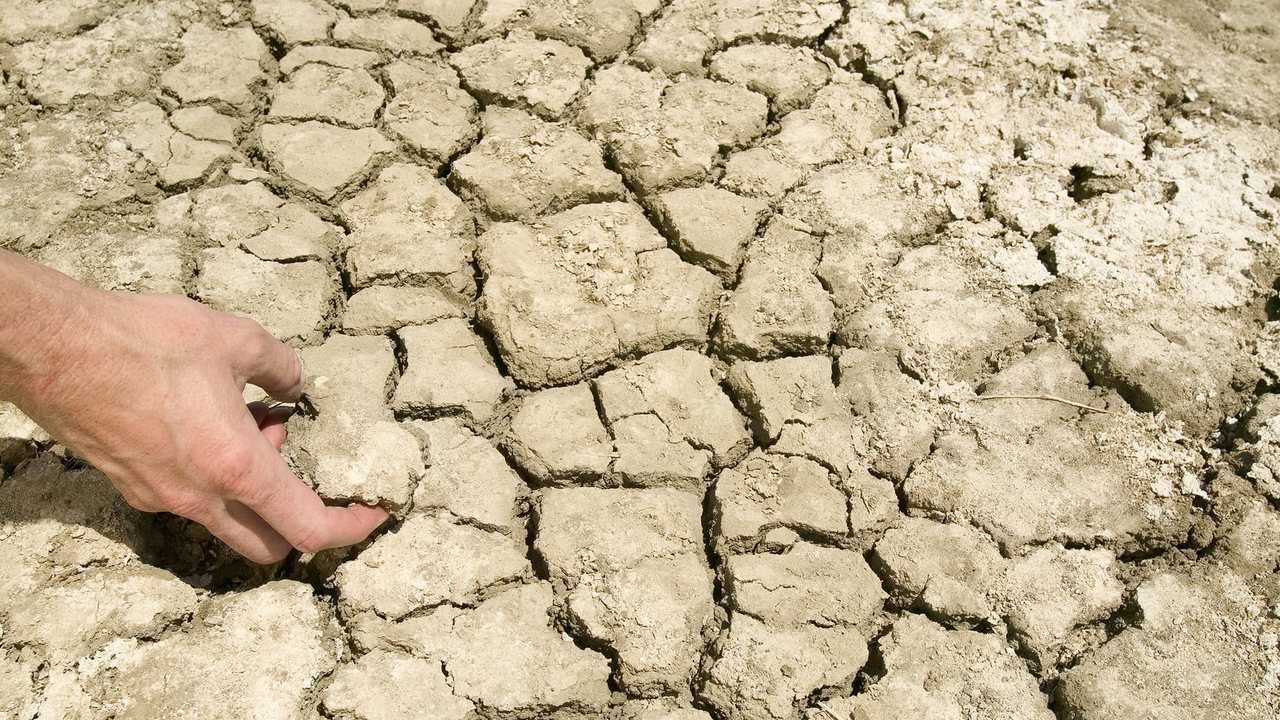
Healthy soil does hold more water — but not nearly as much as the popular claim that every 1% increase in soil organic matter stores “20,000 gallons of extra water per acre” would suggest. The science shows a real benefit, but it is usually modest, strongly dependent on soil texture, and often more valuable for infiltration, rooting, and drought resilience than for dramatically increasing the volume of water in storage.
Where the 20,000-gallon number comes from
The figure has a real scientific root. Bruce Hudson’s 1994 study in the Journal of Soil and Water Conservation showed that, within a given texture group, organic matter is strongly correlated with available water capacity. But Hudson never published a gallons-per-acre number — that conversion was added later, using the assumption that organic matter holds roughly ten times its weight in water. Run that math across an acre of soil and you land near 20,000 gallons.
USDA-NRCS uses a similar but larger figure, stating that each 1% increase in soil organic matter can hold “up to 25,000 gallons of available soil water per acre.” Note the hedge: “up to.” These numbers are best treated as upper-end illustrations, not field results you can bank on.
What the best meta-analysis actually found
The most rigorous accounting comes from Minasny and McBratney’s 2018 meta-analysis in the European Journal of Soil Science, which pooled more than 50,000 measurements from 60 studies. It found that a 1% increase in soil organic carbon raises available water capacity by about 1.16 mm of water per 100 mm of soil, on average — with three-quarters of studies falling between roughly 0.7 and 2.1 mm.
Translated for a one-foot root zone in a medium-textured soil, University of Nebraska and University of Minnesota Extension put that gain at roughly 3,400 gallons per acre per 1% organic matter — about one-ninth of an inch of rain, sitting on top of the ~71,000 gallons per acre the soil already holds. That is real and worth having. It is also six to eight times smaller than the popular number.
Plant-available water gain per 1% organic matter, by texture
- Sandy / loamy sand: ~3,700 gallons per acre
- Silt loam (medium): ~3,400 gallons per acre (≈ one-ninth-inch rain)
- Clay / clay loam: ~2,700 gallons per acre
Estimated from Minasny & McBratney (2018), recomputed for a one-foot depth by UNL/UMN Extension. Gallons are approximate.
One important caveat on direction: Minasny and McBratney found the gain largest in sandy soils and smallest in clays. Hudson’s earlier work found the opposite order, with medium-textured silt loams benefiting most. The ranking is genuinely debated — so treat “sandy soils gain most” as one credible finding, not settled fact.
Two ways to count the water (gain per 1% soil organic matter)
| Measure | Value |
|---|---|
| NRCS ceiling ("up to") | 25000 gal/acre |
| Popular 20,000-gallon claim | 21700 gal/acre |
| Defensible gain — 1 ft, medium soil | 3400 gal/acre |
Why texture sets the ceiling
Texture explains most of the disagreement. Sandy soils start with very low water-holding capacity, so a little extra organic matter can show a large relative response. Clay soils already store a lot of water — but much of it is held too tightly for roots to use, so added organic matter does less for plant-available water. Medium-textured loams and silt loams often see the most practical, root-zone benefit. The exact ranking shifts between studies, but the principle holds: the same 1% of organic matter does different work in different soils.
Plant-available water gain by soil texture (per 1% organic matter)
| Measure | Value |
|---|---|
| Sandy / loamy sand | 3700 gal/acre |
| Silt loam (medium) | 3400 gal/acre |
| Clay / clay loam | 2700 gal/acre |
The bigger payoff isn’t storage — it’s how water moves
For most farms, the largest value of healthy soil is not a bigger reservoir. It is faster infiltration, less runoff, deeper rooting, and a soil that keeps water in the root zone during dry spells. And here the numbers are far more impressive than the storage gains: a peer-reviewed meta-analysis of 89 studies (Basche & DeLonge, 2019) found cover crops increased water infiltration rates by about 35%, and perennials by nearly 60%. Pairing no-till with cover crops pushed the gains higher still.
Put the two side by side. The added stored water from 1% organic matter is about a ninth of an inch of rain. The improvement in how quickly the soil takes in and holds that rain — through better aggregation and pore space — is a 35-to-60% change. That is where soil health earns its keep.
The bigger payoff is infiltration, not storage
| Measure | Value |
|---|---|
| Cover crops | 35 % faster |
| Perennials | 59 % faster |
Takeaway
Healthy soil absolutely improves water management — but the effect is routinely overstated in outreach materials. A more accurate way to put it: building soil organic matter modestly increases plant-available water, especially in lighter soils, while substantially improving the soil’s ability to capture, infiltrate, and hold rainfall. That makes soil health a powerful management strategy. It is just not the miracle number on the brochure.