Soil Probiotics vs. Prebiotics: Why Feeding Microbes Often Works Better Than Adding Them
Soil microbial communities regulate nutrient cycling, soil structure, and plant stress responses—processes that directly affect crop productivity and yield stability. Microbial inoculants (often marketed as biofertilizers/biostimulants) can improve crop performance, but their efficacy is highly variable because establishment and function depend on environmental and biological context.
Modern agriculture is in the middle of a quiet paradigm shift. For decades, the dominant model has optimized yields by leaning heavily on synthetic inputs such as fertilizers, pesticides, and intensive disturbance. That approach can be productive in the short term, but it often treats soil like a passive growing medium.
Soil isn’t passive. It’s a living reactor.
A growing body of research across soil science, microbial ecology, and plant nutrition is converging on a blunt conclusion: the soil microbiome is not a side character in crop production. It’s an operating system. If the operating system is degraded, the whole system becomes more input-dependent, less efficient, and less resilient.
This article builds a simple framework to understand soil microbes and how to manage them using a familiar analogy:
Soil probiotics = adding microbes (inoculants).
Soil prebiotics = feeding and shaping the microbes already there (habitat + carbon flow + incentives).
The analogy is useful only if we treat soil as an ecosystem.
Why plants don’t really function alone
Plants can photosynthesize. They can’t mine nutrients efficiently from complex soil chemistry at field scale without help. Most of the work that turns “nutrients in soil” into “nutrients the plant can use” is biological. Microbes drive that complex nutrient conversion, regulate losses, and build soil structure that determines whether roots can explore water and nutrients in the first place.
And importantly: soil is not uniform. It’s a patchwork of microhabitats, pores, aggregates, root-adjacent zones, oxygen gradients, and thin water films. In the same handful of soil you can have aerobic zones running nitrification millimeters away from anaerobic pockets running denitrification. Management that changes structure and water dynamics (tillage, compaction, residue cover, living roots) doesn’t just change “soil properties”, it rewires the habitat map microbes live in.
Meet the soil microbiome
A single gram of healthy topsoil can contain thousands of microbial taxa: bacteria, fungi, archaea, protists, and viruses
Bacteria: fast nutrient transformers
Bacteria are numerically dominant and respond quickly to fresh carbon and nutrient changes. They’re key players in decomposition and nutrient cycling, but their community composition is strongly shaped by pH, oxygen, moisture, and carbon quality.
One practical implication: repeated high rates of synthetic N can acidify soil over time, and pH shifts can restructure bacterial communities and suppress rarer taxa that contribute to ecosystem “multifunctionality” (the ability to do many processes at once reliably).
Fungi: the soil’s physical engineers
Fungi are the architects of structure. Their hyphae thread through soil, physically binding particles into aggregates and stabilizing pore networks. Two groups matter most for cropping systems:
Saprotrophic fungi: break down tough residues (cellulose, lignin).
Mycorrhizal fungi (especially AMF): partner with roots and extend nutrient/water acquisition beyond the root depletion zone. Most crop species can form these relationships.
In general, systems with less disturbance tend to maintain stronger fungal networks. Intensive tillage is basically a repeated mechanical disturbance that breaks hyphae, often shifting soils toward a more bacteria-dominated, faster-cycling (and often less structurally stable) state.
A useful indicator people discuss is the fungal:bacterial ratio (F:B). It’s not a perfect metric, but it often tracks meaningful shifts: higher fungal dominance tends to align with more aggregation and more stable carbon fractions, especially when coupled with good structure and mineral protection.
Archaea: nitrogen cycling specialists
Archaea were once considered “extreme-environment” organisms. In soil, many are central to nitrification through ammonia oxidation. One important pattern: ammonia-oxidizing archaea often do well under low ammonium fluxes (more typical of organic matter mineralization), while ammonia-oxidizing bacteria can dominate under high ammonium conditions (often seen with synthetic fertilization). This matters because nitrification links directly to nitrate leaching risk and nitrous oxide (N₂O) pathways.
Protozoa and protists: the microbial regulators
Protists are predators. They graze on bacteria and fungi and drive the microbial loop: nutrients locked in microbial biomass get remineralized into plant-available forms through predation. This is one reason soils with more trophic complexity can cycle nutrients efficiently without being “leaky.”
Protist grazing also pressures microbes to produce defensive metabolites, some of which overlap with compounds that suppress pathogens. In other words, predation can indirectly support biocontrol-like behavior.
The three jobs microbes do that matter most for agriculture
Instead of treating microbes as “good” or “bad,” it helps to frame them by function. Most of what matters for crops falls into three linked domains.
necromass binding to minerals → mineral-associated organic matter (MAOM), a key stable SOC pool in many soils
At the same time, microbes produce sticky compounds like EPS (extracellular polymeric substances) and fungi create hyphal networks that stabilize aggregates. Aggregates protect organic matter physically, improve infiltration and aeration, and create root-friendly pore architecture.
For farms, this often shows up as:
better root penetration,
higher plant-available water during dry windows,
less erosion and runoff,
improved yield stability.
3) Plant interaction: symbiosis, signaling, and defense
Plants actively shape microbes using root exudates—sugars, amino acids, organic acids, phenolics. These exudates are both food and information. They filter which microbes thrive in the rhizosphere.
In return, microbes can:
fix N₂ (rhizobia in legumes),
trade nutrients and water (AMF),
produce hormone-like compounds,
reduce stress signaling (e.g., ACC deaminase effects on ethylene pathways),
suppress pathogens by competition, antibiosis, predation networks, and immune priming.
This is why microbial communities are often early indicators: they respond rapidly to changes in roots, moisture, disturbance, and chemistry.
Soil probiotics: adding microbes (and why it is still chanllenging)
Soil “probiotics” are inoculants: PGPR, AMF, consortia, live organisms added to improve nutrient uptake, stress tolerance, or disease suppression.
The key point: inoculation is not like applying nitrogen. It’s ecological transplantation.
The real question is not “did we apply it?” It’s: Did it establish, persist, and express the intended function under field constraints?
What the field-scale science shows
Across studies, average effects can be positive, but variability is enormous. That variance is the story. Large field work on AMF inoculation (for example, multi-field maize trials) has shown responses ranging from negative to strongly positive across sites. In some fields, inoculation helps; in others, it does nothing; in a few, it can reduce growth. What’s striking is that response variability is often predicted better by baseline biology (microbiome structure, pathogen pressure) than by nutrient availability alone. That’s a major reframing: sometimes the biological neighborhood is the constraint, not “fertility.”
Why the soil environment often resists inoculants
Four common reasons:
Colonization resistance Soils already contain dense, adapted communities. New arrivals face competition, predation (protists, nematodes), phages, and chemical warfare (antibiotics/metabolites). “Priority effects” matter: the residents got there first and already occupy niches.
Microscale habitat mismatch Soil is not a uniform structure. A strain that performs in labs may fail in the field because it can’t reach rhizosphere hotspots, can’t survive drying/rewetting cycles, or can’t persist through temperature swings and UV exposure (especially for seed-applied products).
Carbon economics: no food, no function Many beneficial functions are energy expensive (colonization, enzyme production, EPS formation, N fixation). If labile carbon supply is low (few living roots, low residue return, heavy disturbance), inoculants may survive briefly but won’t express function strongly enough to matter.
Nutrient context can remove the plant’s incentive For symbioses like AMF, high soluble P (and sometimes high N) can reduce colonization or reduce carbon allocation to the symbiont, shrinking the payoff.
That’s where the gut analogy becomes genuinely useful: human probiotics also face colonization resistance and context dependence. Mature ecosystems tend to repel newcomers unless conditions are right.
Soil prebiotics: feeding functions and improving habitat (usually the higher-ROI strategy)
Prebiotics are the “change the rules of the ecosystem” approach. Instead of importing microbes, you favor the beneficial ones already present by improving carbon flow, habitat continuity, and plant–microbe incentives.
Plant-health prebiotics: rhizosphere diet design
Plants continuously “feed” the rhizosphere through exudates. Management changes exudate quantity and quality by altering root activity, stress status, and plant community composition.
In practice, rhizosphere engineering looks like:
diverse rotations and cover crops (different exudate profiles),
longer periods of living roots (continuous carbon supply),
avoiding long bare fallows,
reducing disturbance and compaction (habitat preservation),
using amendments that support microbial function instead of disrupting it.
Soil-health prebiotics: field-scale habitat + carbon + time
The most consistently supported soil prebiotics on real farms are:
living roots (cover crops)
organic inputs (compost/manures where appropriate and well-managed)
Cover crops are a good example because they work through multiple mechanisms simultaneously: carbon input, habitat continuity, root-driven recruitment, and improved structure over time. Meta-analyses consistently show increases in microbial biomass proxies (MBC, MBN, PLFA) under cover crops, along with shifts in major groups (bacteria, fungi, AMF-related indicators). Longer-term datasets also show SOC gains in many contexts, with strong dependence on soil texture, climate, and management.
The selectivity mechanism (what makes it truly “prebiotic”)
Selectivity usually comes from three coupled filters:
Substrate chemistry: who can use the carbon and nutrients (labile vs complex C)
Habitat constraints: who can persist (aggregation, redox, moisture stability, pH, salinity)
Plant gating: who gets paid (plants allocate carbon toward microbes delivering nutrients and stress protection)
This is also why simplistic “just add sugar/molasses” strategies can backfire, stimulating fast-growing copiotrophs, increasing respiration losses, immobilizing N at the wrong time, or enhancing denitrification in wet/low-O₂ microsites. Prebiotics aren’t “more carbon.” They’re carbon in the right form, place, and timing, inside a habitat that stabilizes the function you want.
Some numbers and context
Click to expand
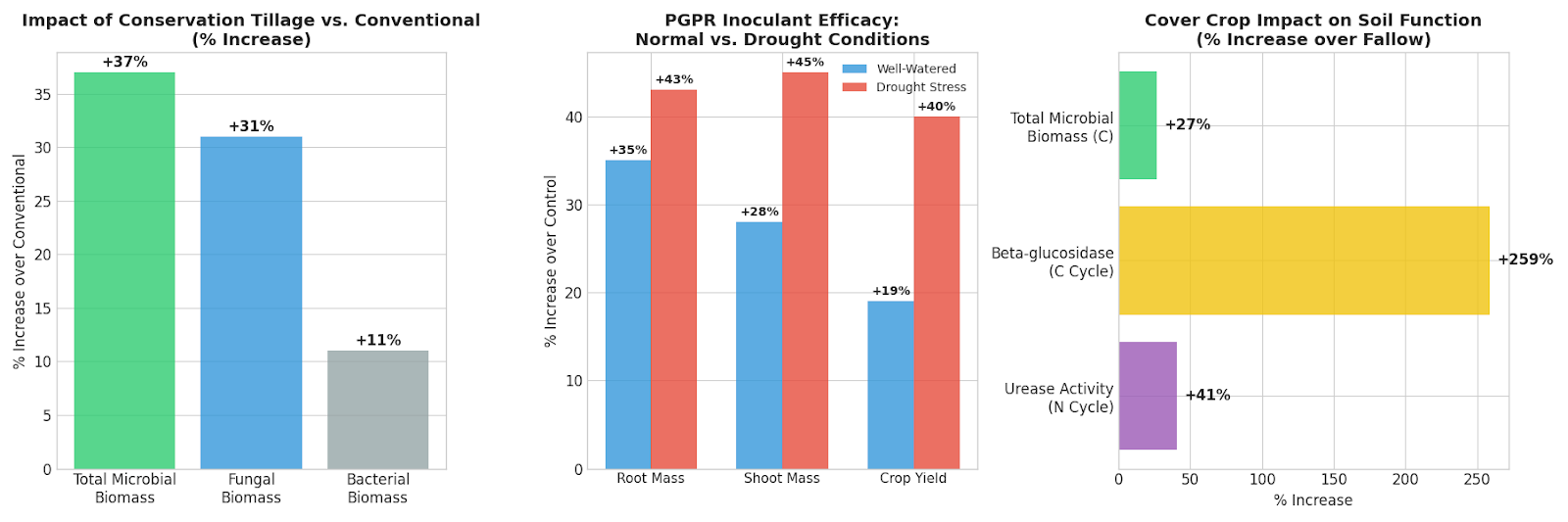
Impact of conservation tillage, PGPR, and cover crops on soil biological indicators and crop production.
Conservation Tillage vs. Conventional Tillage
Conservation tillage (including No-Till and Reduced Tillage) consistently outperforms conventional plowing in building microbial biomass. The most significant gain is in Total Microbial Biomass (+37%),Fungal Biomass (+31%). Source: https://doi.org/10.1016/j.agee.2020.106841
PGPR Efficacy: Normal vs. Drought Conditions
Plant Growth-Promoting Rhizobacteria (PGPR) are more effective under stress. While they increased crop yield by 19% in well-watered conditions, the benefit jumped to 40% under drought stress. Source: https://doi.org/10.1007/s11104-017-3199-8
Cover Crop Impact on Soil Function
The "prebiotic" effect of cover crops is massive for soil function. The 259% increase in Beta-glucosidase (a key enzyme for carbon cycling) shows that the activity of the microbiome responds much more dramatically than just the biomass itself. Source: https://doi.org/10.1016/j.geodrs.2023.e00700
Source material for every claim in this article, plus a citation-ready record for reference managers and scholarly indexes.
Cite this
Reference this work
SHE-ART-2026-0031
Saurav Das (2026). Soil Probiotics vs. Prebiotics: Why Feeding Microbes Often Works Better Than Adding Them. Soil Health Exchange. SHE-ART-2026-0031. https://soilhealthexchange.com/cite/SHE-ART-2026-0031
Soil Health Exchange assigns a stable identifier to every published answer and article. Citations keep working even if the URL changes later.
Cite this articleShow formatsHide
Cite this article
Citation-ready record
APA
Das, S. (2026). Soil Probiotics vs. Prebiotics: Why Feeding Microbes Often Works Better Than Adding Them. Soil Health Exchange. https://soilhealthexchange.com/blog/probiotics-to-prebiotics-soil-health-version
More citation formats
MLA
Das, Saurav. "Soil Probiotics vs. Prebiotics: Why Feeding Microbes Often Works Better Than Adding Them." Soil Health Exchange, 2026-02-07, https://soilhealthexchange.com/blog/probiotics-to-prebiotics-soil-health-version.
Chicago
Das, Saurav. "Soil Probiotics vs. Prebiotics: Why Feeding Microbes Often Works Better Than Adding Them." Soil Health Exchange. Published 2026-02-07. https://soilhealthexchange.com/blog/probiotics-to-prebiotics-soil-health-version.


Discussion
No comments yet. Be the first to share your thoughts!