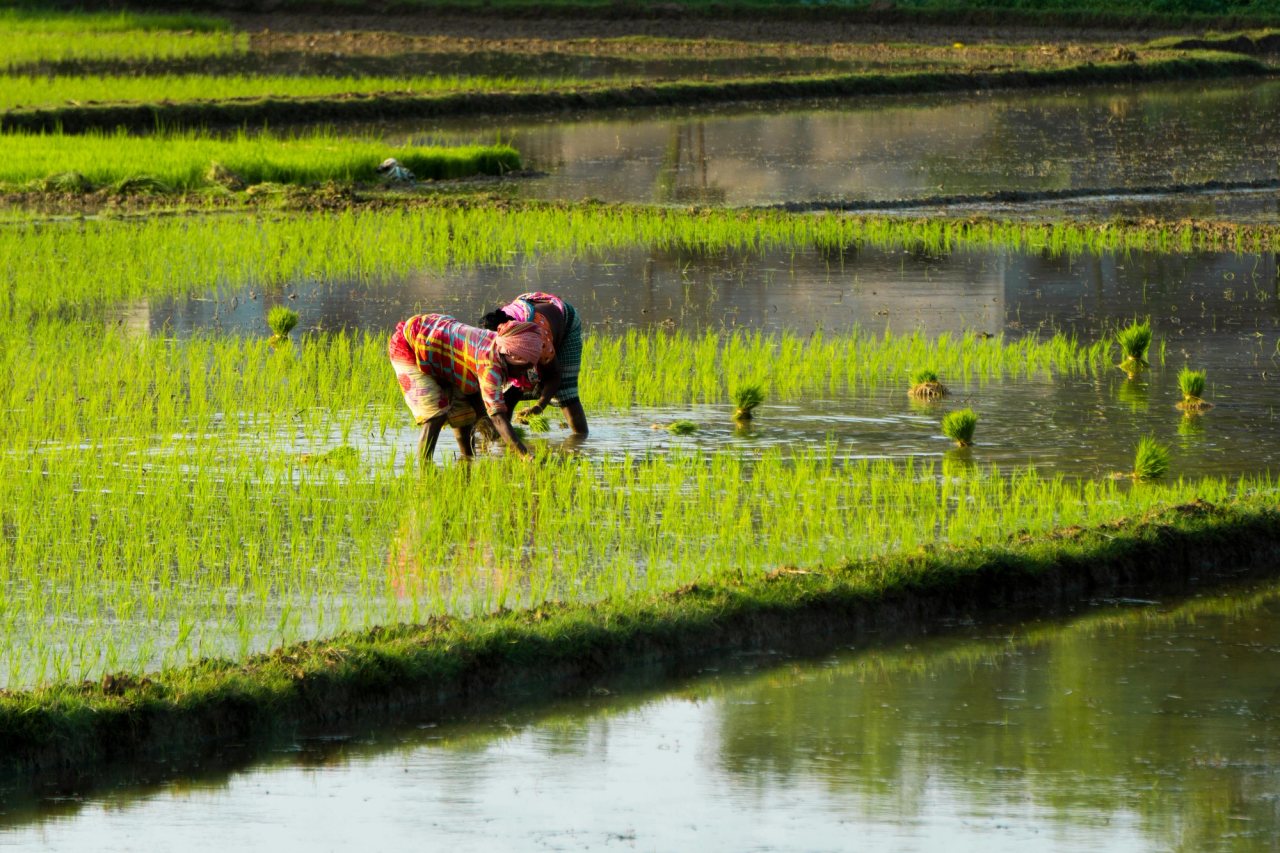
In 2023, the voluntary carbon market for rice quietly broke. Verra, the world's largest carbon registry, inactivated AMS-III.AU - the Clean Development Mechanism methodology that had underpinned most rice methane credit projects globally pausing millions of issued credits and stopping new project registrations mid-pipeline. The reason was scientific, not political: the old methodology failed to account for nitrous oxide rebound when farmers reduced flooding, meaning the climate benefit of rice water management had been systematically overstated.
Three years later, a replacement protocol is live, the first credits under it have been issued, and spot prices in India are trading at $17–18 per tonne CO₂e (carbon equivalent) in Q1 2026, based on registry-listed issuances and buyer disclosures (Gold Standard Registry, 2026; market transaction summaries reported by project developers). The question is no longer whether rice carbon credits work. It is whether the new rules are strict enough to make them last.
When Millions of Credits Were Paused Overnight
By 2022, rice carbon credit projects were operating across millions of hectares in South and Southeast Asia. Aggregators had signed farmer agreements, NGOs had deployed field teams, and investors had committed capital all built on AMS-III.AU, the Clean Development Mechanism methodology that had governed rice methane accounting for nearly a decade. Then, in October 2023, Verra inactivated It (Verra, 2023).
The reason was the greenhouse gas, most people in the room had not been measuring. Nitrous oxide (N₂O), released from rice soils when they dry and then reflood, is approximately 273 times more potent as a greenhouse gas than CO₂ over a 100-year period (IPCC, 2021). Alternate Wetting and Drying (AWD) the water management practice at the heart of every rice carbon project works by allowing paddies to dry between irrigations, cutting methane (CH₄) emissions by 47–70% according to published meta-analyses (Linquist et al., 2012; Sander et al., 2016), consistent with multi-country Asian rice field measurements (Wassmann et al., 2000). What AMS-III.AU missed was that the same drying process primes soil bacteria to produce N₂O on re-flooding. Ignore that exchange, and the net climate benefit of AWD is overstated sometimes significantly, depending on soil type, nitrogen fertilizer rates, and drying intensity.
Verra's decision to inactivate rather than patch the methodology signaled that the error was not minor. Projects already registered were paused. New registrations stopped. Millions of credits in the pipeline some already contracted to buyers entered legal and financial uncertainty. For farmers enrolled in pilots across Telangana, the Mekong Delta, and Punjab, payments that had been promised or anticipated did not arrive. The voluntary carbon market for rice, which had been growing rapidly, effectively went dark.
What replaced it took eighteen months to build and it is considerably more demanding than what came before.
The Methane-Nitrous Oxide Trade-Off Nobody Talked About
Ask a rice farmer why carbon credits exist for water management and the answer is simple: less flooding means less methane. That is true. What AMS-III.AU failed to add was the second half of the sentence less flooding also means more nitrous oxide, and whether the net climate benefit is real depends entirely on how much more.
Flooded rice paddies produce methane (CH₄) through anaerobic microbial decomposition in waterlogged soils, emitted through the plant's own vascular tissue and through gas bubbling at the surface. CH₄ is approximately 27–28 times more potent than CO₂ (IPCC, 2021, AR6) over a 100-year horizon, and a continuously flooded paddy can release several tonnes of CO₂-equivalent per hectare per season.
Alternate wetting and drying (AWD), interrupts this by allowing soils to periodically dry and re-oxygenate. Meta-analyses across South and Southeast Asian rice systems show reduction of CH4 by 47–50% under standard AWD protocols, with reductions approaching 70% under deeper drying cycles in low-SOC soils (Linquist et al., 2012; Sander et al., 2016), with the range depending on drying depth, soil type, and cropping variety. The science on methane reduction is solid. The agronomic foundation of AWD and its water-saving protocol has been extensively documented by the International Rice Research Institute (International Rice Research Institute).
The Nitrous Oxide Trap: Why the Math Didn't Add Up
The science of how soil drying impacts nitrogen was a "hidden variable" that the early carbon market found inconvenient to ignore. To understand why the market broke, you have to look at the microbial "chain reaction" happening beneath the mud.
- The Setup (Drying the Field): When rice paddies dry out during Alternate Wetting and Drying (AWD), oxygen rushes into the soil. This wakes up nitrifying bacteria, which begin converting soil nitrogen (from fertilizers or organic matter) into nitrates. Think of this as "priming the pump."
- The Trigger (Reflooding): When the field is re-flooded, oxygen is suddenly cut off. Specialized denitrifying bacteria take over, using those newly created nitrates as "fuel" for respiration. The byproduct of this process? Nitrous Oxide (N2O)—a greenhouse gas 273 times more potent than CO2 over a century (IPCC, 2021).
- The Climate "Pulse": Under standard shallow AWD protocols, this N₂O pulse is modest and the net greenhouse gas benefit remains clearly positive. Under aggressive drying, particularly in high-nitrogen soils common in intensively managed systems across Punjab and parts of the Mekong Delta, field studies indicate that N₂O pulses can offset a measurable portion of methane savings (Kritee et al., 2018).
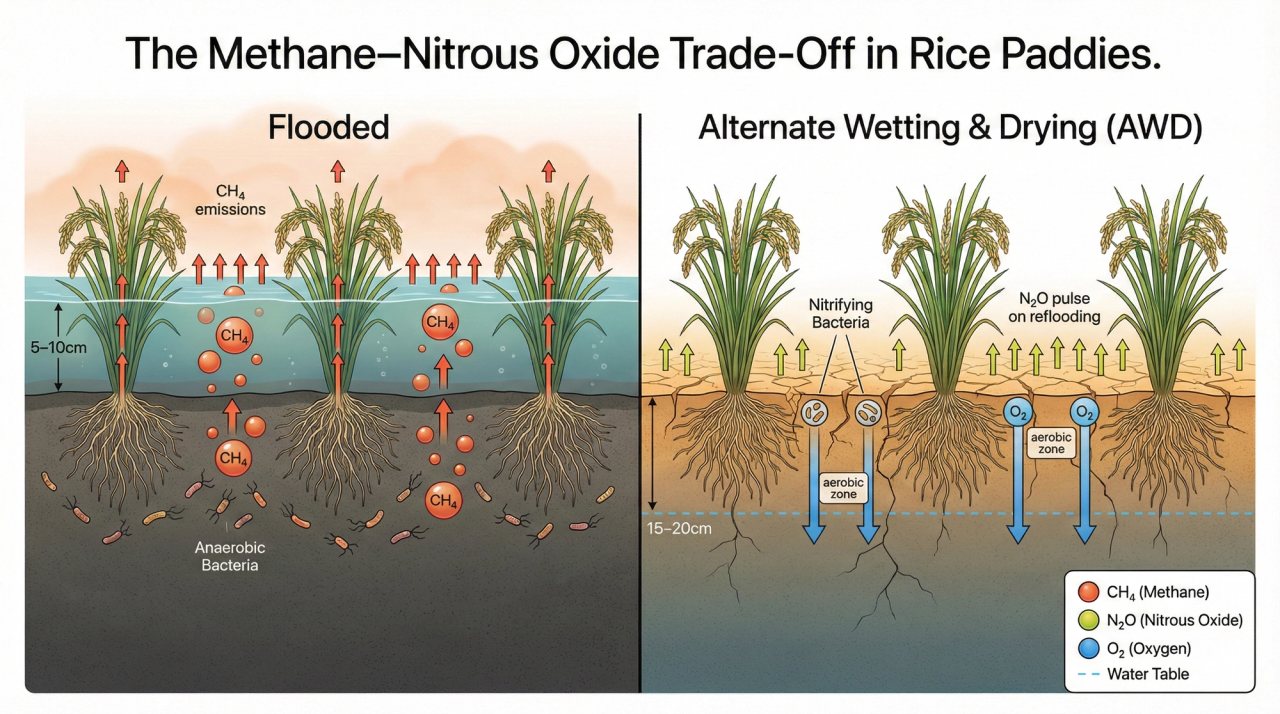
AMS-III.AU used default emission factors that effectively assumed this offset was negligible, an approach that contrasts with updated greenhouse gas inventory refinements requiring improved emission factor treatment for managed soils (Baasansuren et al., 2019).
Verra’s new VM0051 methodology (Verra, 2025), active since February 2025, treats it as non-negotiable. Project developers must now monitor both gases across the full cropping season, use of the Denitrification–Decomposition (DNDC) model (Proctor et al., 2025) calibrated to site-specific nitrogen application rates where direct N₂O measurement is not feasible, and establish a verified baseline over at least two cropping seasons before any credits can be issued. Satellite-based monitoring is permitted for methane-related parameters but field validation is required. There are no default factors for N₂O.
The result is a methodology that is harder to game, more expensive to implement, and if the first Vietnam and Pakistan project data hold more credible to buyers who have spent three years being burned by low-integrity credits. The trade-off nobody talked about is now the centre of the entire accounting system.
$37 Per Hectare: Real Money or Market Mirage?
Imagine a farmer in Telangana, two hectares under paddy, being told that changing how she manages irrigation water could generate an additional payment each season not from the government, not from her input dealer, but from a carbon registry verifying that her field is releasing less methane into the atmosphere. Pilot data indicate payments have been issued. Early pilot data from Telangana suggest gross carbon revenues in the range of $30–40 per hectare per season under credit prices of $15–25 per tonne CO₂e, subject to audit confirmation and MRV cost deductions (Damodaran, H., 2025). What is less obvious is the gap between signing up and actually receiving it, and what has to happen in between.
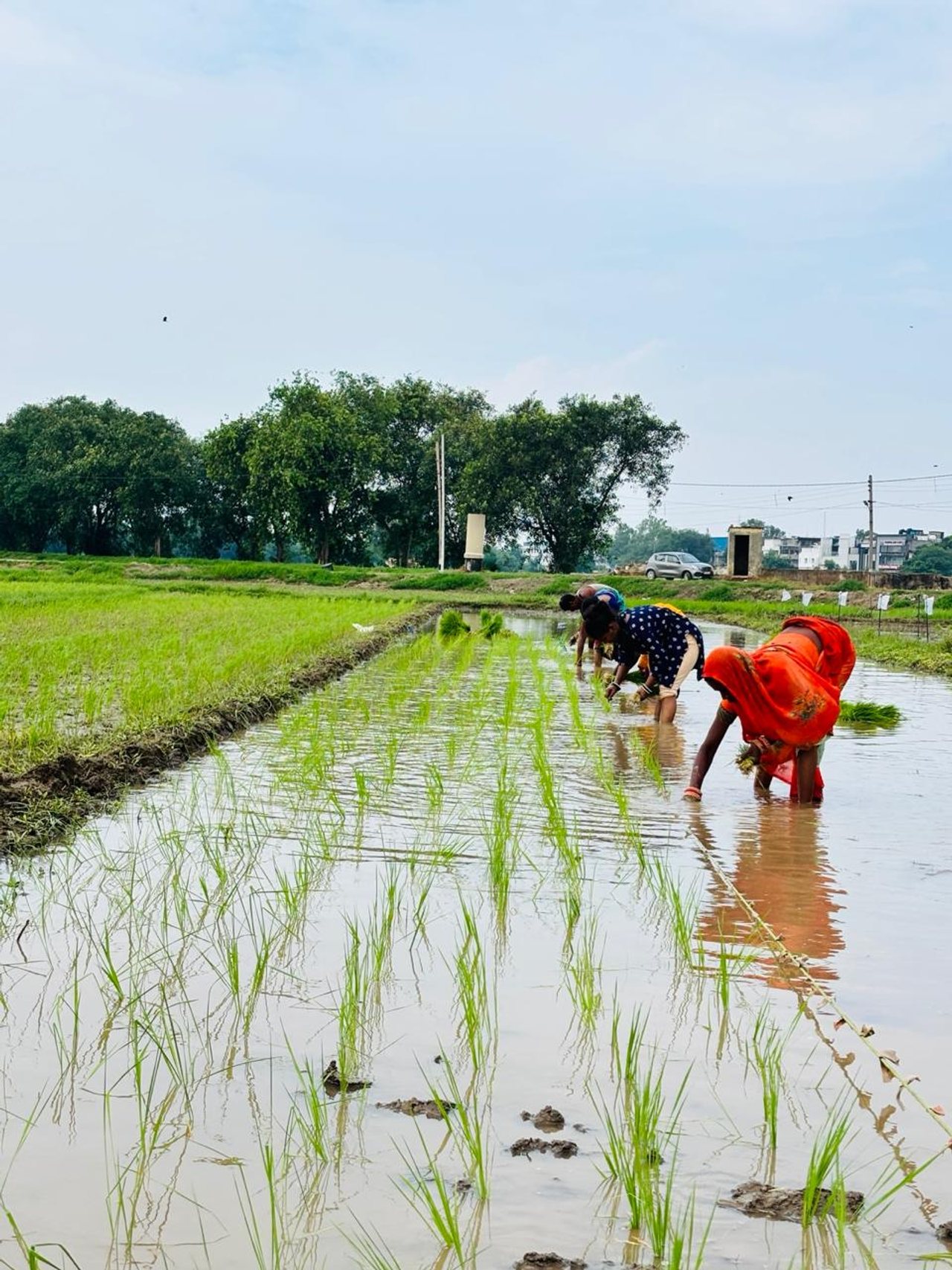
The $37.50 figure comes from multiplying two variables: the volume of verified emissions reductions a well-managed AWD plot can generate typically 1.5–2.5 tonnes of CO₂-equivalent per hectare per season (Linquist et al., 2012; Sander et al., 2016; Smith et al., 2008) depending on baseline flooding depth and nitrogen management, and against a market price that has recovered to $15–25 per tonne following the 2023 methodology reset, with recent India spot sales at $17–18 per tonne. The arithmetic is straightforward. The pathway to that arithmetic is not.
Under VM0051, no credits can be issued until a verified baseline has been established over at least two cropping seasons. That means a farmer enrolling in a program today will not see a carbon payment until late 2026 at the earliest and only then if the In practice, early pilot cohorts reported payments approximately 18–24 months after enrollment, reflecting the time required for baseline establishment and audit review. The carbon income, when it arrived, covered approximately 12% of seasonal input costs meaningful, but not the transformation that some early program marketing implied (Mitti Labs. 2025).
What makes the difference is who is running the program. Monitoring, Reporting and Verification under VM0051 requires continuous field water management data, satellite imagery validation, biogeochemical modeling for N₂O accounting, and independent audit a cost structure that runs to several dollars per tonne at small scale and makes solo participation economically impossible for individual smallholders. Aggregators that bundle 5,000 or more hectares spreading fixed MRV costs across a large verified pool are the only way per-farmer economics work. Mitti Labs has publicly stated a target of 40,000 enrolled farmers by end-2026 (Mitti Labs, 2025). The Vietnam Mekong Delta initiative targeting one million hectares operates on the same principle.
For a farmer evaluating whether to participate, the questions worth asking are practical ones. Is the aggregator registered under VM0051 or Gold Standard and can they show you the registry project ID? When were credits last issued, and what did enrolled farmers in the previous cohort receive per hectare? What is the payment structure lump sum on issuance, or distributed across seasons? What happens if the audit finds a data gap? These are not bureaucratic details. They are the difference between a program that pays and one that promises.
The $37.50 is documented pilot payments. Getting to it requires patience, the right partner, and a clear-eyed understanding that rice carbon income supplements farming it does not replace the work of farming well.
Vietnam, India, Pakistan: Three Markets, Three Lessons
If the first generation of rice carbon credits failed partly because projects prioritized enrollment over measurement, the second generation is being built in reverse MRV infrastructure first, farmer scale second. The three markets where that logic is most visible in 2026 are Vietnam, India, and Pakistan, and each one teaches a different lesson about what it actually takes to get credits issued under the new protocols.
Vietnam's lesson is about the ceiling of ambition. The Mekong Delta 1.6 million hectares of paddy, more than half of national rice output, one of the highest-methane rice landscapes on earth became the anchor of a national low-emission rice program formally backed by the World Bank in 2024 (Tubiello et al., 2013). Pilot implementation across five Mekong provinces began in 2025, with the first VM0051-registered project listed in April of that year. The program's target is one million hectares an order of magnitude larger than anything previously attempted under a single rice carbon framework. The enabling factor is government aggregation: when the state functions as the aggregator, MRV costs can be distributed across the national program budget rather than extracted from per-tonne credit margins. The limiting factor is the same: government programs move on political timelines, and the one-million-hectare target depends on policy continuity across electoral cycles that no carbon buyer can guarantee.
India's lesson is about the speed and risk of private markets. Mitti Labs, the most visible private aggregator in the Indian rice carbon space, has scaled from pilot to a stated 40,000-plus farmer target by end of 2026 operating primarily under VM0051 in Telangana and expanding into Andhra Pradesh and Odisha. The $17–18 per tonne spot price signal that emerged from Indian market transactions in early 2026 reflects genuine corporate demand for high-integrity agricultural credits with documented smallholder co-benefits. It also reflects a market that is still learning to price the difference between rigorous MRV and well-marketed enrollment numbers. India has more aggregators operating in the rice carbon space than any other country and no standardized public registry of their audit outcomes. Buyer due diligence remains the primary quality filter.
Pakistan's lesson is about institutional substitution. Where private aggregators in India and Vietnam rely on field agents to onboard and monitor farmers, Pakistan's Gold Standard project in Punjab leaned heavily on the government agricultural extension system reducing the cost of farmer onboarding while leveraging existing trust relationships in rural communities. The first Gold Standard issuance for rice water management in Pakistan totaled 46,714 tCO₂e in December 2025 (Gold Standard, 2025), with annual issuance projected at 57,188 tonnes as enrollment matures. It is a smaller number than Vietnam's ambitions or India's enrollment targets, but it is issued, audited, and on the registry which in 2026 remains a distinction worth making.
The geography of rice carbon in 2026 is not a map of where AWD works best agronomically. It is a map of where MRV infrastructure, aggregator capacity, and institutional support arrived at the same time.
Final Thoughts: From a "Fragile Promise" to a Durable Market
Rice carbon credits have survived their first real test. This wasn't just a market correction; it was a reckoning. The industry had to stop, admit its methodology failures, and rebuild on stricter scientific ground.
As we move through the first half of 2026, the landscape looks fundamentally different:
- Real Rigor: The active protocols are no longer "guesses"; they are genuinely more rigorous than what they replaced.
- Real Value: Current spot prices of $17–$18 reflect documented transaction activity, not just speculative hype.
- Real Impact: For a smallholder farmer, a 10% reduction in input costs, combined with modest carbon payments is the difference between a viable season and a borrowed one.
The Remaining Question: Can Integrity Scale? The market has built a massive "integrity infrastructure" including satellite monitoring, complex biogeochemical modeling, and multi-year audits. The big unknown is whether this system can be sustained without the high cost of monitoring (MRV) consuming the very profits meant for the farmers.
We won’t find the answer in the next protocol revision. We will find it in the data coming out of Vietnam, India, and Pakistan over the next two cropping cycles. Those results will tell us if this "quality control era" is a durable, long-term market—or simply a better-designed version of the same fragile promise.