- Location
- Nebraska
- Crop
- Corn
- Acres
- 1,000
The challenge
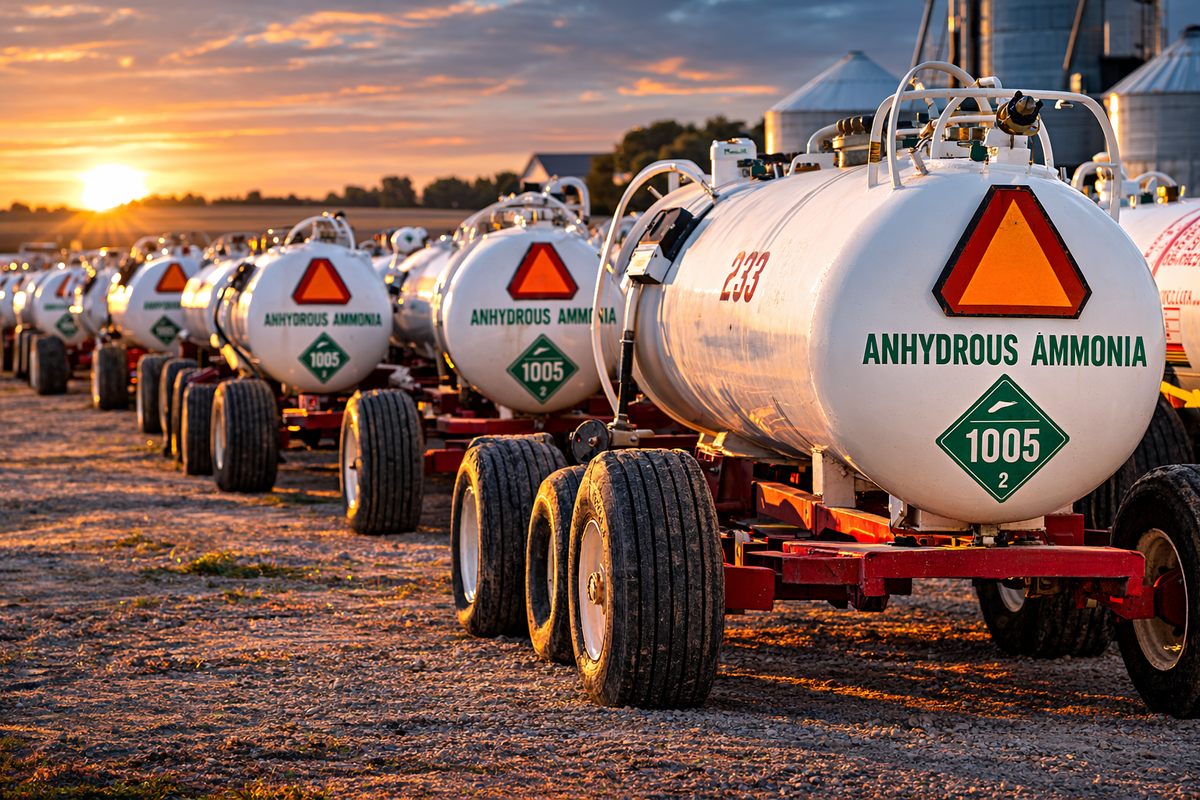
“Do anhydrous ammonia applications make the soil hard?”

Jaya (J) Nepal, Ph.D.
Postdoctoral Research Associate · PennState · University Park, PA
Anhydrous ammonia itself does not chemically “make the soil hard.”
University of Illinois guidance is very explicit that there is no basis for the idea that ammonia itself hardens soil; the bigger issue is that applying it with heavy equipment when soils are moist can create compaction. They also note wet conditions can cause sidewall smearing in the injection slot [1].
What people often notice in the field is one of three things:
- First, compaction from the applicator. If the toolbar and tanks run on wet ground, you can get denser soil, poorer pore continuity, and that “hard” feel afterward. That is a machinery-and-moisture problem, not an ammonia chemistry problem.
- Second, slot smearing / poor closure. Iowa State explains that when soils are wet, the knife track can smear, and if the slot later dries and opens, ammonia can move upward. Illinois also points to sidewall smearing in wet soils as a cause of problems around the application zone [1,2].
- Third, temporary localized injury near the band. Free ammonia is caustic at the injection point, so it can temporarily injure roots and microbes close to the band, especially in dry or poorly sealed conditions. Illinois notes the physical effect is temporary, and microbial effects are localized and recover with time [1].
So the practical answer is:
If a field feels harder after anhydrous application, the most likely causes are wet-soil traffic, injection-slot smearing, shallow placement, or poor sealing, not the ammonia itself. Risk is higher in wet soils for compaction/smearing and in dry or coarse-textured soils for poor sealing and ammonia movement. Iowa State notes ammonia can move farther in coarse-textured and low-moisture soils, while Illinois recommends deeper placement in lighter soils to reduce escape and injury.
A good rule of thumb:
- hard between rows / wheel tracks = likely compaction
- hard right along the knife track = likely smearing/sealing issue
- poor emergence or root pruning near bands = ammonia placement/timing issue
To reduce the problem: avoid application when soil is too wet, make sure the slot closes well, place ammonia deep enough for the soil texture, and keep bands away from future seed rows.
Cite this
Reference this work
Jaya (J) Nepal, Ph.D. (2026). Does anhydrous ammonia make soil hard?. Soil Health Exchange. SHE-FA-2026-0037. https://soilhealthexchange.com/cite/SHE-FA-2026-0037
Soil Health Exchange assigns a stable identifier to every published answer and article. Citations keep working even if the URL changes later.
Keep exploring
Similar questions
Addressing Waterlogging Issues with Soil Health Management
Nebraska
How much manure is enough — and what happens to the rest?
Clay County, Nebraska
Natural Solutions to Soil Compaction — Beyond Mechanical Means and Cover Crops
Nebraska
Reducing Cover-Crop Herbicide Use in Nebraska: Three Lanes, Measured Before Scaling
Nebraska
Discussion
No comments yet. Be the first to share your thoughts!