- Location
- New York
- Crop
- Specialty Crop
The challenge
“Is there rough calculation to quantify data illustrating how much methane is deferred from a single yard of compost ? Our community composting program is trying to quantify our environmental impact. How much GHG we are actually deferring via our small program. We will use this data to motivate our current volunteers and bring on new ones this growing our program, and improving our soil locally.”
Soil Health Exchange Editor Team
Editorial team
Yes — there is a reasonable rough way to estimate it, but the number depends a lot on what your “yard” contains.
For a community composting program, the simplest place to start is with food scraps, because those are the materials most likely to generate methane if they go to a landfill. A practical estimate is that one cubic yard of food scraps weighs about 463 pounds (EPA estimates). Using current EPA WARM factors for composting instead of landfilling food waste, that comes out to roughly 0.15 metric tons of CO2-equivalent (CO2e) emissions avoided per cubic yard composted, or about 332 pounds CO2e per cubic yard.
So, as a rough communication number, you could say:
Each cubic yard of mostly food scraps we compost instead of sending to landfill avoids about 0.15 metric tons CO2e, or about 332 pounds CO2e.
That means:
1 cubic yard = about 0.15 metric tons CO2e avoided
10 cubic yards = about 1.5 metric tons CO2e avoided
50 cubic yards = about 7.5 metric tons CO2e avoided
For a more tangible comparison, one cubic yard of food scraps composted is roughly similar to avoiding about 375 miles of passenger vehicle driving, using EPA’s estimate that a typical passenger vehicle emits about 400 grams of CO2 per mile.
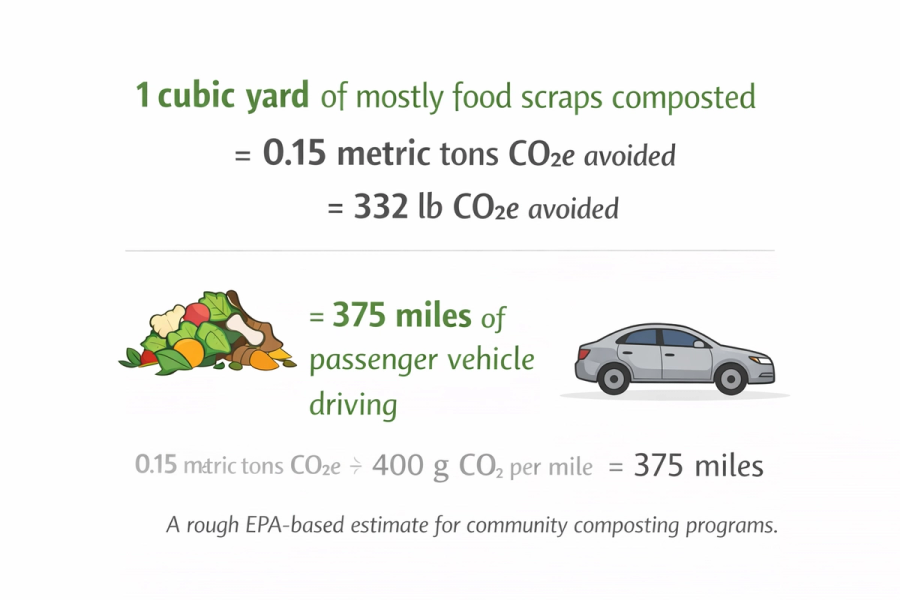
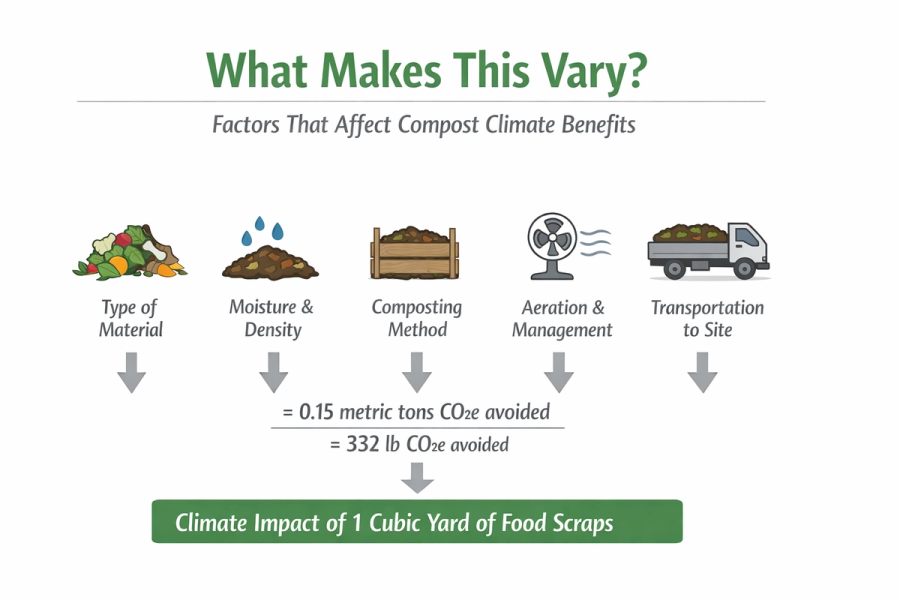
One important note: this is a rough estimate, not a full life-cycle accounting. The actual value will vary depending on what is in the pile. A cubic yard of wet food scraps is very different from a cubic yard of leaves, brush, or mixed yard waste. Composting method, moisture, aeration, and transportation also affect total emissions. Still, for a small community program, this is a solid and defensible way to communicate the climate benefit.
For your program, you can frame it like this:
“Using a rough EPA-based estimate, every cubic yard of mostly food scraps that we compost instead of landfill avoids about 0.15 metric tons of CO2-equivalent emissions. That means our program is helping reduce methane-generating waste while producing compost that improves local soil health.”
FACTS
In 2019, 66.2 million tons of wasted food were generated in the food retail, food service and residential sectors in the United States. Only 5% of that wasted food was composted (EPA: https://www.epa.gov/sustainable-management-food/composting)
In the U.S., food is the single most common material sent to landfills, comprising 24.1 percent of municipal solid waste. When yard trimmings, wood and paper/paperboard are added to food, these organic materials comprise 51.4 percent of municipal solid waste in landfills. (EPA: https://www.epa.gov/sustainable-management-food/composting)
Benefits of Composting
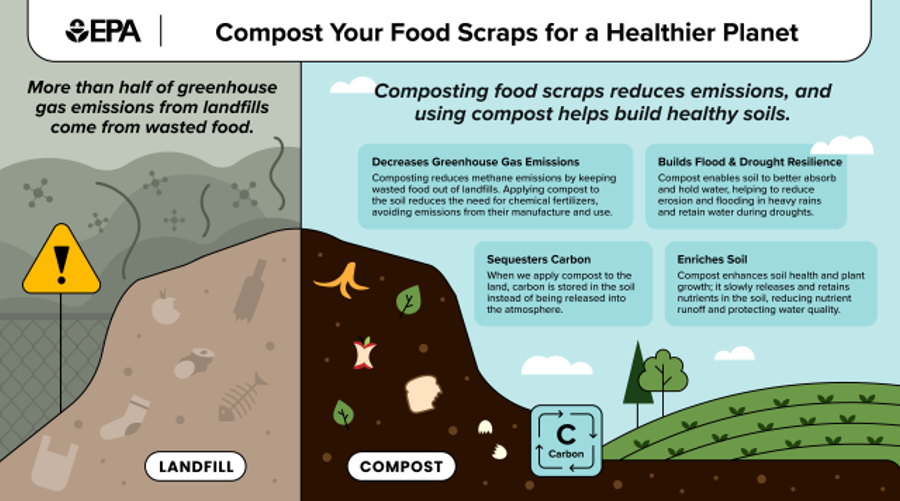
- Reduces methane emissions from landfills.
- Reduces waste.
- Recycles organic materials into a valuable soil amendment – compost.
- Recovers nutrients in organic materials and provides an opportunity to keep them local.
- Creates green jobs.
- Extends municipal landfill life by diverting organic materials.
Reference:
Public Comments on EPA's Waste Reduction Model (WARM) | Institute for Local Self-Reliance - ILSR, accessed March 8, 2026, https://ilsr.org/article/composting-for-community/public-comments-on-epas-warm/
How the US Economy and Environment can Both Benefit From Composting Management, accessed March 8, 2026, https://pmc.ncbi.nlm.nih.gov/articles/PMC9575438/
Using Life Cycle Analysis to Measure GHG Emissions from Composting, accessed March 8, 2026, https://compostingtechnology.com/using-life-cycle-analysis-to-measure-ghg-emissions-from-composting/
Documentation for Greenhouse Gas Emission and Energy Factors Used in the Waste Reduction Model (WARM) - EPA, accessed March 8, 2026, https://www.epa.gov/sites/default/files/2016-03/documents/warm_v14_organic_materials.pdf
Quantifying Methane Emissions from Landfilled Food Waste | US EPA, accessed March 8, 2026, https://www.epa.gov/land-research/quantifying-methane-emissions-landfilled-food-waste
Cite this
Reference this work
Soil Health Exchange Editor Team (2026). How Much Climate Impact Does Composting Avoid?. Soil Health Exchange. SHE-FA-2026-0035. https://soilhealthexchange.com/cite/SHE-FA-2026-0035
Soil Health Exchange assigns a stable identifier to every published answer and article. Citations keep working even if the URL changes later.
Keep exploring
Discussion
No comments yet. Be the first to share your thoughts!