- Location
- Nebraska
- Crop
- Corn
- Soil
- Sandy Loam
- Acres
- 1,000
The challenge
“It seems everyone has a soil health product for sale these days, so I find it hard to sort through and select any amendment or biostimulant with confidence. Is there any independent research concerning biostimulants, humates, etc? I'm in northeast Nebraska, in Pierce, Antelope, and Knox counties. Corn and soybeans. Lots of sandy ground. Thank you.”
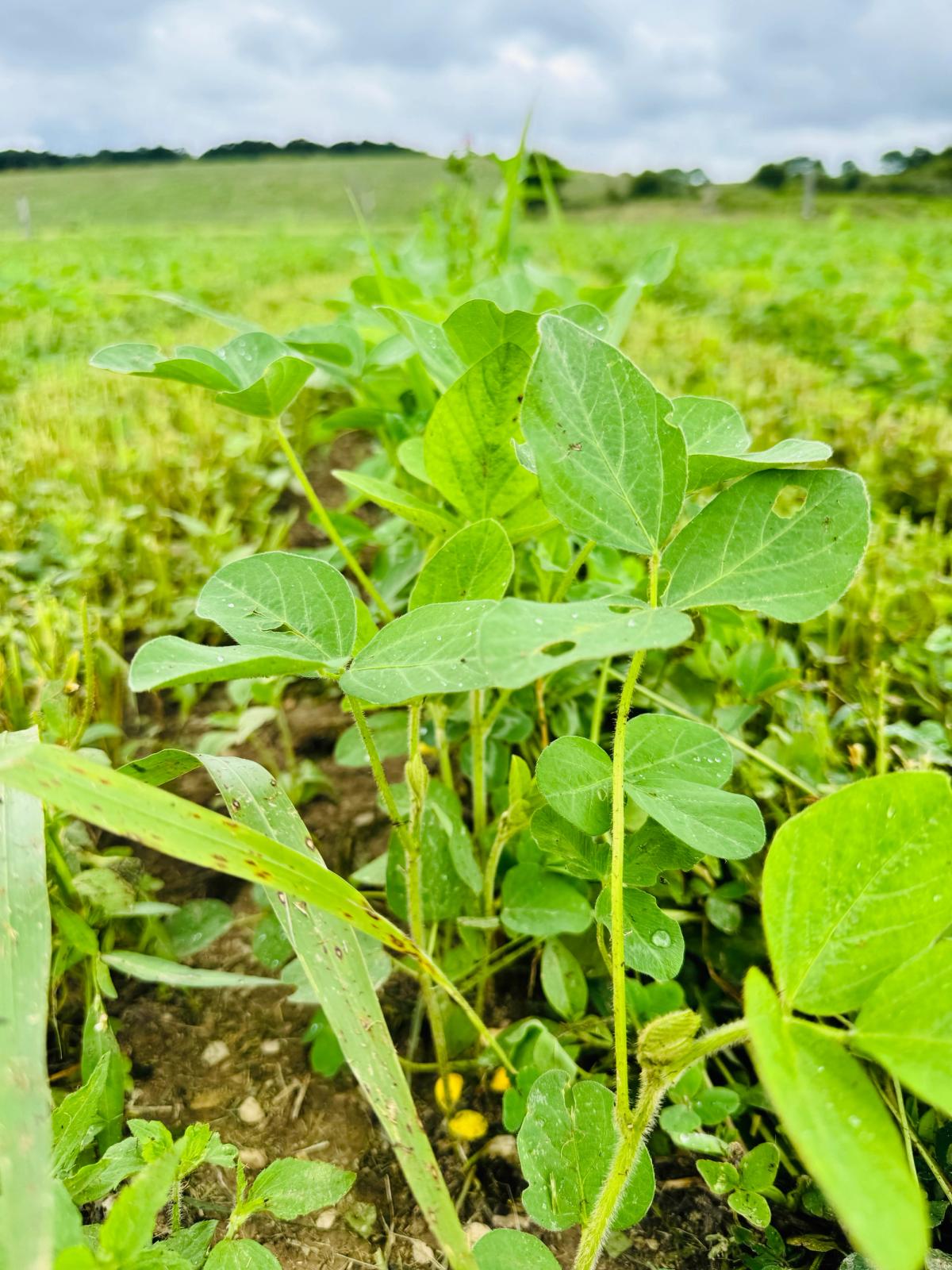
Biostimulants and humic products are marketed as ways to improve crop vigor, nutrient uptake and stress tolerance. Unlike fertilizers, these products provide little nutrient value; instead they contain humic substances, microbial inoculants or plant‑growth regulators. Because they are not regulated by nutrient‐analysis standards, the composition and efficacy of commercial biostimulants varies widely. To answer about northeastern Nebraska (Pierce, Antelope and Knox counties), we can look into some of the studies focusing on corn and soybeans in the U.S. Midwest and similar environments especially from Universities and On-Farm trials.
Evidence from University and On‑Farm Trials
Long‑term humic product study in Iowa (2013–2017)
Researchers from the USDA‑ARS and Iowa State University conducted a five‑year on‑farm trial on the Clarion–Nicollet–Webster soil association in central Iowa. They compared multiple foliar and soil‑applied rates of a liquid humic product on corn (2014 and 2016) and soybeans (2013, 2015 and 2017) versus untreated controls. Key results include:
- Soybean years (2013, 2015, 2017): Humic treatments increased soybean yield by 6–13 % in the drought‑stressed 2013 and 2017 seasons, with statistical significance at the 95 % confidence level. For example, in 2017 the 64 oz ac⁻¹ and 128 oz ac⁻¹ treatments yielded 60.3 bu ac⁻¹ and 61.5 bu ac⁻¹, respectively, compared with 54.4 bu ac⁻¹ for the untreated check, representing +10.8 % and +13.2 % increases. In the favorable year 2015, yield differences were only 3 % and not significant.
- Corn years (2014 and 2016): Humic treatments provided little benefit in the high‑yielding 2014 season. The split application (27 + 14 oz ac⁻¹) produced 186.3 bu ac⁻¹ (2 % above the control) but was not significant. In the drought year 2016 season, foliar applications of 32 and 64 oz ac⁻¹ increased corn yield by 3–4 %, with statistical significance (p ≤ 0.02).
- Environmental interaction: The researchers noted that humic products tended to improve yields only in years with water deficits, whereas no gains were observed in favorable seasons. A companion trial on nearby coarse‑textured soils showed significant yield responses in only one of six treatments, indicating that soil texture and moisture conditions strongly influence performance.
This highlights positive yield differences mainly in drought‑stressed years (2013, 2016, 2017) and negligible or negative responses in favorable years.
Practical Farmers of Iowa – 2024 soybean trials
Keaton Krueger, a farmer cooperating with Practical Farmers of Iowa, conducted replicated strip‑trials on strip‑tilled soybeans in 2024 to evaluate a humic acid plus ammonium thiosulfate (ATS) treatment and humic acid alone. Findings include:
- Humic + ATS trial: Soybeans planted 23 days after applying humic acid + ATS yielded 79 bu ac⁻¹, essentially equal to the untreated strips (78 bu ac⁻¹).
- Humic‑only trial: In‑furrow humic acid at planting resulted in 77 bu ac⁻¹, slightly but significantly lower than the control (80 bu ac⁻¹). The farmer reported seeing improved vegetative growth but no yield benefit.
- The report emphasizes that high concentrations of humic acid can sometimes decrease growth and that researchers frequently observe no yield increase from humic products.
These trials illustrate that humic amendments may not provide economic benefit under high‑yield conditions, even when plant vigor appears improved.
Nebraska On‑Farm Research Network – Vitazyme and other growth promoters (2016)
The University of Nebraska–Lincoln’s on‑farm network evaluated Vitazyme®, a commercial biostimulant containing enzymes and fermentation products, applied at various rates with starter fertilizer on no‑till soybeans. The trial used four replicates on Hastings silt loam soil with irrigation. Results showed:
- None of the Vitazyme treatments produced higher yields than the starter‑fertilizer check; all treatments yielded 66–67 bu ac⁻¹, and differences were not statistically significant.
- Chlorophyll meter readings were slightly higher in treated plots but did not translate into yield gains.
The study concluded that Vitazyme did not improve yield, oil, protein or seed weight relative to the untreated check.
Micronized humic product study (Enersol®) in central Iowa
A field experiment in central Iowa (2012–2016) evaluated a micronized humic product (Enersol®) across multiple soil types and annual weather patterns. Mechanized combine data showed that:
- In drought‑stressed seasons, humic application increased corn grain yield on upland soils by 930–1,600 kg ha⁻¹ (11–19 %) in 2012 and 700 kg ha⁻¹ (7 %) in 2013. On side‑slope soils, only small numeric responses occurred.
- With favorable rainfall in 2014 and 2016, yield increases were small or absent.
- The authors concluded that humic products improved maize growth under rainfed conditions but that benefits were inconsistent and mostly limited to drought stress. No consistent changes in grain nutrient concentrations or soil properties were observed.
What about other biostimulants?
The current literature contains far fewer independent studies on microbial inoculants, amino‑acid formulations or seaweed extracts for Midwestern row crops. Some examples:
- Biological seed treatments: A multi‑state study coordinated by university agronomists evaluated commercial biostimulant seed treatments on soybean across 13 U.S. states. Preliminary reports (2025) indicate minimal or no yield impact relative to untreated seed across the 2023–2024 seasons (average differences <2 bu ac⁻¹). This aligns with the Nebraska and Iowa findings that biostimulant responses are inconsistent.
- Microbial inoculants: Rhizobia inoculants are essential for soybean nodulation in fields with no history of soybeans, but they are considered microbial fertilizers rather than biostimulants. Other microbial products claiming to fix atmospheric nitrogen for corn often lack independent field verification. Extension specialists recommend conducting small on‑farm trials before investing in these products.
Biological Products for Corn and Soybean – Practical Farmers of Iowa Trials
Practical Farmers of Iowa’s Cooperators’ Program ran on‑farm trials from 2019–2024 to evaluate biological products marketed to improve nutrient cycling, plant vigor or yield. Sixteen replicated strip‑trials involving seven farmers examined microbial inoculants, compost teas, nitrogen‑fixing bacteria, algal biostimulants, biochar seed treatments and humic products. These tests followed randomized paired‑strip designs with at least four replications and analysed yield differences using analysis of variance and LSD or HSD statistics. In more than 80 % of trials no significant yield benefit occurred.
Individual product results
MycoApply Soil Inoculant (2019)
- Product – MycoApply® is a commercial blend of mycorrhizal fungi marketed to improve nutrient uptake. Jack Boyer applied 2 lb/ac (≈US$12.50 per acre) to both corn and soybeans.
- Trial design – Four paired strips compared MycoApply vs. untreated control in both crops. Yield data were standardized to 15.5 % moisture and evaluated using LSD at 90 % confidence.
- Findings – Average corn yield (248 bu/ac across treatments) exceeded the county average; the difference between MycoApply (246 bu/ac) and control (250 bu/ac) was 4 bu/ac, LSD was 11 bu/ac; so no significant effect. Mean soybean yield (61 bu/ac) differed by only 2 bu/ac between treatments, which was far below the LSD (14 bu/ac), indicating no effect. Boyer concluded that the inoculant added cost without improving yield.
Holganix Bio 800+ Compost Tea (2023)
- Product – Holganix Bio 800+ is a microbe‑rich compost tea marketed to increase nutrient cycling. It was applied at 1 gal/ac (≈US$20 per acre).
- Trial design – Four replicated strips compared Holganix plus the farmer’s nutrient program against the nutrient program alone.
- Findings – Corn yields were statistically similar between Holganix (188 bu/ac) and the control (189 bu/ac); the LSD was 10 bu/ac. Because there was no yield increase, the extra US$20/ac cost reduced net returns. Boyer reported he would continue evaluating but had not observed economic benefits.
Utrisha N Biological Nitrogen Supplement (2023)
- Product – Utrisha N (Methylobacterium symbioticum) is a foliar‑applied nitrogen‑fixing bacterium marketed to reduce synthetic N requirements. Three cooperators (two organic, one conventional) applied the product.
- Trial design – Each farm compared Utrisha N versus control in randomized strips; organic systems used foliar application on organic corn, while the conventional farm applied it on irrigated conventional corn.
- Findings – Across all farms, Utrisha N caused no significant change in corn yield; average increases were about 3 bu/ac—well below LSD thresholds. Cooperators noted application difficulties (product needed a separate pass and compatibility issues) and costs (~US$17/ac). As yields were unaffected, Utrisha N reduced profitability and farmers said they would likely not use it again.
Biostimulant Effects on Corn (2024)
EnSoil Algae (Jack Boyer, Reinbeck, IA)
- Product – EnSoil Algae is a live algal (Chlorella vulgaris) biostimulant intended to enrich soil.
- Trial design – Boyer ran two trials. In both, he used his typical fertilizer program. Each trial had four replicates of control vs. EnSoil Algae.
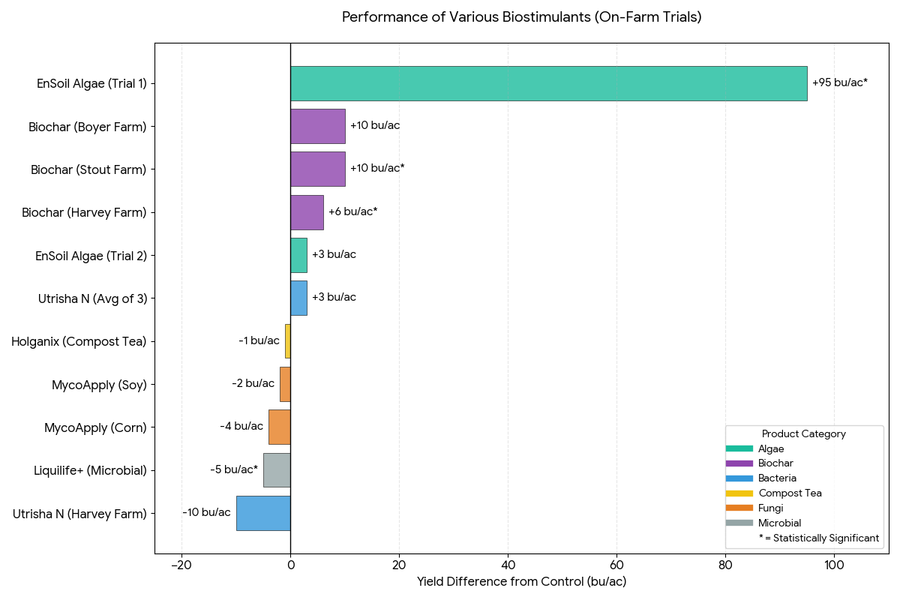
- Findings – Trial 1 (higher N): corn treated with EnSoil Algae yielded 95 bu/ac more than the control (287 vs. 192 bu/ac), far exceeding the LSD of 5 bu/ac, resulting in a large revenue increase. Trial 2 (lower N, wetter field): the treated strips yielded 204 bu/ac versus 201 bu/ac for the control, a difference of only 3 bu/ac, below the LSD of 6 bu/ac. Boyer noted the treated plants looked greener but the effect was not significant.
Utrisha N (Robert Harvey, Redfield, IA)
- Trial design – Four replicates compared control vs. Utrisha N on conventionally fertilized corn (130 lb N/ac). ROI analysis incorporated corn price (US$4.10/bu), N costs and the product cost.
- Findings – Utrisha‑treated corn yielded 179 bu/ac versus 189 bu/ac for the control—a 10 bu/ac decrease (difference < LSD 14 bu/ac), so no significant effect. Because yield declined slightly and the product cost US$26.12/ac, net income fell from US$650.88 to US$624.76 per acre.
Liquilife+ with Reduced N (Joshua Hiemstra, Brandon, WI)
- Product – Biolife Liquilife+ is a diverse microbial inoculant.
- Findings – Liquilife+ treatment yielded 118 bu/ac versus 123 bu/ac in the control; the 5 bu/ac decrease exceeded the LSD (2 bu/ac) and thus was a significant yield loss. Reduced N costs did not offset the yield loss, lowering net income from US$428.12 to US$399.46 per acre.
Biochar Seed Treatment (2024)
- Product – EarthBrew biochar (biochar plus compost tea) applied as a seed coat at 1/3 cup per 50 lb of seed (≈US$3.52/ac cost at Harvey’s farm).
- Trial design – Three farmers (Jack Boyer, Robert Harvey and Rob Stout) planted four replicated strips of biochar‐treated vs. untreated seed.
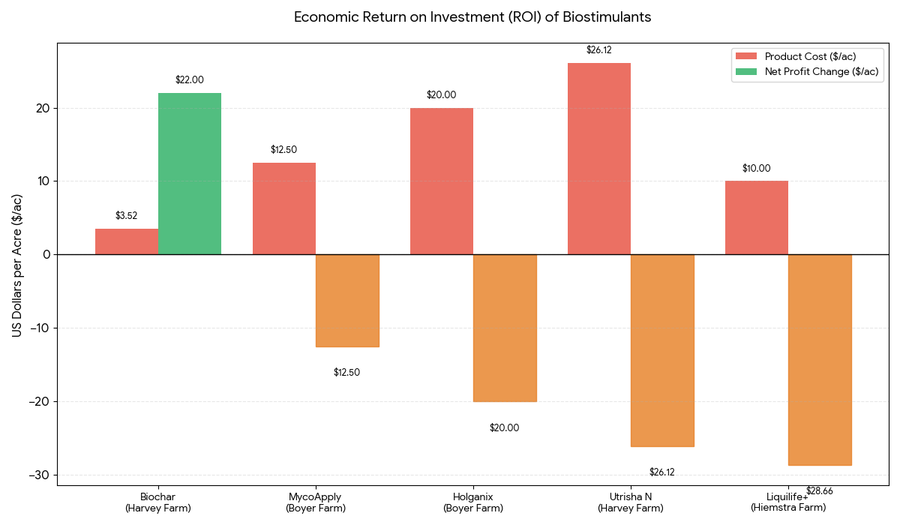
- Findings – Harvey: biochar increased yields from 210 to 216 bu/ac (6 bu/ac increase), exceeding the HSD of 2 bu/ac and significant yield boost. At US$3.52/ac product cost, profit increased by about US$22/ac. Stout: biochar increased yields from 226 to 236 bu/ac (10 bu/ac increase), also significant. Boyer: yields were 240 bu/ac with biochar vs. 230 bu/ac without; the 10 bu/ac difference was less than the HSD (19 bu/ac; meaning lot of variability within tretment) so not significant. Farmers noted seed coating was easy on a small scale but scaling up might require new equipment.
Patterns and recommendations
- Mixed and site‑specific responses – Most products provided little or no yield benefit. Positive responses occurred only in specific situations: EnSoil Algae in one high‑fertility trial produced a large yield gain (49 %), and biochar seed treatment increased yields at two of three farms. However, the same products sometimes showed no effect or even yield loss in other fields or years. Environmental conditions (drainage, weather) and management (fertility level) likely influence outcomes.
- Economic considerations – Because most treatments cost US$3–$26 per acre, small yield differences often translate into net losses when benefits are not significant. For example, Utrisha N reduced net income by US$26/ac when yield differences were not significant, and Liquilife+ reduced income by about US$29/ac due to yield loss and product cost. Farmers should calculate return on investment rather than assuming any yield response.
- Replicated on‑farm trials are essential – Practical Farmers of Iowa emphasizes testing practices in local conditions; even when a product worked on one farm, it failed elsewhere. Farmers interested in biologicals should conduct small‑scale, replicated strip trials to evaluate performance and profitability before using them widely.
- Focus on proven soil‑health practices – Because the majority of biostimulant products did not deliver consistent yield benefits, resources might be better invested in practices with well‑documented benefits such as diverse cover crops, residue retention, manure application, and nutrient‑balanced fertility. Building soil structure, organic matter, and water‑holding capacity through these practices often improves plant resilience more reliably than purchased amendments.
Actionable guidance for farmers in northeast Nebraska
Given the sandy soils typical of Pierce, Antelope and Knox counties, moisture retention and nutrient cycling are critical. Based on the all the studies, might be worth testing:
- Consider testing biochar seed treatments – On moderately productive soils, biochar coating increased corn yields by 6–10 bu/ac, generating a positive ROI at a cost of ~US$3–$4/ac. Test on small areas to confirm benefits under local conditions, especially in sandy soils where moisture retention could improve plant growth.
- Approach microbial inoculants and nitrogen‑fixing products cautiously – MycoApply, Holganix and Utrisha N failed to improve yields and sometimes reduced profitability. Do not expect them to replace fertilizer in high‑yield systems.
- Use humic products sparingly in soybeans – In‑furrow, humic acid reduced soybean yield by 3 bu/ac. Combined humic acid and sulfur showed no benefit. If exploring humic acid, trial at low rates and monitor plant response.
- Evaluate algae and other novel biostimulants only under controlled trials – EnSoil Algae produced one substantial yield increase but lacked consistency. Do not adopt widely without replicated tests and ROI calculations.
- Work with local Extension and the Nebraska On‑Farm Research Network. They can help design trials, interpret results and connect you with other growers who have tested products. The On‑Farm Research Network publishes annual reports with unbiased evaluations of fertilizers, growth promoters and management practices.
- Be cautious of marketing claims. Products labeled as “soil activators,” “microbial enhancers” or “plant growth stimulants” often lack peer‑reviewed data. Before purchasing, ask the manufacturer for independent replicated trial data relevant to sandy loam soils and crops grown in Nebraska.
Reference
- Practical Farmers of Iowa: PFI Research on Biological Products for Corn and Soybean
- Practical Farmers of Iowa: Sulfur Fertilizer and Humic Acid Amendment for Soybeans
- Izquierdo J, Arriagada O, García-Pintos G, Ortiz R, García-Pintos M and García-Pintos M (2025) Humic field biostimulation as a sustainable agricultural practice to increase yield of main grains: evidence from on-farm trials. Front. Plant Sci. 16:1709876. doi: 10.3389/fpls.2025.1709876
- Practical Farmers of Iowa: Biochar Seed Treatment for Corn
Cite this
Reference this work
Soil Health Exchange Editorial (2026). Lessons from Midwest Biostimulant Trials. Soil Health Exchange. SHE-FA-2026-0034. https://soilhealthexchange.com/cite/SHE-FA-2026-0034
Soil Health Exchange assigns a stable identifier to every published answer and article. Citations keep working even if the URL changes later.
Keep exploring
Similar questions
How much manure is enough — and what happens to the rest?
Clay County, Nebraska
Reducing Cover-Crop Herbicide Use in Nebraska: Three Lanes, Measured Before Scaling
Nebraska
Cereal Rye Before Corn: Should You Adjust Your Nitrogen Rate?
IA
Organic Corn in Clover Living Mulch: Protect the Row and Test the Yield Response
PA
Discussion
No comments yet. Be the first to share your thoughts!