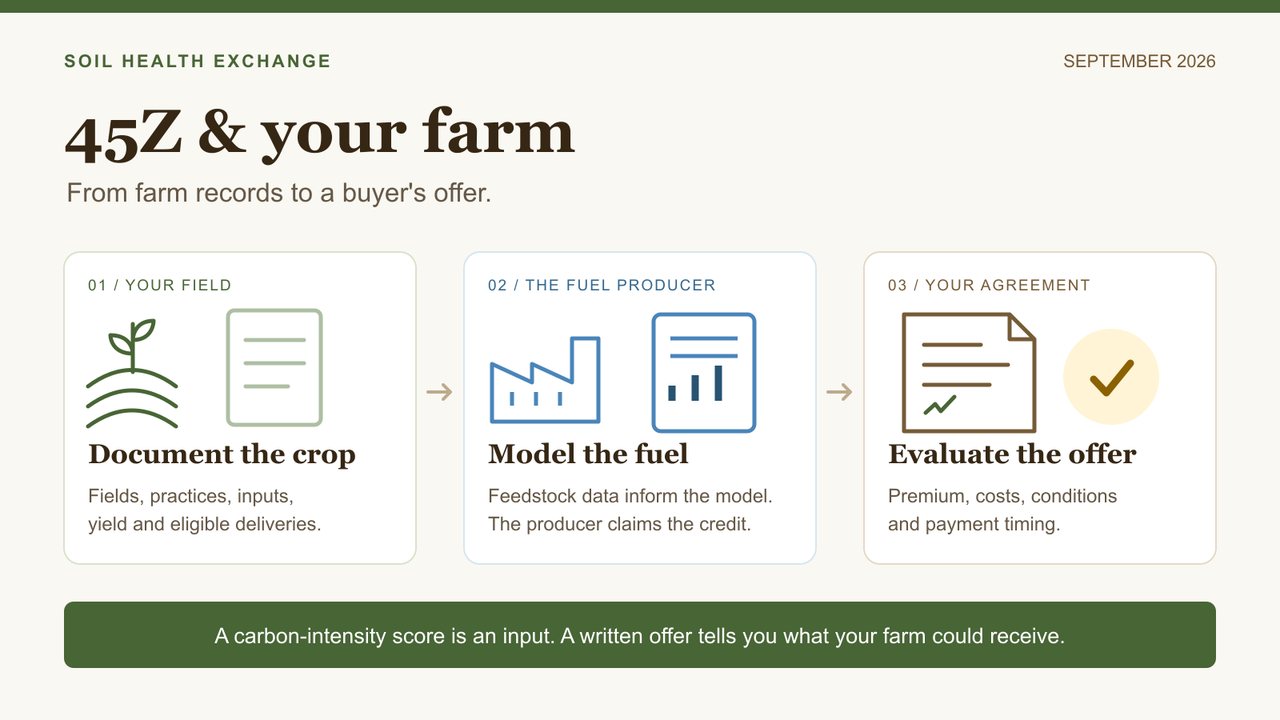
A lower-carbon crop can have value to a fuel producer. Whether that value reaches your farm depends on an agreement: which grain qualifies, how it is documented, what the buyer pays, and what participation costs you. A carbon-intensity score by itself is not a payment offer.
What changed—and what is still proposed
The timeline to use now
| Development | Status as of September 17, 2026 | Why a farmer should care |
|---|---|---|
| USDA feedstock technical guidelines | Final rule published June 29; effective July 29 | Provides the framework for quantification, records, chain of custody, audit and verification. |
| IRS Notice 2026-53 | Effective September 8 | Provides the 2026 emissions-rate table and guidance for regenerative feedstock practices, including limited transition relief. |
| DOE 45ZCF-GREET | September 2026 model and manual published | Includes 45ZCF FD-CIC for modeling specified farm practices and passing feedstock results into fuel calculations. |
| Broader Treasury/IRS 45Z regulations | February 4 proposal remains a proposal in the guidance reviewed here | Do not describe the September notice as finalization of every 45Z regulation. |
The September DOE manual covers regenerative-practice adjustments for U.S.-grown corn, sorghum, soybeans and canola. Its listed practices include cover crops, tillage practices, nitrification inhibitors and manure application. The model’s crop and practice definitions matter; a general claim that a farm is “regenerative” does not establish eligibility for a particular adjustment. [3]
There are also different rules for different fuel production years. Notice 2026-53 explains that the 2026 changes include excluding indirect land-use-change emissions and requiring feedstocks grown or produced in the United States, Canada or Mexico. The broader feedstock-origin rule is not the same as access to the model’s U.S.-only regenerative-practice adjustments. Ask the buyer which production year and pathway it is using. [1]
Who receives the credit?
Section 45Z is a federal income tax credit for qualifying domestic clean-fuel production and qualified sales. The claimant is the qualifying fuel producer. A grower does not receive the credit simply by producing a lower-carbon crop, keeping records or enrolling with a platform. Any crop premium reaching that grower depends on the buyer’s commercial terms. The statutory credit currently covers qualifying fuel produced after December 31, 2024 and sold by December 31, 2029. [1]
A feedstock carbon-intensity result is one input to a fuel calculation. The fuel pathway, other production inputs, volumes, applicable model version and tax requirements also matter. This is why a universal “one CI point equals this many cents per bushel” shortcut is not an appropriate forecast of your payment. The official model calculates fuel emissions; your contract determines your compensation. [3]
The 2025–2026 records relief has limits
Notice 2026-53 permits the 2026 version of 45ZCF FD-CIC to account for specified farm practices for fuel produced in 2025, subject to the USDA technical guidelines, including chain-of-custody and audit/verification requirements. For fuel produced in 2025 and 2026, it also treats the pre-application nutrient-budget requirement as satisfied for 45Z purposes. [1]
That relief does not remove the need to substantiate nutrient applications and measurable nutrient sources and removals entered in the model, or the fuel producer’s obligation to substantiate its credit. Keep the underlying records. Have the buyer identify the relevant fuel production year; the date a crop was planted, harvested or sold is not automatically the fuel production date. [1]
Start with a written offer, then do the math
Before paying an enrollment fee or changing a practice for a premium, get an offer that identifies eligible acres and grain, a payment formula, deductions, acceptance conditions and timing. If compensation is a share of a credit, ask the buyer to show the calculation and explain who bears the risk of a lower credit, rejected records or a later adjustment. Do not insert an assumed “industry-standard” sharing percentage.
Here is an arithmetic example, not a market forecast: a $0.10/bushel premium on 200 eligible bushels per acre across 100 acres produces $2,000 gross. Added costs of $12/acre plus a $300 fixed fee total $1,500. That leaves $500, or $5/acre, before tax. The break-even premium is $0.075/bushel. At the same costs, a $0.05 premium produces a $500 loss. Replace every assumption with your offer and budget.
Count only grain eligible for the premium. If some production goes to another buyer, misses a delivery window or is rejected, gross premium falls. Include incremental transport, recordkeeping time, verification, platform fees and practice costs that you actually incur. Keep those separate from costs you would have incurred anyway. Account separately for other agronomic benefits, risks or cost savings; this calculator does not estimate them.
Seven questions to take to a buyer
- What crop, harvest year, acres, practices and deliveries qualify? Is this a binding purchase offer, an enrollment agreement or only an estimate?
- What is the premium above the otherwise available grain price, and can basis, quality deductions or freight changes offset it?
- Which model, version and fuel production year will be used? Who calculates the feedstock result, verifies it and pays for that work?
- Exactly which records, data permissions and chain-of-custody steps are required? Who keeps the records, who can access them, and for how long?
- When is payment due? What happens if a verification fails, eligible volume is lower, the fuel credit changes or the buyer does not claim it?
- Are environmental attributes exclusive? What restrictions apply to other programs or claims on the same crop or practice? Obtain the relevant terms from each program.
- What are all fees, withdrawal terms and possible repayment obligations? Can the buyer provide a worked settlement example?
Build a records folder before you build expectations
USDA’s final guidelines establish a framework for documenting crop production, practices and supply-chain transactions, with audit and verification provisions. Requirements depend on the crop and practice being modeled. Use the buyer’s written checklist alongside the current official guidelines. [2]
A practical starting folder
| Record group | Examples to gather | Confirm with the buyer |
|---|---|---|
| Field and crop | Field boundaries/IDs, crop year, acres and measured yield | Which management units and eligible volumes enter the calculation? |
| Practices and inputs | Dated tillage and cover-crop records; nutrient sources, rates, timing and inhibitor records where applicable | Which exact practice definitions and substantiation are required? |
| Movement and sales | Scale tickets, delivery records, purchaser and transaction identifiers | How does grain and its information remain traceable through the supply chain? |
| Commercial terms | Signed agreement, fee schedule, verification scope and payment statements | What determines acceptance, deductions and final payment? |
Where soil health testing fits
CEMA 216 helps document soil-health measurements and their interpretation. It is a different activity from quantifying feedstock carbon intensity for 45Z. A CEMA report, soil-carbon measurement or SHE course certificate does not by itself establish 45Z eligibility, an accepted CI result or a premium. Use each tool for the decision it actually supports.
See the annotated CEMA 216 example: from sampling map to final report →
A useful next step this week
Ask one buyer you can realistically deliver to for a written eligibility checklist and a worked payment example. Put that offer through the budget above. If there is no offer yet, organize records you already have and assess practice changes on their agronomic merits; do not budget a promised premium as earned income.
Download the official DOE model, current manual and version history →