Beyond Glyphosate: What Actually Works for Terminating Cover Crops
Roller-crimping can reduce glyphosate use, but its success is crop- and region-specific: reliable for soybeans in humid areas, risky for corn, and unsuitable for semi-arid Plains.
Applied brief
Roller-crimping should not be treated as a universal glyphosate-replacement strategy. The evidence shows it is most practical for high-biomass cereal rye ahead of soybeans in humid regions, where late planting is more tolerable and rye mulch can provide meaningful weed suppression. Its use ahead of corn is much riskier because rye reaches the proper crimping stage too late for optimal corn planting, increasing the likelihood of yield loss from delayed planting, cooler soils, N immobilization, and early-season competition. In semi-arid Plains systems, roller-crimping is generally not a defensible strategy because cover crops often create a soil-water penalty that can reduce subsequent cash-crop performance.

Roller-crimping works reliably for soybeans in humid regions but is a poor fit for corn and a non-starter on dryland Plains acres. The honest data show stand-alone mechanical termination kills only 61% of cereal rye, 49% of hairy vetch, 41% of wheat, and 43% of rapeseed when measured rigorously across multi-state trials (Kumar et al. 2023, PLOS ONE). Even Steve Groff, a 25-year practitioner, summarizes the lived experience as "1-in-5 disaster, 3-in-5 mediocre, 1-in-5 perfect."
Winterkill species are a more reliable glyphosate-replacement strategy in much of the operation, especially the semi-arid acres, but they sacrifice spring biomass and can underdeliver N to corn. The strongest path forward for a mixed humid/semi-arid corn-soybean operation is a regionally segmented strategy: roller-crimp rye into soybeans on humid acres at anthesis, use a triticale-vetch mix ahead of organic corn, deploy an oats-radish-cowpea winterkill blend on the semi-arid acres, and keep a herbicide rescue option budgeted because mechanical-only is unreliable across years.
Bottom Line
Mechanical termination is best understood as a residue-management and biomass-preservation tool, not as a stand-alone replacement for glyphosate. A regionally segmented strategy β crimping rye into soybeans on humid acres, winterkill mixes on semi-arid acres, and reduced-rate chemical termination of vetch-rye ahead of corn β likely cuts total glyphosate use by 50β70% while keeping yields within 5β10% of the conventional baseline.
Stand-alone mechanical kill rates by species (rolled at flowering)
Kumar et al. 2023, PLOS ONE β multi-state trials. Mirsky's own 2023 paper concludes: roller-crimping without herbicide application did not provide effective termination of any cover crop.
Roller-crimping: the soybeanβcorn asymmetry is the central fact
Roller-crimping a high-biomass cereal-rye stand into soybeans at anthesis (Zadoks 61, when pollen sheds) is the one configuration where the data consistently support replacing glyphosate. Penn State's Reed et al. 2019 (Agronomy Journal 111:2314-2325) found no soybean yield difference between planting green and pre-terminated rye across 14 site-years in Pennsylvania, even though planting-green plots had 94β181% more cover crop biomass and soils 8% drier and ~1Β°C cooler at planting.
Practical Farmers of Iowa cooperator data echo this: Vittetoe's in-row crimp at boot stage produced 65 bu/ac vs. 62 bu/ac for a chemically terminated standing rye control, and Lyle's one-pass crimp + plant produced 60β61 bu/ac with zero herbicide. Mischler et al. 2010 (Weed Technology 24:253-261) showed rolled rye suppressed weeds 76β97% vs. fallow in PA soybean trials. Soybeans tolerate the system because indeterminate growth compensates for stand variability, nodulation supplies their N, and cooler soils don't penalize a crop planted late May.
Corn is a different story
Reed et al. 2019 reported corn yield was significantly lower or trended lower in more than half of 12 site-years under planting green. Mischler's 2010 organic no-till trial swung from 17 to 153 bu/ac β a 9Γ range β driven by incomplete vetch control, weed competition, slug damage, and N immobilization from the high-C:N rye mulch. Industry consensus puts corn yield drag at 10β30% for mechanical-termination systems in humid environments.
The calendar problem ahead of corn
The structural problem is calendar-driven: cereal rye in Iowa, Indiana, and Ohio reaches anthesis in mid-to-late May, while optimum corn planting in Wisconsin closes around May 7 (Lauer) and Ohio loses ~1β1.5 bu/day after the first week of May. Waiting for rye anthesis to crimp ahead of corn means giving up roughly 15β25 bu/ac to planting delay alone, on top of any cool-soil and N-tie-up penalties. Soybean's planting window is far more forgiving β only 0.1β0.2% yield loss per day of May delay β which is why roller-crimping has consolidated as a soybean practice.
Daily yield penalty for delayed planting in May (eastern Corn Belt)
Soybean: 0.1β0.2% yield loss per day of May delay. Corn: ~1.0β1.5 bu/ac/day after first week of May (Ohio, Wisconsin). The asymmetry is what consolidates roller-crimping as a soybean practice.
Timing is non-negotiable
Mirsky et al. 2009 (Agronomy Journal 101:1589-1596) established the canonical dose-response: rye control is inconsistent below Zadoks 61 and approaches 100% only at full anthesis or beyond. Rolling at boot stage (Zadoks 41β49) leaves stems too pliable β they bend, the crown survives, and the stand can recover within two weeks. A 2023 grower trial reported 98% kill at anthesis vs. roughly 60% regrowth at boot.
Rye kill rate by Zadoks growth stage at rolling
Mirsky et al. 2009 + 2023 grower trial data. The kill window is narrow β typically 7β14 days for rye and 7β10 days for vetch β and overlaps with peak spring rainfall in the eastern Corn Belt.
Cost of missing the window
PFI's Bakehouse 2022 trial illustrates the cost of missing the kill window: rolling at dough stage rather than anthesis cut soybean yield by ~8 bu/ac, a $81/ac net loss despite herbicide savings. Hairy vetch follows the same curve: kill rises from ~80% at 40% bloom to 89β100% at late flower-to-pod (Mischler et al. 2010).
Humid-region performance is real, but biomass is the gating variable
Across humid regions, the biomass threshold for stand-alone weed suppression is ~8,000 kg/ha (β7,150 lb/ac), with a soft floor of 4,600 kg/ha for moderate suppression (Mirsky et al. 2013; Finney, White & Kaye 2016, Agronomy Journal 108:39-52). The hard reality from the largest dataset assembled: the U.S. cereal rye biomass database (Mirsky et al. 2024, Scientific Data 11:200) shows a national mean of just 3,428 kg/ha and median of 2,458 kg/ha across 5,695 observations β well below the threshold for reliable weed suppression. Most farmers, in most years, will not produce the biomass roller-crimping demands as a true herbicide replacement.
Cereal rye biomass: U.S. reality vs. weed-suppression thresholds
Mirsky et al. 2024, Scientific Data. The gap between typical biomass and the suppression threshold is the central reason mechanical-only systems fail across years.
Regional variation is enormous. Penn State, USDA-ARS Beltsville, and Rodale operations regularly hit 5,000β10,000 kg/ha biomass with cereal rye terminated at anthesis, and BeltsvilleβPoffenbarger work in vetchβrye mixtures occasionally exceeds 9,500 kg/ha. Rodale's Farming Systems Trial (since 1981) has shown organic no-till corn matching conventional after transition and outperforming by ~30% in drought years (Rodale 30-year report) β though often questioned for single-site design. Northern New England is at the cold/humid edge: Wallace et al. 2017 explicitly warn that organic no-till corn into rolled rye "normally does not work well in northern New England due to short growing season."
Wisconsin and Iowa data show mechanical-only systems still need help. Bunchek et al. 2020 (Weed Science 68:534-544) found that even with high-residue rye-vetch (~4,500 lb/ac), PRE herbicide integration was necessary for resistance management; cover crop alone was insufficient. The Mid-Atlantic Wallace et al. 2018 trial showed that high-residue inter-row cultivation reduced corn weed biomass an additional 23β62% across PA, MD, DE even after roller-crimping, confirming that mechanical termination is a residue-management tool that complements, rather than replaces, an integrated weed strategy.
The semi-arid Plains: roller-crimping is essentially unviable
The data here are unambiguous. Nielsen, Lyon, Hergert et al. 2016 (Agronomy Journal 108:243-256) concluded after multi-site work at Akron CO and Sidney NE: "Crop production systems in the water-limited environment of the semiarid central Great Plains may not have potential to profitably use cover crops because of lowered subsequent wheat yields."
Dryland winter wheat yield reduction following spring-planted legume covers
Nielsen & Vigil's 6-year study. Each mm of soil water depleted costs ~15.2 kg/ha of wheat yield. Kelly et al. documented covers reducing soil moisture 4β22% in the top 180 cm across CO/KS/NE.
Three structural barriers compound
(1) Garden City and Akron biomass typically falls below 5,000 kg/ha β roughly half the Mirsky threshold. (2) Robinson & Nielsen 2015's 'water conundrum' paper documents that one inch of cover crop water use is not offset by mulch evaporation savings. (3) Anthesis-stage termination conflicts with the dryland imperative to terminate as early as possible to preserve soil water. The roller-crimper is, mechanically and agronomically, a humid-region tool.
The practical implication for an operation spanning both regions: roller-crimping should be deployed on the humid acres only, while semi-arid acres need a different glyphosate-reduction strategy entirely β winterkill species, grazing, or "flex" cover-cropping that skips dry years.
Equipment: weight, blade pattern, and ground speed
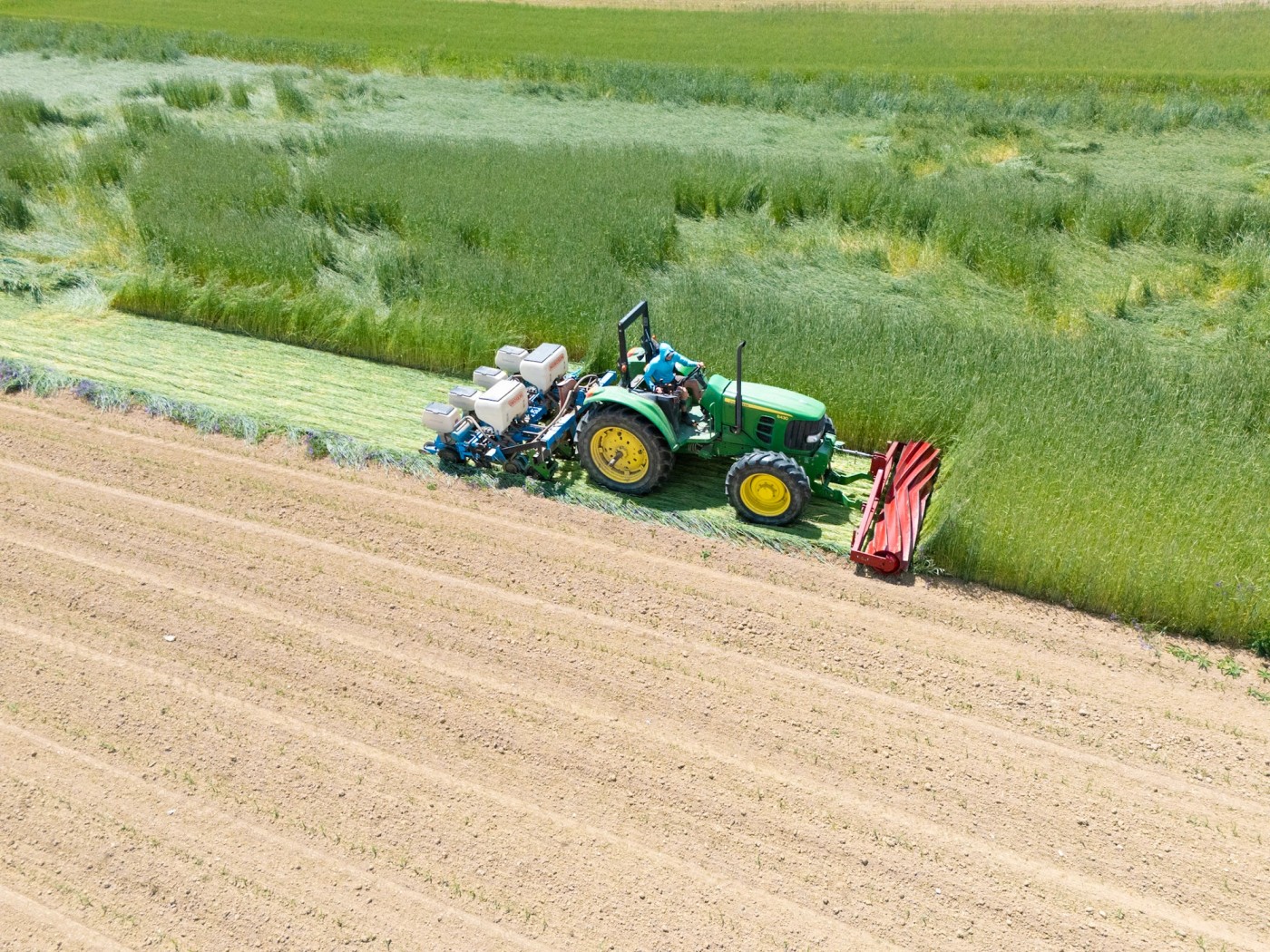
Effective roller-crimpers follow Jeff Moyer's Rodale-developed standard: ~200 lb per linear foot of roller width, hollow water-fillable steel drum, chevron (V-pattern) blade spaced 6β7 inches, operating at 4β8 mph (8 mph with 75Β° angled gangs in the Nebraska CropWatch design). A Penn State front-mounted Mirsky unit weighs 1,520 kg total (~320 lb/ft on a 10.5-ft roller).
Commercial options include I&J Manufacturing (the Rick Clark supplier, ~$15β20K for a 15-ft unit) and Dawn Equipment's ZRX floating row-unit crimpers that improve performance on uneven ground. Lighter rollers (under 150 lb/ft), sharpened rather than blunt blades, or operation under 4 mph all reduce kill effectiveness and produce mowing rather than crimping. A 10-ft crimper with ~800 lb water/oil load delivers approximately 75 PSI of stem pressure β the operating threshold for stem hydraulic disruption at anthesis.
Rick Clark's 7,000-acre system: replicable in some conditions, not all
Rick Clark farms ~7,000 acres in Williamsport, IN, with roughly 750β1,200 acres certified organic and the rest in transition or non-GMO production. His system: 4 passes β air-seed cover in fall, plant cash crop in spring, roller-crimp 3β5 days post-planting (sometimes up to 30), harvest. He runs 5β12 species cocktails (his "Gunslinger" blend includes oats, sorghum-sudangrass, tillage radish, Austrian winter peas, balansa clover; his rye-based mixes are deployed for crimping ahead of soybeans).
Rick Clark β input cost reductions vs. baseline
Documented in Lancaster Farming, No-Till Farmer, and The Furrow. Synthetic N: 220β0 lb/ac (100%). Chemical cost: $18β$5/ac (72%). Targets 10,000 lb/ac biomass, achieves ~140 bu corn / 40 bu soy.
What is hard to replicate
The organic premium and direct-to-Dannon dairy supply chain that finance the yield discount; the scale that justifies $200K+ in equipment; and the on-farm experience curve. His nutrient-cycling claims (e.g., 82 lb N/ac at 12-inch rye height) are self-measured field tests, not peer-reviewed protocols, and should be treated as illustrative. Importantly, his Indiana acres are humid, not semi-arid, so the system has no direct analog for Plains acreage.
Winterkill species: a reliable backbone, with a real N-supply trade-off
Winterkill species exploit the simplest possible termination mechanism β a hard freeze. The reliability matrix below summarizes the evidence base from MCCC, SARE Managing Cover Crops Profitably (3rd ed.), and USDA-ARS Mandan's Cover Crop Chart v.4.0:
Winterkill species reliability by USDA hardiness zone
| Species | Kill temp (Β°F) | Zone 4 | Zone 5 | Zone 6 | Zone 7 | Cost ($/ac) |
|---|---|---|---|---|---|---|
| Spring oats | 17β20 (seedling); 6 single dip | Reliable | Reliable | Reliable | Mostly | $15β36 |
| Tillage/forage radish | 20β25 | Reliable | Reliable | Reliable | Mostly (10% survival risk) | $11β16 |
| Cowpea | 28β32 | Reliable | Reliable | Reliable | Reliable | $38β50 |
| Sunn hemp | 28 | Reliable | Reliable | Reliable | Reliable | $50β90 |
| Spring field pea (4010) | 10β20 | Reliable | Reliable | Mostly | Marginal | $30β60 |
| Phacelia | 18β20 | Reliable | Reliable | Reliable | Mostly | $7β25 |
| Buckwheat | 32 (frost) | Reliable | Reliable | Reliable | Reliable | $15β20 |
| Crimson clover | 5β10 | Reliable | Mostly | Marginal | Overwinters | $24β30 |
| Sorghum-sudangrass | 32 | Reliable | Reliable | Reliable | Reliable | $27β32 |
| Pearl millet | 32 | Reliable | Reliable | Reliable | Reliable | $7β10 |
MCCC + SARE + USDA-ARS Mandan Cover Crop Chart v.4.0. Costs reflect 2024β2025 typical seed pricing.
The N-supply gap is the central trade-off
Hairy vetch fixes roughly 2 lb N/ac/day from April 10 to May 5 and supplies up to 180β200 lb N/ac to subsequent corn at full bloom (Wallace, Penn State; Lichtenberg 1994). A winterkilled crimson clover delivers maybe 50β80 lb N/ac because the bulk of legume N fixation occurs during spring vegetative-to-flowering growth β which a winterkilled stand never reaches. Cowpea is the workhorse winterkill N-fixer at 75β130 lb N/ac realistically in 60β90 days, and sunn hemp delivers slightly more (120β165 lb N/ac) at 2β3Γ the seed cost.
Nitrogen supply to following corn by termination strategy
Midpoints from Wallace/Penn State, Lichtenberg 1994, and SARE. Winterkilled legumes deliver only ~30β50% of what a chemically-terminated full-bloom vetch supplies. Cereal rye can immobilize 15β25 lb N/ac early-season.
PFI's Sloan trial documented this gap directly: a winterkill crimson + berseem blend produced $80/ac lower ROI than an overwintering red+alsike clover blend in the same Iowa fields, primarily through reduced corn N supply.
Plains-specific winterkill formula
For the Great Plains acres specifically, the recommended winterkill mix is the MCCC Nebraska post-wheat formula: oats 16β24 lb + sorghum-sudangrass 4 lb + pearl millet 2 lb + grain sorghum 1 lb + rapeseed 1 lb + buckwheat 4 lb, totaling $25β35/ac. Phacelia (drought-tolerant to <10 inches precipitation per USDA NRCS PMC Bridger) and cowpea (8-foot taproot, sandy-soil tolerant) are particularly well-suited semi-arid additions.
Mild-winter risk is real and underappreciated
Tillage radish reportedly survived mild winters across much of the Midwest in 2011β12 and 2015β16 (No-Till Farmer). PFI's 2025 cooperator reports document multiple 'winterkill' species (winter barley, winter wheat) failing to die when expected, and other species producing far less biomass than rye. Any winterkill plan needs a budgeted backup termination option.
The Akron CO 10-species mix work (Nielsen et al. 2014β2015) confirmed the inverse relationship that matters here: every 1,000 kg/ha of cover crop biomass reduces stored soil water by 10 mm and subsequent wheat yield in proportion β meaning a low-biomass winterkill mix may actually be the optimal choice in the Plains because it captures the soil-health upside of covers while minimizing the moisture debt.
Hybrid mixes: the sweet spot is functional diversity, not species count
Three combination strategies merit consideration, with the data ranking them clearly.
Cereal rye + hairy vetch (or triticale + vetch) for roller-crimping
This is the most-studied combination. Poffenbarger et al. 2015 (Agronomy Journal 107:2069-2082) at Beltsville established the operating parameters: 24 lb vetch + 30 lb cereal rye drilled is the optimum seeding rate for maximum N with maintained mulch persistence; aboveground N rises from 64 to 181 kg/ha as vetch biomass share rises from 0% to 100%; biological N fixation is 86% of vetch N in mixture (vs. 63% in monoculture) because rye scavenges soil N and forces vetch to fix more.
Aboveground N at termination β Beltsville rye/vetch ratio trial
Poffenbarger et al. 2015. Vetch must be β₯50% biomass for corn β pure-rye mulch causes N immobilization during early corn N demand (Wallace 2017; Finney 2016).
Thapa et al. 2018 meta-analysis (21 studies, 55 site-years) found vetch-rye mixtures outyielded vetch monocultures by 63% in biomass while equaling or exceeding rye monocultures. The standard recommendation is to substitute triticale for cereal rye when terminating with a roller-crimper ahead of vetch full bloom β triticale matures 5β7 days later than 'Elbon' rye and aligns with the vetch kill window, while rye reaches anthesis before vetch is ready and risks two passes or a partial vetch kill.
Winterkill species + cereal rye blend
The concept β winterkill components do fall biomass and N capture, rye carries spring biomass for crimping β is partially validated. Hirsh & Weil 2021 across 19 Mid-Atlantic farms found radish monocultures averaged 3,085 kg/ha fall biomass while a radish + winter cereal + crimson clover mix produced ~14% less, indicating fall-aggressive species can crowd out the slower-establishing rye. Penn State's "farm-tuned" Cover Crop Cocktails research (Baraibar et al. 2018, 2020) confirmed that at high soil N, canola and triticale dominate; at low N, peas and clovers express.
Practical synthesis
This combination works when rye seeding rate is reduced ~25β35% from monoculture (50β60 lb/ac) and aggressive species like radish are kept low (3β5 lb/ac). The combination is unlikely to produce more spring biomass than rye monoculture, but it broadens fall services meaningfully.
Multi-species cocktails of 5β12 species
The peer-reviewed evidence is skeptical of going beyond ~4 functional groups. Finney, White & Kaye 2016 found a weak relationship between species count and biomass (RΒ²=0.15), with mixtures designed for phenological complementarity not exceeding the highest-yielding monocultures. Smith, Atwood & Warren 2014 in PLOS ONE found 5-species spring mixes overyielded but produced no enhancement in weed suppression, biomass stability, or oat yield vs. the best monoculture.
Florence et al. 2019 tested 1, 3, 6, and 18-species mixes and found biomass and weed suppression generally not improved past 3β4 species. Finney & Kaye 2017 reframed this with a functional-trait lens: functional diversity (one grass + one legume + one brassica), not raw species count, drives multifunctionality. Rick Clark's 7β12 species cocktails can be defended on insurance grounds β different species express in different years β but the published data don't show a productivity step-change beyond a well-designed 3β4 species mix.
Marginal benefit of additional species in cover crop mixes
Synthesis of Finney 2016, Smith 2014, Florence 2019. Diminishing returns past 3β4 functional groups. Functional diversity, not species count, drives multifunctionality.
Failure modes are real and need to be budgeted
Honesty about failure rates is essential. Combining peer-reviewed data with practitioner experience, a defensible composite estimate for humid Eastern US adoption without herbicide backup:
Outcome distribution: stand-alone mechanical termination, humid East
Composite from Kumar et al. 2023, Mirsky 2023, and practitioner data. Maps directly onto Steve Groff's "1-in-5 disaster, 3-in-5 mediocre, 1-in-5 perfect" summary of 25 years of practice.
Weed pressure consequences are documented
Hamberg et al. 2025 found waterhemp seed production exceeded 5,000 seeds/mΒ² even with cereal rye + integrated herbicide programs. Kumar et al. 2023 quotes ~12% yield reduction in corn and soybean from incomplete rye termination. MU Extension reports cereal rye reduced waterhemp emergence for 4β6 weeks in 2018 and 2020 but provided no detectable suppression in 2019 under high seedbank pressure. Cover crop residue is only effective against small-seeded annuals (lambsquarters, pigweed) β large-seeded weeds (giant ragweed, foxtails) push through, and perennials (Canada thistle) are essentially unaffected (Mohler & Teasdale 1993).
Some species cannot be crimped at all. Annual ryegrass lacks rigid stem structure and cannot be reliably terminated mechanically. Sorghum-sudangrass and oats often regrow. Perennials (red clover, alfalfa) survive via crown.
Wet-spring lockouts. OSU notes that "in one out of four years, excessive rainfall in April and May forces farmers in Ohio to plant or replant up to half of their corn acreage as late as early to mid-June." A 7β14 day rye anthesis window inside that volatility is structurally fragile.
Comparison: viable options for the operation
Glyphosate-reduction strategies β region, crop, reliability, cost
| Option | Best region | Crops | Reliability | Cost ($/ac) | Key limitation |
|---|---|---|---|---|---|
| Rye monoculture, roll-crimped at anthesis | Humid Midwest/NE | Soybean | Medium-High | $30β50 total | Requires 7,000+ lb/ac biomass; needs herbicide backup most years |
| Triticale + hairy vetch, roll-crimped at vetch full bloom | Humid Midwest/NE | Organic corn (vetch β₯50%), soybean | Medium | $50β65 seed | Two passes often needed; corn N synchrony issues |
| Cereal rye + hairy vetch, planted green + chemical termination | Humid Midwest/NE | Corn (with N credit), soybean | High | $40β55 + reduced herb. | Doesn't fully eliminate glyphosate but reduces rate |
| Oats + tillage radish winterkill mix | Zones 4β6 humid | Corn and soybean | High | $20β30 | No spring weed suppression; less N supply than vetch |
| Oats + radish + cowpea + crimson clover | Zones 4β6 humid | Corn (better N), soybean | Medium-High | $40β55 | Cowpea/crimson need 45β60 frost-free fall days |
| Winterkill mix + reduced-rate cereal rye | Zones 4β6 humid | Corn and soybean | Medium-High | $30β45 | Fall-aggressive species can suppress rye establishment |
| MCCC Nebraska winterkill mix | Semi-arid Plains | Corn, soybean, wheat | High | $25β35 | Modest biomass (2,000β4,000 lb/ac); skip in dry years |
| Phacelia + cowpea + radish | Semi-arid Plains | Corn, soybean | Medium-High | $30β45 | Cowpea seed cost; phacelia establishment uneven |
| Roller-crimping in semi-arid systems | None viable on dryland | β | Low (unviable) | N/A | Insufficient biomass; water debt eliminates economic return |
Reliability is qualitative across years, accounting for biomass, kill window, and weather risk. Cost ranges include seed plus typical termination/crimping pass.
What this means for the operation
The most defensible glyphosate-reduction strategy is regionally segmented and crop-segmented, not a single approach across the operation.
On humid acres going to soybean, roller-crimping cereal rye at anthesis is well-supported β Penn State, Beltsville, Rodale, and PFI data converge on yield neutrality to small yield gains, with weed suppression dependent on hitting 7,000+ lb/ac biomass. Plan for herbicide backup in roughly one year in three; budget $15β25/ac for the crimping pass; accept that rye anthesis in late May means soybean planting in late May to early June rather than mid-May.
On humid acres going to corn, roller-crimping is hard to recommend without an organic premium that pays for the 10β30% expected yield drag. The realistic path is either (a) a triticale-vetch mix terminated chemically with a reduced glyphosate rate to deliver vetch's 150β180 lb N/ac, or (b) accepting Rick Clark-style yields and economics with full system commitment over 5β10 years.
On semi-arid acres, abandon roller-crimping entirely. The MCCC Nebraska post-wheat winterkill mix at $25β35/ac, deployed in years with adequate stored soil moisture and skipped in dry years ("flex" cover-cropping), is the highest-ROI glyphosate-reduction practice the data support. Pearl millet, cowpeas, phacelia, and tillage radish are the species best-suited to <20" precipitation. Expect modest biomass (under 4,000 lb/ac), no spring weed suppression, and accept that this is a soil-building investment over 5β10 years with possibly negative short-term cash-crop yield effects.
The fundamental insight
Mechanical termination is best understood as a residue-management and biomass-preservation tool, not as a stand-alone replacement for glyphosate. Treating it that way β and budgeting for the 20β40% of years when a herbicide rescue or mid-season cultivation is needed β produces a much more honest decision frame than the popular narrative around organic no-till. The combined strategy of (1) roller-crimping rye into soybeans, (2) winterkill mixes on the semi-arid acres, and (3) reduced-rate herbicide termination of vetch-rye ahead of corn likely cuts total glyphosate use by 50β70% across the operation while keeping yields within 5β10% of the conventional baseline.
Key references
Peer-reviewed sources
- Kumar, V. et al. (2023). Mechanical termination of cover crops: efficacy and limitations across multi-state trials. PLOS ONE.
- Mirsky, S. B. et al. (2009). Control of cereal rye with a roller/crimper as influenced by cover crop phenology. Agronomy Journal 101:1589β1596.
- Mirsky, S. B. et al. (2024). U.S. cereal rye cover crop biomass database. Scientific Data 11:200.
- Reed, H. K. et al. (2019). Planting green in soybean and corn: cover crop and yield response across 14 site-years. Agronomy Journal 111:2314β2325.
- Mischler, R. A. et al. (2010). Cover crop and weed management in a no-till organic cornβsoybean rotation. Weed Technology 24:253β261.
- Poffenbarger, H. J. et al. (2015). Biomass and nitrogen content of hairy vetchβcereal rye mixtures. Agronomy Journal 107:2069β2082.
- Finney, D. M., White, C. M. & Kaye, J. P. (2016). Biomass production and carbon/nitrogen ratio influence ecosystem services from cover crop mixtures. Agronomy Journal 108:39β52.
- Bunchek, J. et al. (2020). Cover crop residue and weed management in no-till corn. Weed Science 68:534β544.
- Nielsen, D. C. et al. (2016). Cover crop biomass production and water use in the central Great Plains. Agronomy Journal 108:243β256.
- Thapa, R. et al. (2018). Cover crop biomass and nitrogen accumulation in mixed-species and monoculture stands: a meta-analysis.
- Wallace, J. M. et al. (2017, 2018). Cover crop residue and integrated weed management in organic no-till corn. Penn State / Mid-Atlantic trials.
- Hamberg, R. et al. (2025). Cereal rye and integrated herbicide programs for waterhemp suppression.
Extension and grower data
- Practical Farmers of Iowa cooperator trials (Vittetoe, Lyle, Sloan, Bakehouse). practicalfarmers.org
- USDA-ARS Mandan. Cover Crop Chart v.4.0.
- Midwest Cover Crops Council selector and Nebraska post-wheat formula. midwestcovercrops.org
- SARE. Managing Cover Crops Profitably (3rd ed.).
- Rodale Institute Farming Systems Trial. 30-year report.
- Robinson, C. & Nielsen, D. C. (2015). The water conundrum: cover crop water use and mulch evaporation savings in the semi-arid Plains.
Practitionerβs summary
Limitations
The main limitation is that roller-crimping is highly context-dependent and should not be generalized across crops, regions, or years. Its strongest evidence base is for cereal rye ahead of soybean in humid regions, but performance declines when biomass is below the threshold needed for weed suppression or when rye is terminated before anthesis. Ahead of corn, the system is constrained by a mismatch between rye maturity and the optimal corn planting window, creating risks of delayed planting, cooler soils, nitrogen immobilization, and yield loss.
Have a question about cover crop termination on your acres?
Scholarly record
References & Citation
Source material for every claim in this article, plus a citation-ready record for reference managers and scholarly indexes.
Cite this articleShow formats
Cite this article
Citation-ready record
APA
Exchange, S. H. (2026). Beyond Glyphosate: What Actually Works for Terminating Cover Crops. Soil Health Exchange. https://soilhealthexchange.com/blog/beyond-glyphosate-what-actually-works-for-terminating-cover-crops
More citation formats
MLA
Exchange, Soil Health. "Beyond Glyphosate: What Actually Works for Terminating Cover Crops." Soil Health Exchange, 2026-04-30, https://soilhealthexchange.com/blog/beyond-glyphosate-what-actually-works-for-terminating-cover-crops.
Chicago
Exchange, Soil Health. "Beyond Glyphosate: What Actually Works for Terminating Cover Crops." Soil Health Exchange. Published 2026-04-30. https://soilhealthexchange.com/blog/beyond-glyphosate-what-actually-works-for-terminating-cover-crops.
Citation metadata is provided for discovery tools and reference managers. Inclusion in external scholarly indexes is not guaranteed.
Continue reading
All articles βCite this
Reference this work
Soil Health Exchange (2026). Beyond Glyphosate: What Actually Works for Terminating Cover Crops. Soil Health Exchange. SHE-ART-2026-0003. https://soilhealthexchange.com/cite/SHE-ART-2026-0003
Soil Health Exchange assigns a stable identifier to every published answer and article. Citations keep working even if the URL changes later.
Listen on the topic
PLFA Analysis: What Soil Biology Testing Can and Cannot Tell You
22 min

Discussion
No comments yet. Be the first to share your thoughts!