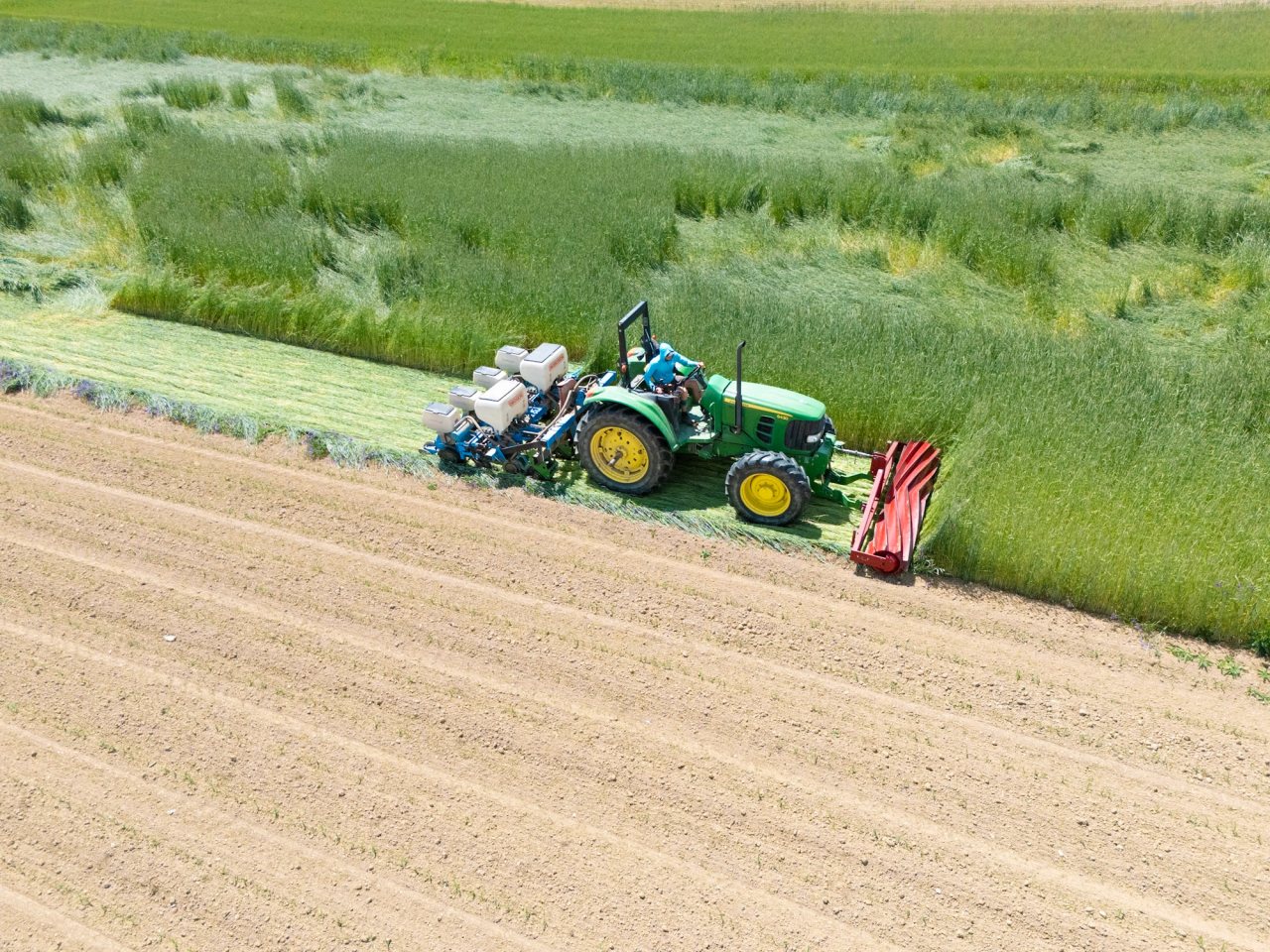
Cover-crop termination is not a contest between one tool and another. It is a timing decision. The method has to stop the cover, leave a seedbed the planter can handle, protect the next crop's water and nitrogen, and fit the farm's labor and weather window. A method that works well on mature cereal rye before soybeans may be a poor fit for vegetative rye ahead of corn.
Begin with the planting window
First decide how long the cover can keep growing without putting the cash crop at unacceptable risk. Waiting can add biomass, roots, nitrogen capture, and mulch. It can also use soil water, delay planting, increase residue-handling difficulty, and move a grass cover closer to viable seed. The right balance changes with rainfall, soil water storage, cover-crop goals, and the cash crop [1][3][7].
Soybeans usually provide more flexibility for a late-terminated cereal rye than corn. Corn is more sensitive to early-season nitrogen competition, cool residue-covered soil, planter performance, and delayed establishment. Penn State therefore describes planting green and roller-crimping as a stronger fit for soybean, while corn requires closer attention to nitrogen, residue placement, and crop establishment [1][2][4].
Choose the method by the job it must do
| Method | Best fit | Main limitation | Backup question |
|---|---|---|---|
| Winterkill | Species reliably killed by local winter conditions | Survival changes with species, variety, snow cover, planting date, and winter | What will you do with surviving patches? |
| Roller-crimper | Mature annual covers that form a continuous mulch | Early rolling often bends the cover without killing it | Can you wait for the required growth stage? |
| Mowing | Covers at a non-regrowing stage where residue chopping is acceptable | Regrowth and rapidly decomposing residue; multiple passes may be needed | What will control regrowth? |
| Tillage | Systems that can accept disturbance and need rapid incorporation | Erosion, moisture loss, clods, compaction, and more than one pass | Is the soil fit to till? |
| Labeled herbicide | No-till systems or covers that cannot be reliably killed mechanically in the available window |
Growth stage decides whether a roller-crimper can finish the job
A roller-crimper works by damaging stems at several points while laying the cover in one direction. The plant must be far enough into reproductive growth that it cannot readily stand back up and regrow. In Penn State research, cereal rye control became consistent at Zadoks 61, the beginning of anthesis when anthers are visible and shedding pollen [5][8]. Rolling rye earlier may help manage residue, but it should not be treated as reliable stand-alone termination [1].
Hairy vetch matures differently. Research found more consistent roller-crimper control near early pod set than during early flowering [5][9]. Mixtures are harder because the species do not reach a susceptible stage together. If rye is ready but vetch is not, the least mature species may survive. Perennial legumes, biennials, canola, and annual ryegrass are among the covers that Penn State cautions may not be controlled reliably by a roller-crimper alone [5].
A field-stage check before rolling
| Cover | Stage associated with better roller control | What to see in the field | Risk if rolled earlier |
|---|---|---|---|
| Cereal rye | Anthesis or later | Anthers visible and shedding pollen along the head | Plants may stand up, regrow, and compete |
| Hairy vetch | Early pod set | One or more young pods visible on upper nodes | Vines may regrow and produce seed |
| Cereal–legume mixture | The later-maturing component controls the timing | Both components have reached a susceptible stage | One species may survive even when the other is controlled |
| Species without local roller data | Not established | Treat a small strip as a test, not a field-wide assumption | Incomplete termination and a lost planting window |
Measure the mulch before asking it to replace another tactic
Weed suppression generally improves as cereal rye biomass and soil coverage increase, but there is no universal biomass threshold. A 2023 review of 43 site-years found that moderate biomass sometimes provided good suppression and sometimes did not; suppression was less variable at higher biomass, but weed species, residue distribution, environment, and the rest of the program still mattered [10]. That is more useful than treating one biomass number as a guarantee.
Walk the field before termination. Look for thin headlands, wet spots, winter injury, wheel tracks, volunteer crops, perennial weeds, and emerged weeds already above the cover canopy. Estimate or sample dry biomass if mulch-based weed suppression is a primary goal. A field with large gaps needs a backup tactic even when the average biomass looks adequate.
- Separate cover-crop termination from weed control in the plan.
- Identify the weeds most likely to escape the mulch.
- Keep cultivation, a labeled postemergence option, hand removal, or another locally appropriate rescue tactic available.
- Do not let surviving cover plants or escaped weeds produce seed.
Protect water in moisture-limited fields
In dryland and drought-prone systems, the termination date may be set by stored soil water rather than by maximum biomass. Nebraska Extension describes the central tradeoff: keeping a cover alive longer can increase growth and residue, but it can also reduce water available to the following crop [7]. The field's soil-water profile, forecast, cover growth, and cash-crop sensitivity should carry more weight than a calendar borrowed from a humid region.
Earlier termination may produce less mulch and weaker weed suppression, yet still be the better whole-farm choice if it protects crop establishment. If a mechanical method requires waiting for reproductive maturity, but the field cannot spare the water or planting delay, choose a method that works in the earlier growth stage instead of forcing the roller-crimper window.
Match residue management to the planter
A successful kill can still become a planting failure. Tall rye changes down-pressure, residue cutting, gauge-wheel contact, seed depth, slot closure, and hair-pinning risk. Plant in the same direction as rolled residue, verify that row cleaners and closing wheels can move through the mulch, and stop after the first rounds to check seed placement [1][3][6].
Mowing creates shorter residue that decomposes faster and can mat differently. Tillage incorporates residue but needs suitable soil moisture and enough depth to cut or uproot the cover; Minnesota Extension notes that shallow vertical-tillage or coulter tools may move soil without reliably terminating the stand, and a second pass may be necessary [3]. Count those passes, fuel, labor, drying time, and erosion exposure in the method comparison.
Write a two-path termination plan
The field plan to complete before spring
| Decision | Primary plan | Trigger for the backup | Backup plan |
|---|---|---|---|
| Timing | Target growth stage and expected date range | Cash-crop deadline, soil water, forecast, or seed-set risk | Earlier method that is effective at the observed stage |
| Cover control | Expected kill from the chosen method | Visible regrowth five to ten days later | Second pass or another locally supported method |
| Weed control | Expected mulch and crop competition | Thin stand, large emerged weeds, or perennial weeds | Cultivation, labeled herbicide, mowing, or targeted removal |
| Planting | Planter setup and residue direction | Poor seed depth, hair-pinning, open slot, or wrapping | Stop, adjust, or move to a field with a simpler residue condition |
| Soil protection | Method fits moisture, slope, and residue goals | Soil is too wet to traffic or till, or too dry to spare more water |
The decision to carry into the field
A useful termination plan names the cover, the growth stage, the cash-crop deadline, the soil-water condition, the primary method, and the rescue method. It also separates three questions: Did the cover die? Did the mulch suppress the weeds that matter? Did the cash crop establish well? When those questions are recorded separately, the next year's plan becomes much easier to improve.