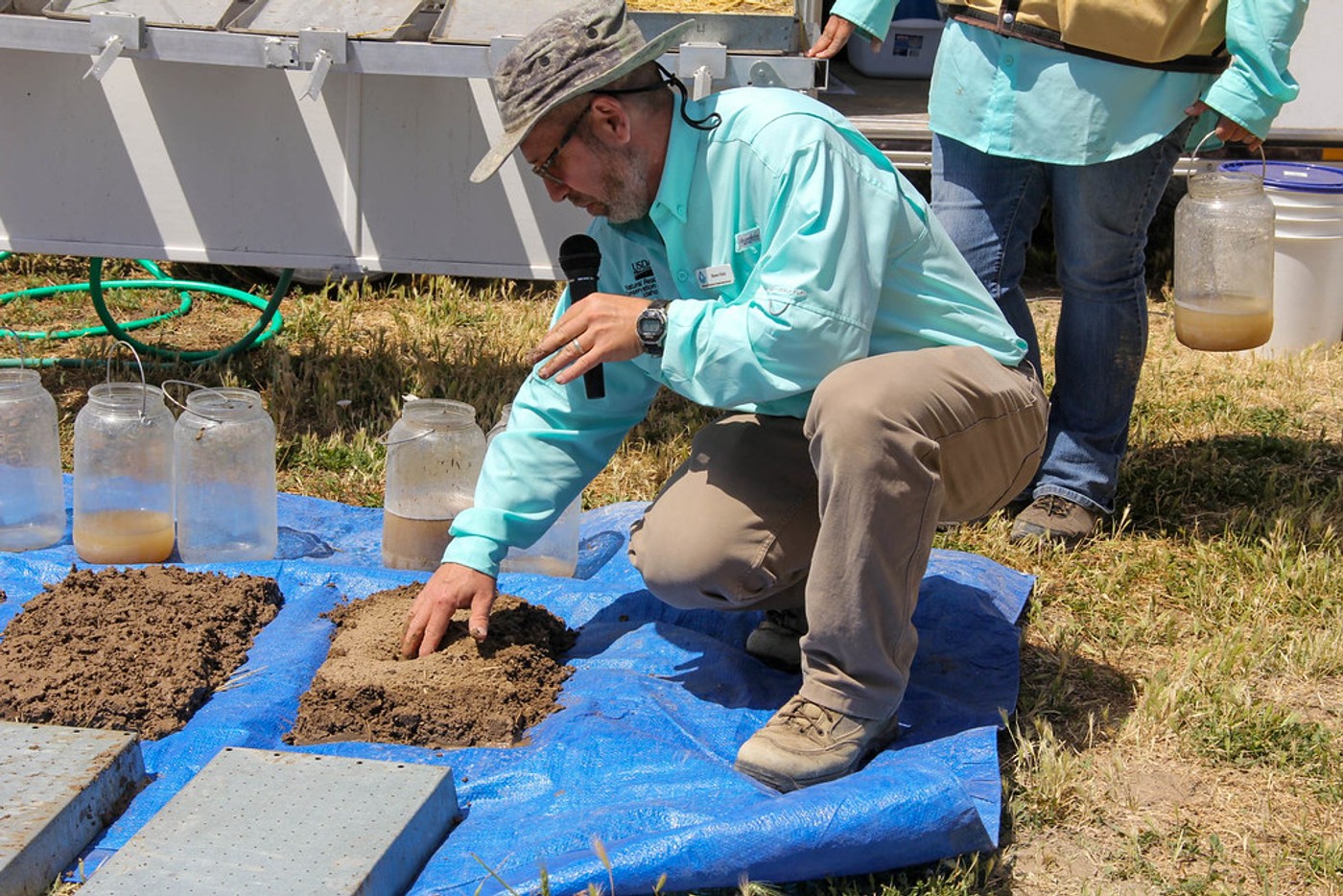
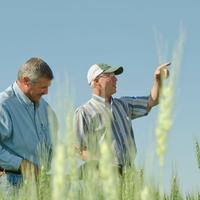
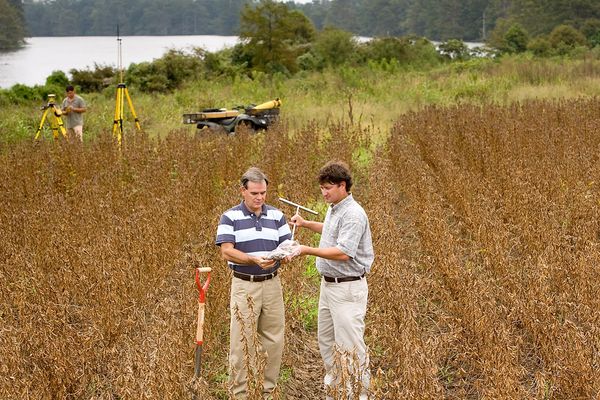
A practical toolkit helps farmers, Qualified Individuals, laboratories, and field-office staff carry the same record through the CEMA 216 workflow. — Credit: NRCS photo by Carly Whitmore; public domain
Explore the completed CEMA 216 example to see how field records, mapped samples, laboratory results, interpretation, and handoff fit together. For a real project, use the automated workspace to carry your sampling plan into field documents, record results and photos, check missing information, and assemble participant and NRCS report copies. The QI supplies and reviews the evidence, interpretation, and certification. Use the current NRCS standard, state instructions, contract, and laboratory protocol throughout.
Review the fictional workbook and report first. Then bring your own field plan, laboratory results, observations, and interpretation into the project workspace.
The public example contains fictional records, maps, results, photo placeholders, and unsigned review spaces. It demonstrates a completed package. Your project workspace assembles documents from your own entries and sampling plan; the QI supplies the original evidence, interprets results, and reviews the finished work before signing.
Version note. The guide and resource list were checked against the CEMA 216 standard listed by NRCS as 04-2026, the Job Aid 4-2026, and the April 10, 2026 FAQ. Verify future revisions before starting a new activity or final-year repeat [1][2][3].
What your project package brings together
From field records to the final report
Project record
Purpose
Cover and instructions
Identify the operation, QI, contract or instance, and workbook date
Pre-work conference record
Record participants, objective, PLU, scope, responsibilities, costs, and data-sharing choices
Laboratory and method verification
Confirm every required method, qualification route, handling protocol, price, and turnaround
Sampling plan worksheet
Document the design, three main points, WGS84 coordinates, four-subsample orientation, and controls
Field collection log
Track the five collections in each of three separate composites
Handling and chain of custody
Record bags, temperatures, transfers, shipment, APHIS check, tracking, and laboratory receipt
Baseline repeatability record
Preserve locations, timing, depth, methods, context, and the return-visit instruction
QI deliverable checklist
Audit the cover, notes, maps, results, interpretations, monitoring schedule, and delivery
Handoff and review record
Track traceability, corrections, resolution, and the participant's privacy choice
Official resource desk and file index
Open source documents and retain one complete, read-only baseline archive
The example shows how these records connect. The workspace organizes your entries and generated documents; original maps, laboratory reports, and other supporting evidence must accompany the delivery set.
NRCS abbreviation decoder
Federal conservation documents compress long program, professional, mapping, and laboratory terms into abbreviations. Use these tables when reading a contract, activity document, job aid, laboratory quote, sampling map, or final report. The definitions reflect the current CEMA 216 standard and related NRCS program materials; they explain the terms but do not replace the controlling documents [1][3][5][8].
CEMA 216 is an activity number, not a soil-health score
CEMA means Conservation Evaluation and Monitoring Activity. Number 216 identifies NRCS Soil Health Testing. The work produces evaluation, monitoring, test, or assessment results; it is different from a conservation plan, an implementation design, or an indicator rating.
Programs, activities, people, and places
Abbreviation
Meaning
Why it matters here
USDA
U.S. Department of Agriculture
The federal department that includes NRCS and APHIS
NRCS
Natural Resources Conservation Service
The USDA agency administering the conservation activity and reviewing the completed package
CEMA
Conservation Evaluation and Monitoring Activity
Produces evaluation, monitoring, test, or assessment results; CEMA 216 is Soil Health Testing
CPA
Conservation Planning Activity
Produces a conservation plan and generally aligns with steps 1–7 of the NRCS planning process
DIA
Design and Implementation Activity
Produces designs, prescriptions, or implementation instructions and generally aligns with planning step 8
QI
Qualified Individual
The person responsible for completing and documenting CEMA 216 who self-certifies that the activity's qualification criteria are met
TSP
Technical Service Provider
An NRCS-certified provider for specified technical services; a TSP may also qualify as a CEMA 216 QI
CCA / CPAg / CPSS / APSS
Certified Crop Adviser / Certified Professional Agronomist / Certified Professional Soil Scientist / Associate Professional Soil Scientist
Professional credentials listed among the current CEMA 216 QI qualification pathways
PLU
Planning Land Unit
The mapped planning area within which the sampling strategy and representative locations are established
RPP
Regenerative Pilot Program
The USDA-NRCS pilot that uses CEMA 216 testing to establish and track soil-health outcomes
EQIP
Environmental Quality Incentives Program
A principal NRCS financial-assistance program through which conservation activities and practices may be contracted
CSP
Conservation Stewardship Program
An NRCS program supporting conservation improvements and stewardship on working lands
FOTG
Field Office Technical Guide
The state-specific NRCS technical reference for conservation practices and related activity documents
These are the terms most likely to appear in the contract, pre-work conference, QI qualifications, and NRCS review.
Sampling, mapping, and laboratory abbreviations
Terms that protect sample traceability and method compliance
Abbreviation
Meaning
Why it matters here
SSPOT
Soil Sample Planning Optimizer Tool
A tool named by CEMA 216 as one option for identifying sampling locations; another suitable geospatial tool may be used
GIS
Geographic Information System
Software and spatial data used to organize the PLU polygon, soils, landscape features, and sampling points
GPS
Global Positioning System
The positioning technology commonly used to record and relocate sampling points
WGS84
World Geodetic System 1984
The geographic reference required for reporting sampling-point latitude and longitude in the CEMA 216 map
APHIS
Animal and Plant Health Inspection Service
The USDA agency whose restrictions must be checked before regulated or quarantined soil is moved
NAPT
North American Proficiency Testing Program
One program associated with a laboratory-qualification route listed in CEMA 216
PAP
Performance Assessment Program
The NAPT performance program named in one CEMA 216 laboratory-qualification route
ANAB
ANSI National Accreditation Board
An accreditation body named in another CEMA 216 laboratory-qualification route
Soil-health test and interpretation abbreviations
Terms commonly printed on the laboratory report
Abbreviation
Meaning
How to read the term
SOC
Soil Organic Carbon
The carbon-cycling indicator; confirm whether it was measured by dry combustion or calculated from loss-on-ignition organic matter
POXC
Permanganate-Oxidizable Carbon
The preferred CEMA 216 labile-carbon method
WEOC
Water-Extractable Organic Carbon
The alternate CEMA 216 labile-carbon method
ACE protein
Autoclaved Citrate-Extractable protein content
The preferred CEMA 216 bioavailable-nitrogen indicator
WEON
Water-Extractable Organic Nitrogen
The alternate CEMA 216 bioavailable-nitrogen method
PLFA
Phospholipid Fatty Acid
The preferred advanced microbial-diversity method; it requires strict cooling, freezing, and rapid shipment
SHAPE
Soil Health Assessment Protocol and Evaluation
An NRCS interpretation framework that places indicator results in soil and production context; it is not a fertilizer prescription
Write the term out the first time
A strong final report introduces the full term followed by the abbreviation in parentheses—for example, Qualified Individual (QI). Farmers, future sampling teams, and reviewers should not have to decode unexplained initials to understand the record.
Build the project in five stages
Stage 1: create the working file before sampling
Start a project workspace and an evidence folder for each CEMA 216 instance. Place the current standard, job aid, FAQ, state and contract instructions, pre-work record, QI scope and quote, laboratory confirmation, maps, and source records in that folder. Use stable names containing the farm or tract, PLU or instance, sample date, and document type.
Do not begin with a generic laboratory package
The CEMA 216 Job Aid instructs users to call and verify that the laboratory offers the necessary preferred or alternate methods. Complete the method-verification page from written laboratory confirmation, not only a marketing name or website description [1][2][3].
Stage 2: complete the map before anyone removes soil
Use the sampling-plan page with the field map. Record why the design is random, stratified, problem-focused, or combined; show the PLU polygon; identify at least three main locations; and save WGS84 coordinates. At each main location, plan the center plus four surrounding collections about 20–50 feet away [1][2][3].
NRCS Web Soil Survey can help identify mapped soil and landscape variation, but Soil Survey texture cannot replace the laboratory texture required under CEMA 216. Treat the map as planning context and the laboratory result as the required measurement [1][3][6].
Stage 3: carry the log into the field and shipment
The field log makes the three-by-five structure visible: check the center and four surrounding collections for Composite 1, repeat for Composites 2 and 3, and keep the three bags separate. Record date, collector, coordinates, depth, tool, soil and weather conditions, recent operations, observations, and deviations.
Use the custody page to connect field IDs to laboratory IDs, temperature control, transfer, tracking, and receipt. Follow the receiving laboratory's instructions. For PLFA, CEMA 216 calls for close coordination, ice in the field, immediate freezing, and overnight shipment on ice as soon as possible. Check APHIS requirements before moving regulated soil [1][7].
Stage 4: assemble and audit the completed package
Attach the laboratory report, interpretations, model or tool outputs, and monitoring schedule. Use the QI deliverable page to confirm the cover statements and signatures, site-visit records, correspondence, maps, sample traceability, methods, depths, units, reporting bases, and two-set delivery requirement. Use the correction log to document any item returned for clarification [1][3].
Stage 5: preserve the baseline for the repeat visit
Lock one completed baseline archive after acceptance. Store a separate working copy for future notes. The return team should be able to recover the exact locations, design, season, field conditions, depth, collection tool, handling, laboratory, tests, methods, units, and reporting basis. If something must change, document the method break rather than presenting the results as directly comparable [1][4].
Official CEMA 216 resource desk
Start with primary sources
Resource
Use it for
NRCS FY2026 CPA, DIA, and CEMA resource page
Find the currently posted activity standard, job aid, FAQ, fact sheets, and related conservation activities
CEMA 216 Soil Health Testing 04-2026
Controlling national activity requirements and deliverables
CEMA 216 Job Aid 4-2026
Sampling summary and laboratory-method verification worksheet
CEMA 216 FAQ 04-10-2026
Current clarifications about scope, QIs, sampling, results, privacy, laboratories, and RPP
Regenerative Pilot Program
National pilot requirements, eligible primary practices, fact sheets, and training
How to Choose a Soil Health Testing Laboratory
Laboratory selection and questions
NRCS Web Soil Survey
Official soil maps and SSURGO context for sampling design
NRCS Field Office Technical Guide
State-specific conservation references and practice information
USDA APHIS domestic soil movement
Check interstate movement restrictions from quarantined areas
Ask the field office for the controlling state and contract documents
The national resources are the starting point. Payment schedules, implementation details, ranking, state review processes, and contract-specific requirements may differ. Record the documents supplied by the local field office and the date they were checked.
Where professional judgment is needed
Ask the NRCS field office when the contracted PLU, number of instances, scenario, payment item, or privacy handoff is unclear.
Ask the QI when the objective, sampling design, map, interpretation, or comparability judgment is unclear.
Ask the receiving laboratory when the exact method, sample quantity, container, cooling, freezing, shipment, reporting basis, or amended result is unclear.
Ask APHIS or the appropriate State plant-health contact when soil movement may cross a quarantine boundary.
Use regional fertility testing and recommendations for nutrient or lime rates; the CEMA 216 workflow does not convert soil-health indicators into fertilizer prescriptions.
Use the current official document when it conflicts with an older article, saved template, laboratory handout, or general soil-sampling example.
The most valuable file is the one a future farmer, adviser, QI, laboratory, or field-office reviewer can understand without relying on memory. Preserve the map, methods, sample identity, context, interpretations, authorizations, and monitoring instruction together.
CEMA 216 Part 6: Toolkit and Resources Knowledge Check
Each attempt draws 8 questions from a 14-question pool and shuffles the answer choices. Score 85% or higher to earn a Certificate of Completion.
1.What is the status of the Soil Health Exchange CEMA 216 workbook?
2.When should the pre-work conference page be completed?
3.What should be entered on the laboratory-method verification page?
4.How does the sampling-plan page represent the CEMA 216 minimum?
5.Why does the field log use a separate section for each composite?
6.Which handling sequence matches current CEMA 216 instructions for PLFA?
7.Why does the toolkit include an APHIS soil-movement check?
8.What is the best way to preserve the CEMA 216 baseline?
Soil Health Exchange Team (2026). The CEMA 216 Toolkit: Example Workbook and Automated Workflow. Soil Health Exchange. https://soilhealthexchange.com/blog/cema-216-farmer-toolkit-templates-resources
More citation formats
MLA
Soil Health Exchange Team. "The CEMA 216 Toolkit: Example Workbook and Automated Workflow." Soil Health Exchange, 2026-08-08, https://soilhealthexchange.com/blog/cema-216-farmer-toolkit-templates-resources.
Chicago
Soil Health Exchange Team. "The CEMA 216 Toolkit: Example Workbook and Automated Workflow." Soil Health Exchange. Published 2026-08-08. https://soilhealthexchange.com/blog/cema-216-farmer-toolkit-templates-resources.

Discussion
No comments yet. Be the first to share your thoughts!