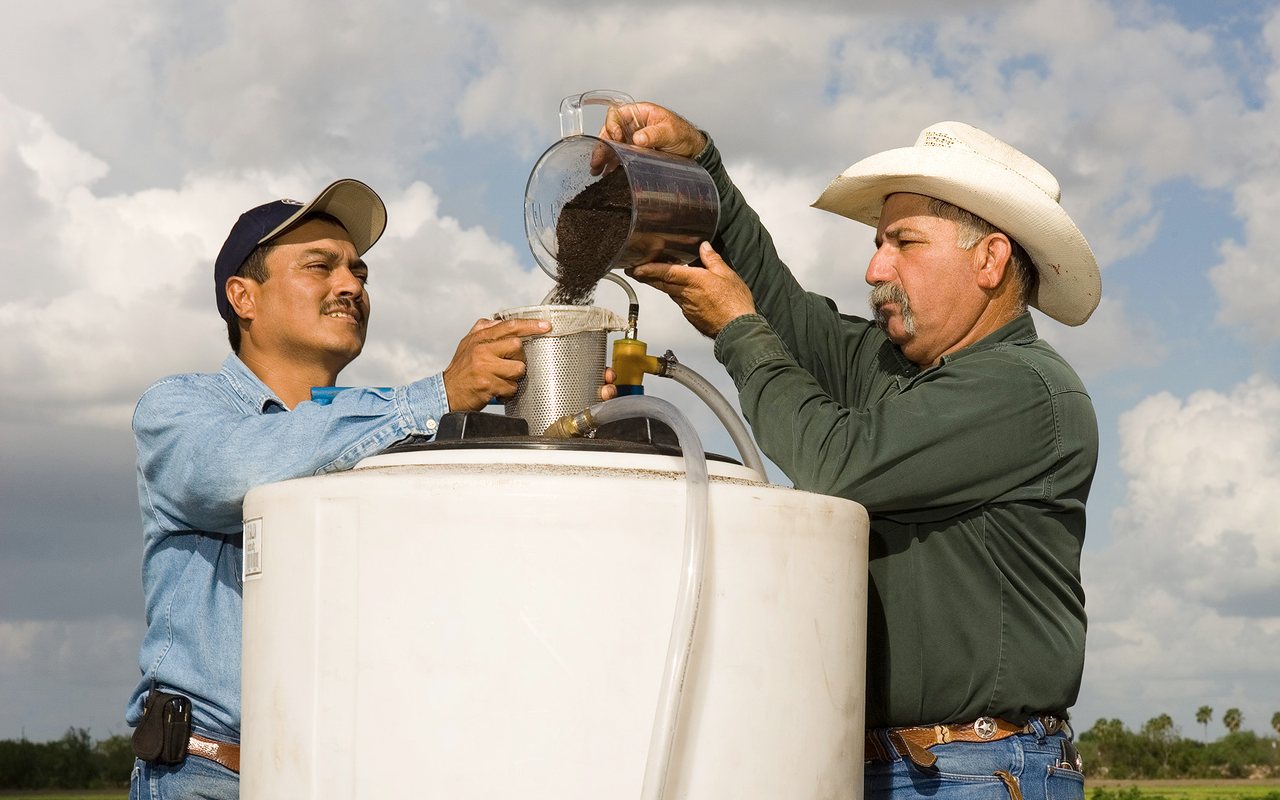
The appeal of compost tea is easy to understand. Put a small amount of compost into water, extract some of its organisms and soluble compounds, and carry that liquid to plants through a watering can or sprayer. For a grower interested in soil biology, it offers a practical way to experiment with a biological input.
The questions come quickly. Will it feed the crop? Help with disease? Establish useful organisms? Is an air pump necessary, and should molasses go into the tank? Those questions involve different processes, so a useful answer starts with the job you want the tea to do.
Research has found crop growth and disease suppression benefits from particular compost teas. Other experiments have found little response. The strongest reason to try one is a defined problem, evidence from a comparable crop and system, and a small comparison that lets the result earn its place on the farm.
What compost tea is
Compost tea begins with compost and water. Mixing and steeping move soluble substances and some organisms into the liquid. Depending on the method, the liquid is used soon after extraction or incubated to encourage microbial growth. Published studies and commercial suppliers use the words tea and extract differently, so ask for the preparation method whenever someone recommends a product. [1][2]
Know which liquid you are discussing
| Material | How it is made | What matters in practice |
|---|---|---|
| Compost extract | Compost is mixed or washed in water, commonly with a short extraction and little intentional incubation. | Identify the feedstock, extraction method, and time to application. |
| Actively aerated compost tea | Compost and water are incubated with forced air or recirculation; some recipes include microbial foods. | Air delivery, temperature, food additions, and oxygen demand shape the batch. |
| Non-aerated compost tea | Compost is steeped or incubated without continuous forced aeration. | Treat this as a distinct preparation with its own evidence and handling requirements. |
| Compost or worm-bin leachate | Liquid drains through decomposing material and collects beneath it. | Its composition and contamination history differ from a deliberately prepared extract. |
| Manure or plant tea | Uncomposted manure or fresh plant material is soaked in water. | The feedstock and risks differ from finished compost. Identify it explicitly. |
Vermicompost tea starts with worm-processed material, usually called castings or vermicompost. The liquid collected from the bottom of a worm bin is leachate. A bin containing fresh scraps is still processing those materials; drainage from it should not be treated as a ready-made spray for edible crops. [1][9]
What the liquid can contribute
Three components help explain the interest in compost tea. First are living organisms, including bacteria and fungi. Certain organisms can compete with plant pathogens, produce inhibitory substances, or interact with roots. Their usefulness depends on which organisms are present and what happens after application. Second are dissolved nutrients, which contribute directly to plant nutrition. Third are organic compounds that can influence plant growth or microbial activity. A growth response can involve more than one of these components. [2][3][5]
Brewing also changes the community. Organisms that grow rapidly in warm, aerated liquid with readily available food gain an advantage over organisms adapted to other conditions. The resulting community is selected by the brewing environment. It carries part of the biology of the starting compost. [3][4]
After application, those organisms encounter a different environment: sunlight and drying on a leaf, or competition and existing food supplies around roots. A useful biological claim therefore needs a chain of evidence: the relevant organism reaches its target, remains active, and produces the intended crop response. A tank count describes the starting material. Following the crop response tests the whole chain. [4][5]
What experiments have found
The most useful way to read compost tea research is to keep the crop, preparation, comparison, and measured outcome together. These examples illustrate both the opportunities and the conditions that determine whether a result transfers to another farm.
Four experiments and the decisions they inform
| Study and setting | What the researchers found | Practical meaning |
|---|---|---|
| Vegetables in a protected tunnel on volcanic soil in Italy; Bonanomi and colleagues, 2025 [3] | Weekly tea applications increased lettuce leaf production by 21%, onion bulb biomass by 58%, and chard leaf production by 110% at the stronger treatment compared with water controls. All plots received mineral fertilizer. | The reported weekly volume was 1.6 L/m², about 1,700 US gal/acre. Compare that volume and the protected growing conditions with your intended program. |
| Soybean in a disturbed field in Quebec; Bali and colleagues, 2021 [4] | Across six blocks, four applications of living tea showed no significant advantage over heat-treated tea in bacterial community measures, shoot dry mass, or sampled grain weight. There was no untreated comparison. | This tests the added contribution of living tea relative to a heated preparation in that field. It does not measure the whole tea program against applying nothing. |
| Cucumber seedlings in soilless containers; Scheuerell and Mahaffee, 2004 [5] | Some formulations suppressed damping-off caused by Pythium ultimum. Aerated tea with kelp and humic acids was the most consistent formulation tested. | A defined disease and preparation can respond. A container result gives a reason for targeted testing in a comparable system. |
| Tomato Septoria leaf spot in Kansas field trials, 2006 and 2007; Bates and Carey [6] | Weekly compost tea sprays with several additives did not significantly improve disease control over untreated plots. Fish hydrolysate increased severity in the greenhouse comparison. | Additives and repeated spraying need evidence for the particular disease. Keep a dependable disease management plan while testing. |
Large headline percentages also need a clear baseline. A 2023 meta-analysis reported 92% more crop biomass with compost tea than with unfertilized controls, and about 10% less than with synthetic fertilizer treatments. Only five included papers concerned compost tea; the other 30 concerned anaerobic digestate. The authors said the compost tea dataset was too small for a conclusive result. They also selected the highest-yielding rate when a study tested several rates of the same fertilizer. Treat the headline as a summary of that selected evidence, rather than an expected return from a sprayer pass. [7]
For a supplier or adviser, the useful follow-up is specific: what crop and disease were involved, what was in the tank, what did the control receive, and how often was it applied? A trial close to your conditions is more informative than a broad claim about beneficial microbes.
How compost tea fits a fertility and soil health plan
Calculate the nutrient amount
For a fertilizer decision, the useful figure is nutrient mass delivered per acre. Ask a laboratory for a suitable liquid analysis and calculate the amount delivered at your intended rate. Distinguish total nitrogen from nitrate and ammonium, and keep elemental phosphorus and potassium separate from fertilizer units such as P₂O₅ and K₂O.
For an illustrative calculation, choose a tea concentration of 100 milligrams of total nitrogen per liter and an application rate of 20 US gallons per acre. That volume, about 75.7 liters, supplies 7.57 grams of nitrogen per acre, or about 0.017 lb. Even if all that nitrogen became available, its contribution would be small relative to a field crop fertilizer program. Substitute a measured batch concentration and your planned application rate to calculate your own nutrient contribution.
Additions such as fish fertilizer can change the nutrient contribution substantially. If a mixture improves growth, include the added fertilizer in the nutrient account and the trial comparison. That gives you a better basis for deciding which ingredients are worth buying.
Match the input to the soil goal
Solid compost brings organic material, nutrients, and organisms together. University of Maryland Extension describes improvements in soil structure, aeration, and water-holding capacity from compost additions. For that job, evaluate compost quality, rate, nutrient loading, and the soil you are amending. [16]
Tea delivers a different amount and form of material. If the goal is to add organic carbon, calculate the carbon applied per acre before choosing a liquid program. Living roots, retained residues, and appropriate organic amendments supply the food and habitat on which soil communities depend. NRCS places living roots, soil cover, diversity, and reduced disturbance at the center of soil health management. An inoculation trial fits within that management plan; its value is the extra response it produces. [17]
Food crop use starts with the ingredients
Brewing can amplify human pathogens as well as the organisms you hope to cultivate.
Ingram and Millner tested teas made from compost deliberately containing low initial populations of E. coli O157:H7 and Salmonella. Nutrient supplements supported pathogen growth in both aerated and non-aerated systems. In aerated preparations, some supplement combinations produced increases of 10 to 1,000 times for E. coli and 10 to 10,000 times for Salmonella within 24–36 hours. The authors advised avoiding nutrient supplements in teas used on fresh produce. Aeration does not make a batch sanitary. [8]
For a home vegetable garden, a straightforward choice is to apply suitable finished compost to the soil. If you experiment with a liquid preparation, use potable water, keep it away from edible plant parts, and follow produce safety guidance for the ingredients involved. Cornell’s produce safety guidance advises against applying teas to edible seed sprouts and against spraying leachate onto plants. Applying to soil reduces direct contact, but splash and later crop contact still matter. [9]
For commercial production in the United States, review the actual preparation with your produce safety adviser. Under the Produce Safety Rule, an agricultural tea of animal origin is considered untreated if it contains an agricultural tea additive. Qualifying as treated also depends on treatment of the source material and water that is not untreated surface water and has no detectable generic E. coli in 100 mL. These requirements apply to the animal-origin amendments covered by the rule. [10]
Organic certification adds its own requirements. USDA guidance subjects tea made from compost that fails the specified compost requirements to raw manure restrictions. For food crops, the organic raw manure intervals are at least 120 days before harvest where edible portions contact soil, or 90 days for other food crops, with incorporation requirements. Have your certifier review the feedstocks, additives, process, application, and records before use. Those intervals govern the relevant organic manure use; they are not a general safety clearance for any homemade tea. [11][12]
A practical process for a small trial batch
Choose the crop and intended use before choosing a recipe. A method suited to an ornamental soil drench may be unsuitable for a crop eaten raw. For edible crops, resolve the ingredient and application questions above before making a batch.
- Start with a documented compost source. Obtain the feedstocks, maturity information, and relevant compost treatment records. For purchased material, ask for available nutrient, salt, and quality analyses. Keep raw manure, unfinished scraps, and collected leachate out of a finished-compost trial.
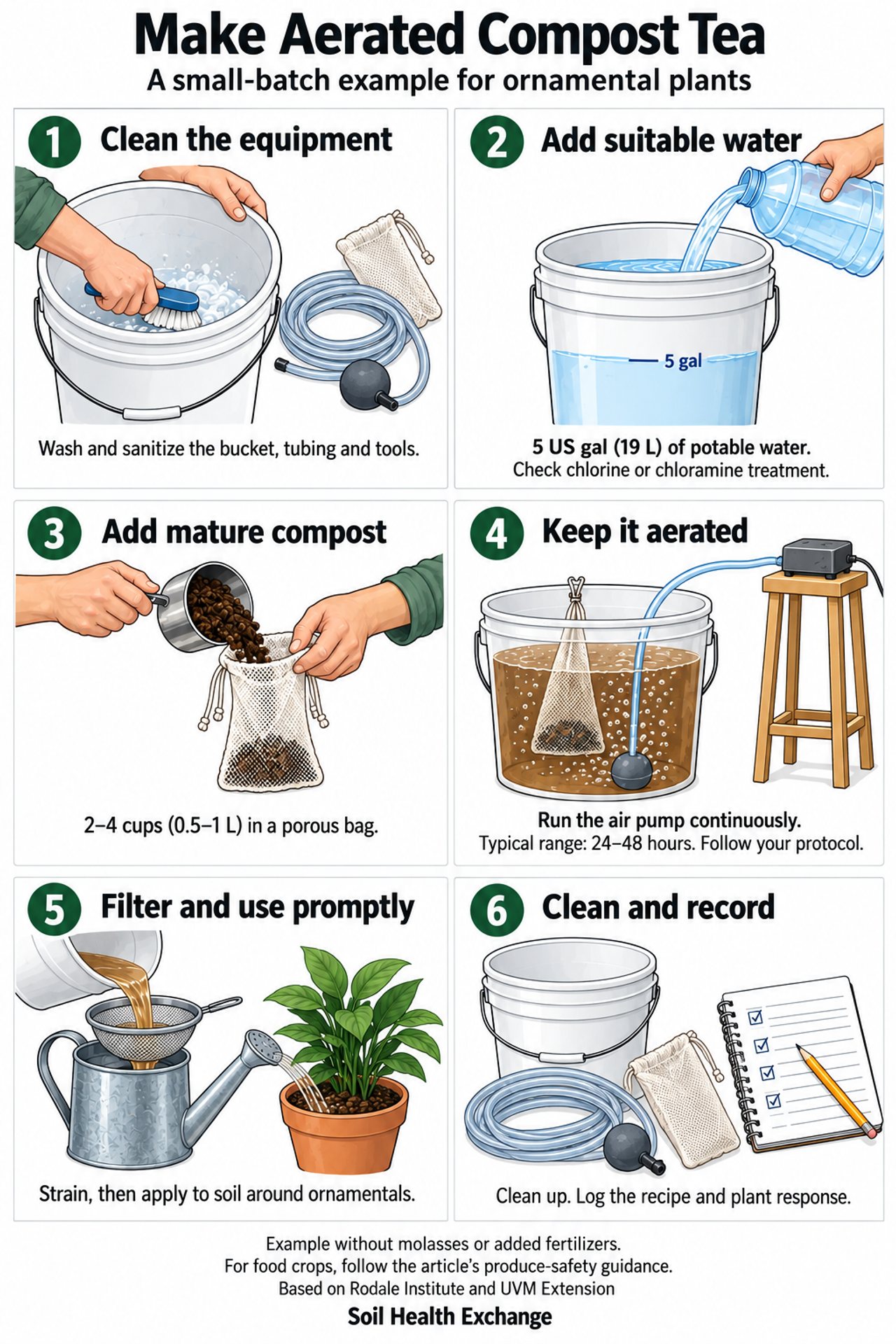
- Use clean equipment and potable water. Clean the vessel, hoses, aeration components, and application equipment between batches. Keep preparation equipment away from raw manure handling and other contamination sources. [1][9]
- Check the water treatment. Ask the water supplier whether it uses free chlorine or chloramine. If the chosen brewing protocol requires removal, use a verified method suitable for that disinfectant. EPA states that leaving water to stand at room temperature does not remove monochloramine. Keep treated water protected from recontamination. [13]
- Follow one defined preparation. Record compost mass or volume, water volume, ingredients, incubation time, and temperature. For an aerated method, use equipment sized for the mixture and vessel, and monitor dissolved oxygen where the protocol calls for it. Extra microbial food raises the oxygen demand as well as changing the ingredients. [1][2]
- Match filtration to delivery. Check the mesh, screens, nozzles, and irrigation passages that the mixture must pass through. Test the liquid through the intended equipment before committing a full tank. Record any settling or blockage. [1][2]
- Coordinate brewing and application. Prepare only what you can apply promptly at the end of the process. Rodale recommends immediate application; the 2025 vegetable study applied tea without a storage phase. [2][3]
- Keep a batch and field log. Include preparation details, application time, tea volume per area, carrier water, crop stage, weather, and the plots treated. A repeatable record makes the next batch and the next comparison much more useful. [9]
Published preparation times differ. UVM describes 24–48 hours as a common range for aerated tea; non-aerated methods can take longer. Time alone does not establish batch quality. A recipe brings together a particular compost, food supply, aeration system, temperature, and intended use. Change one of those and the process changes with it. [1]
For a small ornamental-plant trial, Rodale’s published aerated method gives a starting mixture of 2–4 cups of mature compost in 5 US gallons of water, about 0.5–1 liter in 19 liters. It uses a porous bag and continuous aeration, followed by filtration and immediate application. Use a defined protocol for the incubation period and record it; that ingredient ratio alone establishes neither an effective crop dose nor suitability for food crops. [2]
What to check before applying
Start with the problem the check can answer. A liquid nutrient analysis helps calculate fertilizer contribution. Electrical conductivity helps assess soluble salts, especially for seedlings and containers. pH and dissolved oxygen describe the liquid and brewing conditions. A microbial assay or microscope examines particular organisms or structures. Testing for human pathogens requires an appropriate microbiological method.
Keep those purposes separate. A microscope image, high bacterial count, foam, or earthy smell does not establish disease suppression or produce safety. In the cucumber damping-off study, bacterial counts across all teas did not have a significant relationship with suppression. Process records and appropriate laboratory checks help assess a batch; a crop comparison establishes whether it delivers the result you want. [5][8]
Ask the laboratory how to collect and ship a representative sample and how quickly it must arrive. For a new preparation, test a small group of plants for injury before wider application. Record the crop response, including leaf injury, germination, or root growth, alongside any laboratory result.
Application rate and timing depend on the job
A recommendation should specify the quantity of prepared tea, the area treated, any dilution, the application route, and the number of applications. Twenty gallons of tea diluted into a larger carrier volume remains twenty gallons of tea. A tank dilution ratio alone cannot tell you the dose per acre.
For a soil application, decide how the liquid will reach the root zone. For a foliar application, coverage, drying conditions, crop stage, and the target disease become central. Repeated wetting of foliage also belongs in the disease management decision. Use a crop-specific protocol and record the application conditions rather than choosing a calendar interval from a general recipe.
Keep an experimental tea application separate from tank mixes until the ingredient labels and compatibility have been checked. Fertilizers change concentration and salt load; products intended to kill microorganisms can conflict with a live-microbe objective. A physical jar test helps reveal precipitation or mixing problems. Ask for separate evidence of microbial survival and crop performance when a supplier recommends a combination.
Test whether the program earns its cost
Begin with one question that matters economically: more marketable vegetables, greater forage dry matter, improved transplant survival, or less of a diagnosed disease. Choose the measurement and the size of improvement needed to pay before the trial starts.
For a first farm comparison, keep normal management on both treatments and add tea to one. Match carrier water and application traffic where practical. Repeat each treatment in at least four plots or strips and randomize their placement within blocks. University of Minnesota Extension recommends at least three replications and explains why multiple samples within one strip are subsamples, rather than independent treatment replicates. [15]
Choose a measurement that answers your question
| Goal | Measure in each independent plot | Record alongside it |
|---|---|---|
| Improve production | Marketable harvest weight, grain yield, or forage dry matter from a defined area | Crop stage, harvest dates, moisture basis, grading losses, and management |
| Suppress a disease | Incidence or severity of the diagnosed disease, plus marketable yield | Disease pressure in controls, scouting dates, and other control measures |
| Improve establishment | Emergence, surviving plants, or a defined root or growth measurement | Seed lot, transplant age, soil conditions, and any plant injury |
| Change soil biology | A chosen biological measure, sampled consistently before and after treatment | Sampling depth, timing, moisture, laboratory method, and crop response |
If you want to distinguish the effect of the complete program from an added fish or kelp product, a separate additive-only treatment can help. Separating living organisms from the liquid’s other components requires a more demanding design. Work with an adviser on that question; the heat-treated comparison in the soybean experiment illustrates why the control determines what a result means. [4]
Count the full program cost: compost, additives, water treatment, labor for brewing and cleaning, electricity, testing, equipment ownership, and every application pass. Purchased tea adds product and transport costs. Compare those expenses with the extra crop margin from the plots.
If the tea seems useful enough to expand, repeat the comparison in another season or field. That tests whether the response survives a change in weather, soil conditions, or disease pressure. Increase the area as the evidence and economics justify it.
Answers to common compost tea questions
Is aerated tea always better
Aeration changes the process and the organisms favored by it. Both aerated and non-aerated preparations have shown disease suppression in specific experiments. Choose on the basis of evidence for the preparation and intended use. An air pump by itself establishes neither efficacy nor sanitation. [5][8]
Should I add molasses
Molasses supplies readily available food that changes microbial growth and oxygen demand. For fresh produce use, the pathogen-growth findings give a clear reason to avoid nutrient supplements. For other uses, ask what benefit the additive contributes in a controlled comparison before including it routinely. [8]
Can I store a homemade batch for next week
Plan to make it close to application and use it promptly. Microbial composition and oxygen conditions continue to change after brewing. A fresh homemade tea needs its own storage evidence; a commercial product’s shelf life applies to that formulation. [1][2]
What if a batch develops a strong sour or putrid smell
Treat an unexpected odor as a process deviation. Hold the batch out of the trial and review the ingredients, water, incubation, aeration, and equipment cleaning. Record what changed before restarting the documented process. Odor is a useful reason to investigate; laboratory tests answer the specific contamination question.
Will compost tea establish mycorrhizal fungi
Arbuscular mycorrhizal fungi depend on living host roots to complete their normal life cycle. A tank containing compost and microbial food is not a multiplication system for these root partners. An extract might carry propagules present in its source, but successful inoculation requires viable propagules and root colonization. Ask for evidence of those outcomes when evaluating a mycorrhizal claim. [14]
Is tea a substitute for crop specific inoculants
Use evidence for the organism and job involved. A recommendation for a named microbial strain on a particular crop does not establish that an unspecified compost tea supplies that organism or performs the same function. Ask for product identity, viable-organism information where relevant, and trials supporting the proposed substitution.
What about bottled compost tea
Ask what is in the bottle: a fresh biological preparation, a stabilized extract, a liquid fertilizer, or a formulated microbial product. Then request its ingredients, guaranteed analysis where provided, storage conditions, expiry information, and trials on the relevant crop. Compare the labeled application program and its full cost with your objective.
How often should I apply it
Frequency belongs to the tested program. A useful recommendation states what problem it addresses, when treatment begins, how many applications were tested, and the response obtained. Keep the same schedule in your comparison plots long enough to evaluate that program, then judge the benefit against its total cost.
Start with the question you need answered
Compost tea is most useful to evaluate when the question is concrete. A nursery might test a defined drench against a particular seedling disease. A vegetable grower might compare marketable yield under a documented application program. A grain producer might ask whether an extra pass adds enough crop margin to cover the season’s brewing and application costs.
Write down that question, choose the measurement, and leave room for a fair comparison. A result that repeats under your conditions gives you a reason to keep the practice. A result that fails to pay gives you an equally useful answer before the next tank is brewed.
Considering a compost tea program? Bring the crop, intended benefit, compost source, complete recipe or product label, application rate, and current management plan to the discussion. Those details turn a general conversation about microbes into a decision you can test.