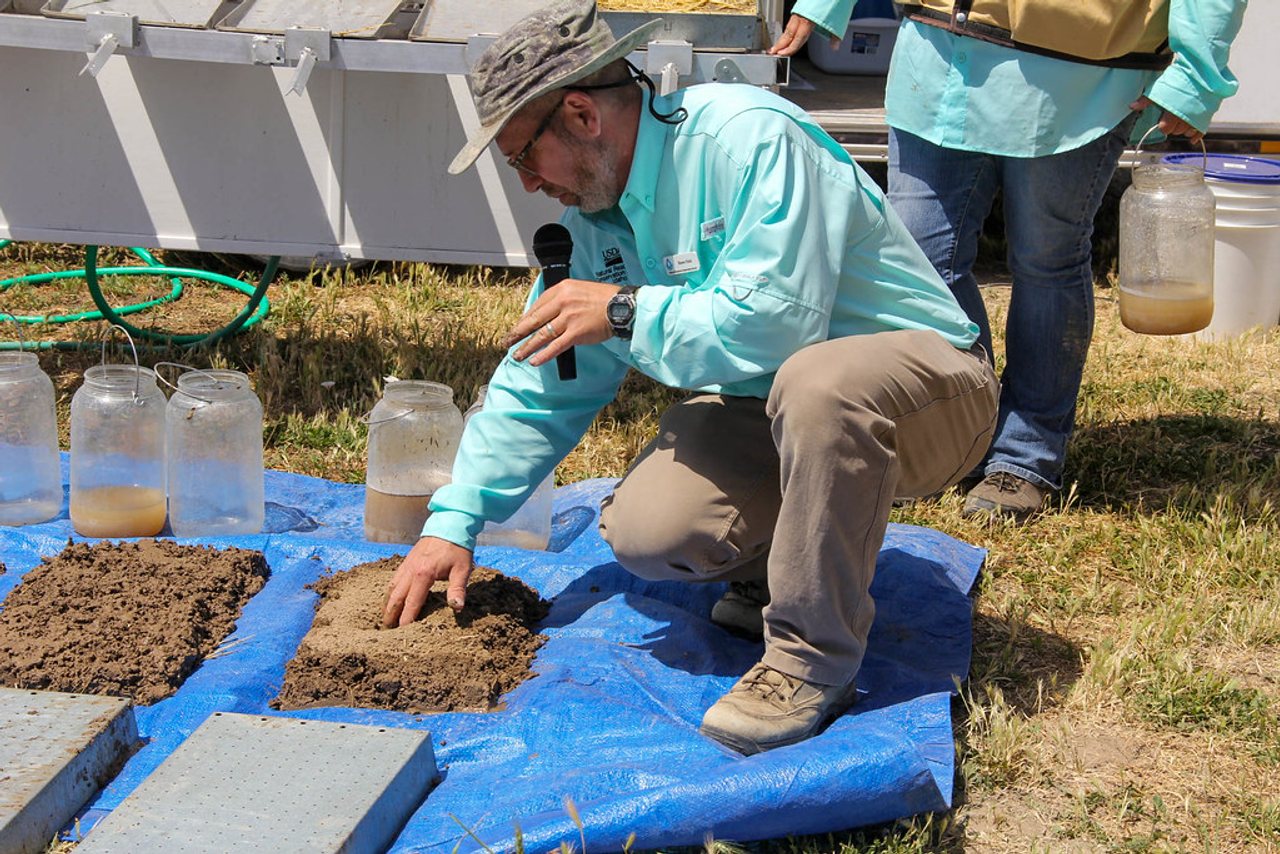
Stand at a fence line during a hard August rain and you can watch two economies at work. On one side, water pools between the rows, finds the low spots, and starts to move — carrying soil, and the nutrients bound to it, toward the ditch. On the other side, the same storm disappears into the ground within the hour. Same rain, same slope, often the same soil series on the county map. Two fields, doing very different amounts of work.
Only one side of that fence line will ever appear in a ledger. The struggling field shows up as line items: a replant decision, a rutted headland, another pass to repair what the water did, a thinner stand in the dry weeks that follow. The field that drank the storm earns nothing on paper. There is no entry for the rain that stayed, no line for the soil that did not leave, no credit for the crop failure that never happened.
That gap — between the work soil does and the value accounting can see — is the central economic problem of soil health. It is also one of the defining opportunities of the next decade in agriculture. This editorial, the first in a new series, is about closing the gap: what soil failure has already cost this country, what healthy soil actually does, how to prove it is changing, what the evidence says that work is worth, and how to build an economy in which everyone who benefits from living soil helps pay for it — with the farmer at the center of the return.
“When better soil function reduces cost, lowers risk, or creates a public benefit, how should that value be measured — and how much of it should return to the farm?”
We have paid for lost soil before
This country has been forced to put a price on soil before. In April 1935, a soil scientist named Hugh Hammond Bennett was testifying before a Senate committee about erosion when the sky outside began to darken. A dust storm that had stripped fields across the Great Plains days earlier was arriving over Washington. As USDA tells the story, Bennett slowed his testimony until the room dimmed, then pointed his questioners to the window. Within days, Congress passed the Soil Conservation Act of April 27, 1935, declaring soil erosion a menace to the national welfare and creating the agency that became NRCS.
For one terrible decade, the ledger was honest. Topsoil is where a field's fertility is concentrated — decades of accumulated organic matter, biology, and nutrients. When it blows or washes away, that capital leaves with it, and the replacement comes back by the ton: purchased, hauled, and spread. The Dust Bowl let the whole country see what soil function had been worth, because everyone was suddenly paying for its absence.
That bill never stopped running; it only left the headlines. Satellite-era research published in PNAS estimates that roughly a third of the cultivated Corn Belt has fully lost its carbon-rich A-horizon — the layer that holds most of the soil's fertility — at a cost of about $2.8 billion a year in lost productivity. And that is a conservative accounting, because part of erosion's true cost hides inside the input bill, in the extra fertility purchased to farm what remains.
The modern version of the story arrives by water instead of wind. In June 2025, the regional utility serving about 600,000 central Iowans issued the first lawn-watering ban in its history — not for lack of water, but because nitrate in the rivers it draws from tested as high as twice the federal drinking-water standard, and its removal equipment could not treat enough water to meet both demand and the standard. A second ban followed this summer. Running the region's nitrate-removal facility can cost up to $16,000 a day at full capacity — about $2.2 million in 2025 — and monitoring consistently points to agricultural land as the largest source, by far, of the nitrate in those rivers. The statehouse has spent much of the past year debating who should pay for monitoring, practices, and treatment.
This series takes no side in that political debate, and it never will. The economics are the point: nitrogen that escapes a field was bought by a farmer, feeds no crop, and is then removed a second time — at public expense — by a city. The same pound of soil function is paid for twice, on two different ledgers, and neither payment built anything that lasts. Soil that holds its nutrients through living roots, cover, and active biology is not only stewardship. It may be the cheapest infrastructure in the system.
Wind in the 1930s. Water today. We always end up pricing soil function — the only question is whether we price it before the loss or after. Ninety years ago it took a dust cloud over the Capitol. This series is about learning to see the value while the soil is still in the field.
What healthy soil actually does
The USDA Natural Resources Conservation Service defines soil health as the continued capacity of soil to function as a vital living ecosystem that sustains plants, animals, and people. The operative words are capacity and function. Healthy soil is defined by the work it keeps doing.
NRCS names five essential functions: regulating water, sustaining plant and animal life, filtering and buffering potential pollutants, cycling nutrients, and providing physical stability and support. On a working farm, those functions are whether a field carries equipment after rain, how deep roots travel, whether nitrogen is available in the weeks the crop demands it, whether the surface crusts or breathes, and how long a stand stays green after the rain shuts off in July.
Six management principles anchor the practice, laid out in a 2026 Rodale Institute position paper on soil health in practice:
- Keep living roots in the ground as continuously as possible, so the biology below is fed in every season the climate allows.
- Maintain protective soil cover — residue or canopy — so rain lands on armor instead of bare ground.
- Minimize disturbance, mechanical and chemical, so structure and biological networks can persist from season to season.
- Increase functional biodiversity in rotations and covers, so more of the field's work is done by more kinds of life.
- Integrate livestock where it fits the operation and is well managed.
- Make management context-specific and adaptive — matched to the soil, drainage, climate, rotation, equipment, and labor actually on hand.
A practice earns its place when it restores the function a field is missing without creating a larger problem somewhere else.
How to prove your soil is changing
A practice by itself proves nothing. Proof is water entering the profile instead of leaving with the topsoil; aggregates that hold together in a jar of water; roots running past an old tillage layer; a crop that holds on a week longer under stress. Much of that proof costs almost nothing to collect — an infiltration ring, a shovel, a slake test, a note about which fields were fit to plant first this spring.
Laboratory measurement turns observation into a record. The goal is not to order every analysis in the catalog. A small, repeatable suite — routine chemistry and pH, organic matter or carbon, one structural or hydrologic indicator, one biological indicator that can guide a real decision — sampled at consistent depths, seasons, and locations, is worth more than a one-time panel of everything. NRCS groups soil-health indicators into physical, chemical, and biological indicators; the strongest reading brings all three together, alongside the management record and what the field actually did.
The dimensions of a useful soil-health record
| Dimension | Examples | Question it helps answer | Economic connection |
|---|---|---|---|
| Physical | Aggregate stability, infiltration, bulk density, structure, rooting depth, water-holding capacity | Can water, air, and roots move through this soil? | Erosion, trafficability, rooting, water use, and weather resilience |
| Chemical | pH, electrical conductivity, nitrate, phosphorus, potassium, reactive carbon | Are nutrients available, balanced, and at risk of loss? | Input efficiency, crop nutrition, and loss prevention |
| Biological | Respiration, microbial biomass, enzymes, earthworms, particulate organic matter | How active is the living system that cycles carbon and nutrients? | Nutrient supply, residue turnover, disease pressure, and system stability |
| Management and outcomes | Rotation, tillage, cover, inputs, yield, cost, field operations, weather response | Which decisions changed function, performance, and risk? | Farm ROI, learning, verification, and future planning |
Change arrives on its own schedule — function first, in cover, infiltration, and biological activity; structure over one to three seasons; carbon stocks over years. That is compounding: each season of measurement builds on the last, until the record stops being a stack of test results and becomes an operating record of the soil asset itself — evidence that can steer nutrient, tillage, rotation, and capital decisions on the farm, and hold its own with buyers, lenders, insurers, landowners, and public programs beyond it.
The farms that went first
Some farms have been running this experiment for decades. In the Soil Health Institute's assessment of 100 farms across the United States, the farmers interviewed had used no-till for an average of 19 years and cover crops for an average of nine. Based on the figures those producers supplied, soil-health management systems cost an average of $24.00 less per acre for corn and $16.57 less for soybean. Using standardized prices, average net income was $51.60 per acre higher for corn and $44.89 higher for soybean — and net income rose for 85% of the corn growers and 88% of the soybean growers in the assessment.
What 100 experienced farms reported, per acre
| Measure | Value |
|---|---|
| Corn: operating cost saved | 24 $ per acre |
| Corn: net income gain | 51.6 $ per acre |
| Soybean: operating cost saved | 16.57 $ per acre |
| Soybean: net income gain | 44.89 $ per acre |
Growers whose net income rose under soil-health systems
| Measure | Value |
|---|---|
| Corn growers | 85 % of growers |
| Soybean growers | 88 % of growers |
Those numbers are the testimony of experienced systems — and a preview of what patience buys. How fast the value arrives varies with soil, climate, rotation, and management, and the transition years ask real investment before they pay. But the direction of travel is consistent, and the value showed up on every side of the business: lower operating cost, stronger yield response, resilience in extreme weather, and field access when timing mattered most.
What the market prices — and what it leaves outside
Agricultural markets are good at pricing what crosses a scale: bushels, pounds, grade, protein, moisture, timing, delivery. Farm records are equally good at visible costs — seed, fertilizer, fuel, labor, iron. Some conservation and supply-chain programs now pay for a practice or a verified outcome. That is the part of the ledger that works.
Everything else healthy soil produces sits outside it — water regulated, nutrients held in the root zone, volatility damped, habitat, water quality, carbon, productive capacity handed to the next generation. The beneficiaries are scattered across the supply chain, the finance system, the watershed, and the public — and almost none of them are currently asked to pay.
From farm-created value to a payment pathway
| Value created | Where it appears today | Who benefits | Stronger payment pathway |
|---|---|---|---|
| Crop production and quality | Commodity or specialty-market price | Farm, buyer, consumer | Market price, quality premium, multiyear offtake contract |
| Lower operating cost | Farm records, often after a transition period | Farm | Farm margin plus transition finance or cost share |
| Lower production risk | Sometimes visible in yield variability; rarely in pricing | Farm, insurer, lender, buyer | Insurance pricing, lending terms, risk-sharing contract |
| Water regulation and nutrient retention | Usually outside the farm income statement | Farm, water users, community, public | Watershed payment, public conservation contract, beneficiary-funded program |
| Carbon, biodiversity, and habitat | Selected environmental markets and public programs | Supply chain, public, future generations |
The result is a structural mismatch: a farmer can carry the full cost of transition while part of the return arrives years later, lands outside the farm gate, or takes the form of a loss that never occurred. The gap is not an absence of value. It is a mismatch among who pays, who benefits, when the benefit arrives, and what the current ledger is able to record.
A farm value account
An honest account begins at the field or management-system level, records five forms of value, and subtracts the full cost of changing management and of proving the change.
There is no single national price for an acre of healthy soil, because its value is local by nature — and that is a strength. Reduced nutrient loss is worth most in watersheds paying to remove it. Stored water is worth most where rainfall extremes drive the losses. Baseline, slope, climate, management, and duration all move the numbers. Valuation done well keeps those differences usable in a decision, and a price grounded in place is one a farmer, a buyer, and an insurer can all trust.
For a specific farm, the sequence is workable today: establish the baseline; measure the change; connect the change to a soil function and a field outcome; apply a local value through production gained, cost avoided, damage avoided, risk reduced, or an established outcome price; identify the share attributable to management; and subtract transition and verification costs. What remains is a defensible estimate of what the farm created — and a short list of who is in a position to help finance it.
Boundaries keep the account honest. Name the baseline. Separate private benefits from public ones. Never count the same outcome twice. Respect the time change requires. Record who owns the data and the claim. And keep the caution offered by the soil ecosystem-services valuation literature: monetary valuation can sharpen decisions, but some values — cultural, health, equity, the standing of future generations — should shape a decision without ever becoming a tradable credit.
How the next farm economy gets built
Every soil function can find its financing — not through one market but through several channels, each matched to a benefit and its beneficiary, organized around one principle: whoever receives a measurable benefit helps finance it, and the farmer keeps enough of the return to sustain the management that created it. None of these pieces is futuristic. Each exists somewhere today. The work of the next decade is connecting them.
1. Farm ROI must include risk and time. Evaluate the system across seasons, not first-year yield alone. Count transition cost, labor, machinery, and input changes — and count prevented losses, yield stability, field access, learning, and the management options a healthier soil keeps open.
2. Buyers contract for the value they receive. If healthier-soil systems improve supply reliability, shrink a product footprint, or fulfill a customer commitment, buyers can respond with multiyear contracts, premiums, shared measurement, and transition support — and be transparent about the claim being purchased and the farmer's share of it.
3. Insurers and lenders price demonstrated risk. A defensible record connecting management, soil function, and lower loss exposure can inform premiums, lending terms, reserves, and shared-risk structures. This is the step that moves soil health from the conservation conversation into core farm finance.
4. Public programs pay for public goods. Cleaner water, reduced erosion, habitat, and long-term land capacity benefit people far beyond one farm, and public conservation payments are the appropriate way to share those costs. USDA's Regenerative Pilot Program is moving in this direction, combining whole-farm planning, bundled practices, soil testing, and outcomes credited back to producers.
5. Measurement is shared infrastructure; farm data belongs to the farmer. No one should pay repeatedly to translate the same soil information for every program. Common definitions, comparable methods, portable records, transparent models, and permission-based use can cut transaction costs while keeping identifiable farm data under farmer control.
One warning belongs on the blueprint. USDA Economic Research Service's 2025 national review of soil-health and conservation economics shows that costs and returns vary widely by region, soil, climate, crop, and production system — some practices pay quickly, others develop over years or only in combination. Programs should reward verified function wherever it occurs, without assuming every farm travels the same road to it.
The stewardship dividend: a business model hiding in plain sight
Underneath those five channels sits one business model. Call it the stewardship dividend: when soil management measurably reduces someone else's cost — a treatment plant not expanded, a reservoir not dredged, a claim not filed, a filtration plant never built — part of the avoided cost returns, by contract, to the farms that created the saving. The beneficiary still comes out ahead. The steward finally gets paid for work that used to be invisible. Nothing about this is charity; it is procurement. A city buying nitrogen reduction from a watershed's farms is buying infrastructure, the same way it buys concrete — and usually at a better price.
Faced with a federal mandate to filter its drinking water, New York City chose to protect its Catskill and Delaware watersheds instead — spending roughly $2.5 billion over two decades on land protection, stream restoration, septic upgrades, and paying and equipping the watershed's dairy farms to manage nutrients. The avoided alternative: a filtration plant estimated at $8 to $10 billion to build, plus on the order of a million dollars a day to operate. A National Academies review judged the program a success, and the city still operates under a filtration waiver today. For more than twenty-five years, the cheapest water infrastructure in New York has been other people's stewardship — and the city has paid for it accordingly.
The same logic is already working in the Iowa watersheds where this editorial began. Through the Soil and Water Outcomes Fund, cities including Cedar Rapids and Ames — alongside the state agriculture department and companies like Cargill — buy verified water-quality outcomes directly from farms. In 2021, outcome buyers paid $10.3 million, participating farmers received an average of more than $31 per acre, and enrolled fields kept 1.62 million pounds of nitrogen out of Iowa waterways, a 28 percent reduction from baseline. A city's alternative is more treatment capacity at the end of the pipe. The fund lets it buy the same pounds upstream, cheaper, from the people who decide where those pounds go.
The dividend can ride on risk as well as water. Since 2017, Iowa has offered a $5-per-acre crop-insurance premium discount for fall-planted cover crops — nearly 2,000 farmers and more than a million acres so far, a model USDA and neighboring states have copied. It is a small number with a large signature: part of a risk saving handed back to the practice that created it.
The stewardship dividend, by avoided cost
| Cost avoided | Who saves | Sharing mechanism | Where it is working |
|---|---|---|---|
| Water treatment and filtration | Utilities and ratepayers | Watershed procurement, outcome purchases | New York City watershed program; Soil and Water Outcomes Fund (Iowa) |
| Crop-loss claims and premium subsidy | Insurers, reinsurers, taxpayers | Premium discounts, dividends | Iowa cover-crop discount; Michigan NextGen pilot (2027) |
| Dredging, flood damage, nutrient loss downstream | Cities, drainage districts, downstream owners | Watershed contracts, resilience bonds | The next frontier — mechanisms exist, contracts are rare |
Three conditions make the dividend durable. The savings must be measured against an honest baseline — which is why the soil record described earlier is the foundation of the entire model, not an accessory to it. The contract must be multiyear, because stewardship is a multiyear investment and a one-year payment cannot buy it. And the farmer's share must be large enough to matter after transaction costs — the verifiers, brokers, and advocates who stand these markets up earn their part, and the steward's share is what keeps the model alive.
Michigan is putting soil health into crop insurance
Michigan is now building the most ambitious version of the risk-side dividend. The state's NextGen Crop Insurance pilot connects soil-health management directly to the price of agricultural risk. The Michigan Department of Agriculture and Rural Development describes a model designed to reflect the lower long-term risk associated with soil-health practices. That is a different economic signal than paying for practice adoption: it puts management, evidence, and risk into the same financial decision.
For the 2027 crop year, the pilot focuses on corn and soybean growers in Huron, Saginaw, Sanilac, and Tuscola counties who use practices such as cover crops, crop rotation, and no- or reduced-till. The state says participating farmers keep their federal crop insurance and their current agent. The supplemental model offers the potential for lower premiums where practices reduce crop-loss risk, plus the opportunity for a dividend after at least four years of enrollment, with rates developed from farm and soil-health information intended to better reflect actual risk.
However enrollment unfolds, the design deserves attention, because it treats a farmer's soil record as financial evidence — and that precedent travels. The pilot information page invites growers to request information without committing to participate or purchase coverage, and Soil Health Exchange has organized the eligibility, economics, data, and farmer-question details in our Michigan policy brief.
Bring us your soil data
All of this depends on shared knowledge. Farmers need soil data they can understand and act on. Researchers and advisers need field context. Programs need credible, comparable evidence. Buyers, lenders, and insurers need definitions that connect a measurement to a function without erasing the reality of place.
That connective work is what Soil Health Exchange exists to do. We are building a community of soil-health stewards and a practical knowledge base — research, field experience, indicators, management context, economics, and policy in one place — so that a soil report becomes the beginning of a decision. The future we are working toward is concrete: a farm where the soil record sits beside the yield map and the balance sheet, read together, telling one story about how the land is doing and where the business is going.
If you have a soil report or a farm dataset you want to understand, bring it to us. We will help you read what each measurement means, see which questions your data can answer, find what is missing, and connect the result to a management or economic decision. If you have years of experience caring for soil, bring that too — the strongest soil-health record pairs measurement with the judgment of the person who manages the field. The ledger this series describes will not be built by institutions first. It will be built field by field, record by record, by people who decide the work their soil does should finally count.
If you farm and want to share your thinking — or write the story of your own soil-health journey for this series — reach us at contact@soilhealthexchange.com.
“Healthy soil is working infrastructure. Measure the work it does, connect the evidence to the people who benefit, and stewardship stops being a cost the farmer carries alone — it becomes part of how a farm holds its value.”
Sources and further reading
- USDA Natural Resources Conservation Service. Soil Health: definition, functions, and management principles.
- USDA Natural Resources Conservation Service. Soil Health Assessment: physical, chemical, and biological indicators.
- USDA Economic Research Service. Economic Outcomes of Soil Health and Conservation Practices on U.S. Cropland (ERR-353, 2025).
- Das, S., Hamido, S., and Panday, D. Soil Health in Practice: Principles, Proof, and the Path Forward (2026).
- Soil Health Institute. Economics of Soil Health Systems on 100 Farms.
- Baveye et al. Potential of the economic valuation of soil-based ecosystem services to inform sustainable soil management and policy (2020).
- USDA Natural Resources Conservation Service. Regenerative Pilot Program.
- Michigan Department of Agriculture and Rural Development. MDARD Invests in Next Generation Crop Insurance Pilot for Michigan Farmers (July 21, 2026).
- USDA Farmers.gov. Dr. Hugh Hammond Bennett: Sparked the Creation of a Conservation Agency.
- Thaler, E. A., Larsen, I. J., and Yu, Q. The extent of soil loss across the US Corn Belt (PNAS, 2021).
- Iowa Environmental Council. .