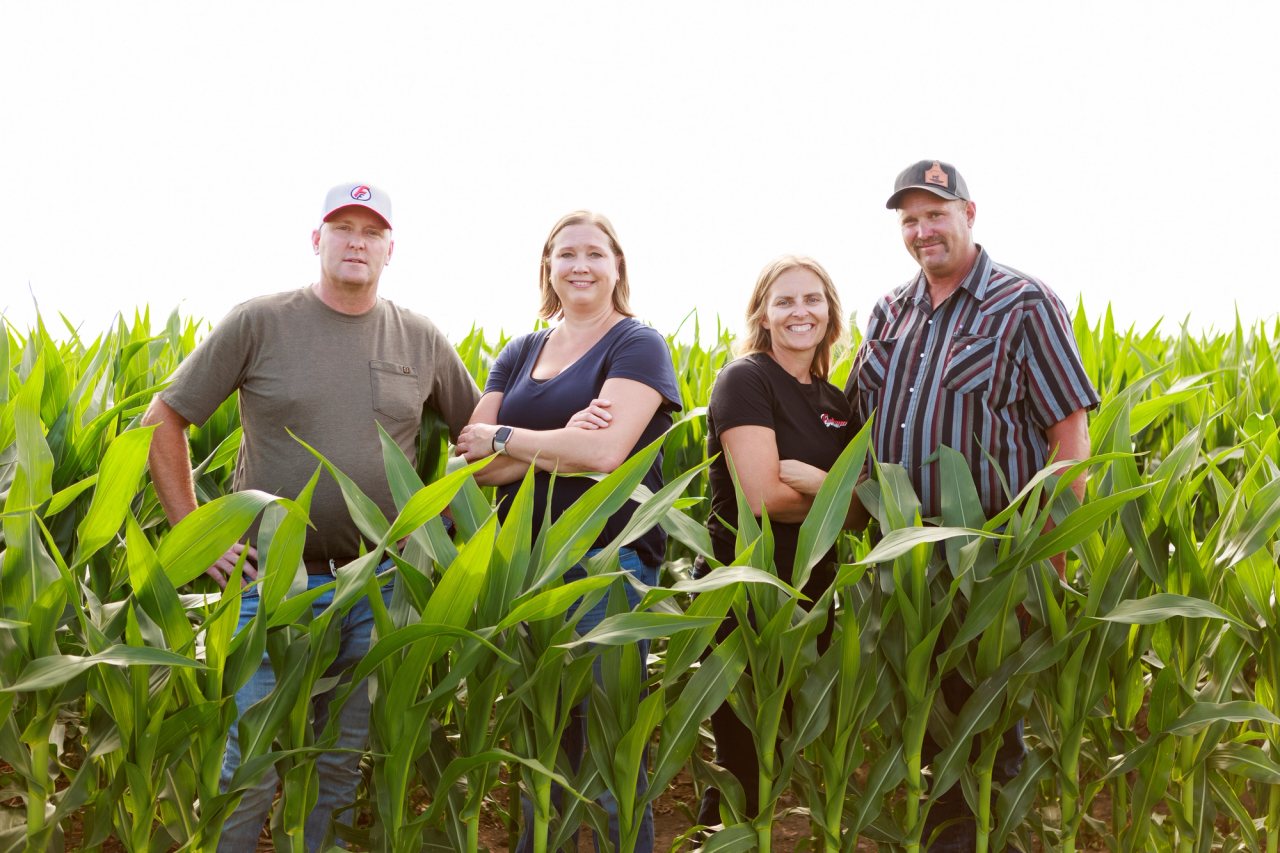

In 2014, heavy rain was carrying soil off the Feikemas' fields near Luverne, Minnesota. The family had been farming here for three generations. Now they needed to change how they cared for the land.
Shawn Feikema recalled sitting around a table with his brother and uncle, talking about what had to change. “There's got to be a better way,” he told USDA NRCS.
They tried cover crops in 2015. In 2016, they bought strip-till equipment and sold their conventional tillage equipment. By 2018, strip-till or no-till covered nearly all their acres.
Those few years changed how the family put a crop in the ground. The work since then has reached into nearly every part of the farm: the cattle yard, the fertilizer bill, the harvest calendar, and Becky's search for a cover crop that protects the soil without making life harder for young corn. Each change has had to find its place in a business the family wants to carry forward.
A farm built by three generations
Clarence Feikema started with dairy cattle and crops in 1950. When his sons Bob and Chuck returned from military service, they expanded the crop acres and replaced the dairy with a beef feedyard. Later, after Chuck's two sons earned agriculture degrees, management passed to them. The family's history is already a history of adapting.
Today, Shawn and Becky farm alongside Mike and Staci. Shawn works with crops, Mike with cattle, and Becky leads the cover crop program. Longtime employees bring their own knowledge to the operation. The work overlaps: what happens in the cattle yard affects what goes onto the fields, and what grows in those fields shapes the choices available to everyone else.
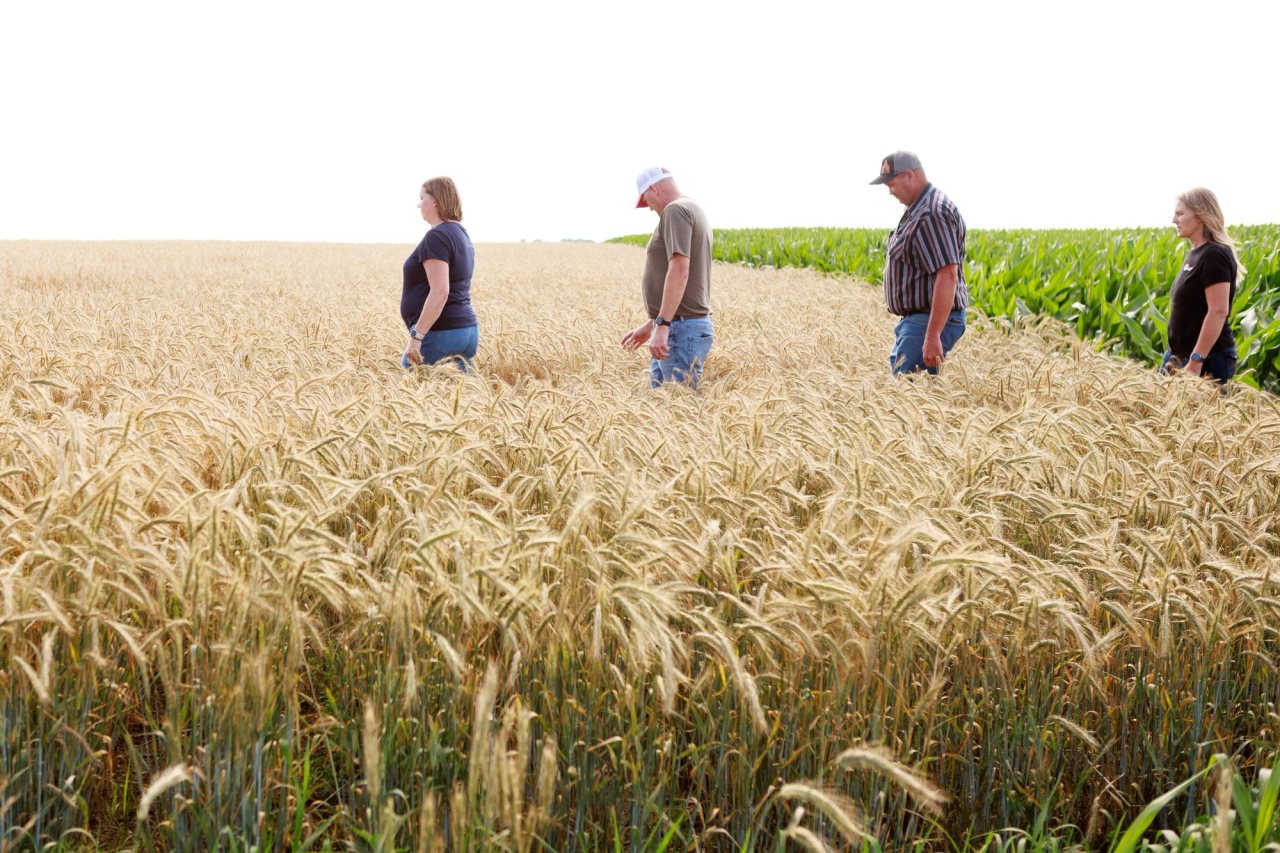
The family describes caring for the earth God has given them as a calling. That responsibility includes the people who depend on the farm, from family and employees to the businesses around it. Keeping the land productive and keeping the operation viable belong to the same commitment.
Learning to leave more of the field alone
Strip-till changed the work of preparing a seedbed. Only narrow planting rows were tilled; the ground between them stayed undisturbed. Cover crops added living plants during more of the year. Together, these practices gave the family a way to respond to the erosion that had brought them to the table.
Decisions across the generations
1950: Clarence starts the farm
Dairy cattle and crops form the original operation.
1971: The next generation takes over
Bob and Chuck take over from their father.
2014: Erosion prompts a rethink
Heavy rain reveals the need for better soil protection.
2015: First cover crop fields
Cover crops enter some fields for the growing season.
2016: An equipment commitment
The family buys strip-till equipment and sells its conventional tillage equipment.
2018: Strip-till and no-till across the farm
Used across the acres, with exceptions for special circumstances.
The family has seen less wind and water erosion, better soil structure, and more water soaking into the ground. On their website, they describe soil taking on new life.
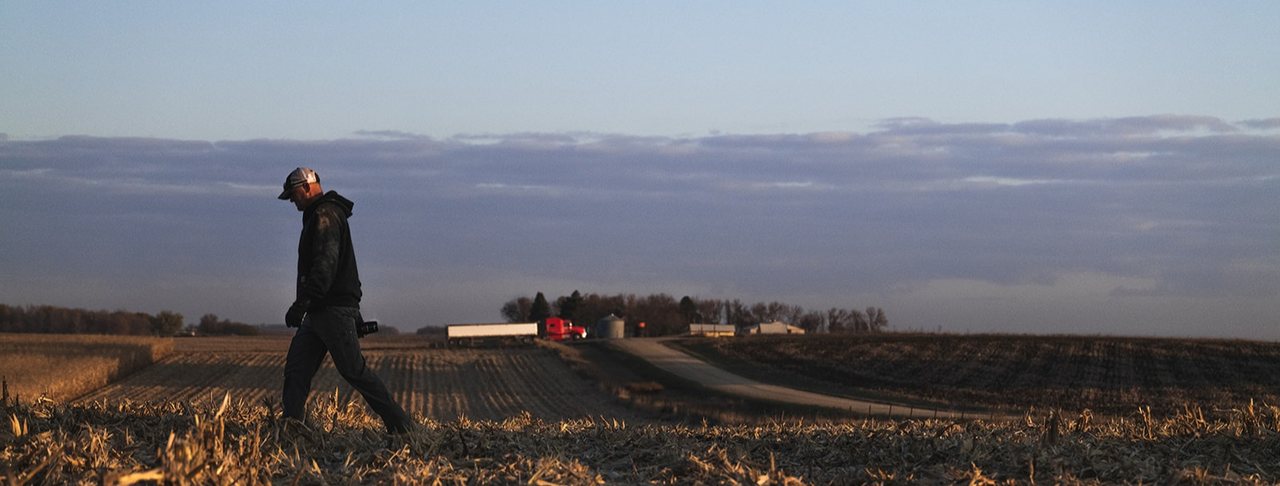
In a 2025 CHS interview, Shawn explained that the shift had been an economic necessity as well as an agronomic one. The farm needed the soil to keep doing its work. Protecting it meant changing some of theirs.
And tillage was only part of what they were learning. Long before the equipment sale, field records had begun drawing Shawn's attention to a resource the cattle yard produced every day.
What Shawn saw in the records
Fields that regularly received manure were performing differently from fields that did not. As Shawn compared the records, those differences changed how the family planned around manure. In Rhonda Brooks's July/August 2026 Farm Journal feature, Waste Not, Profit More, he put it plainly: “First off, we don't call it waste. We call it fertilizer.”
That view reaches into the crop plan itself. The family looks at which fields have gone longest without manure, then considers what to grow there next. Becky described the order of thinking to Brooks: “In some ways we start with where we're hauling manure, and then we look at what crop we're going to plant there next.”
Soil tests help them work out what a field still needs. Sampling on 2.5-acre grids, with crop ground on a four-year sampling cycle, lets them find places that need additional phosphorus and potassium. Shawn gave Brooks the example of treating just 20 acres within a 160-acre field. The records allow that kind of decision within a field, as well as between fields.
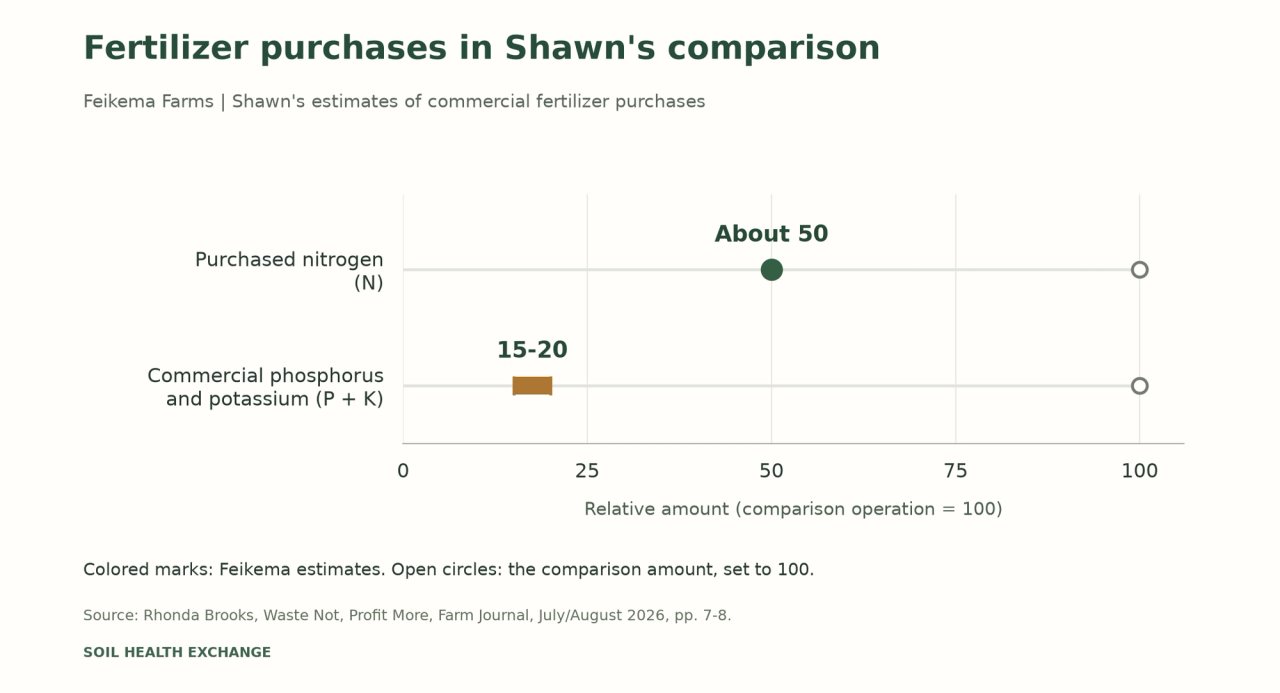
Shawn estimates that the farm buys about half the nitrogen of a comparable row-crop operation, and uses roughly 15–20% as much commercial phosphorus and potassium as a typical operation. Manure supplies part of the nutrients behind those lower purchases.
These decisions reach across a large crop and cattle operation:
Feikema Farms in 2026
| At a glance | Details |
|---|---|
| More than 7,000 acres | Corn, soybeans, small grains, and alfalfa |
| 4,000 head | Beef feedyard |
| 2.5-acre grids | Soil sampling within crop fields |
| Four-year sampling cycle | Rotation for sampling crop ground |
Source: Rhonda Brooks, Farm Journal, July/August 2026, pp. 6–7.
Knowing where manure could help was one part of the job. Finding time to get it there was another.
The crop that gave them more time
Small grains can be hard to defend on the income from a single harvest. The Feikemas told Farm Journal that premium seed contracts help those crops pay their way. But their place in the rotation also changes what the family can get done before the next corn crop.
A typical sequence runs corn, corn, soybeans, then a small grain before returning to corn. Liquid swine manure usually fits between the corn crops. Beef manure often follows the small grain, when an earlier harvest opens the field for other work.
Shawn described a manure application window once squeezed between October 1 and November 30. With small grains, it could begin around August 1. That opened roughly two more months for hauling manure and establishing cover crops ahead of the next season.
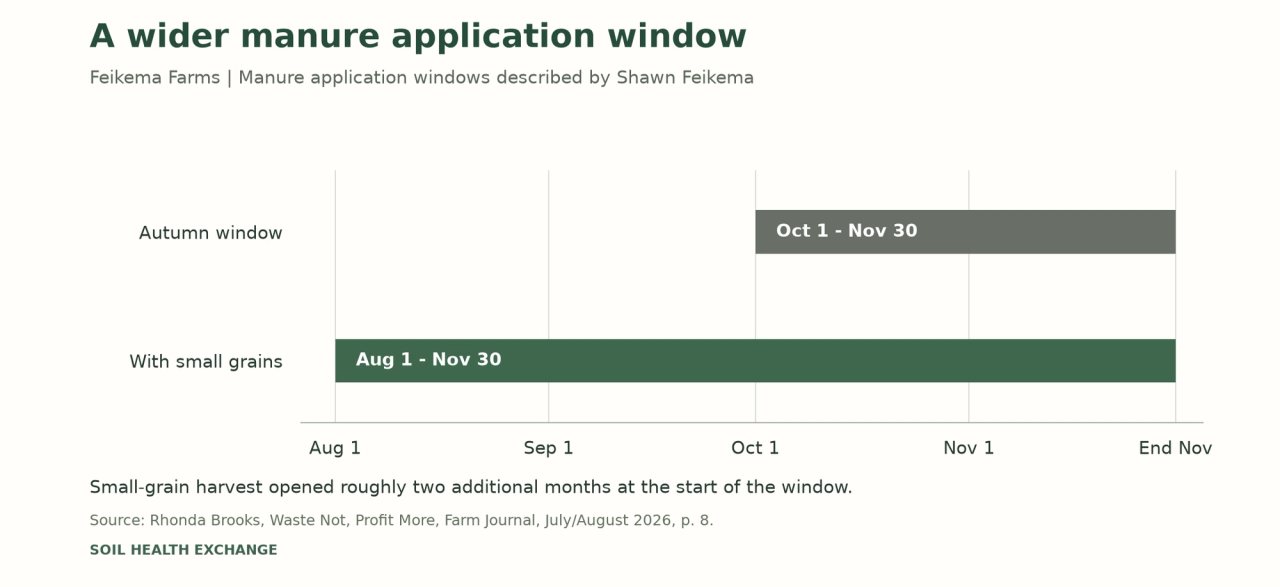
The small grain still has to be planted, harvested, and marketed. Its modest returns remain part of the calculation. So does the time it frees up. By the time corn comes around again, the value of that earlier harvest reaches beyond the grain that left the field.
Becky keeps working on the next crop
For Becky, the next crop is always part of the cover crop decision.
Ahead of soybeans, cereal rye has found a useful place. The family plants soybeans into the living stand, then terminates the rye and leaves a thick mulch. Becky told Farm Journal that the mat of residue has helped suppress weeds in their fields.
Ahead of corn, the same vigorous growth has been harder to manage. Rye can compete with young corn for moisture and nutrients, she reported, leaving uneven emergence. A lighter mix of wheat, triticale, and camelina has been easier on corn in some fields. In others, it has left the soil too exposed to wind.
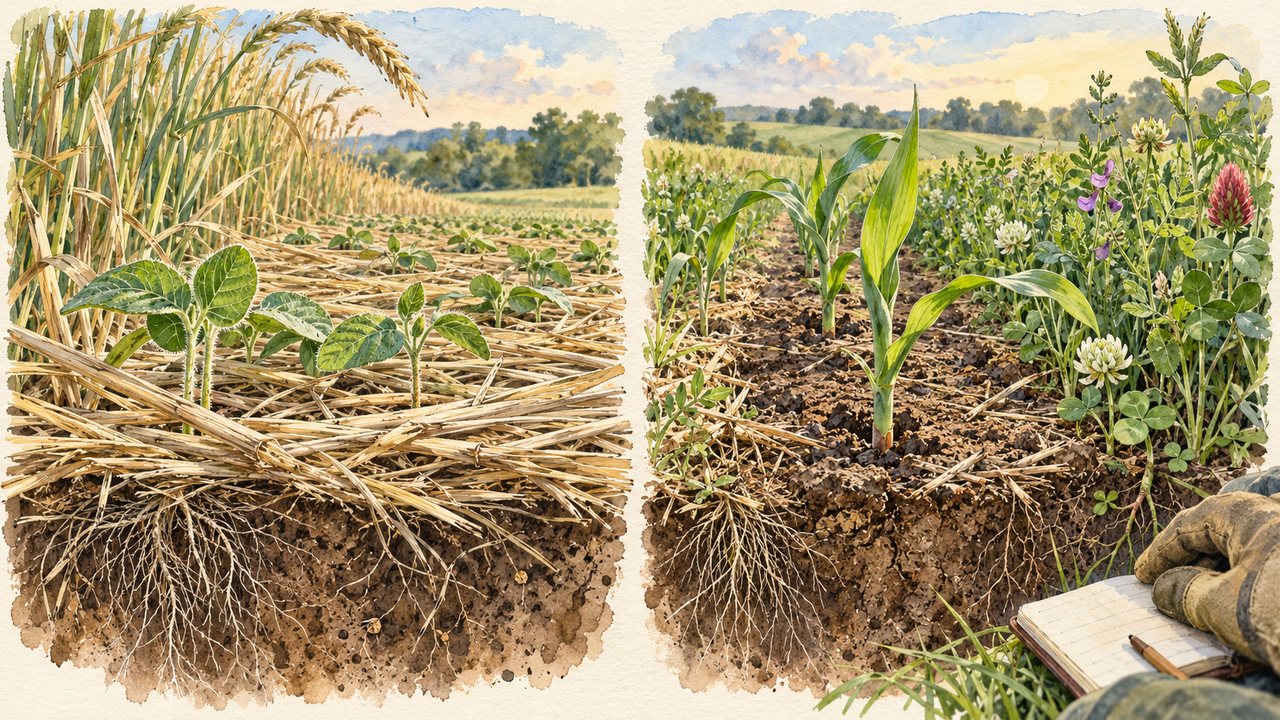
That is the problem Becky is working through: enough growth to hold and protect the soil, with room for corn to get a good start. One field can reveal a weakness that another did not. Success ahead of soybeans gives the family something to build on, while corn keeps asking for an adjustment.
By summer 2026, the family was testing mixtures and seeding methods, from drilling to an air cart pulled behind a vertical tillage tool. They also planned to try more aerial and broadcast seeding. Each approach offered another way to fit living roots into the crop calendar.
Making the changes work in the yard, too
Back in the cattle yard, the resource that helps feed the crops brings work of its own. Manure must be stored, handled, and hauled. Heavy equipment can compact the very soil the family is trying to improve. They share GPS guidance lines with custom applicators so machinery follows recurring tracks through the fields.
Storage required a substantial investment. NRCS reported in 2024 that manure-handling improvements cost roughly $500,000, with EQIP assistance covering 90% of that project's costs.
Then an employee helped make more of the investment. The longtime feedlot foreman took responsibility for the storage site, checking temperatures and turning material on a schedule to develop the composting work. His experience became part of how the farm used its manure.
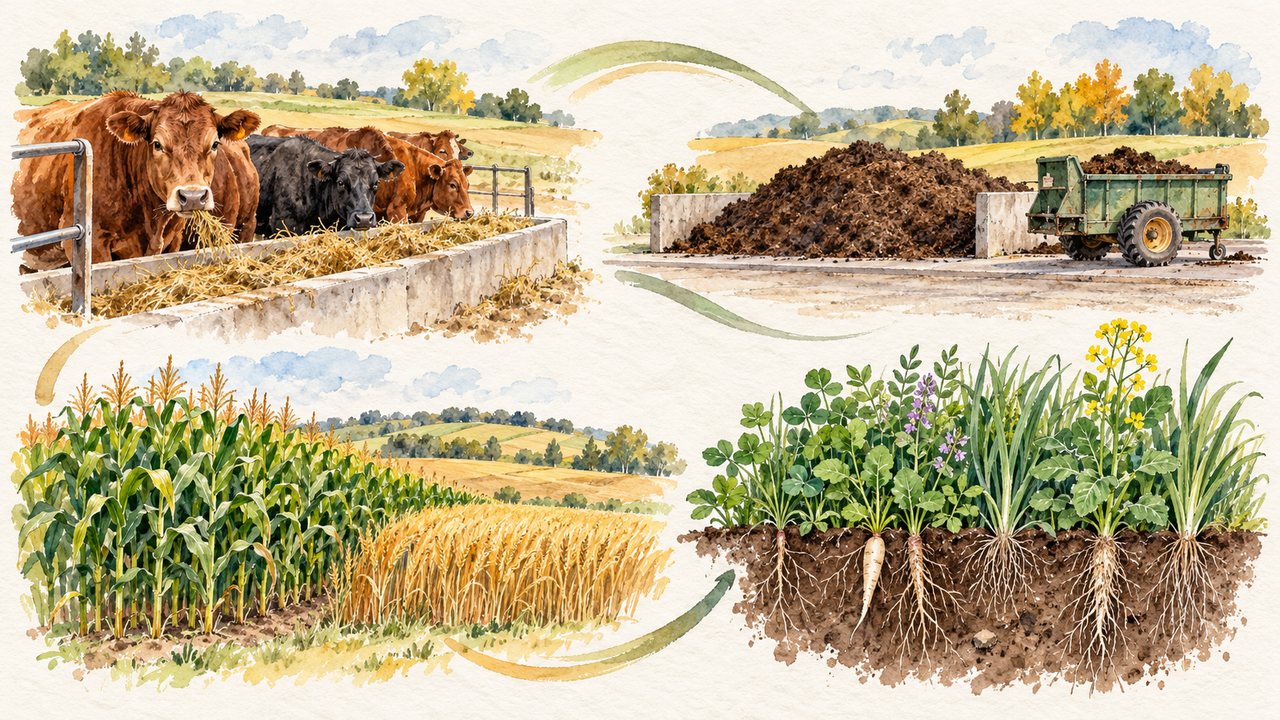
The cattle business brings financial pressure as well. Shawn told Brooks that high cattle prices can still leave a feedlot squeezed by the cost of buying animals. Having lived through a group of cattle that lost heavily, he was prepared to leave space empty rather than repeat the experience.
That willingness to examine the business extends beyond the yard. The farm's account of a 2024 Farm4Profit interview describes Shawn pursuing agricultural executive education, the family hiring a fractional chief financial officer, and the start of monthly board meetings. As the field practices changed, they also made more room to look closely at the business supporting them.
The people beyond the farm gate
When Shawn talks about the value of livestock, he also talks about the people who keep a farm running. Feed, parts, veterinary care: the needs recur through the year, and the spending reaches local businesses. Becky points to the people the farm employs and what those jobs mean to the community.
Those connections help explain why the family has opened its work to a wider audience. Through farm tours and the documentary From the Heartland, they have shared the people and decisions behind the fields. The film follows the relationship between farms and rural communities through their experience; the family's media page offers a place to explore it.
In the CHS interview, Shawn spoke about wanting people to understand that agriculture is carried on by families. The work of protecting soil belongs to that larger picture: people making a living, depending on one another, and trying to keep a place going.
What they hope to pass on
“We don't want to do one thing 10% better. We want to do everything 5% better,” Shawn told Farm Journal.
That ambition takes shape in the work: soil tests that guide fertilizer placement, an earlier harvest that eases the fall workload, an employee's care for the compost, and Becky's next cover crop mix. Together, those decisions have reshaped the farm the family sat down to talk about in 2014.
Clarence began with dairy cattle and crops. His sons built a different operation. Shawn, Mike, Becky, and Staci are making their own changes now. What they hope to pass on is a farm with productive soil, a business that can support a family, and room for the next generation to make decisions of its own.
Bring your experience to the exchange
Your experience can help another farmer make a decision. SHE's Farmer Expert Panel brings farmers and ranchers into that exchange of practical knowledge. Participation is voluntary, unpaid, and flexible.
If you would like to contribute, apply through the farmer pathway. Tell us about your farm and a decision you have learned from. A useful conversation can start there.
Story by Soil Health Exchange, drawing on material shared by the Feikema family, Rhonda Brooks's July/August 2026 Farm Journal feature, and the sources linked below.
Photographs: Tami Carda Photography (@tamicardaphotography), shared by Becky Feikema; harvested-field photograph by Andrew Bydlon / Feikema Farms. Learn more at Feikema Farms.