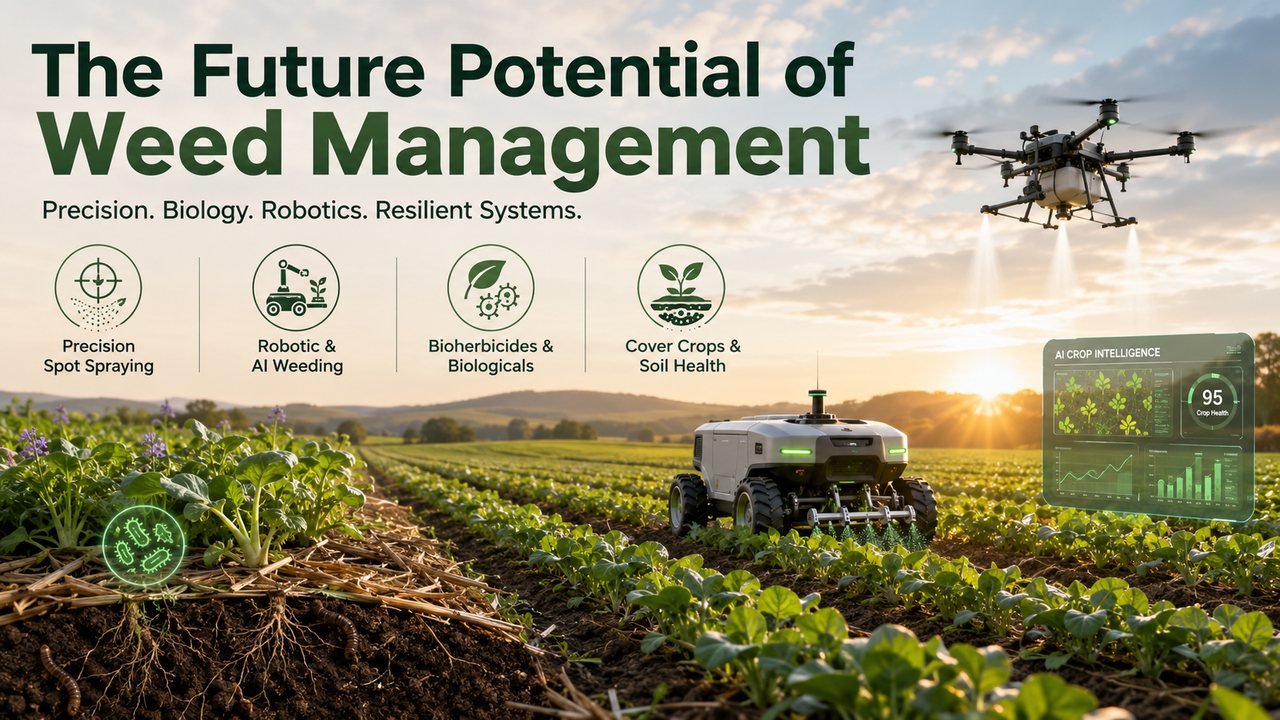
A new sprayer, robot, herbicide, or biological tool can be useful. None of them removes the need to know which weeds are present, why they escaped, and how many seeds they may return to the field. The most durable programs use several points of control across the season, then adjust those points from field records.
Why another single-tool program will fail
The International Herbicide-Resistant Weed Database reported 548 unique species-by-site-of-action resistance cases, involving 275 weed species and 21 of 31 known herbicide sites of action, as of August 8, 2026 [1]. Those figures describe confirmed resistance cases, not the number of farms or acres affected. Their value is the direction they show: repeated selection with the same effective site of action continues to narrow future choices.
Rotating brand names is not resistance management if the effective sites of action remain the same. A stronger program combines effective herbicide sites of action with tactics that do not depend on the same biology: clean seed and equipment, crop rotation, crop competition, cultivation or mowing where appropriate, and prevention of seed return [2][3].
Build the program in layers
Five layers of a field-level weed plan
| Layer | Question | Examples | Record after the season |
|---|---|---|---|
| Prevention | How could a new weed or resistance trait enter? | Clean seed, equipment cleanout, field-border control, known manure or feed sources | New patches and likely entry route |
| Crop competition | How can the crop close space sooner? | Rotation, planting date, row spacing, stand uniformity, cover-crop residue | Canopy timing, gaps, crop injury |
| In-season control | Which tactics work at the weeds' current size? | Effective labeled herbicides, cultivation, mowing, hand or targeted removal | Weed size, weather, control, crop response |
| Seed-return control | Which escapes could replenish the seedbank? | Rogueing, patch treatment, harvest weed seed control where weeds retain seed | Escapes and seed-producing patches |
| Learning | What should change next year? | Maps, resistance testing, cost and yield records, treatment strips |
Long-term Iowa research found that diversified crop rotations could reduce herbicide use while maintaining yields and profitability under the conditions studied [13]. A global meta-analysis also found that crop rotation reduced weed density and increased crop yield on average, though results varied with rotation design and environment [14]. These findings support diversification; they do not promise that adding any crop to a rotation will solve a specific weed problem.
Which tools are ready now?
A practical readiness check
| Tool or strategy | Current status | Where it can help | What to verify |
|---|---|---|---|
| Diversified integrated weed management | Ready now | Reduces dependence on one tactic and adds control points across the rotation | Fit to the field's weeds, crops, labor, and soil-conservation goals |
| Targeted or spot spraying | Commercial; field-dependent | Avoids spraying weed-free portions of a field | Weed density, detection limits, speed, tendering, service, and rescue plan |
| Camera-guided cultivation | Commercial in suitable crops | Improves guidance and can reduce operator fatigue or crop injury | Row structure, residue, rocks, soil moisture, weed size, and acres per day |
| Harvest weed seed control | Field-ready for selected systems; still adapting in North America | Keeps retained weed seed from returning through combine chaff | Seed retention at harvest, crop, harvest timing, moisture, capacity, and cost |
| Laser, electrical, or autonomous weed removal | Emerging to early commercial |
Precision spraying can save product, but the field sets the savings
Targeted sprayers use sensors and software to identify where a spray is needed. USDA Agricultural Research Service work is testing these systems under field conditions [8]. In one ARS field study, targeted spraying reduced spray volume by about 79 to 80 percent when failed runs were excluded [9]. In five Iowa soybean fields totaling 415 acres, a GROW on-farm evaluation reported average product savings of 76 percent [10]. These are useful measurements, not a guaranteed savings rate.
Sparse weeds create more opportunity to turn nozzles off. Dense weeds can make a targeted pass resemble a broadcast pass. Performance can also change with weed size, canopy, dust, shadows, speed, nozzle control, and the system's ability to distinguish crops from weeds. Current industry interviews point to cost, dealer support, operating changes, and uncertain payback as adoption barriers even as the technology improves [11].
Calculate payback with the whole program
Inputs for a farm-specific technology budget
| Input | What to enter | Common omission |
|---|---|---|
| Acres and years | Realistic annual acres over the expected ownership period | Assuming every acre is suitable every year |
| Current program | Product, application, labor, fuel, and rescue costs | Comparing only herbicide price |
| New system | Purchase or service fee, subscription, interest, maintenance, training, and tender changes | Ignoring software and support |
| Field performance | Expected treated area by weed density and pass | Using the best demonstration field for every acre |
| Capacity and risk | Acres per day, downtime, weather window, misses, and backup pass | Assigning no cost to delay or failure |
| Agronomic result | Crop injury, escape control, seed return, and yield | Counting savings while ignoring weaker control |
Run at least three scenarios: low, typical, and high weed pressure. Include a year with poor field conditions or downtime. Montana State University's precision-spray return-on-investment calculator, described by GROW, is one place to begin, but farm records should replace default assumptions wherever possible [12].
Use harvest to protect the seedbank
Harvest weed seed control captures, concentrates, or destroys weed seed that is still held on plants when the crop is harvested. North American research describes strong potential and important limits: the target weed must retain enough seed at harvest, the crop and combine system must handle the tactic, and harvest moisture and timing must be workable [16]. Corn and weeds that shed seed early may be poor fits. Treat it as one seedbank tactic, not a substitute for controlling weeds during the crop year.
Keep emerging claims in the correct category
Some technologies are scientifically interesting but not yet dependable field recommendations. Laser and electrical systems must prove crop safety, acres per day, reliability, energy use, and cost in the intended crop. Autonomous machines add questions about supervision, transport, service, liability, and what happens during a narrow weather window. Small-plot weed injury is not the same as whole-farm control.
Herbicides remain tools with labels, not assumptions
Glyphosate products remain registered in the United States when used according to their labels while EPA completes registration review [4][5]. Dicamba use in dicamba-tolerant cotton and soybean has changed through court decisions and new registrations; EPA's current dicamba page should be checked before each season [7]. Spray-drift language and mitigation requirements also continue to evolve [6]. Build the plan from the current federal and state label, not last year's practice or a general article.
A three-year field plan
- Year 1: map weeds and escapes, confirm suspected resistance where testing is available, stop seed production in the worst patches, and record the cost and result of each pass.
- Year 2: add one tactic that changes the selection pressure—such as a different crop and planting date, a competitive cover, cultivation, or harvest-time seed control—while keeping an effective rescue option.
- Year 3: compare seed-producing escapes, herbicide use, labor, field passes, crop injury, yield, and total cost with the Year 1 baseline. Keep what reduced both risk and whole-program cost.
The useful question is not which technology will replace glyphosate. It is which combination leaves fewer survivors, returns fewer seeds, fits the farm's labor and soil goals, and remains affordable when the season does not go as planned. That is a weed-management system a farm can improve each year.