The Future of Weed Management: Science, Investment, and the Path Beyond Glyphosate
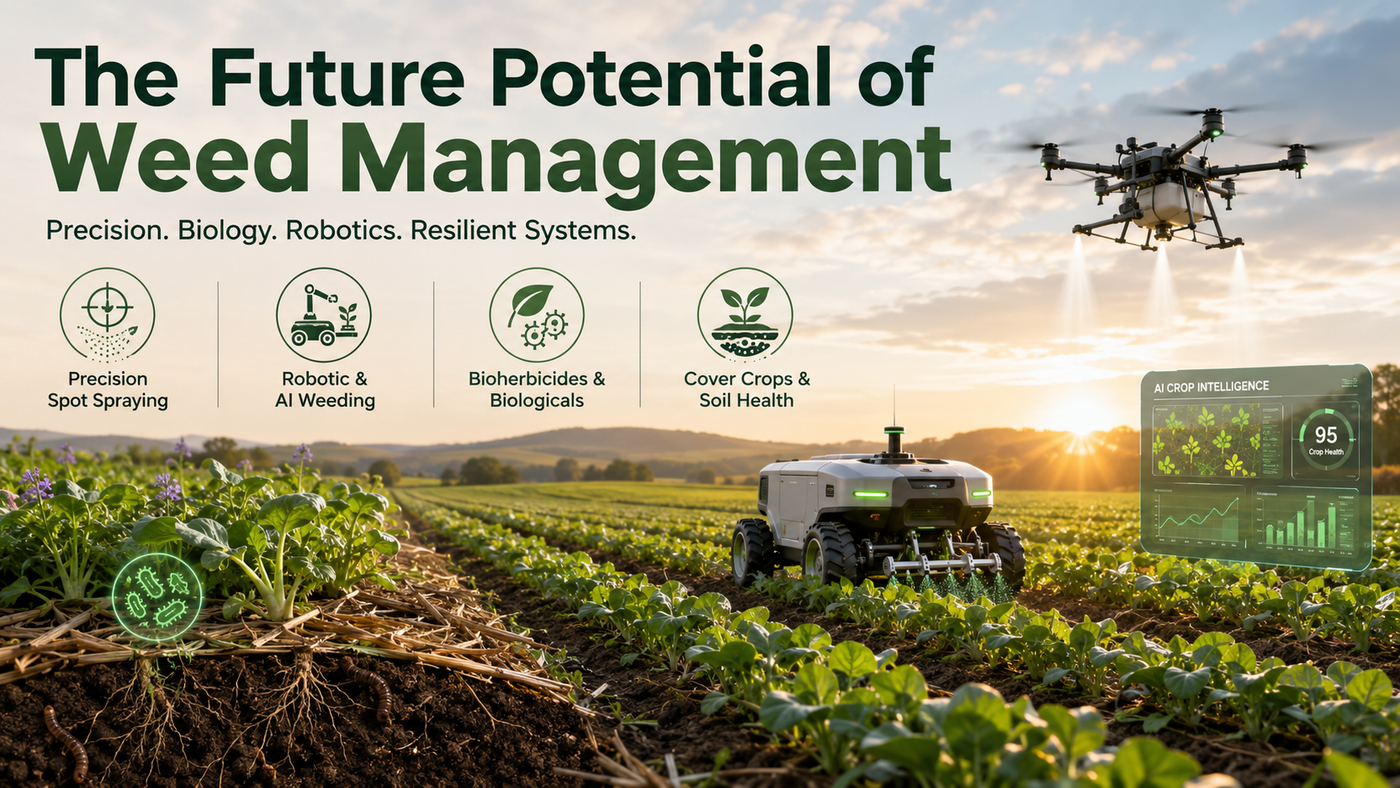
The $42–44B herbicide market is growing at 5–6% CAGR even as 546 resistance cases (IHRWD) and tightening regulation expose its limits. Precision spot-spraying has crossed the chasm; robotics works in specialty crops but unit economics are brutal; RNAi remains pre-commercial after 14 years. Here is the science, the capital, the policy, and what soil-health practitioners should do now.
Editor's Note
Soil Health Exchange has no affiliation with any herbicide manufacturer, AgTech robotics company, or carbon-market program named in this analysis. This piece is a synthesis written for soil-health practitioners; figures are reconstructed from disclosed sources and should be treated as directional where noted.

Weed control is the most acute — and most investable — problem in row-crop agronomy. The global herbicide market is still expanding at 5–6% per year even as the resistance crisis deepens, regulatory pressure tightens in the EU, and litigation circles glyphosate in the U.S. The result is a market that is not shrinking but bifurcating: legacy chemistry continues to grow on rising labor costs and re-treatments, while the fastest-growing segments — precision spot-spraying, bioherbicides, and robotic mechanical/laser weeding — are visibly displacing broadcast spray in the fields where the economics already work.
Brief
The $42–44B herbicide market is growing at ~5–6% CAGR even as 546 species×site-of-action resistance cases (IHRWD) and tightening regulation expose its limits. Precision spot-spraying is winning the near term — John Deere's See & Spray cut non-residual herbicide use ~50% on >5M acres in 2025. Bioherbicides, allelopathic cover crop breeding, and microbiome approaches are promising but commercially immature; spray-induced RNAi weed control is still pre-commercial after 14 years. Capital is flowing to a smaller set of proven precision/robotic leaders. For soil-health practitioners, the right frame is Integrated Weed Management (IWM) — pair precision tech with allelopathic cover crops now; integrate bioherbicides and microbiome tools as they mature.
Key findings
- The herbicide market is bifurcating, not shrinking. Conventional revenue continues to grow, but the fastest-growth segments are precision applicators and bioherbicides — the bioherbicide market alone is forecast to grow from $3.37B (2024) to $7.87B by 2030 at 15.2% CAGR (Grand View Research).
- Resistance is the central driver of innovation. 546 unique cases across 274 weed species and 21 of 31 known sites of action (Heap, weedscience.org, 2026). No novel commercial MoA in 30+ years — until very recent entries like Sumitomo's epyrifenacil.
- Precision spot-spraying has crossed the chasm. ~50% non-residual herbicide reduction on 5M+ acres (Deere, 2025); 43–59% in independent University of Arkansas trials; 70–95% in specialty crops (Ecorobotix ARA, Carbon Bee).
- Robotic non-chemical weeding works in specialty crops but unit economics are brutal. FarmWise — technically successful, 80% hand-weeding reduction in pilots — still ran out of capital and was acquired by Taylor Farms (April 2025).
- Bioherbicides remain niche. Of ~62 documented development programs, only ~5 achieved measurable commercial success.
- RNAi for weed control is "all smoke and no fire" so far (Panozzo et al., 2025). Bayer's BioDirect platform — announced in 2012 with stated weed targets Amaranthus palmeri and Kochia scoparia — has not produced a commercial herbicide product 14 years later.
- EU Farm to Fork is the global pacesetter — but with cracks. –27% in hazardous pesticide use vs. 2015–17 baseline by 2023, but the binding Sustainable Use Regulation (SUR) was withdrawn in February 2024 after farmer protests.
- Glyphosate is in legal but not regulatory jeopardy in the U.S. EPA reaffirms "not likely carcinogenic"; the bigger threat is litigation. Monsanto v. Durnell was argued before the Supreme Court on April 27, 2026, with a decision on FIFRA preemption expected by early July 2026.
1. The current landscape of weed management
Market size
Estimates of the global herbicide market vary by methodology but converge in a tight band — $40–44B in 2024 with a 5.1–6.5% CAGR to 2030.
Global herbicide market — estimates by source
| Source | 2024 size | 2030 projection | CAGR |
|---|---|---|---|
| TechSci Research | $42.15B | $61.48B | 6.49% |
| Grand View Research | $39.5B (2023) | $55.8B | 5.1% |
| Mordor Intelligence | $41.32B | $53.17B (2029) | 5.18% |
| IndexBox | ~$40B | $50.6B | 6.1% (value) |
| InsightAce | $44.14B | $93.75B (2034) | 7.9% |
Five independent research houses converge on a 5–6.5% CAGR. The U.S. herbicide market alone is $11.44B in 2025 → $14.63B by 2030 (Mordor). The bioherbicide sub-segment is small in absolute terms but growing fastest at 15.2% CAGR.
Figure 1 — Global herbicide market, 2020–2030 (consensus mid-range)
Consensus mid-range of disclosed estimates from Grand View, TechSci, Mordor, IndexBox, InsightAce, and DataMIntelligence. Headline CAGR 2024–2030: 5.1–6.5%.
The resistance crisis
The International Herbicide-Resistant Weed Database (Heap, weedscience.org, accessed 2026) reports 546 unique species × site-of-action resistance cases globally in 274 species (156 dicots, 118 monocots), to 168 different herbicides across 21 of 31 known modes of action. ALS inhibitors (~133 cases) and EPSP synthase (glyphosate, 57+ species) are the dominant problems.
Figure 2 — Cumulative herbicide-resistance cases worldwide, 1980–2026 (IHRWD/Heap)
Unique species × site-of-action cases. The first confirmed case was commelina to 2,4-D in 1957. By 2026 the count covered 168 different herbicides across 21 of the 31 known sites of action. Source: weedscience.org (Heap, 2026).
Soil-health and microbiome impacts
Glyphosate and related herbicides exert documented effects on soil microbial communities, particularly EPSPS-bearing rhizobacteria and arbuscular mycorrhizal fungi — though magnitude and persistence are debated. The Frontiers in Soil Science 2022 review (Cordeau et al.) notes U.S. growers spend >$5B annually on herbicides (58% of total pesticide spend), with associated tillage contributing to soil erosion.
Regulatory pressure
Three regulatory storms
1. EU Farm to Fork targets 50% reduction in chemical pesticide use & risk by 2030 — 27% reduction in hazardous pesticide use achieved by 2023. The binding Sustainable Use Regulation (SUR) was withdrawn in February 2024 after farmer protests; targets remain official but non-binding. 2. EPA glyphosate review is mid-stream — the 2020 Interim Decision was vacated by the Ninth Circuit (June 2022); EPA withdrew remaining portions and is conducting a new ESA-compliant review with a human-health risk assessment due in 2026. EPA still classifies glyphosate as "not likely to be carcinogenic to humans." 3. Litigation is the immediate threat. Bayer reports ~67,000 pending cases with $5.9B in legal provisions (April 2025 AGM). Monsanto v. Durnell, on whether FIFRA preempts state failure-to-warn claims, was argued before SCOTUS on April 27, 2026, with a decision expected by early July 2026.
2. Alternative & emerging approaches
(a) Biological weed control — bioherbicides and mycoherbicides
Plant-pathogenic fungi dominate the commercial pipeline. Per a 2022 Plants review (Roberts et al., PMC9460325), at least 16 mycoherbicide products have been developed for commercial use; common genera include Colletotrichum, Phoma, Alternaria, Fusarium, Phytophthora, Puccinia, Phomopsis. Notable examples:
- BioMal (Colletotrichum gloeosporioides f.sp. malvae) — round-leaved mallow; first Canadian-registered bioherbicide.
- Collego/LockDown — northern jointvetch in rice.
- Di-Bak Parkinsonia™ — Australian stem-injected capsule for invasive Parkinsonia aculeata.
- Toothpick Company Striga product — Fusarium oxysporum f. sp. strigae seed coating; Kenya approval June 2023; 2024 Sankalp Africa Award.
- Phoma macrostoma — broadleaf turf bioherbicide.
Hard limitations
Narrow host range (commercial liability), short shelf life (live spores), dew/humidity requirements for infection, and a stark gap between lab and field — of ~62 documented bioherbicide development programs, only ~5 reached measurable commercial success.
(b) Precision/robotic mechanical weeding
The most commercially advanced alternative category. Major players have raised substantial late-stage capital even as the broader AgTech market has tightened.
Largest 2022–2025 weed-management rounds (selected)
| Company | Round | Amount | Date | Lead |
|---|---|---|---|---|
| Carbon Robotics | Series D | $70M | Oct 2024 | BOND |
| Enko Chem | Series C (incl. ext) | $80M (total) | 2022–23 | Nufarm + Eight Roads |
| Verdant Robotics | Series A | $46.5M | Nov 2022 | Cleveland Avenue |
| FarmWise | Series B | $45M | 2021 | Fall Line, Middleland |
| Naïo Technologies | Growth | €32M ($33M) | 2023 | Mirova |
| SwarmFarm | Series B | A$30M | Oct 2025 | Edaphon |
| Aigen | Series A | $12M | Nov 2023 | ReGen Ventures |
| FarmDroid | Growth | €10.5M | Oct 2024 | Convent Capital |
| Red Barn Robotics | Pre-seed | $500K | Mar 2025 | YC |
| Tortuga AgTech | Series A | $20M | Apr 2021 | Lewis & Clark AgriFood |
Capital has tightened (CropLife's Crunchbase analysis shows 736 AgTech startups raised a flat $5.7B in 2024) but flowed to a smaller set of proven weed-management leaders. Notable acquisitions: Trimble→Bilberry (Aug 2022), Kubota→Bloomfield (Q3 2024), John Deere→Blue River ($305M, 2017 — antecedent of See & Spray), Oishii→Tortuga (Mar 2025), Taylor Farms→FarmWise (Apr 2025).
Cautionary tale: FarmWise (April 2025)
FarmWise's Vulcan was priced at $645K MSRP + $45K/year service and delivered 10–15% yield increases and 80% hand-weeding reduction in pilots. The company still ran out of capital and was acquired by Taylor Farms days after shutdown. Lesson: even technologically successful robotics companies face brutal unit economics, and vertical integration with a strategic buyer may be the surviving business model.
(c) Allelopathy and cover crop suppression
Cereal rye (Secale cereale) is the most-studied allelopathic cover crop. Mechanisms include benzoxazinoid (BX) exudation plus competition for light/nutrients and physical mulch suppression of small-seeded weeds.
- Maryland no-till study: rye residue reduced total weed density by an average of 78% when residue covered >90% of soil (SARE).
- California study: 99% weed density reduction under high rye residue.
- Living rye exudes low levels of benzoxazinoids; residues release 12–20 kg/ha of BX (Schulz et al., 2013).
- The Cover Crop Breeding Network (NC State, USDA-ARS, Maryland, NY, Wisconsin, MN) is breeding cereal rye for high allelopathy + biomass.
Caveat from extension services
Iowa State and Wisconsin IPCM extension caution that under field conditions, the dominant mechanism appears to be competition and physical suppression — not chemical allelopathy. Breeding for "allelopathy" may in practice be breeding for vigor and biomass.
(d) Precision/smart herbicide application
The category most rapidly displacing broadcast spray. John Deere's See & Spray is the leader by scale; Ecorobotix's ARA platform leads in specialty crops.
Figure 5 — Reported herbicide reduction by precision platform
Reported herbicide-savings ranges from vendor case studies and independent extension trials. Ecorobotix is unique in supporting both selective and non-selective herbicides. Carbon Robotics' LaserWeeder replaces chemistry entirely (100%).
Application Savings Guarantee (Deere, 2025)
John Deere now offers $1/fallow acre and $5/in-crop acre paid only when actual savings are delivered. This is the first significant outcome-based pricing in precision spray — a meaningful de-risking of adoption for row-crop operators.
(e) UAV/drone-based application and scouting
Drones are now widely used for weed mapping (UAV imagery → patch-spray maps); patch spraying based on UAV maps yields 40–60% herbicide savings without weed control loss (Gerhards et al., 2022). Aerial spraying with drones is expanding rapidly in row crops and orchards, particularly in Brazil, China, and increasingly the U.S. Notable companies: XAG, DJI Agras, Hylio, Rantizo, Guardian Agriculture.
(f) Synthetic biology and RNA interference (RNAi) herbicides
Status: pre-commercial after 14 years
Monsanto's BioDirect™ platform was announced in 2012 with original patent (US20110296556A1) targeting Amaranthus palmeri and Kochia scoparia. Per Panozzo et al. (Pest Management Science, 2025): "Despite the promotion and the very suggestive premises of SIGS [spray-induced gene silencing], no commercial product reached the market" for weed control. Bayer's 2024 innovation pipeline lists Icafolin (small-molecule new MoA), TriVolt, and AgPlenus-licensed APTH1-inhibitor — but no RNAi herbicide. The first commercial RNAi pesticide is GreenLight Biosciences' Calantha™ (ledprona, EPA-approved 2024) — for Colorado potato beetle, not weeds.
Bottleneck: Foliar-applied dsRNA does not yet achieve systemic silencing of endogenous genes in most plant species under field conditions (Frontiers Plant Science, 2020).
(g) Soil microbiome manipulation
A research frontier with no commercial weed products yet. Foundational reviews include Trognitz et al. (FEMS Microbiology Ecology, 2016) and Cordeau et al. (Frontiers in Soil Science, 2022). Approaches under investigation: deleterious rhizobacteria (DRB) that selectively suppress weed seedlings (e.g., Pseudomonas fluorescens strains against downy brome; Kennedy et al. 1991); seed coatings with crop-supportive endophytes; biocrust manipulation. This is a 5–10 year horizon — practitioners can run on-farm trials but should not yet expect proprietary inputs.
(h) Optical/flame/steam/electrical weeding
- Flame weeding (propane): commercially established in organic carrots, onions, garlic.
- Steam weeding: organic specialty crops; high energy cost.
- Electrical: crop.zone Volt.Fuel hybrid (potatoes for haulm destruction, expanding), Zasso XPower (non-selective in vineyards/orchards/railways), RootWave (perennial weeds and stumps).
3. Startup & investment landscape
Per CropLife's Crunchbase analysis (Kyle Welborn, Cultivation Capital), 736 AgTech startups raised $5.7B globally in 2024 — "a flat level of funding and a small decrease in deals from 2023." The larger ~47% YoY drop occurred in 2023 vs. the 2022 peak. Robotics startups saw a $135M funding increase YoY in 2024 while CEA dropped $125M. Capital flight-to-quality favored proven late-stage weed-management players.
Figure 4 — Estimated VC investment in alternative weed management, 2018–2025
Author estimates aggregated from disclosed rounds. AgTech VC reporting (PitchBook, Crunchbase, AgFunder) does not separately tag "weed management," so these are reconstructed and should be treated as directional. 2022 peak driven by Enko ($70M), Verdant ($46.5M), and Naïo preparation; 2024 by Carbon Robotics ($70M Series D) and FarmDroid (€10.5M).
Key VC archetypes
- Climate/regen specialists: ReGen Ventures, Cleveland Avenue, S2G Ventures, Prelude Ventures, DCVC Bio, Tenacious Ventures, Emmertech, Edaphon, Astanor Ventures.
- Strategic corporate venture: NVIDIA NVentures, Bayer's Leaps, Syngenta Group Ventures, BASF Venture Capital, Cultivate Next (Chipotle), Taylor Farms.
- Bill & Melinda Gates Foundation: major backer of Enko, especially for sub-Saharan Africa / Striga-control applications.
Corporate R&D pivots
Big-five corporate weed-management pipelines (2024–2026)
| Company | Notable programs |
|---|---|
| Bayer | Icafolin (new MoA), TriVolt, AgPlenus APTH1 partnership (Feb 2024), SmartStax PRO/VT4PRO RNAi traits (insect, not weed) |
| BASF | Surtain (encapsulated corn herbicide, 2023 launch); Luximo (cinmethylin) for ALS-resistant grasses |
| Corteva | Reklemel, Rinskor (florpyrauxifen-benzyl) |
| Syngenta | Tymirium (nematicide); active Enko collaboration; GreenLight RNAi partnership (Colorado potato beetle) |
| FMC | Isoflex (active fluindapyr) |
| Sumitomo | Epyrifenacil — novel PPO inhibitor, only major new MoA in 30+ years |
After a 30-year drought in novel modes of action, two of the most interesting weed-MoA programs sit at Sumitomo (epyrifenacil) and Bayer (Icafolin). Neither is RNAi.
4. Performance & comparative data
Comparative scorecard — efficacy, cost, soil impact, readiness
| Approach | Efficacy | Typical $/acre | Soil/microbiome impact | Commercial readiness |
|---|---|---|---|---|
| Broadcast glyphosate | 85–95% (susceptible); resistance widespread | $10–25 | Documented rhizosphere shifts; low soil persistence | Mature; cheap |
| Spot spray (See & Spray, ARA) | Equivalent to broadcast | $5–15 chemical + capital | Reduced soil chemical load 50–95% | Commercial, scaling |
| Laser weeding (LaserWeeder G2) | >95% in specialty crops | High capital ($1M+); 1–3 yr payback | Zero soil disturbance, no chemical | Commercial in specialty crops |
| Mechanical robot (Vulcan/Naïo/Aigen) | 80–95% | $645K MSRP (Vulcan) | Some soil disturbance; no chemical | Specialty; broadacre emerging |
| Cereal rye allelopathy | 50–99% (small-seeded annuals) | $30–60 (seed+termination) | Strong positive (OM, microbiome) | Mature practice; new breeding emerging |
| Bioherbicides (mycoherbicides) | 60–90% on target species | Variable | Generally neutral-positive | ~5–16 products globally; niche |
| RNAi herbicides | Lab only (45–75% effects) | n/a | Likely benign | Pre-commercial; 14 years |
| Microbiome suppression | Research stage | n/a | Positive by design | Pre-commercial; 5–10 yr horizon |
| Flame/steam/electrical | 70–95% (top growth) | $50–200+ (energy) | Soil heating; emissions | Commercial in organic, niche |
The decision is rarely "one technology vs. another." The economically dominant choice is to layer precision spot-spraying with allelopathic cover crops today, and prepare to integrate bioherbicides and microbiome tools as they mature.
Figure 3 — Technology landscape across five dimensions (1–5 relative scores)
Higher is better for every row (regulatory risk and cost are inverted so 5 always = favorable). No single approach scores well on every dimension — the case for IWM is structural.
5. Bottlenecks & challenges
- Biological: shelf life of live spores; narrow host range; environmental sensitivity (dew, temperature); regulatory pathway — EPA Section 25(b) "minimum risk" vs. full FIFRA registration costs $5–10M.
- Robotic: $100K–$1M+ capex; throughput 1–5 acres/hour for laser/mechanical (vs. 30–60 acres/hour for sprayers); crop damage tolerance; data infrastructure (Starlink-class connectivity); fleet logistics.
- Allelopathy: residue interference with planters; corn yield drag under late-killed high-biomass rye; N immobilization; small-seed weeds suppressed more than large-seeded.
- RNAi: systemic silencing not yet achieved under field conditions; off-target effects in non-target plants; environmental persistence of dsRNA; public/regulatory acceptance.
- Data/AI: training data scarcity for less common weed species and cropping systems outside U.S./EU specialty crops.
- Economic: generic glyphosate sells for $4–8/gallon in 2025; cost-competitiveness of alternatives requires resistance pressure, regulatory pricing-in, or labor savings.
- Regulatory: EU SUR collapse leaves a Member-State patchwork; EPA's ESA-compliant reviews are creating year-long backlogs; biocontrol registration globally lacks harmonization.
6. What needs to happen — gaps and path forward
Research priorities
- Field-validated quantification of cereal rye and sorgoleone allelopathy genetics — close the lab-to-field translation gap.
- Microbiome consortia screening for weed seedbank suppression (deleterious rhizobacteria as biocontrol).
- dsRNA delivery chemistry (nanoparticle, lipid encapsulation) to achieve systemic silencing in weeds.
- New small-molecule modes of action — the 30-year drought is the single greatest scientific risk.
- Combined biocontrol–chemical formulations (synergies of bioherbicides with reduced glyphosate doses showed up to 100% efficacy enhancement per Aneja 2024).
Policy & regulatory reforms
- EPA harmonization of bioherbicide registration (lower data requirements for low-risk biological actives).
- EU restoration of SUR-equivalent binding targets paired with farmer compensation linked to demonstrated IWM adoption.
- Federal IWM cost-share (USDA EQIP/CSP) extension to robotic and precision spray adoption, not just cover crops.
- A clear FIFRA preemption framework — Monsanto v. Durnell (decision expected by early July 2026) would substantially de-risk innovation in adjacent chemistries.
Infrastructure and data commons
- Open weed-image dataset (analogous to ImageNet) covering minor crops and global biotypes — currently each robot company duplicates this at enormous cost.
- Resistance reporting upgrades to weedscience.org (IHRWD) with georeferenced spread data.
- Connectivity infrastructure (Starlink/rural fiber) for cloud-trained AI model updates in field robotics.
7. Recommendations for soil-health practitioners
Now (2026)
1. Pair allelopathic cover crops with terminate-and-plant green technologies in row crops. Adopt cereal rye varieties from the Cover Crop Breeding Network as they become commercially available; roller-crimp ahead of soybeans, plant green into corn with reduced PRE herbicide. Document weed pressure changes for 2–3 seasons. 2. For specialty growers facing $300/acre+ hand-weeding bills, run a 6-month paid trial with Carbon Robotics, Verdant, FarmWise (now Taylor Farms-owned), Naïo, or Aigen. At current labor inflation, 1–3 year payback is realistic if labor exceeds $200/acre. 3. Convert from broadcast to spot-spray on corn/soy/cotton acres ≥1,000 acres. Deere's Application Savings Guarantee substantially de-risks adoption. 4. Audit your rotation for resistance pressure using local extension data and the IHRWD; if Palmer amaranth or waterhemp resistance is documented within 50 miles, prioritize the above three steps.
Within 12–24 months
5. Pilot mycoherbicide products where available for your weed targets (e.g., Phoma macrostoma for turf broadleaf, Striga seed coatings in Africa). Treat as 30–60% control add-ons, not replacements. 6. Build farm-scale weed imagery datasets if you have agronomic data infrastructure — these will become a marketable asset to AI players or training data buyers. 7. Engage policy advocacy for binding U.S. herbicide-resistance management plans and EPA biocontrol pathway harmonization.
Within 3 years
8. Watch RNAi commercial pipelines — if Bayer, GreenLight, or Syngenta announce field-scale spray-induced gene silencing herbicides, evaluate. Until then, treat as long-horizon R&D. 9. Watch microbiome consortia — first commercial weed-suppressive microbial products may emerge by 2028–2030 from companies like Pivot Bio and Indigo Ag (currently nitrogen/biostim focused, with R&D in microbial pest control).
Benchmarks that should change these recommendations
- Generic glyphosate price doubles → accelerate adoption of all alternatives.
- A novel small-molecule MoA achieves >70% control of multi-resistant Amaranthus at <$30/acre → conventional chemistry regains dominance for 5–10 years.
- U.S. Supreme Court rules against FIFRA preemption (Monsanto v. Durnell, expected by early July 2026) → expect substantial herbicide label changes and price increases.
- See & Spray Application Savings Guarantee penetration exceeds 25% of U.S. row-crop acres → spray-tech investment thesis is proven; capital flows to robotic mechanical/laser for specialty.
- If Bayer CEO Bill Anderson's April 2025 warning materializes — "we're nearing a point where the litigation industry could force us to even stop selling this vital product" — alternative weed management becomes urgent, not strategic.
Caveats
- Market sizing variance: Herbicide market estimates vary by 15–25% in any given year due to differing scopes (e.g., whether turf/non-crop is included). The 5.1–6.5% CAGR range is robust across sources.
- Resistance spread rates: Popular figures of 15–20 miles/year for wind-dispersed glyphosate resistance overstate the modeled rate; Iowa State extension citing Liu et al. (2010) predicts ~3 miles/year via pollen dispersal. Field-observed spread is influenced by combine and equipment movement.
- Resistance data underreports: IHRWD relies on researcher submissions; on-farm resistance prevalence is likely 1.5–2× reported cases (per Comont et al. 2023 bioRxiv).
- Robotic ROI claims come largely from vendor case studies. Independent extension validation lags by 1–2 seasons in most cropping systems.
- FarmWise's April 2025 shutdown is a material risk signal for the robotic weeding sector — even technologically successful companies face capital headwinds.
- EU regulatory trajectory uncertain post-SUR withdrawal. Farm to Fork numerical targets remain official policy but are no longer binding.
- EPA glyphosate timing: A new human-health risk assessment is due in 2026; if it changes the carcinogenicity classification, the entire competitive landscape shifts.
- RNAi: Public information on Bayer's internal BioDirect weed program is opaque post-2021; advanced but undisclosed development cannot be ruled out.
- VC totals in Figure 4 are author estimates aggregated from disclosed rounds — AgTech VC reporting does not separately tag "weed management."
- Soil microbiome–weed interactions literature is genuinely promising but small; commercial products are 5–10 years out and could fail entirely.
Written by
Soil Health Exchange Research Desk
Synthesis prepared by the Soil Health Exchange editorial research desk, drawing on the International Herbicide-Resistant Weed Database, peer-reviewed agronomy literature, vendor disclosures, and AgTech investment reporting.
Scholarly record
References & Citation
Source material for every claim in this article, plus a citation-ready record for reference managers and scholarly indexes.
Cite this
Reference this work
Soil Health Exchange Research Desk (2026). The Future of Weed Management: Science, Investment, and the Path Beyond Glyphosate. Soil Health Exchange. SHE-ART-2026-0009. https://soilhealthexchange.com/cite/SHE-ART-2026-0009
Soil Health Exchange assigns a stable identifier to every published answer and article. Citations keep working even if the URL changes later.
Sources (40)Show sources
- 1.Heap, I. The International Herbicide-Resistant Weed Database (IHRWD), weedscience.org, accessed May 2026.
- 2.Weed Science Society of America (2016). Estimated economic impact of uncontrolled weeds in U.S. and Canadian corn and soybean.
- 3.Kubiak, A. et al. (2022). Global yield-loss potential from weeds across major crops.
- 4.Cordeau, S. et al. (2022). Opportunities for Microbiome Suppression of Weeds Using Regenerative Agricultural Technologies. Frontiers in Soil Science.
- 5.Trognitz, F., Hackl, E., Widhalm, S., & Sessitsch, A. (2016). The role of plant-microbiome interactions in weed establishment and control. FEMS Microbiology Ecology.
- 6.Roberts, J. et al. (2022). Mycoherbicides — a review of commercial development. Plants, PMC9460325.
- 7.Panozzo, S. et al. (2025). Spray-induced gene silencing for weed control — all smoke and no fire? Pest Management Science.
- 8.Rebong, D. et al. (2024). Breeding cereal rye for cover-crop allelopathy and biomass. Weed Science.
- 9.Schulz, M. et al. (2013). Benzoxazinoid release from cereal rye residue.
- 10.Gerhards, R. et al. (2022). UAV-based weed mapping and patch spraying — herbicide savings of 40–60%.
- 11.Kennedy, A.C. et al. (1991). Pseudomonas fluorescens strains suppressing downy brome (Bromus tectorum).
- 12.Liu, J. et al. (2010). Modeled spread of glyphosate resistance via pollen dispersal — Iowa State extension reference.
- 13.Aneja, K.R. (2024). Synergy of bioherbicides with reduced-rate glyphosate.
- 14.Comont, D. et al. (2023). On-farm prevalence of herbicide resistance — under-reporting estimates. bioRxiv.
- 15.Grand View Research — global herbicide and bioherbicide market reports (2024).
- 16.TechSci Research — global herbicides market 2024–2030.
- 17.Mordor Intelligence — U.S. and global herbicide market reports (2024–2025).
- 18.IndexBox; InsightAce Analytic — herbicide market estimates 2024–2034.
- 19.European Commission — Farm to Fork pesticide reduction progress reports (2023).
- 20.European Commission — Sustainable Use Regulation (SUR) withdrawal notice, February 2024.
- 21.U.S. EPA — Glyphosate Interim Decision (2020), Ninth Circuit vacatur (June 2022), and ongoing ESA-compliant re-review.
- 22.Bayer AG Annual General Meeting disclosures (April 2025) — Roundup litigation provisions ($5.9B; ~67,000 pending cases).
- 23.Monsanto v. Durnell — U.S. Supreme Court oral argument, April 27, 2026 (FIFRA preemption). SCOTUSblog.
- 24.Wall Street Journal — Bayer CEO Bill Anderson interview, March 2025; AGM remarks April 25, 2025.
- 25.John Deere — See & Spray 2024 and 2025 performance disclosures; Application Savings Guarantee (2025).
- 26.Norsworthy, J.K. et al. — University of Arkansas See & Spray field trials.
- 27.Carbon Robotics — LaserWeeder G2 product disclosures and Series D announcement (BOND, October 2024).
- 28.Verdant Robotics — SharpShooter and Series A disclosures (Cleveland Avenue, November 2022).
- 29.FarmWise / Taylor Farms — shutdown and acquisition announcements, April 2025.
- 30.Naïo Technologies — €32M growth round (Mirova, 2023) and deployment disclosures.
- 31.SwarmFarm Robotics — A$30M Series B announcement (Edaphon, October 2025).
- 32.Aigen — Series A disclosure (ReGen Ventures, November 2023) and Bowles Farming partnership (April 2025).
- 33.Ecorobotix — ARA platform technical and performance disclosures.
- 34.Trimble — Bilberry acquisition announcement (August 2022); WeedSeeker 2 product disclosures.
- 35.CropLife / Cultivation Capital (Kyle Welborn) — Crunchbase AgTech funding analysis 2023–2024.
- 36.GreenLight Biosciences — Calantha™ (ledprona) EPA approval, first commercial RNAi pesticide (2024).
- 37.Bayer Crop Science — 2024 innovation pipeline disclosures (Icafolin, TriVolt, APTH1 partnership).
- 38.Sumitomo Chemical — epyrifenacil (novel PPO inhibitor) commercial disclosures.
- 39.SARE — Managing Cover Crops Profitably; Maryland and California cereal rye weed suppression studies.
- 40.Cover Crop Breeding Network — NC State, USDA-ARS, Maryland, NY, Wisconsin, MN.
Cite this articleShow formats
Cite this article
Citation-ready record
APA
Soil Health Exchange Research Desk (2026). The Future of Weed Management: Science, Investment, and the Path Beyond Glyphosate. Soil Health Exchange. https://soilhealthexchange.com/blog/future-of-weed-management-beyond-glyphosate
More citation formats
MLA
Soil Health Exchange Research Desk. "The Future of Weed Management: Science, Investment, and the Path Beyond Glyphosate." Soil Health Exchange, 2026-05-22, https://soilhealthexchange.com/blog/future-of-weed-management-beyond-glyphosate.
Chicago
Soil Health Exchange Research Desk. "The Future of Weed Management: Science, Investment, and the Path Beyond Glyphosate." Soil Health Exchange. Published 2026-05-22. https://soilhealthexchange.com/blog/future-of-weed-management-beyond-glyphosate.
Citation metadata is provided for discovery tools and reference managers. Inclusion in external scholarly indexes is not guaranteed.


Discussion
No comments yet. Be the first to share your thoughts!