
The acronyms look almost identical, which is why reports are often misread. PLFA means phospholipid fatty acid. NLFA means neutral lipid fatty acid. The important difference is not the instrument at the end of the analysis; it is the lipid fraction separated from the sample before the fatty acids are measured.
NLFA and PLFA at a glance
| Feature | PLFA | NLFA |
|---|---|---|
| Full name | Phospholipid fatty acid | Neutral lipid fatty acid |
| Main biological pool | Cell-membrane phospholipids | Neutral storage lipids, especially triacylglycerols in fungi |
| Common soil use | Total microbial biomass proxy and broad community fingerprint | Storage-lipid or reserve-carbon proxy; targeted use for AMF |
| AMF-associated marker | PLFA 16:1ω5, with a disputed bacterial background in mixed soil | NLFA 16:1ω5, generally more sensitive and specific for AMF-associated biomass |
| Does it identify species? | No | No |
| Does it measure activity or crop benefit? | No | No |
Start with the lipid, not the acronym
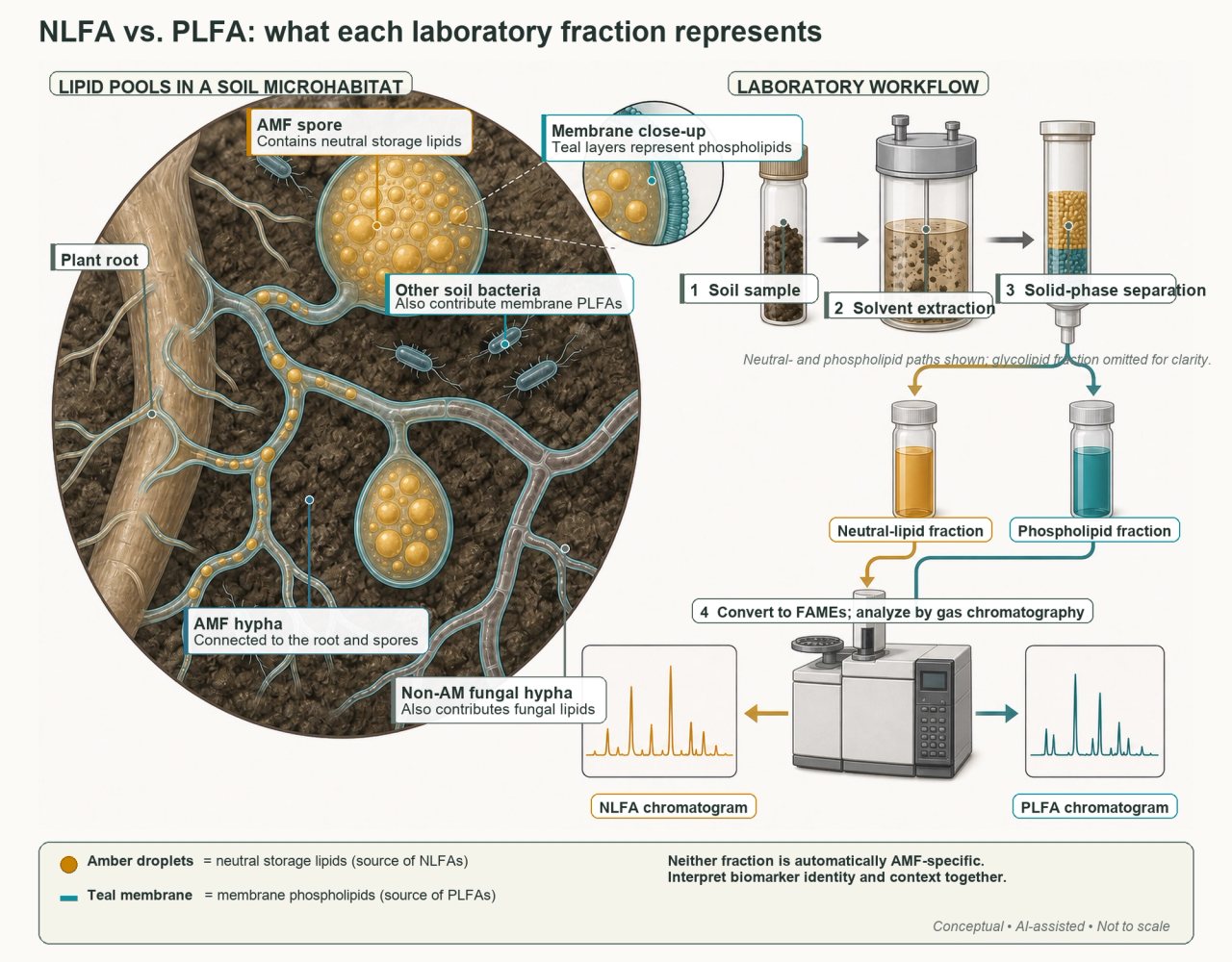
A fatty acid is a chemical building block that can occur in several kinds of lipids. Phospholipids form much of the membrane around microbial cells. Neutral lipids are uncharged compounds used prominently for energy and carbon storage. AMF store large quantities of lipids in spores, vesicles, and mycelium. The same fatty acid can therefore occur in both a membrane phospholipid and a neutral storage lipid; the fraction tells you which pool the laboratory recovered [2][5][6].
How the laboratory produces the number
- Collect and preserve the soil. The sample is kept under the laboratory's specified temperature and holding time so the living community does not change before extraction.
- Extract the lipids. An organic-solvent mixture removes a broad set of lipids from a known mass of soil.
- Separate lipid classes. Solid-phase chromatography separates neutral lipids from glycolipids and polar phospholipids. This fractionation is what distinguishes NLFA from PLFA.
- Convert fatty acids to methyl esters. A chemical reaction produces fatty-acid methyl esters that are suitable for gas chromatography.
- Separate and quantify the peaks. Gas chromatography identifies compounds by retention behavior and measures them relative to standards.
- Apply biomarker rules. The laboratory sums selected peaks into categories such as total PLFA, Gram-positive bacterial markers, Gram-negative bacterial markers, saprotrophic fungal markers, or AMF-associated 16:1ω5 [1][2][3].
The method produces a chemical fingerprint, not a microscope image, culture, or DNA identification. Several organisms can share a fatty acid, and one organism contains many fatty acids. Group assignments are therefore proxies defined by a biomarker list, not a taxonomic census [1][2].
What PLFA can tell you
Total PLFA concentration is widely used as a proxy for microbial biomass because phospholipids are central membrane components and generally do not accumulate as long-lived soil residues. A controlled paddy-soil incubation found half-lives of 14–27 hours for added phospholipids at 25°C, with an average near 20 hours; turnover was nearly twice as slow at 15°C [4]. This supports the membrane-biomass interpretation, but the exact values are not universal decay constants for every soil.
Rapid phospholipid turnover in one controlled soil study
| Measure | Value |
|---|---|
| Shortest measured half-life | 14 hours |
| Average total phospholipid half-life | 20 hours |
| Longest measured half-life | 27 hours |
Individual or summed PLFA markers can also reveal whether two samples have different lipid profiles. That makes PLFA useful for monitoring a management change, land-use contrast, contamination gradient, or treatment experiment. It is rapid and sensitive to community shifts, but it cannot resolve individual species and should not be converted into a conventional species-diversity index [1][2].
How to read common PLFA outputs
| Report line | Defensible meaning | What it does not mean |
|---|---|---|
| Total PLFA | Sum of quantified phospholipid fatty acids under that protocol; a broad living-microbial-biomass proxy | Total cells, activity, diversity, or universal soil health |
| Bacterial PLFA | Sum of fatty acids the laboratory assigns to bacterial groups | Every bacterium or a species count |
| Fungal PLFA | One or more fungal-associated membrane markers, often including 18:2ω6,9 | All fungi; plant tissue can contribute some markers |
| AMF PLFA 16:1ω5 | A membrane-associated fatty acid that may include AMF and non-AMF background | A stand-alone AMF census in mixed soil |
| Fungal:bacterial ratio | Ratio of the laboratory's selected fungal marker sum to its selected bacterial marker sum | A literal biomass ratio or a universal optimum |
| Stress ratios | Changes in selected fatty-acid ratios that may be consistent with physiological or community shifts | A diagnosis of the cause of stress |
What NLFA can tell you
NLFA analysis measures fatty acids in neutral lipids. In fungi, that fraction commonly represents stored energy and carbon reserves rather than cell membranes. For AMF, the fatty acid 16:1ω5 can be abundant in neutral lipids of spores, vesicles, and mycelium. Controlled work linked spore number most strongly with NLFA 16:1ω5, while hyphal length related more closely to the phospholipid fraction in that experimental system [5][6].
A later comparison grew maize in three soils and compared root colonization and spore density with three lipid methods. NLFA 16:1ω5 had the highest correlation with spore counts. PLFA 16:1ω5 was not significantly correlated with spore density and did not reproducibly correlate with root colonization [7]. That study supports NLFA as an AMF-associated storage-biomass proxy, not as a substitute for every AMF measurement.
The hard question: can PLFA 16:1ω5 measure AMF?
In a sterile or otherwise well-controlled AMF experiment, PLFA 16:1ω5 can track membrane-rich AMF mycelium. The difficulty is assigning the same peak in mixed field soil. Olsson and Lekberg's 2022 review found that more than half of published studies had used PLFA 16:1ω5 to quantify AMF biomass without controls that could estimate the non-AMF contribution. They argued that bacterial background cannot be separated reliably and recommended NLFA 16:1ω5 for more accurate and sensitive AMF biomass assessment [8].
There is a published scientific disagreement. Joergensen argued that there is no experimental evidence for marked amounts of PLFA 16:1ω5 in Gram-negative bacteria and supported its use as an AMF indicator [2]. A multi-author response concluded that specificity remains uncertain and recommended NLFA unless a control estimates contributions from other microbes [9]. The careful interpretation is therefore not that PLFA 16:1ω5 is useless, nor that it is universally AMF-specific: its strength depends on the sample, comparison, and controls.
When the 16:1ω5 marker is more or less convincing
| Situation | Interpretation strength | Reason |
|---|---|---|
| Controlled AMF culture with a matched non-mycorrhizal control | Stronger for PLFA and NLFA | Background 16:1ω5 can be estimated |
| Field soil with NLFA 16:1ω5 and standardized comparison | Useful AMF-associated biomass proxy | Neutral fraction is generally more responsive and has less bacterial interference |
| Field soil with PLFA 16:1ω5 but no control | Weak as a stand-alone AMF estimate | AMF and non-AMF contributions cannot be separated confidently |
| Generic fungal PLFA or fungal:bacterial ratio | Not an AMF measurement | Pools broad groups and depends on the laboratory's marker definitions |
What about the NLFA:PLFA ratio?
The ratio of NLFA 16:1ω5 to PLFA 16:1ω5 has been used in controlled AMF studies as an index of carbon allocation to storage relative to membranes, sometimes described as fungal nutritional status. In the 1997 phosphorus experiment, the ratio changed with phosphorus supply [6]. But both numerator and denominator inherit the marker and extraction limitations, and the PLFA denominator may include non-AMF background. There is no universal ratio that defines a healthy field, an active fungus, or an optimal crop–AMF partnership.
Evidence snapshot: the methods do not move together
What selected studies actually found
| Evidence | Data or result | Lesson |
|---|---|---|
| Controlled AMF phosphorus experiment [6] | Spore number related most closely to NLFA 16:1ω5; hyphal length to PLFA 16:1ω5 | The lipid fraction changes the biological pool represented |
| Maize grown in three soils [7] | NLFA had the highest correlation with spore counts; PLFA did not significantly correlate with spores and was inconsistent for root colonization | One AMF endpoint cannot be inferred reliably from another |
| 2022 critical review [8] | More than half of reviewed studies used PLFA 16:1ω5 for AMF biomass without proper controls | Published use does not guarantee valid specificity |
| Three-year cover-crop field study [10] | Propagule counts and NLFA C16:1cis11 were the most consistently responsive AMF measures; PLFA response was marginal | Treatment sensitivity and crop-performance relevance are separate questions |
| Seventeen prairie soils under alternative handling [11] | Air-drying, room-temperature storage, and oven-drying all caused significant PLFA losses and shifted biomarker ratios | Sample handling can change both totals and apparent community structure |
Units matter as much as the biomarker
Absolute lipid results are commonly reported as nanomoles of a fatty acid per gram of dry soil, but laboratories may use other mass, volume, or moisture bases. Relative abundance may be reported as mole percent of the detected lipid pool. These are not interchangeable: mole percent can rise because one marker increased or because other markers decreased. A value per gram of field-moist soil cannot be compared directly with a value per gram of oven-dry soil without a moisture correction.
- nmol g−1 dry soil: an absolute concentration under the stated extraction and calibration.
- mol%: the marker's share of the quantified lipid pool; compositional, not absolute.
- Total PLFA: a sum whose included peaks and detection limits may differ by laboratory.
- Group biomass: a biomarker sum, sometimes converted with a factor; ask whether the conversion is directly validated for that sample type.
- Ratio: a quotient of two marker sums; uncertainty and interference in both parts affect the result.
Sampling and storage can dominate the result
Lipids respond to roots, crop stage, moisture, temperature, depth, residue placement, and recent management. They can also change after collection. In the 17-soil handling study, all tested alternatives to fresh, promptly lyophilized material—including air-drying, field-moist room-temperature storage, and oven-drying—lost PLFA markers, and microbial groups were affected disproportionately [11]. That means a shifted fungal:bacterial ratio can be a storage artifact rather than a field response.
- Ask the laboratory before sampling. Use its container, cooling or freezing instructions, maximum holding time, and shipping method.
- Fix the soil depth and position. A root-zone sample and a bulk-soil sample answer different questions.
- Composite consistently. Use the same number and pattern of cores, but preserve independent field replicates when statistical inference is needed.
- Record soil moisture and crop stage. Sample comparisons made after different weather or at different growth stages can confound treatment with time.
- Do not compare fresh and dried protocols. Keep preservation and dry-mass correction identical.
- Use the same laboratory and method over time. Cross-laboratory differences in extraction, peak identification, marker sums, and reporting can be larger than the management effect.
Which test should you choose?
Match the test to the question
| Question | Best starting method | Useful confirmation |
|---|---|---|
| Did broad living microbial biomass change? | Total PLFA with standardized sampling | Microbial biomass C and a process measurement such as respiration |
| Did the broad lipid profile change? | PLFA profile analyzed multivariately | Targeted DNA or process data chosen in advance |
| Did AMF-associated soil biomass change? | NLFA 16:1ω5 with consistent controls and units | Root colonization microscopy plus infective-propagule or hyphal measurement |
| Are crop roots colonized by AMF? | Cleared and stained root microscopy | AMF-targeted qPCR when taxonomic scope is validated |
| Is an AMF product viable? | Host-plant bioassay in controlled substrate | Root microscopy and a viable positive control |
| Did AMF improve nutrient delivery or yield? | Controlled field or mesh-compartment experiment with plant endpoints | Plant tissue nutrients, yield, and an isotope tracer when causal pathway matters |
Questions to ask a commercial laboratory
- Are you measuring PLFA, NLFA, or both, and are the fractions separated before analysis?
- Which exact fatty acids are included in total bacteria, fungi, AMF, Gram-positive, and Gram-negative categories?
- Is 16:1ω5 reported separately in the neutral and phospholipid fractions?
- What unit and moisture basis are used: nmol per gram dry soil, another absolute unit, or mole percent?
- What are the extraction recovery, internal standard, detection limit, and quantification limit?
- How should samples be collected, cooled, frozen, lyophilized, shipped, and held—and for how long?
- Are current values directly comparable with the laboratory's historical database, or has the extraction or marker algorithm changed?
- What validation supports any categories labeled 'AMF,' 'active,' 'stress,' 'diversity,' or 'soil-health score'?
- Can you provide the raw marker table and method version, not only colored gauges or percentile ranks?
- What agronomic calibration supports a sufficiency threshold for this crop, soil, region, depth, and season?
Frequently asked questions
Is NLFA better than PLFA?
Only for certain questions. NLFA 16:1ω5 is generally the stronger lipid proxy for AMF-associated biomass in mixed soil. PLFA is better for total living microbial biomass and broad lipid-community profiles. Neither is universally superior because they measure different pools.
Does PLFA measure living microbes?
It is a useful proxy for living microbial biomass because intact phospholipids are membrane components and turn over rapidly after release. It is not a direct live/dead test and does not show culturability, infectivity, growth rate, or function [2][4].
Does NLFA measure AMF spores?
NLFA 16:1ω5 often correlates strongly with AMF spores because spores contain storage lipids, but the signal can also come from AMF vesicles and mycelium. It is an AMF-associated lipid concentration, not a microscopic spore count [5][6][7].
Is a high fungal:bacterial ratio healthier?
Not universally. The ratio depends on the selected markers, extraction, vegetation, crop stage, soil type, and management. Different ecosystems support different communities. Interpret the ratio as a protocol-specific comparison, not a universal target or a literal count of fungi divided by bacteria [1][2].
Can NLFA or PLFA identify a microbial inoculant strain?
No. Many organisms share fatty acids. Demonstrating establishment of an introduced strain requires a validated strain-specific molecular assay or another strain-resolving method, sampled through time. Product viability requires a growth or host-infectivity test.
Can I compare my result with a value from another laboratory?
Only after confirming the same lipid fraction, extraction and calibration, marker list, unit, dry-mass basis, sampling depth, preservation, and season. A shared acronym does not guarantee a comparable measurement.
How to interpret an NLFA or PLFA report
- Read the fraction first. PLFA 16:1ω5 and NLFA 16:1ω5 are not interchangeable.
- Read the unit and denominator. Absolute concentration and relative abundance answer different questions.
- Request the marker definitions. A group label is a laboratory rule, not a universally fixed organism list.
- Check sample handling. Drying, warming, and holding time can alter totals and ratios.
- Demand a meaningful comparator. A matched treatment, repeated time point, or well-described reference is more useful than an unexplained percentile.
- Separate biomass, composition, activity, and function. A lipid change proves only a lipid change under the method used.
- Avoid universal thresholds. USDA-NRCS describes soil biological values as generally directional—higher is better—and notes they may not be well defined regionally; it offers no calibrated critical limits for lipid biomarkers [12].
- Link the result to an endpoint. For farm decisions, pair the lipid measurement with crop nutrition, yield or quality, soil fertility, and economics.