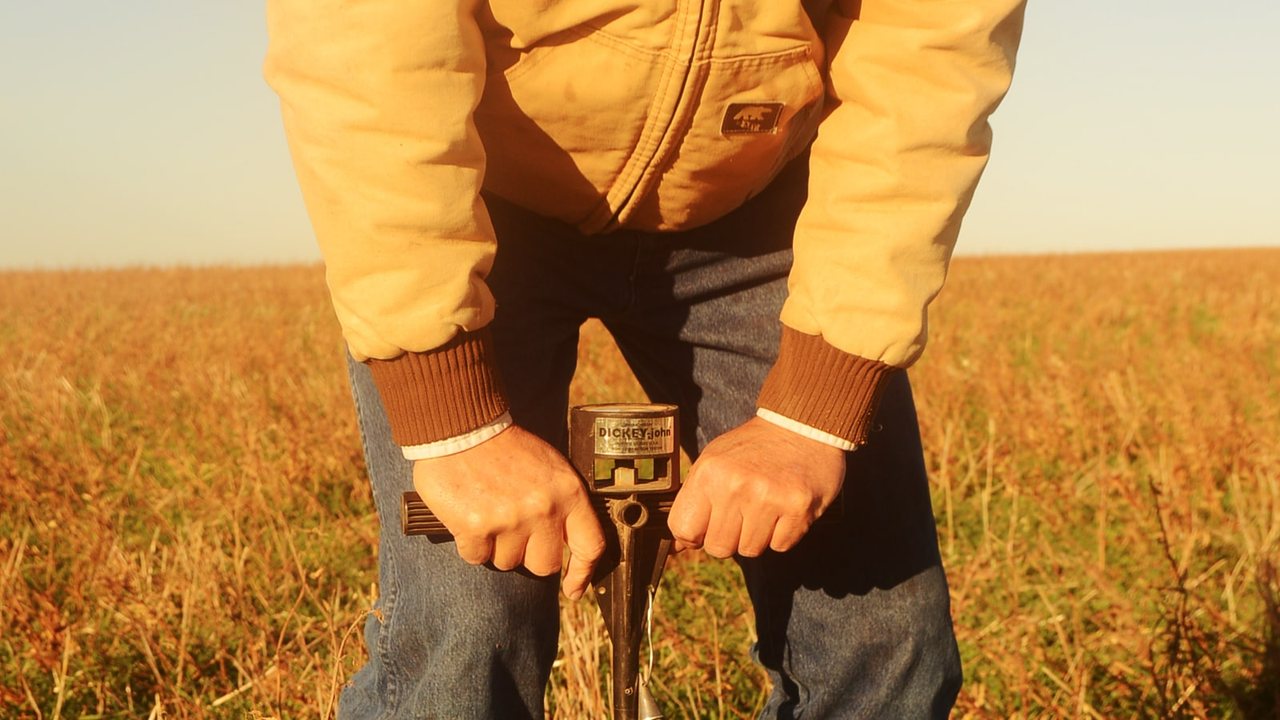
Compaction isn’t just “hard soil.” It’s a measurable shift in soil physical state. Higher bulk density means fewer connected soil pores, higher penetration resistance (the resistance to root growth), slower soil water infiltration (water logging and ponding issues), and restricted rooting (less root accessibility to nutrients).
Compacted soil restricts plants accessing water and nutrients, and this can result into yield drag that’s highly patchy (near tracks, headlands, turn rows, lanes). The good news is that you can diagnose compaction in under an hour with a shovel and a few low-cost tools, and you can match the fix to the actual constraint.
What compaction looks like in the field (symptoms worth mapping)?
Before tools, scan the pattern. Compaction often shows up as:
- wheel-track yield loss, stunting, uneven canopy
- ponding or slow infiltration after moderate rain
- shallow or “J-shaped” roots hitting a dense layer
- platy structure / horizontal layering in the topsoil or a distinct dense zone at a consistent depth
These patterns matters because they hint at where the problem sits (surface seal vs. tillage pan vs. deep traffic compaction) and why it formed (traffic when soil is wet, repeated passes with heavy equipment, high axle load, and poor residue protection).
Step 1 — Choose the right timing (moisture controls your numbers)
Penetrometer readings and even “feel” can swing dramatically with water content. As a rule: measure when the soil is moist but not plastic (often near field capacity). Wet soils are much more susceptible to compaction from traffic, and the same soil will show higher or lower resistance depending on moisture.
Practical note: if you measure after rain, record that, your goal is comparability (same moisture window across spots), not perfection.
Step 2 — Rapid diagnosis with a shovel: VESS + rooting + structure
Dig a small pit or extract a spadeful block (top ~20 cm / ~8 in). Then do three observations:
A) Visual Evaluation of Soil Structure (VESS)
VESS is a fast scoring system (1–5) based on aggregate shape, porosity, and ease of break-up. As a general guide, scores 1–3 are usually acceptable; 4–5 indicate a structural problem that needs a management change.
B) Root pathway check
Look for roots following cracks/bio-pores only, or abruptly turning horizontal at one depth, is a classic sign of a restrictive layer.
C) Structure type by layer
Platy or massive layers with few pores are common in compacted zones; granular/crumb with visible pores is what you want in the rooting zone.
Outcome of Step 2: you should be able to say: “This is mostly surface structural degradation” vs. “There’s a dense layer at ~6–10 inches” vs. “The restriction is deeper and linked to traffic.”
Step 3 — Quantify severity and depth: penetrometer + bulk density
A) Penetration resistance (cone index)
- A widely used threshold is ~2 MPa (~290 psi) where “most roots can no longer grow through the soil.”
- Take multiple readings:
- compare wheel tracks vs inter-row
- headlands vs interior
- log depth where resistance jumps (that depth often identifies the “pan”)
- Interpretation rule of thumb
- If resistance spikes only in the top inch or two: think surface seal/crust + low cover + raindrop impact
- If it spikes at a consistent depth (e.g., 6–8"): think tillage pan / repeated shallow tillage
- If spikes deeper (10–16"+) and aligned with traffic lanes: think deep traffic compaction / axle load effect
B) Bulk density (BD): texture-specific thresholds
Bulk density thresholds depend on texture. NRCS provides texture-based ranges for “ideal,” “affects root growth,” and “restricts root growth.”
Here’s a simplified diagnostic table (g/cm³):
Bulk Density Thresholds by Soil Texture
| Texture | Ideal BD | Affects Roots | Restricts Roots |
|---|---|---|---|
| Sand / loamy sand | <1.60 | ~1.63 | >1.80 |
| Sandy loam / loam | <1.40 | ~1.63 | >1.80 |
| Silt / silt loam | <1.40 | ~1.60 | >1.75 |
| Clay loam / sandy clay loam | <1.40 | ~1.60 | >1.75 |
| Clayey soils | <1.10 | ~1.39–1.49 | >1.47–1.58 |
Use BD when you want a stable, lab-based confirmation of compaction severity. (Penetrometer is faster, but moisture-sensitive.)
Step 4 — Decide what kind of compaction you have (a simple decision tree)
- If VESS is poor (4–5) and restriction is mostly shallow:
→ the bottleneck is typically surface structure + infiltration + oxygen exchange. - If penetrometer spikes at 6–10 inches across the whole field:
→ likely tillage pan / repeated shear zone, often fixable with a targeted reset + prevention. - If penetrometer spikes deeper and only in traffic zones/headlands:
→ likely traffic-driven compaction; the “fix” is mostly traffic management + timing, not steel.
Fixes that match the diagnosis (and what to stop doing)
1) Surface structural degradation (top 0–2")
Goal: rebuild stable aggregates + protect the surface.
- keep residue armor; reduce bare soil exposure
- increase living roots (covers, perennials where feasible)
- avoid shallow tillage that destroys aggregates repeatedly
- address slaking/crusting drivers (low cover, intense rainfall impact)
2) Tillage pan (often 6–10")
Goal: disrupt once, then prevent re-formation.
- consider strategic deep tillage only when soil is dry enough to fracture (not smear)
- immediately follow with a root/biopore strategy (deep-rooted cover crops) to “biologically hold” the structure
- reduce repetitive shallow tillage passes that recreate the shear plane
3) Traffic compaction (often deeper, patchy)
Goal: prevent the load from being applied when the soil can’t resist it.
- avoid field operations when soil is wet/plastic (highest risk)
- reduce axle loads where possible; optimize tire pressure / flotation
- adopt controlled traffic (keep compaction in permanent lanes)
- keep continuous roots to build biopores and resilience over time
Key reality check: deep ripping without traffic changes often gives temporary improvement then the field repacks.
A minimal “compaction data sheet” farmers can actually fill out
Field/zone: _________ Date: _________ Crop: _________
Soil moisture status (dry/moist/plastic): _________
Locations: headland / wheel track / inter-row / low spot
VESS score (1–5): _________
Penetrometer: depth where PR ≥ 2 MPa (or ~290 psi): _________
Notes: ponding? roots turning? visible layers? _________
Action hypothesis: surface vs pan vs traffic: _________
Closing: the compaction mindset shift
- Compaction management is mostly physics + timing:
- Wet soil + heavy load + repeated passes = compaction risk
- Diagnosis tells you whether to use biology, traffic control, or steel—and at what depth.