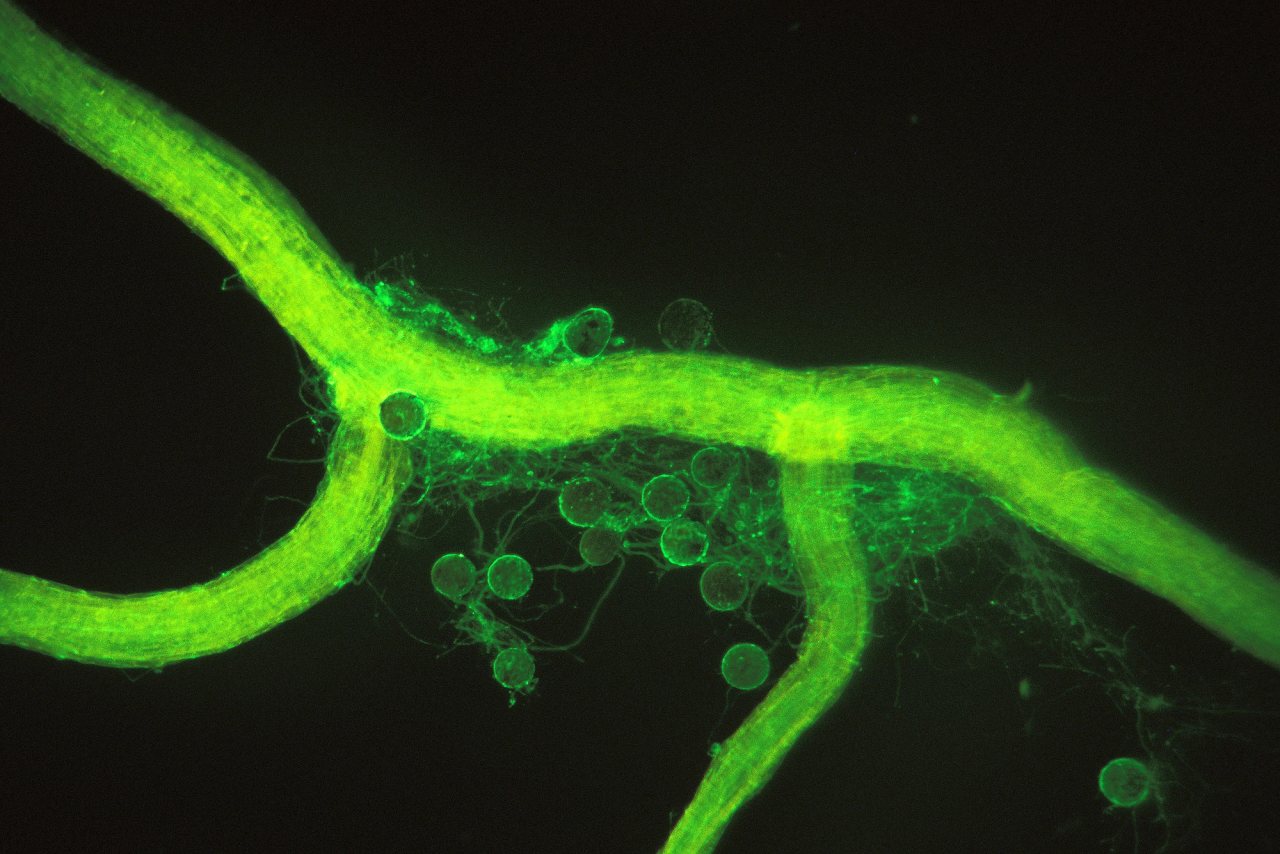
AMF is short for arbuscular mycorrhizal fungi. The name describes what they build. "Mycorrhiza" means fungus-root, and an arbuscule is the highly branched, tree-like exchange structure the fungus forms inside a living root cortical cell. The fungus does not enter the plant cell's cytoplasm. Plant and fungus remain separated by plant-derived membrane, creating a large interface across which phosphorus, nitrogen, carbon, and other compounds can move [1].
AMF are not mushrooms, bacteria, roots, or fertilizer. They are microscopic fungi whose body is made of threads called hyphae. Some hyphae live inside the root; others extend into soil. Spores, colonized root fragments, and living hyphae can all act as propagules that start or continue colonization. AMF are obligate biotrophs: they need a living host to complete their life cycle and reproduce, although propagules can persist in soil between crops [1][2].
AMF vocabulary in plain language
| Term | Meaning | Why it matters |
|---|---|---|
| AMF | Arbuscular mycorrhizal fungi—the fungal partners | The living organisms, not the relationship or a product category |
| Arbuscular mycorrhiza | The symbiosis formed by a plant root and AMF | A biological trade whose outcome can be beneficial, neutral, or costly |
| Arbuscule | A finely branched exchange structure inside a root cortical cell | The main interface for resource exchange |
| Hypha / mycelium | One fungal thread / the connected mass of threads | Extends the soil volume explored beyond the root surface |
| Vesicle | A storage structure formed by many, but not all, AMF | Stores lipids; its absence does not prove AMF are absent |
| Propagule | A viable spore, colonized root piece, or hyphal fragment | The biological unit capable of starting colonization |
How the partnership works
The sequence begins with chemical recognition. Compounds released by a suitable root—including strigolactones under many nutrient-limited conditions—stimulate nearby AMF hyphae to branch. The fungus contacts the root, enters through or between outer root cells, and grows into the cortex. There it forms arbuscules. Outside the root, new hyphae spread into soil pores that roots and root hairs cannot explore as thoroughly [1].
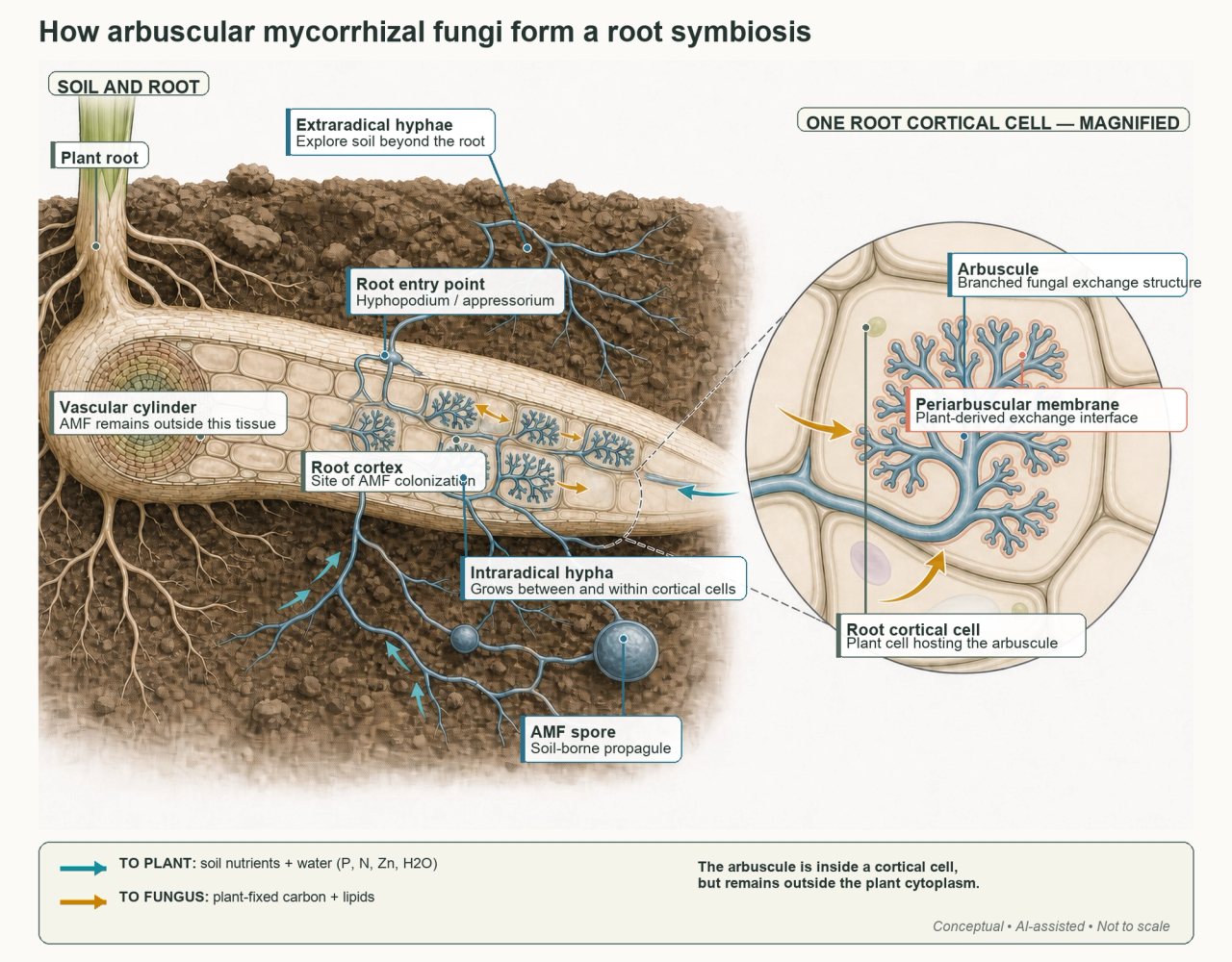
- A viable propagule encounters a compatible living root. A spore germinates or an existing hypha grows toward the root.
- The fungus colonizes the root cortex. It forms intraradical hyphae and arbuscules; many taxa also form lipid-storage vesicles.
- Extraradical hyphae forage through soil. Their small diameter and branching let them cross phosphorus-depletion zones immediately around roots.
- Resources move across the arbuscule interface. The fungus supplies mineral nutrients—most consistently phosphorus—and can contribute nitrogen and micronutrients; the plant supplies carbon compounds.
- The network turns over and reproduces. Hyphae die and regrow, arbuscules are renewed, and new spores or colonized root pieces become future inoculum [1][2].
For decades the exchange was simplified as "plant sugar for fungal phosphorus." The chemistry is richer. Plants deliver both sugars and fatty acids or lipid precursors, and AMF depend on the host for those lipids [3]. In return, the fungal pathway can deliver phosphorus, nitrogen, zinc, copper, sulfur, and water. The quantities depend on fungal identity, host genetics, soil supply, temperature, moisture, competing microbes, and the plant's own roots [1][2].
Which crops form AMF partnerships?
Roughly 70% of land-plant species are estimated to form arbuscular mycorrhiza [15], though some extension summaries put the share nearer 80% [19] depending on the plant inventory and classification used. Nearly all land plants form some mycorrhizal association, but that broader figure also counts ectomycorrhizal, ericoid, and orchid types, not arbuscular mycorrhiza alone [2]. Major AMF host crops include corn, wheat, rice, sorghum, oats, soybean and other legumes, sunflower, cotton, potato, onion, many vegetables, forages, grasses, fruit crops, and many trees. Host status does not mean every cultivar is equally responsive, and root colonization does not guarantee a yield response.
Common crop hosts and non-hosts
| Usually AMF hosts | Generally non-host or weak-host crops | Rotation implication |
|---|---|---|
| Corn, wheat, oats, rice, sorghum | Canola, mustard, radish and other brassicas | A brassica interval does not feed AMF; keep the whole rotation and cover-crop mix in view |
| Soybean, dry bean, pea, clovers, alfalfa | Sugar beet, table beet, spinach and close relatives | Legume hosts can support both AMF and their separate rhizobial partnership |
| Sunflower, flax, cotton, potato, onion | Lupins are often non-host or weak hosts | Species, cultivar, soil, and resident fungi control actual response |
| Most grasses and many fruit or vegetable crops | Bare fallow has no living host | Long host-free periods usually reduce living inoculum potential |
What AMF can do—and what the data actually measure
AMF effects are often reported as root colonization, tissue nutrient concentration, nutrient uptake, plant biomass, or harvested yield. Those are not interchangeable endpoints. A larger seedling in a sterilized pot is not the same evidence as more grain in a field already containing native AMF. Meta-analyses are useful because they summarize many experiments, but their mean is not a guaranteed response for a specific farm.
Average plant responses to AMF inoculation across 187 publications
| Measure | Value |
|---|---|
| Plant biomass | 47 % |
| N concentration | 16 % |
| P concentration | 27 % |
| Whole-plant N uptake | 67 % |
| Whole-plant P uptake | 105 % |
The strongest and most consistent nutritional role is phosphorus acquisition. Phosphate moves slowly through soil, so roots create a depleted zone around themselves. Fine fungal hyphae can extend beyond that zone and deliver phosphate through the fungal pathway. AMF may also improve nitrogen and micronutrient uptake, alter root architecture and plant signaling, prime some defenses, and change plant water relations. These mechanisms can matter most when the resource or stress is actually limiting [1][2][4].
For yield, a 2019 meta-analysis focused on grain crops and separated field inoculation from less realistic experimental systems. Across the field-inoculation dataset, AMF inoculation increased grain yield by 16% on average, with 77% of trials showing a positive effect. Responses differed by crop, cultivar era, and soil pH [5].
Field grain-yield response to AMF inoculation
| Measure | Value |
|---|---|
| All grain crops | 16 % |
| Corn | 13 % |
| Rice | 17 % |
| Wheat | 17 % |
| Barley | 0.94 % |
| Sorghum | 37 % |
A separate synthesis restricted to rainfed agriculture estimated a 23% average crop-yield increase, with a 95% confidence interval of 16–30%, but it included only 21 eligible articles and the observed effects ranged from negative to strongly positive [6]. The honest conclusion is not that every rainfed crop will gain 23%. It is that water-limited conditions can create opportunities for AMF benefits, while crop and field context still dominate the outcome.
Why a real symbiosis can produce no yield response
The plant pays for AMF with carbon. If roots can already acquire enough phosphorus and water, the fungal pathway may add little while still costing photosynthate. A fungus that performs well with one crop genotype may perform poorly with another. Native AMF may already occupy the roots, and an introduced strain may fail to establish, displace resident taxa without improving function, or encounter a soil environment that does not suit it [2][7].
The main controls on AMF response
| Control | Why response may increase | Why response may disappear or reverse |
|---|---|---|
| Crop and cultivar | Compatible, responsive genetics and meaningful nutrient demand | Non-host crop, weak dependence, or cultivar with low response |
| Soil phosphorus | Fungal foraging helps where diffusion and root access limit uptake | When P is readily available, the plant can reduce colonization and gain little from the trade |
| Resident microbiome | Introduced AMF can fill a missing function or compete with pathogens | Native AMF already provide the function or resist establishment |
| Water and weather | Hyphal access and altered root physiology can help under some droughts | Severe drought, saturation, low oxygen, or cold can constrain plant and fungus |
| Management history | Living hosts, diversity, and lower disturbance can preserve inoculum | Long fallow, non-host sequences, and intensive disturbance can reduce or rearrange networks |
| Inoculant quality and placement | Viable, compatible propagules contact young roots at an adequate dose | Dead propagules, poor storage, incompatible strains, or placement away from roots |
The most instructive modern field study tested one AMF isolate in 54 conventionally managed maize fields in Switzerland. Growth response ranged from −12% to +40%. Fourteen fields—about one quarter—had a significant positive biomass response of 12–40%; most did not. A model using soil fungal-community indicators and a smaller set of soil measurements explained much of the observed variation within that study, and the abundance of potentially pathogenic fungi was more informative than phosphorus supply [7].
Managing the AMF already in the field
Most agricultural soils already contain native AMF. The first management question is therefore not "What should I add?" but "Does this rotation provide compatible living hosts and a reasonable habitat?" A meta-analysis of field trials found that both cover crops and lower-intensity tillage can increase colonization of the following cash crop, with the outcome depending on cover-crop type and tillage system [10]. An Upper Midwest field study found that forage oats and oat-containing mixtures increased AMF inoculum potential after small grains; at one site a mixture doubled it [11].
- Keep compatible living roots when the agronomy works. A mycorrhizal cover crop can maintain a carbon supply and living hyphae between cash crops. A brassica-only cover is not an AMF host; include a suitable grass or legume if AMF continuity is one goal [10][11].
- Reduce unnecessary soil inversion and passes. Tillage severs hyphae and redistributes propagules. The size and persistence of the effect vary by soil, depth, implement, crop, and time since disturbance, so "no-till always means more AMF" is too simple [10].
- Use crop diversity strategically. Rotate among compatible host species and functional groups. Diversity can support a broader AMF community, but species count alone does not guarantee function.
- Apply phosphorus from a calibrated soil test and crop response curve. Excess readily available P often suppresses plant investment in the symbiosis; withholding needed P to force colonization can sacrifice yield. The goal is efficient fertility, not deliberate deficiency [18].
- Protect the whole root habitat. Avoid prolonged saturation, severe compaction, erosion, and unnecessary bare periods. These stresses affect the plant, oxygen supply, pore space, and the fungal network together.
- Evaluate pesticides by active ingredient, rate, placement, and timing. Some fungicides suppress AMF; others have small or transient effects at labeled use rates. A product's word "fungicide" alone does not predict the field response [20].
Should you buy an AMF inoculant?
Sometimes—especially in fumigated, sterilized, highly disturbed, low-inoculum, nursery, transplant, mine-reclamation, or other controlled systems. In ordinary field soil, the answer is less predictable because native AMF are usually present and the introduced strain must be alive, reach the root, establish, compete, and provide a function the crop needs.
Product quality is a separate problem from AMF biology. A three-continent evaluation tested 28 commercial inoculants overall. Of the 25 products tested in sterilized soil under AMF-favorable bioassay conditions, 21 of 25 (84%) did not produce mycorrhizal root colonization, so the assay detected no viable propagules capable of establishing symbiosis. In nonsterilized greenhouse soil, commercial products increased plant biomass in only 1 of 25 treatments [8].
A 2025 meta-analysis spanning 302 trials of commercial AMF inoculants reached a similar conclusion. Among the observations that reported colonization, 189 of 226 (84%) had zero to negligible hyphal colonization. Fewer than 12% paired sufficient hyphal colonization with improved crop growth. Some products improved growth without sufficient AMF colonization, suggesting nutrients or other ingredients—not a functioning mycorrhizal symbiosis—may have caused the response [9].
Commercial AMF evidence: potential versus product performance
| Evidence set | Result | Practical meaning |
|---|---|---|
| 25 sterilized-soil tests within a 28-product, three-continent evaluation (2022) | 21 of 25 (84%) failed to colonize roots | Ask for batch-level viability, not just a claimed propagule count |
| 25 nonsterile-soil treatments (2022) | 1 treatment increased plant biomass | Native AMF and field context can make added inoculum redundant |
| 250 commercial-product trials within a 2025 meta-analysis | 189 of 226 colonization observations (84%) were zero/negligible; 19 commercial observations (12%) paired sufficient colonization with growth | A growth claim does not prove that viable AMF caused the result |
| 54 Swiss maize fields (2023) | Response ranged from −12% to +40%; one quarter responded significantly | Even verified inoculum and one selected cultivar remain field-dependent |
What to ask an inoculant supplier
- Which AMF taxa or isolates are present, and which host crop was used to propagate them? A long species list is not automatically better.
- What does the propagule number count? Spores, colonized root fragments, hyphae, or a viability-based infectivity assay are not equivalent.
- Is there a batch-specific, dated root-colonization bioassay? Ask for methods, host, controls, percent colonization, and storage conditions—not only an internal certificate.
- Are field trials available for this crop, soil type, fertility program, and region? Prefer replicated trials with the same carrier in the untreated control.
- What else is in the carrier? Fertilizer, humic substances, bacteria, Trichoderma, wetting agents, or other ingredients can cause a response that is incorrectly credited to AMF.
- What is the delivered cost per acre and the breakeven yield? Calculate product plus application cost divided by expected crop price, then test against that threshold.
- How must it be handled and placed? Heat, age, moisture, incompatible tank mixes, and failure to place viable propagules near young roots can turn a good culture into a failed application [8][9].
How AMF are measured
There is no single "AMF soil-health number." Different methods measure different pools—structures in a sampled root, propagules capable of infection, a lipid associated with fungal biomass, or DNA from particular taxa. USDA-ARS compared several approaches in a multi-year cover-crop study and found infective propagule number and a neutral-lipid biomarker responsive to management, while root colonization and a phospholipid version of the biomarker answered different questions [12].
Choose the AMF test that matches the question
| Method | What it measures | What it cannot prove |
|---|---|---|
| Stained-root microscopy | % root length containing hyphae, arbuscules, or vesicles | Nutrient flow, strain identity, yield benefit, or field-wide abundance |
| Most-probable-number / host bioassay | Propagules capable of colonizing a test plant under defined conditions | Which taxa are present or whether the crop will profit in the field |
| NLFA 16:1ω5 | A storage-lipid signal often used for AMF propagules and biomass | Exact species, activity, or benefit; biomarker specificity is imperfect |
| PLFA 16:1ω5 | A membrane-lipid signal sometimes reported as an AMF indicator | A precise AMF census, especially at low biomass where bacterial background matters |
| qPCR / amplicon sequencing | Target DNA or the relative composition of detected AMF taxa | Viability, absolute activity, nutrient delivery, or crop response without added measurements |
| Spore count | Spores recovered by the chosen extraction method | Viability, hyphal/root-fragment inoculum, or current root function |
A useful monitoring design keeps crop, growth stage, root zone, sampling depth, season, and laboratory method consistent. Compare management treatments or track a field through time. Do not compare a PLFA estimate with a microscopy percentage as if they were the same unit, and do not interpret a higher value as automatically better. NRCS describes soil biological values as directionally useful—higher is better—rather than as calibrated, fertilizer-style recommendations, and notes they may not be well defined regionally [13].
AMF, soil structure, and carbon: important but easy to overstate
AMF hyphae can enmesh particles, influence microbial communities, and contribute organic compounds that affect aggregate formation. Experimental and synthesis work supports a role for mycorrhizae in soil aggregation, but AMF are one contributor among roots, bacteria, saprotrophic fungi, minerals, organic matter, wetting and drying, and management [16].
Be careful with glomalin claims. The common hot-citrate extraction and Bradford assay produce what should be called glomalin-related soil protein (GRSP): a mixture that can include non-AMF proteins, lipids, and humic material. GRSP may correlate with aggregation or soil condition, but it is not a specific measure of AMF biomass, a purified molecule, or a direct carbon-credit quantity [17].
The global AMF network—scale estimates, not farm guarantees
| Estimated quantity | Best current global estimate | Interpretation limit |
|---|---|---|
| AMF hyphal length in topsoil | About 110 quadrillion km | A modeled global total, not a field benchmark |
| Carbon held in AMF hyphae | About 300 million metric tons of carbon | Large uncertainty remains in under-sampled ecosystems |
| Share associated with grasslands | About 40% of global AMF biomass | Reflects modeled distribution across ecosystems |
| Large-scale cropland network density | About 50% lower than non-cultivated land on average | Association across land uses; not a controlled tillage or fertilizer trial |
| Annual plant carbon allocated to AMF | About 3.93 Gt CO2-equivalent per year | Carbon transferred belowground is not automatically stabilized or permanent |
A 2023 synthesis estimated that plants allocate about 3.93 gigatons of CO2-equivalent per year to AMF [14]. A 2026 global mapping study estimated roughly 110 quadrillion kilometers of AMF hyphae and about 300 million metric tons of carbon held in AMF hyphae in topsoils, with large-scale croplands averaging about half the modeled network density of non-cultivated land [15]. These numbers establish scale. They do not establish how much AMF-derived carbon remains in a particular field, for how long, or how many carbon credits an inoculant creates. Carbon allocation, fungal biomass, aggregate protection, microbial respiration, and durable soil-carbon storage are different measurements.
Frequently asked questions
Are AMF always beneficial?
No. The interaction lies on a continuum from beneficial to neutral and occasionally negative. If fungal delivery does not repay the plant's carbon cost, growth or yield may not improve. Field responses can change with crop genotype, fertility, native fungi, pathogens, and weather [2][7].
Can AMF replace phosphorus fertilizer?
Not as a general rule. AMF can improve access to soil phosphorus and sometimes maintain performance at a lower input rate, but they do not add P to the farm. Use locally calibrated soil and tissue tests, realistic yield goals, nutrient budgets, and loss-risk management. Any fertilizer reduction should be tested against a fully fertilized control without confounding other changes.
Does high phosphorus kill AMF?
Usually not literally. When readily available P is abundant, plants commonly reduce signaling and carbon investment in the partnership, so colonization or fungal abundance often declines. The response varies with P form, rate, placement, plant, fungus, and starting fertility [18].
Do fungicides kill AMF?
Some active ingredients, rates, seed treatments, or repeated exposures can reduce spore germination, colonization, or hyphal growth; others show little field effect at labeled rates. AMF are fungi, but "fungicide" is a job category, not a single mode of action. Check crop-specific compatibility data and separate disease-control decisions from unsupported blanket claims [20].
Does no-till guarantee more AMF?
No. Reducing disturbance often preserves hyphal continuity and can increase colonization, but effects depend on the implement, soil depth, crop sequence, cover, residue, climate, and which AMF metric is measured. Some studies find different communities rather than simply "more" fungi [10][12].
Can AMF protect crops from drought or disease?
AMF can change water uptake, root architecture, osmotic adjustment, defense signaling, and competition within roots. Average experimental effects under drought are often positive, and the Swiss maize study linked positive responses more strongly with pathogen-related microbiome indicators than with P [7][22]. But AMF are neither irrigation nor a pesticide, and protection is not universal across stresses or pathogens.
Do common mycorrhizal networks let plants share resources?
Hyphal networks can connect multiple plants, and tracer studies show movement of nutrients, carbon, water, and signals. That does not mean a forest or field operates as an altruistic "wood-wide web." Net transfer, donor and receiver benefit, fungal retention, and consequences for plant competition depend on experimental context. Reviews of the forest literature have documented positive citation bias and overinterpretation of common-network claims. For farm decisions, proven crop response matters more than a communication metaphor [21].
Can I see AMF in my soil?
Not reliably with the naked eye. AMF do not produce familiar aboveground mushrooms. Hyphae and spores are microscopic, and arbuscules require cleared, stained roots and microscopy or molecular methods. White fungal growth on residue is not evidence of AMF; it is often saprotrophic fungi decomposing the residue [1][12].
A defensible on-farm AMF trial
If a product or management change is plausible, let the field answer. A useful trial isolates the AMF treatment from the carrier, fertility, and application effects. It measures economic yield, not only an early-season photograph.
- Write the hypothesis. Example: "This inoculant will increase corn grain yield enough to cover its delivered and application cost on this low-P, host-crop field."
- Confirm crop host status, soil fertility, and product viability. Do not knowingly test dead inoculum or a non-host crop.
- Use paired, randomized, replicated strips. Include at least four treatment–control pairs where practical, sized for the planter, sprayer, and combine. Alternate order or randomize within blocks.
- Keep every other input identical. The control should receive the same carrier and any nutrients or co-formulants without live AMF when the supplier can provide it.
- Record stand, weather, operations, and a pre-stated harvest endpoint. Root colonization can confirm biological establishment, but calibrated yield or marketable harvest is the economic endpoint.
- Harvest and analyze strips separately. Use weigh-wagon or calibrated yield-monitor data, remove headlands and obvious errors, and retain individual strip values rather than comparing only two whole-field averages.
- Calculate net return and repeat. Net return equals yield change times crop price minus product and application cost. One responsive strip in one season is a lead, not a universal recommendation.