Required CEMA 216 tests
Explore the annotated CEMA 216 example: follow three fictional samples from the map through laboratory results, interpretation and handoff. Includes an annotated example PDF and an explanation of what the QI supplies and reviews.
For the minimum Scenario 1: Soil Health Testing suite, choose one approved laboratory method in each of the first five rows below. Soil texture and pH are also required to interpret the five indicator results. The suite therefore contains seven required measurements. Document the selected methods and obtain agreement from the Qualified Individual and NRCS before sampling [1][2].
The minimum CEMA 216 laboratory order
| Required soil process or context | Indicator the report must include | Approved method choice |
|---|---|---|
| 1. Soil aggregation | Wet aggregate stability | Wet sieving; or Cornell sprinkle infiltrometer; or image analysis |
| 2. Soil carbon cycling | Soil organic carbon (SOC) | Dry combustion; or SOC calculated from loss-on-ignition soil organic matter |
| 3. Microbial activity | Soil respiration | 24-hour CO₂ incubation/burst; or 96-hour incubation |
| 4. Carbon food source | Labile carbon | Permanganate-oxidizable carbon (POXC); or water-extractable organic carbon (WEOC) |
| 5. Nitrogen food source | Bioavailable nitrogen | Autoclaved citrate-extractable (ACE) protein; or water-extractable organic nitrogen (WEON) |
| 6. Interpretation context | Soil texture | KSSL particle-size distribution by pipette; or hydrometer method |
| 7. Interpretation context | Soil pH |
Version note. This guide was checked against the national CEMA 216 standard and job aid listed by NRCS as “04-2026,” plus the CEMA 216 FAQ dated April 10, 2026. Program rules, state payment schedules, ranking dates, and laboratory offerings can change. Confirm the current documents and contract terms with the local NRCS field office before signing an agreement or collecting soil [1][2][3].
This series was developed in response to questions from farmers and agronomists seeking clearer guidance on CEMA 216.
Why CEMA 216 matters now
NRCS launched the FY2026 Regenerative Pilot Program (RPP) in December 2025 with $700 million in announced support—$400 million through the Environmental Quality Incentives Program (EQIP) and $300 million through the Conservation Stewardship Program (CSP). The pilot is offered in all 50 states and territories, with states directed to set aside 25% of their EQIP and CSP financial-assistance funding. CEMA 216 is the national activity used for the program's quantitative soil health testing [4][7].
What the Regenerative Pilot Program asks of the farmer
| RPP requirement | What it means | Where CEMA 216 fits |
|---|---|---|
| Whole-farm assessment and plan | Assess all applicable resource concerns and work toward a whole-farm conservation plan; at minimum, soil and water planning criteria must be met by contract end | Laboratory indicators inform planning; CART and the conservation plan document the applicable resource concerns and outcomes |
| At least one primary regenerative practice | Plan or continue at least one practice from the national RPP primary-practice list; supporting practices may also be eligible when they serve the conservation plan | The required CEMA instance must be planned on the same PLU that carries the soil-and-water outcomes and primary regenerative practice |
| Beginning-and-end soil health testing | Complete CEMA 216 in the first and last contract years at minimum; it may be contracted more often, including annually | The baseline and follow-up must retain comparable locations, conditions, laboratory tests, methods, and records |
EQIP and CSP use different RPP planning scopes
| Program route | Whole-farm scope | Required soil-and-water outcome |
|---|---|---|
| EQIP | The RPP whole-farm plan may encompass a subset of land under the operator's control, based on the producer's objectives; all land that constitutes that defined whole farm is evaluated | At least one land unit must meet the applicable soil and water resource-concern thresholds by contract end |
| CSP | All land the operator controls for the life of the contract is included and evaluated; CSP Stewardship Threshold Eligibility and other CSP rules still apply | At least one land use—crop, pasture, range, or forest—must meet the applicable soil and water resource-concern thresholds by contract end |
The 15 national primary RPP practices
| Code | Practice |
|---|---|
| 328 | Conservation Crop Rotation |
| 330 | Contour Farming |
| 331 | Contour Orchard and Other Perennial Crop |
| 340 | Cover Crop |
| 554 | Drainage Water Management |
| 511 | Forage Harvest Management |
| 666 | Forest Stand Improvement |
| 449 | Irrigation Water Management |
| 484 | Mulching |
| 590 | Nutrient Management |
| 595 | Pest Management Conservation System |
| 528 | Prescribed Grazing |
| 329 |
Before applying or contracting
NRCS accepts applications continuously but considers them in state ranking periods. Start with the local USDA Service Center and ask for the current RPP ranking date and whether EQIP or CSP fits the operation. The general financial-assistance process includes an AD-1026 highly erodible-land and wetland compliance form, a CPA-1200 application, other eligibility certifications, and evidence such as an official tax ID, deed or lease showing control of the land, and an FSA farm number. Selection is competitive, and the producer chooses whether to sign after an offer is made [4][8].
Producers already using a listed practice or testing soil remain eligible. They must continue CEMA 216 testing in the required first and last contract years, and a producer already implementing an identified practice may request an outcomes report. Ask the field office how existing records and practices will be documented in the assessment and contract [7].
Testing establishes a documented baseline for comparison in the final contract year. The April 2026 FAQ sets no statistical improvement threshold for contract compliance [3].
What is optional or outside the minimum CEMA 216 suite
Advanced testing and related tests
| Category | What is measured | Approved choice |
|---|---|---|
| Scenario 2: Advanced Soil Health Testing | Microbial or functional diversity, in addition to all Scenario 1 measurements | PLFA; or three selected enzyme assays from the approved list |
| Outside CEMA 216 | Full fertility testing, nutrient-management recommendations, CEC, and total nutrient digest | Use regionally calibrated fertility testing and, when contracted, CEMA 217 |
The pre-work conference: decide what the samples must answer
Before fieldwork, the QI must arrange a pre-work conference with the producer and local NRCS field office. The group should agree on the producer's objectives, planning land units, number of contracted instances, sampling strategy, laboratory methods, timing, maps, interpretation plan, and deliverables [1].
Questions the pre-work conference should settle
| Decision | Example question |
|---|---|
| Monitoring change | Did reduced tillage and cover cropping change the same representative areas between baseline and the final contract year? |
| Comparing management | How does a long-term no-till field compare with a similar tilled field or reference area? |
| Diagnosing variability | How does the poor-performing slope differ from the productive area and an undisturbed comparison? |
| Selecting the scenario | Will PLFA or enzyme results change a decision, or is the standard five-process suite sufficient? |
| Coordinating fertility testing | Does a separate nutrient-management sample require a different depth, location pattern, timing, or contracted CEMA 217 activity? |
Who can serve as the Qualified Individual?
The QI is accountable for protocol adherence, documentation, interpretation, and the completed report, including work performed by sample collectors under the QI's guidance [1][3].
- A QI may qualify as a Certified Crop Adviser (CCA), Certified Professional Agronomist (CPAg), Certified Professional Soil Scientist (CPSS), or Associate Professional Soil Scientist (APSS) [1].
- A Technical Service Provider certified for Soil Health Management Plan CPA 116 or Soil Health Management DIA 162 may qualify [1].
- A person with an associate degree or higher in an agricultural or soil-science field and at least two years of experience collecting soil for laboratory analysis may qualify [1].
- Other people may collect samples under a QI's guidance or management, but the supervising QI remains responsible and should review and sign the deliverable [1][3].
- A producer may serve as QI by independently meeting one qualification route. Other producers may collect samples under a QI's guidance while the QI retains responsibility [3].
- Federal NRCS staff are ineligible to act as the producer's QI. Conservation-district employees, laboratory staff, partners, and retired NRCS staff may serve when the responsible individual meets a listed QI route and supplies every required deliverable [3].
- QI and NRCS-certified Technical Service Provider (TSP) are distinct roles. A TSP qualifies for CEMA 216 by meeting a listed CEMA 216 qualification route. Confirm the role, qualifications, payment arrangement, and responsibility for revisions before hiring [1][3][9].
The producer is responsible for selecting the QI. NRCS does not maintain a national QI list; its FAQ suggests starting with professional-society “Find a Professional” directories and the NRCS TSP Registry for professionals certified for CPA 116 or DIA 162 [3]. Ask candidates how they qualify, who will collect the soil, who will interpret the report, what mapping they provide, and whether their quoted price includes laboratory charges and revisions requested during NRCS review.
How one contracted instance is sampled
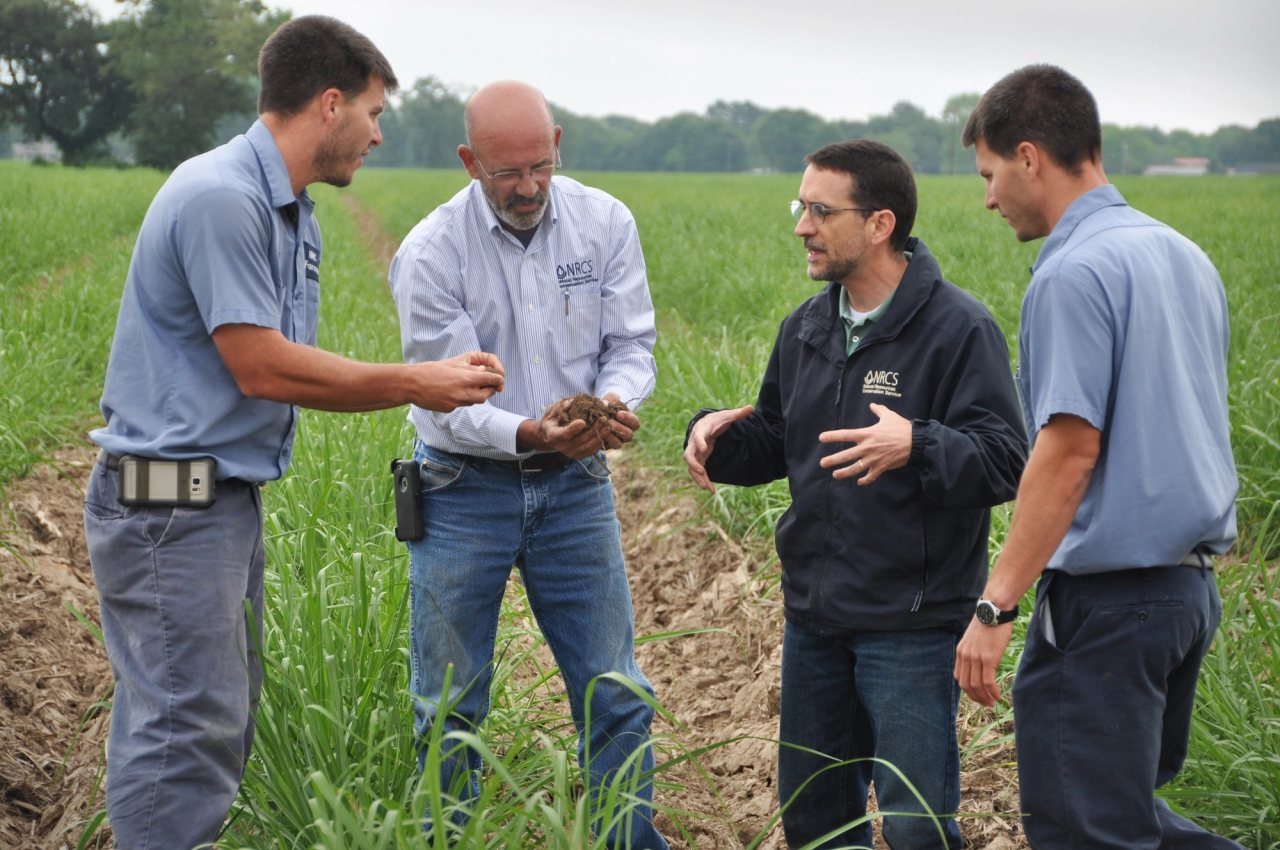
One CEMA 216 instance includes at least three separate representative locations within the planned management unit. At each location, collect the central sample plus four subsamples approximately 20–50 feet away and combine those five subsamples into one composite. Keep the three composites separate for laboratory analysis. Part 2 provides the mapped nine-step sampling-plan field guide [1][2][3].
Choose the sampling design that matches the decision
| Design | Use it when | What the composites represent |
|---|---|---|
| Random | The unit is reasonably uniform and has few distinct problem areas | Randomly selected positions across the defined unit |
| Stratified | Soil type, slope position, drainage, or management creates meaningful zones | Random positions within mapped strata, allocated to represent those strata |
| Problem comparison | The objective is to diagnose uneven performance | A poor area, a good-producing comparison, and an undisturbed or reference area |
Payment follows the contracted instance. Planners may schedule multiple instances to capture variability in a large or heterogeneous land unit. The planner and producer base the design on assessments and objectives. Three composites can answer a defined comparison; a highly variable operation may require additional instances to represent its soils, slopes, and management histories [3].
Depth, tool, timing, and handling
- Preserve soil structure. When practical, dig an 8-inch hole with a tile spade, sharpshooter, or straight shovel and remove a uniform 2-inch-thick vertical rectangular slice extending to the approved 6–8-inch sampling depth. A probe with at least a 1-inch inside diameter may be used when a slice is impractical [1][2][3].
- Do not use a Dutch or spiral auger. The current FAQ says augers are not acceptable because they destroy or compact the aggregates being evaluated [3].
- Avoid accidental hot spots. Unless the design targets them, avoid wheel tracks, drive lanes, borders, depressions, saturated soil, fertilizer bands, eroded and non-eroded areas mixed together, different rotations, and row/inter-row positions mixed without a plan [1].
- Choose repeatable timing. Sample during the crop year under moderate moisture and temperature conditions, allowing sufficient time after tillage, amendments, fertilizer, or chemical inputs to avoid a temporary pulse [1][3].
- Follow the receiving laboratory's handling instructions. Keep samples cool and out of sunlight. The FAQ calls for refrigerated, overnight-on-ice shipment for PLFA and enzyme samples; the CEMA standard additionally directs PLFA samples to be frozen immediately and shipped on ice as soon as possible [1][3].
- Start from the planning record. Collect at the same locations where the applicable in-field resource-concern assessments were completed, unless the agreed sampling design establishes a documented comparison [1].
- Prevent cross-contamination. Clean all equipment before sampling; when collecting PLFA samples, sanitize equipment between composite samples [1].
- Follow movement restrictions. Comply with USDA APHIS rules for prohibited, regulated, or quarantined soils before moving or shipping samples [1].
- Record coordinates and conditions. Capture WGS84 latitude-longitude, date, crop stage, soil condition, recent weather, and recent field operations so the final-year team can reproduce the baseline [1].
Choose the laboratory before collecting soil
Select a laboratory with a current accepted proficiency or accreditation route: NAPT-PAP, ANAB, the specified ISO route, or an appropriate state-approved program. NRCS provides no national approved-laboratory list. The QI must also verify that the laboratory offers every selected method [1][3][6].
Questions to send the laboratory in writing
| Question | Why it matters |
|---|---|
| Which exact method will you use for each required process, texture, and pH? | Exact methods establish CEMA compatibility |
| What units, dry-weight basis, moisture correction, and detection limits will appear? | Units and reporting basis support interpretation and repeat testing |
| For SOC, is the result direct dry combustion or calculated from loss-on-ignition SOM? How are carbonates handled? | Total carbon can include inorganic carbon |
| Which aggregate-stability protocol and output will be reported? | Wet-sieving, rainfall, and image methods use different scales |
| What sample mass, container, temperature, holding time, and shipping schedule do you require? | Biological results are vulnerable to handling differences |
| Can you repeat the same methods in the final contract year and notify us if a method changes? | Long-term comparability depends on continuity |
| Which accepted proficiency or accreditation program currently covers the laboratory? | The deliverable must document use of an eligible laboratory |
Know what the completed deliverable contains
The finished package requires a signed cover page; participant, contract, land, and QI information; the sampling purpose and strategy; site-visit notes and relevant correspondence; sample IDs; laboratory results; interpretations or observations; a schedule for additional monitoring; a general location map; and a sampling map with the planning land-unit polygon and WGS84 sampling points. The QI prepares two complete sets—one for the participant and one for the local NRCS office—with a participant acceptance statement and space for NRCS administrative review. Transmission to the field office by the QI requires the participant's authorization [1][3].
Land-use and tenure questions to raise before contracting
| Situation | What the national guidance says |
|---|---|
| Forestland, rangeland, pasture, cropland, or another land use | CEMA 216 is applicable to all land uses; select locations and interpretation that fit the land use and producer objective |
| Public land | Testing requires permission from the managing authority and must follow program guidance for contracting on public land |
| Leased PLU or possible loss of control before final-year testing | Show control during application and discuss tenure risk before contracting; if control is later lost, document it immediately and work with NRCS on the contract-administration response, modification, or waiver |
Pre-sampling farmer checklist
- □ I have the current CEMA 216 standard, job aid, FAQ, and state contract documents.
- □ I understand the full RPP plan: whole-farm assessment, soil-and-water planning outcomes, at least one primary practice, CEMA 216 testing, and a minimum five-year contract.
- □ The producer, QI, and NRCS field office agreed on the objective, land units, number of instances, and scenario.
- □ The required CEMA instance is on the same PLU as the RPP soil-and-water outcomes and primary practice; any additional tested PLUs are clearly identified.
- □ The map and design produce three separate composite samples per instance, each made from five subsamples.
- □ The depth, tool, timing, recent-management exclusion window, containers, cooling, and shipping plan are written down.
- □ The laboratory confirmed every required method, units, reporting basis, qualification route, price, and turnaround time in writing.
- □ The quote distinguishes QI services, mapping, laboratory fees, shipping, interpretation, and possible revision costs.
- □ The baseline record is detailed enough for a different qualified team to repeat the work in the final contract year.
- □ Any fertility or nutrient-management decision will use a separately valid sample and regional calibration rather than CEMA 216 alone.
Next: understand what the numbers mean
Continue with Part 2: the step-by-step CEMA 216 sampling-plan field guide. It turns the agreed objective and PLU into the mapped three-by-five field design used before any soil is collected.