Edison Brothers: How a Rural Missouri Team Is Building Practical Tools for Soil Health
A rural Missouri team is building practical tools for soil health, sensing, and regenerative agriculture.
Editor's Note
This feature post was published as an independent community spotlight with no compensation. Sponsored or paid collaborations, when applicable, are labeled explicitly.
How a rural Missouri team is building practical tools for soil health and regenerative agriculture
Some innovations begin in research labs. Others come to life in a farm shop, with a welder humming, metal on the table, and sensors scattered across a workbench.
Edison Brothers LLC, based in rural Sweet Springs, Missouri, is a small innovation company working at the intersection of metal fabrication, equipment repair, prototyping, and applied technology.
Founded by brothers Jason Chavies and Scott Abney, the company brings together hands-on shop experience and a drive to build practical solutions. Jason, a U.S. Air Force veteran with experience as a helicopter crew chief and in quality assurance, brings a strong systems mindset to the work. Together, the team cuts custom farm parts, repairs equipment, develops prototypes, and explores how electronics and sensing tools can be integrated into rugged, field-ready builds.
But this story is bigger than one shop.
Jason and Matt Adler, both Air Force veterans with experience in Model-Based Systems Engineering, connected through Matt’s work at Elm Spring Farm and the 1840 Foundation. Their shared question was straightforward but important: how can practical engineering help regenerative agriculture move faster and work better in the real world?
That question opened the door to a broader collaboration. Matt brings direct farming experience, along with academic training as a master’s student at Lincoln University and stewardship of the historic Elm Spring Farm near Hughesville, Missouri.
Click to expand
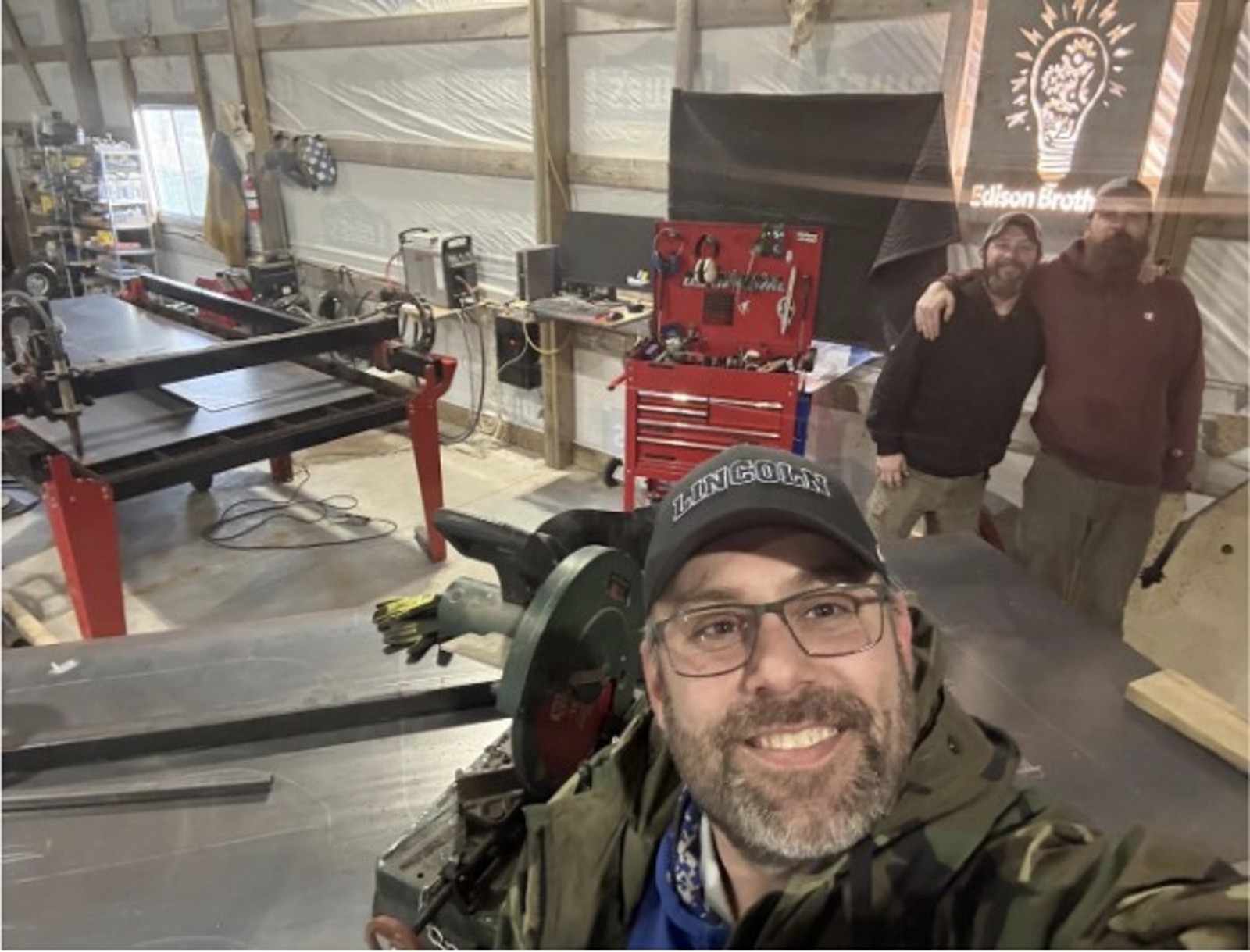
Matt Adler w/ Edison Bros @ Edison Brothers HQ
The team is also working with Dr. Chandan Shilpakar, Assistant Professor of Forage Science at Lincoln University, who contributes expertise in plant systems and soil health, and with Dr. Todd Sparks at MOPine, who is helping explore how sensor data can be integrated into larger engineering frameworks.
Together, they saw the same problem many farmers face. Producers are trying to rebuild living soil after decades of extractive management, yet many of the tools used to monitor soil conditions remain expensive, closed, and slow to adapt. That gap created the motivation to build something different: modular, adaptable platforms made from off-the-shelf components and rapid fabrication methods, designed to create faster feedback loops between soil, farmers, and engineers.
SoilDaddy is the first sensor platform of that larger vision.
SoilDaddy: the first platform
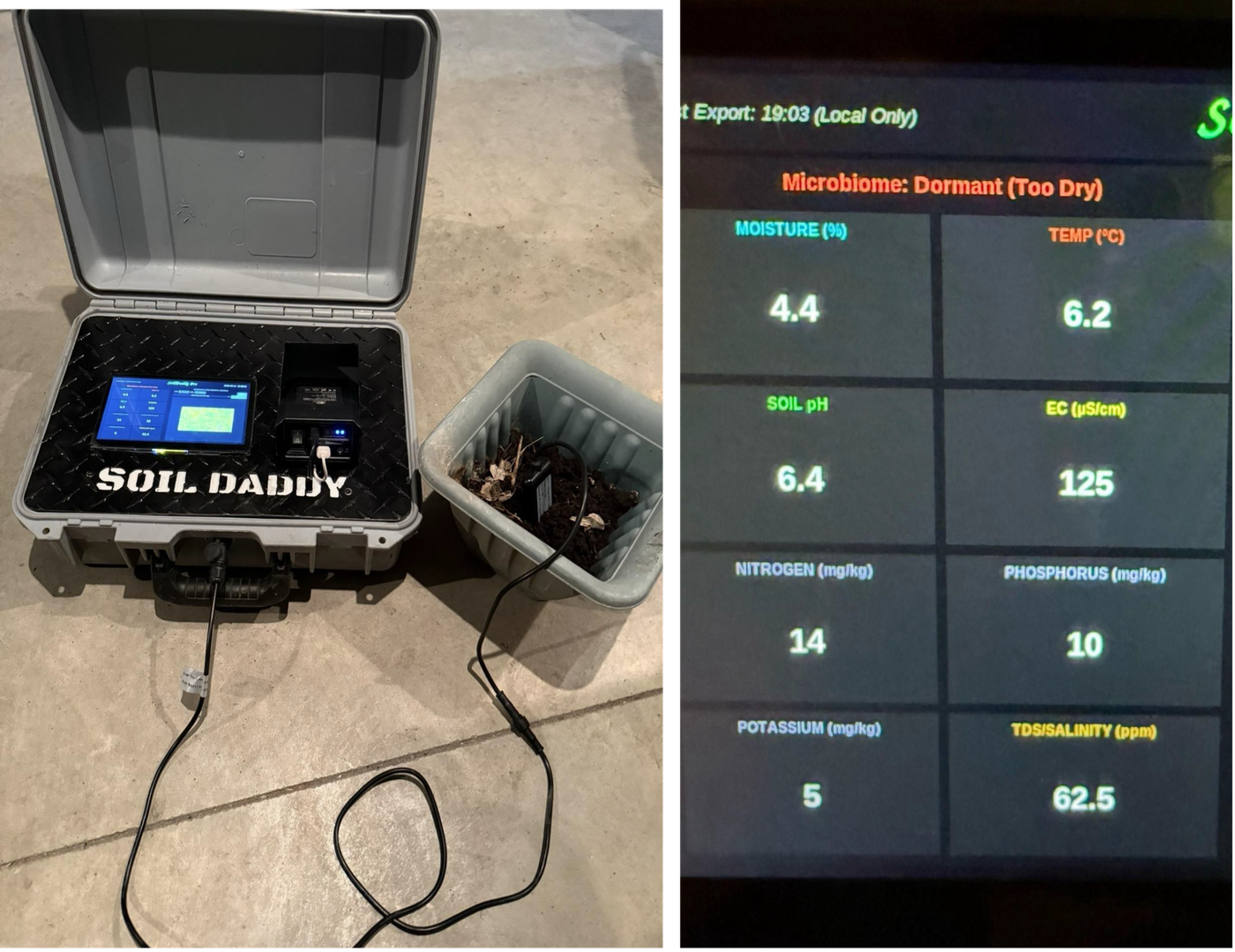
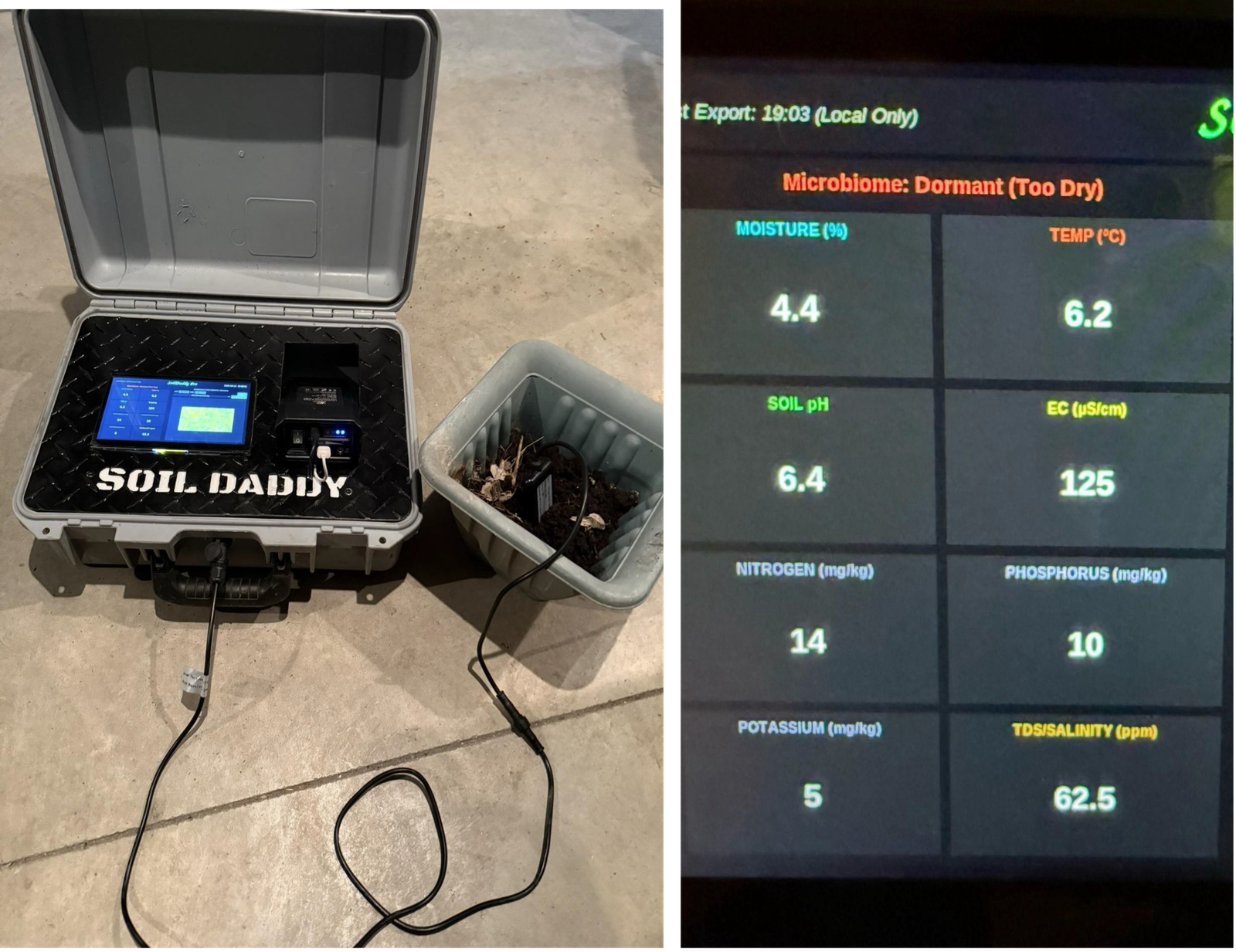
SoilDaddy is a 7-in-1 soil sensing prototype designed to measure several basic soil properties in a single platform. In its current form, the system is intended to measure soil moisture, soil temperature, pH, electrical conductivity, nitrogen, phosphorus, and potassium.
For readers outside the technical world, a few of those terms are worth unpacking. Soil pH describes how acidic or alkaline the soil is. Electrical conductivity, often shortened to EC, is a measure related to dissolved salts in the soil and can provide a rough indicator of nutrient and salinity conditions. Nitrogen, phosphorus, and potassium are three of the major nutrients that support plant growth and are commonly tracked in agricultural systems.
The goal of SoilDaddy is not to claim laboratory-grade precision at this stage. The goal is to build a practical, scalable sensing platform that can be improved through testing, calibration, and field validation. That distinction matters. Research-grade instruments are often more precise than lower-cost commercial components, so part of the team’s current effort is focused on evaluating better commercial off-the-shelf, or COTS, sensors and improving system accuracy.
Click to expand
Left photo: Soil Daddy prototype. Right photo: Live Soil Daddy data. Description: Modular station tracking soil metrics for regenerative insights. Current Status: Working prototype, early testing. Collaboration Needs: Sensor and software experts.
Where the project stands now
The SoilDaddy platform is currently at the prototype stage. A working unit has already been built. Discussions are underway with Dr. Chandan Shilpakar at Lincoln University about establishing a soil data system in the research greenhouses in Jefferson City, Missouri, where the platform could begin calibration and validation under controlled conditions. The team is also presenting the sensor system to Dr. Todd Sparks to explore how its data streams may fit within a Model-Based Systems Engineering framework.
In practical terms, the project is moving from the “we built it” stage to the far more important “now we test it, compare it, refine it, and improve it” stage.
What MBSE means in this project
One of the more technical ideas behind the work is Model-Based Systems Engineering, or MBSE. While the term may sound intimidating, the underlying idea is simple: instead of treating hardware, software, sensors, and data as separate pieces, MBSE links them together in one connected system model.
This connected structure is often called a digital thread. In plain language, a digital thread is a way of tracking how an idea becomes a design, how that design becomes a working tool, and how the data coming back from the field can be used to improve the next version. It helps reduce the silos that often slow down innovation.
For agricultural prototypes like SoilDaddy, this matters because the sensor is not intended to remain a standalone gadget. The larger goal is to connect soil measurements, engineering design, biological feedback, and decision-making into one evolving system. Over time, that kind of framework could help the team improve sensor placement, simulate system behavior, refine performance, and accelerate design improvements based on real field data.
That said, it is important to be clear about the current stage. MBSE is best described here as a framework the team is beginning to explore, not yet a fully deployed system.
Looking ahead: robotics and autonomous sensing
The team is also thinking beyond stationary or handheld soil sensing. One future direction is integrating soil sensing into autonomous mobile platforms. In simple terms, that means placing sensors on robotic or semi-robotic machines that can move through fields or pasture while collecting data.
In their vision, such platforms could eventually support tasks like soil monitoring, manure distribution, and rotational grazing management. The potential on-farm value is significant: less manual labor, more frequent and consistent data collection, improved pasture uniformity, and more targeted soil and nutrient management.
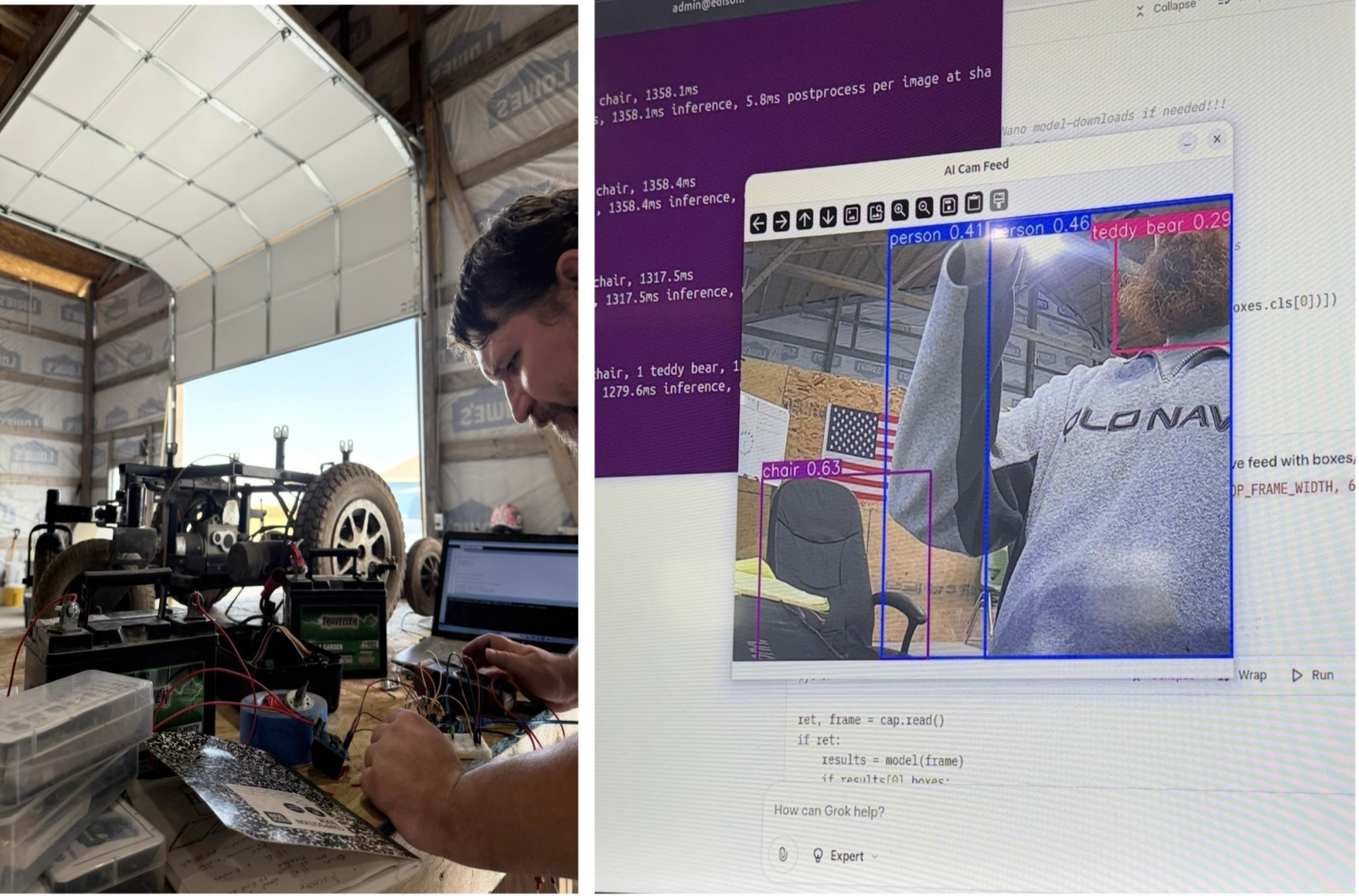
At this stage, that work remains early, with initial prototypes focused on motor controls and basic sensor integration. Still, it points to the broader direction of the project: not just measuring soil, but building systems that interact with it more intelligently.
Click to expand
Left photo: Testing motor control. Right photo:Display from open source image recognition)Description: Semi-autonomous platforms for pasture management. Current Status: Pre-prototype Potential Impact: Efficient manure spread, grazing coordination. Collaboration Needs: Partnerships and funding.
The hard truth
The vision is exciting, but the challenges are very real.
Technically, soil is not a clean or uniform environment. Measurements can vary across depth, moisture conditions, texture, temperature, and management history. A sensor that behaves well on a bench may struggle in the field, where variability is the rule rather than the exception.
There are also cost barriers. Fabrication, electronics, sensor integration, and repeated prototyping all require time and money. Open and community-oriented innovation often faces a funding gap, especially in the early stages when systems are still being validated.
Then there is the practical reality of adoption. Farmers are right to be cautious. New technology earns trust only when it proves useful, reliable, and clearly connected to decisions that matter on the ground.
That honesty is part of what makes this work credible. The team is not pretending the road is easy. They are building in full view of the engineering, financial, and adoption challenges that come with trying to create something new.
Why collaboration matters
The next stage of progress will depend on collaboration. The team is looking for partners who can help with sensor validation, field trials, calibration work, data sharing, and support for open development.
This is also why community-oriented platforms matter. Spaces like Soil Health Exchange can help create the kind of environment where farmers, engineers, and researchers are not working in separate silos, but instead building around shared questions and shared needs.
SoilDaddy is still early. But the larger idea behind it is already clear: practical, adaptable tools built close to the ground, shaped by real-world problems, and improved through collaboration.
Collaboration Needs: Partnerships and funding
Thank you for taking the time to check out our work! Find us online at www.edisonbros.com
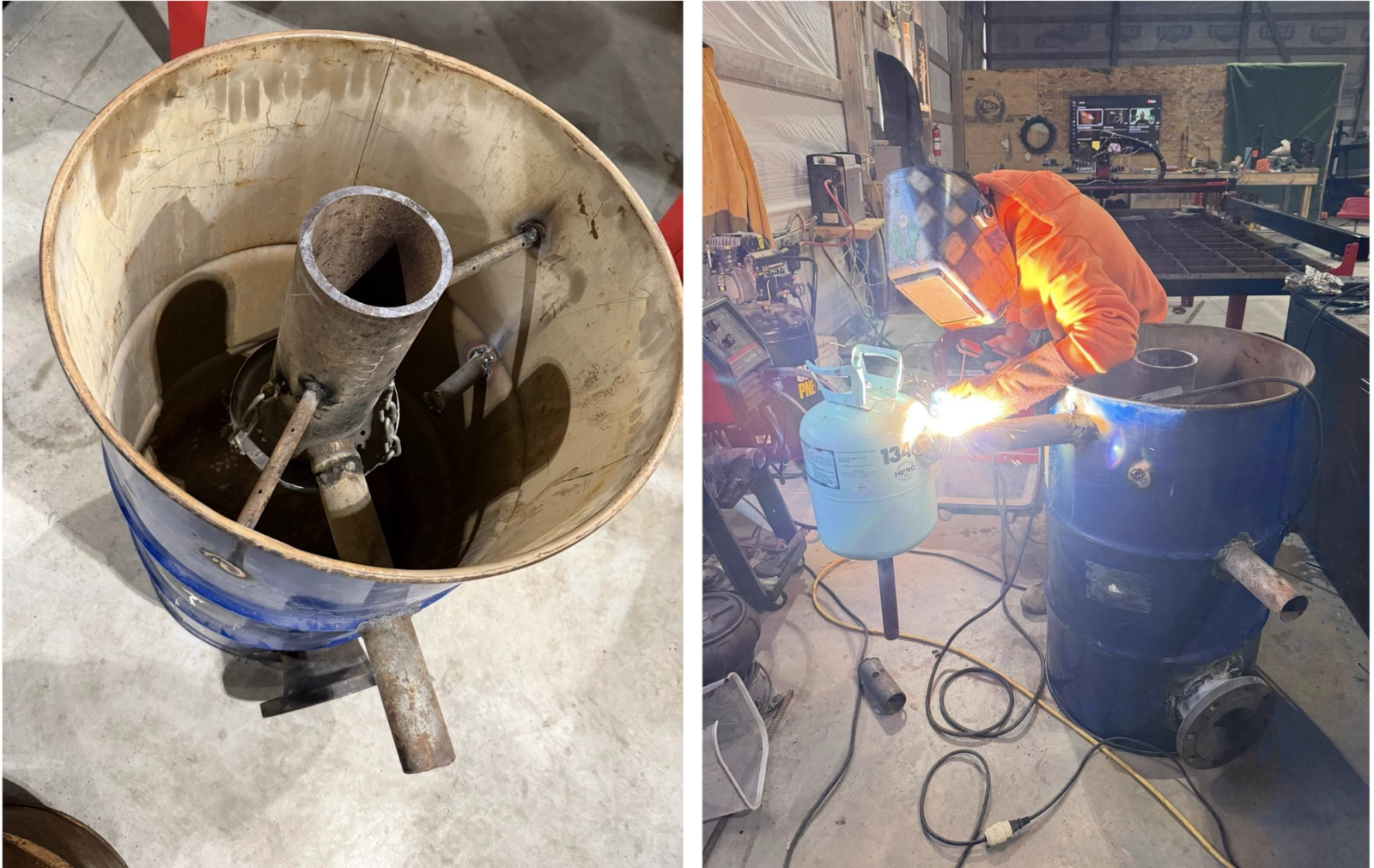
Biochar Gasifier System
The team is also working on a biochar gasifier system designed for small farms. The goal is to convert biomass into biochar while capturing gases that could be used as an on-farm energy resource. Still in development, the project points to a broader vision of turning waste streams into useful tools for soil improvement and farm resilience. Edison Brothers is currently seeking collaboration with biomass researchers and engineers to help move the system forward.
Click to expand
Left photo: A Look inside the gasifier. Right photo: Welding more tanks to the system Description: Converts biomass to biochar, captures gases for small farms. Current Status: Under development. Potential Impact: Soil amendment from waste, energy harvest. Collaboration Needs: Biomass researchers and engineers.
Written by
Edison Brother
Edison Brothers LLC is a Sweet Springs, Missouri-based company blending fabrication, repair, and applied technology to build practical tools for soil health, regenerative agriculture, and small-farm innovation.
#Soil Health#Soildaddy#Edison Brothers
Scholarly record
References & Citation
Source material for every claim in this article, plus a citation-ready record for reference managers and scholarly indexes.
Cite this
Reference this work
SHE-ART-2026-0038
Edison Brother (2026). Edison Brothers: How a Rural Missouri Team Is Building Practical Tools for Soil Health. Soil Health Exchange. SHE-ART-2026-0038. https://soilhealthexchange.com/cite/SHE-ART-2026-0038
Soil Health Exchange assigns a stable identifier to every published answer and article. Citations keep working even if the URL changes later.
Cite this articleShow formatsHide
Cite this article
Citation-ready record
APA
Brother, E. (2026). Edison Brothers: How a Rural Missouri Team Is Building Practical Tools for Soil Health. Soil Health Exchange. https://soilhealthexchange.com/blog/edison-brothers-open-architecture-and-agile-engineering-for-regenerative-soil-health
More citation formats
MLA
Brother, Edison. "Edison Brothers: How a Rural Missouri Team Is Building Practical Tools for Soil Health." Soil Health Exchange, 2026-03-16, https://soilhealthexchange.com/blog/edison-brothers-open-architecture-and-agile-engineering-for-regenerative-soil-health.
Chicago
Brother, Edison. "Edison Brothers: How a Rural Missouri Team Is Building Practical Tools for Soil Health." Soil Health Exchange. Published 2026-03-16. https://soilhealthexchange.com/blog/edison-brothers-open-architecture-and-agile-engineering-for-regenerative-soil-health.

Discussion
No comments yet. Be the first to share your thoughts!