- Location
- Nebraska
- Crop
- Corn, Soybean
- Acres
- 1,000
The challenge
“What are some specific soil health challenges that producers and agribusiness stakeholders in the Midwest region, primarily involved in corn and soybean production, might want to address through the Soil Health Exchange platform?”
Soil Health Exchange Editor Team
Editorial team
What soil health challenges matter most in Midwest corn and soybean systems?
Midwest corn–soybean systems face a cluster of connected soil health challenges that directly affect yield stability, input efficiency, water quality, and long-term profitability. The biggest issues are not isolated problems. Erosion, nutrient loss, compaction, drainage stress, declining soil organic carbon, and biological pressures often reinforce one another. These risks are made worse by short planting windows, heavy equipment, tight labor, and volatile input costs.
For producers and agribusiness stakeholders, this means soil health is no longer just a conservation conversation. It is a production, risk-management, and market-access issue. In many Midwest fields, the challenge is not simply whether soil is “healthy” or “unhealthy,” but which specific constraints are limiting performance and what management changes are realistic under current farm economics.
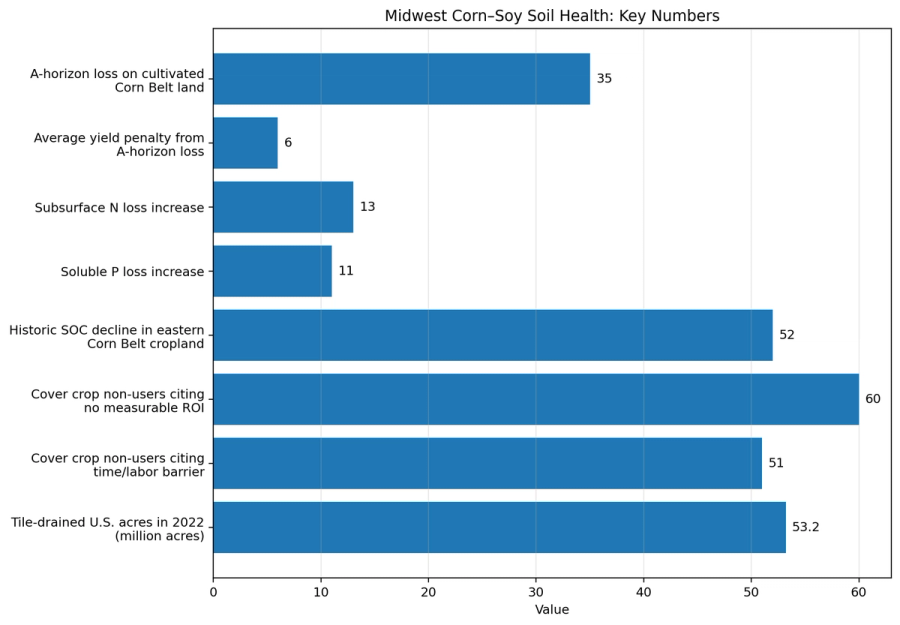
Numbers that matter
~35% of cultivated Corn Belt land shows complete A-horizon loss in remote-sensing assessments.
~6% average yield penalty is linked to that topsoil loss across affected landscapes.
+13% subsurface nitrogen loss was observed in CEAP comparisons even as some surface losses declined.
+11% soluble phosphorus loss highlights that nutrient-loss pathways can shift below ground rather than disappear.
~52% SOC decline has been estimated for eastern Corn Belt cropland since agricultural conversion in the mid-1800s.
60% of cover crop non-users cite “no measurable economic return” as a major barrier to adoption.
~51% cite time and labor as a major adoption barrier for cover crops and related practice changes.
~53.2 million U.S. acres were reported tile-drained in 2022, with much of that footprint concentrated in the Midwest.
Key challenge
Erosion and topsoil loss
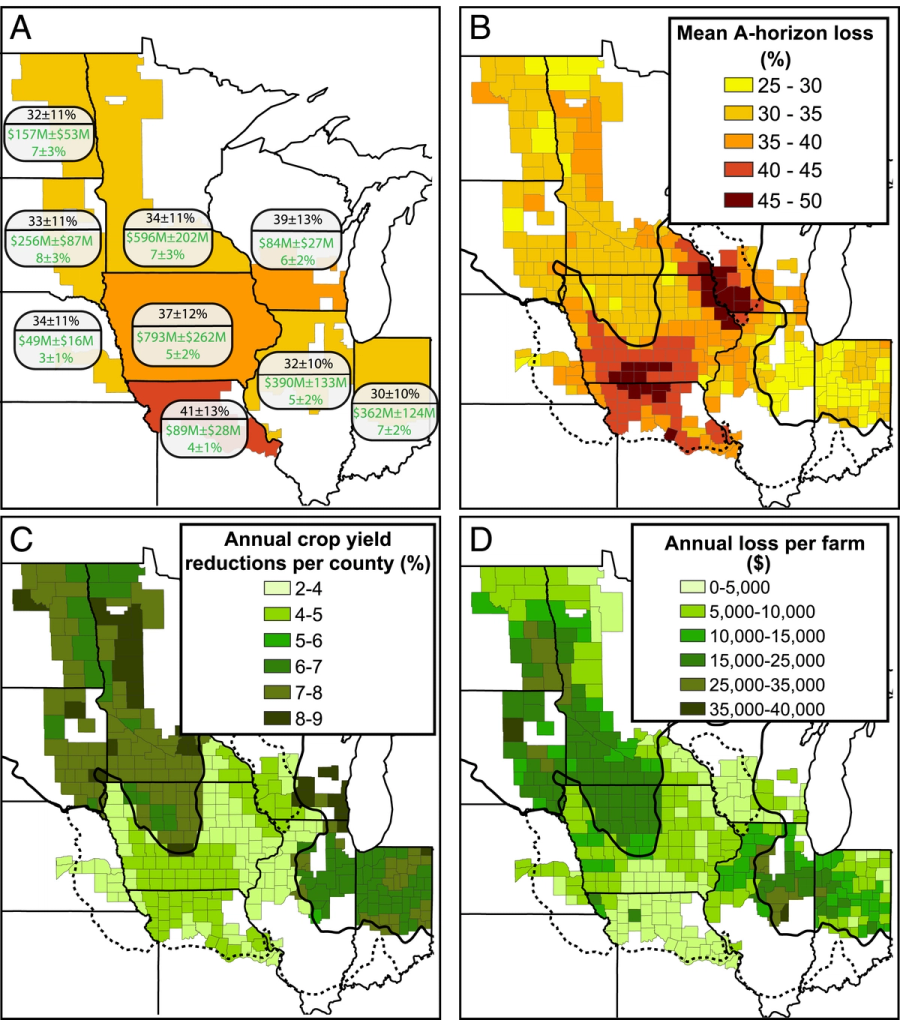
Topsoil loss remains one of the most important long-term productivity threats in Midwest row-crop systems. Even where overall erosion rates may look better on paper, many hilltops and exposed landscape positions have already lost much of their A horizon. That means lower biological activity, weaker structure, reduced water-holding capacity, and less resilience under stress. In practical terms, erosion is no longer only a conservation issue; it is a yield and land-value issue. Remote-sensing assessments suggest complete A-horizon loss across about one-third of cultivated Corn Belt land, with an associated average yield penalty of about 6%.
Why it matters: Lower yield potential, poorer drought buffering, weaker soil function, and economic loss.
What may help: Keeping soil covered with crop residue or cover crops, reducing unnecessary disturbance, targeting conservation practices to vulnerable field positions, and using slope-aware management rather than treating the whole field the same.
Nutrient loss through tile drainage and subsurface flow
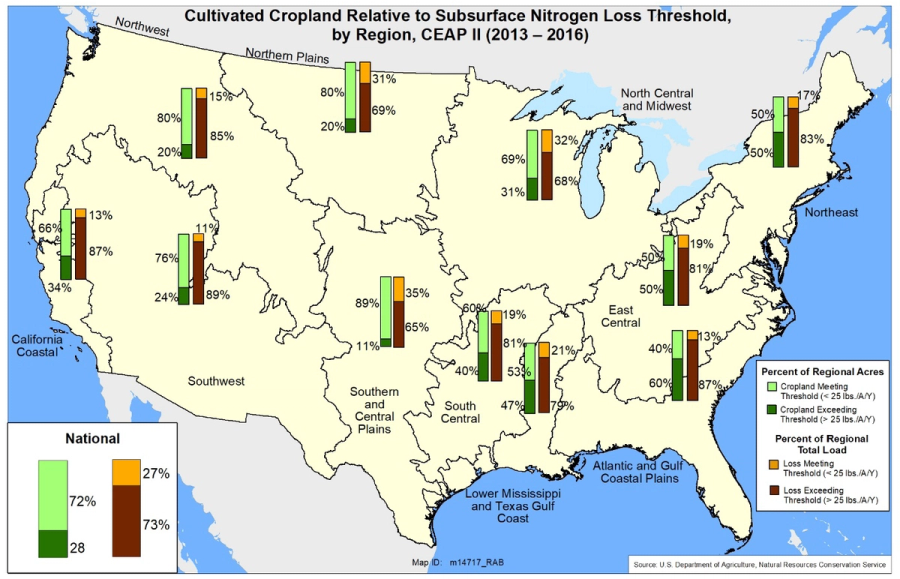
In much of the Midwest, nutrient loss is increasingly a below ground problem rather than just a surface-runoff problem. Practices such as reduced tillage and residue retention often help protect the soil surface, reduce erosion, and lower sediment-bound phosphorus losses. That is a real benefit. But these practices do not automatically reduce dissolved nutrient movement. In tile-drained landscapes, more water can infiltrate through the soil profile instead of leaving as overland runoff, and that water can carry nitrate and soluble phosphorus into subsurface drainage pathways. Conservation Effect Assessment Project (CEAP) comparisons reflect this tradeoff clearly: surface nitrogen losses declined by about 3% and sediment-transported phosphorus by about 6%, yet subsurface nitrogen losses increased by about 13% and soluble phosphorus losses by about 11% . In other words, the problem is not that conservation practices fail; it is that they can shift nutrient-loss pathways unless they are paired with better nutrient placement, timing, living cover, and edge-of-field interception such as wetlands or buffers.
Why it matters: Lost fertilizer dollars, water-quality pressure, and stronger policy and supply-chain scrutiny.
What may help: Better nutrient timing and placement, living cover to retain nutrients, matching fertilizer programs to actual field conditions, and pairing in-field practices with edge-of-field solutions such as buffers or wetlands.
Compaction and traffic damage
Compaction is one of the most operationally stubborn soil health problems in corn–soy systems. It is driven by wet field conditions, heavy machinery, and the pressure to plant or harvest within narrow weather windows. Once present, it restricts rooting depth, reduces infiltration, increases ponding risk, and can amplify disease and water stress. Compaction is both common and difficult to mitigate because farmers often face a tradeoff between avoiding soil damage and missing critical fieldwork windows.
Why it matters: Delayed planting, shallow roots, poor infiltration, yield instability.
What may help: Avoiding traffic on wet soils when possible, improving load distribution, using controlled traffic where feasible, maintaining living roots to support structure, and improving drainage and infiltration so the field is less vulnerable in the first place.
Poor drainage, water-logging, and wet–dry swings
In many Midwest row-crop landscapes, drainage is a major issue. Better drainage and infiltration can help soils dry faster, improve trafficability, and make timely planting possible in wet springs. But poorly drained soils can still experience periodic waterlogging, oxygen stress, shallow rooting, and greater disease pressure, especially during intense rainfall events or prolonged wet periods. These wet–dry swings also strain soil structure and increase the risk of uneven crop performance across the field.
Why it matters: Delayed planting, restricted root growth, greater disease risk, uneven stands, and higher potential for nutrient movement off-field.
What may help: Improving drainage where appropriate, strengthening infiltration through better soil structure, maintaining residue and cover, reducing compaction, and identifying field zones where water stress consistently limits performance.
Soil organic carbon and organic matter decline
SOC and SOM depletion are foundational problems because they sit underneath many other soil health constraints. Lower carbon means weaker aggregation, lower biological buffering, less stable infiltration, and reduced resilience to weather extremes. Eastern Corn Belt cropland has lost about 52% of SOC since agricultural conversion. That is a giant legacy debt, which explains why recovery is usually slow and why one or two good practices do not instantly fix the whole machine.
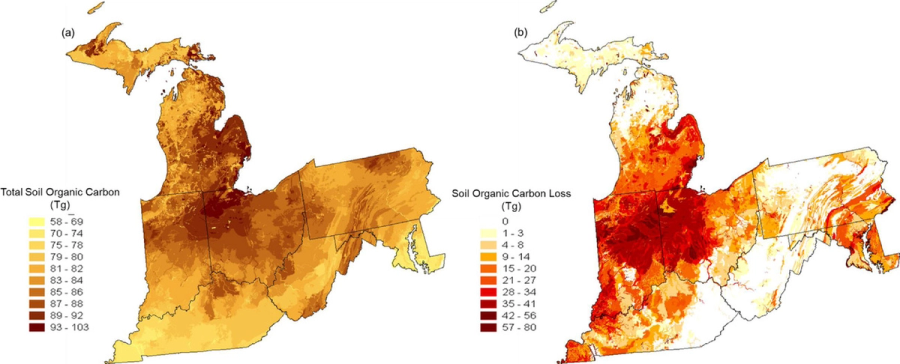
Why it matters: Reduced resilience, lower structural stability, and slower recovery from stress.
What may help: More continuous living cover, greater biomass return, reduced disturbance, diversified rotations, manure or organic amendments where appropriate, and realistic long-term expectations about how fast carbon can rebuild.
Soil-tied pests and pathogens
Biological pressure matters more than many soil health discussions admit. Simplified corn–soy rotations can intensify soil-related pest and pathogen problems over time. Soybean cyst nematode remains a major yield-loss factor in northern soybean systems, and rootworms and soil-associated diseases continue to constrain corn. These issues are tied to drainage, compaction, residue, and rotation diversity, which means they belong inside the soil health conversation rather than outside it.
Why it matters: Hidden yield loss, poor root performance, and reduced system resilience.
What may help: Rotation diversity, improved drainage and root-zone conditions, better scouting and diagnostics, reducing stressors that weaken crop roots, and integrating pest management with broader soil-function goals.
Adoption barriers: economics, labor, and risk
The biggest adoption barrier is usually not lack of interest. It is risk. Across many studies, producers consistently report that the challenge is whether a practice will fit the farm’s labor, timing, equipment, and cash-flow realities. Among cover crop non-users, 60% report no measurable economic return as a major concern, and about 51% cite time and labor. Equipment upgrades, residue handling, seeding logistics, and volatile fertilizer and machinery costs all make practice change harder.
Why it matters: Even good practices stall when they do not fit labor, timing, or cash flow.
What may help: Starting with the most limiting field or management problem, identifying low-friction first steps, using cost-share or incentive programs where available, and choosing practices that solve more than one problem at the same time.
Topics
Cite this
Reference this work
Soil Health Exchange Editor Team (2026). Understanding Soil Health Challenges in Midwest Corn and Soybean Fields. Soil Health Exchange. SHE-FA-2026-0036. https://soilhealthexchange.com/cite/SHE-FA-2026-0036
Soil Health Exchange assigns a stable identifier to every published answer and article. Citations keep working even if the URL changes later.
Keep exploring
Similar questions

From the blog
Discussion
No comments yet. Be the first to share your thoughts!