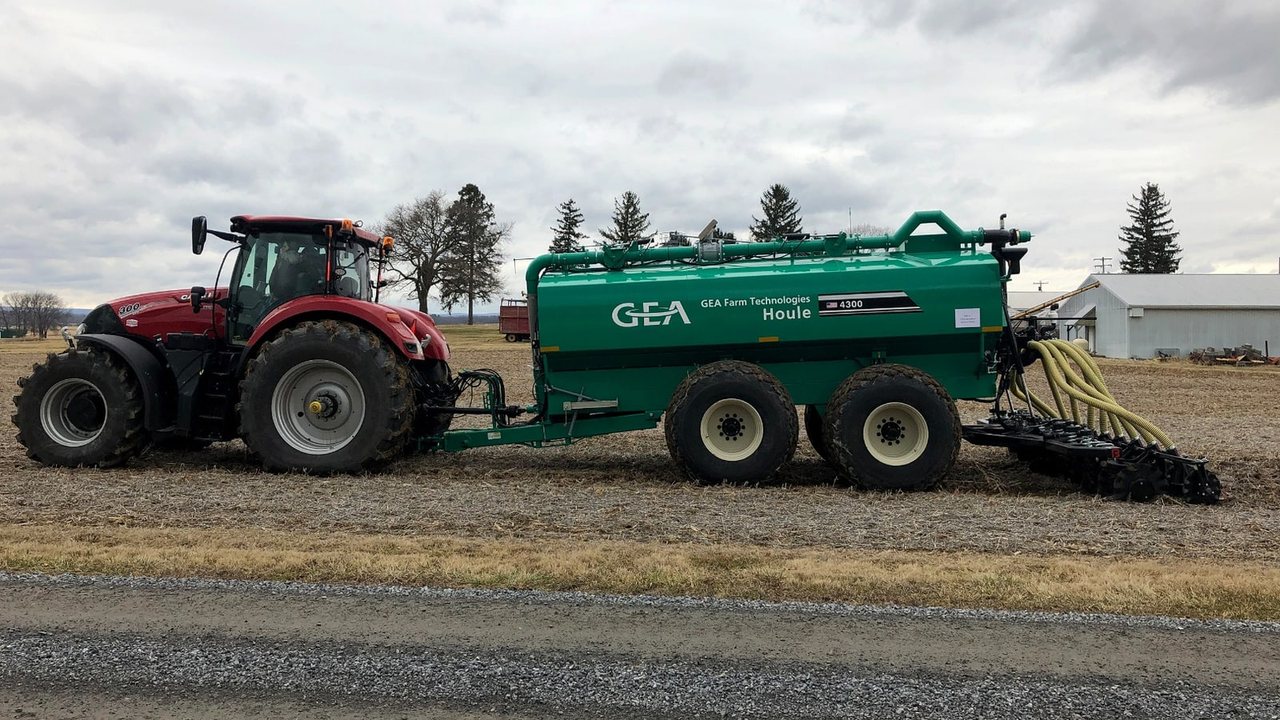
Many fall manure plans begin with a practical deadline: storage must be drawn down before winter or the next production cycle. That tells you when action is needed, but not which field should receive the manure or what the nutrients are worth there. To answer those questions, look at storage, manure analysis, crop need, haul distance, soil condition, water risk, and the rules that apply to the farm.
Start with storage and the real application window
Begin with the storage. Remaining capacity determines how long the farm can wait for better field or weather conditions. The USDA NRCS Agricultural Waste Management Field Handbook lists storage capacity, field activities, weather and soil conditions, land and equipment availability, and crop stage among the factors that shape an application schedule [8]. NRCS's Animal Waste Management tool uses herd, bedding, process water, climate, and storage information to estimate waste volume and evaluate capacity [6].
Write down the current storage level, expected daily or weekly additions, reserve required for precipitation or operational uncertainty, planned drawdown date, available equipment, and acres that could legally and physically receive manure. If the remaining capacity leaves little flexibility, identify the safest suitable fields and conditions now rather than waiting until every choice has narrowed.
The operational questions to answer first
| Question | Record | Why it changes the plan |
|---|---|---|
| How much usable capacity remains? | Current level, expected inflow, precipitation allowance, required reserve, and emergency margin | Establishes the latest safe drawdown date |
| What equipment is actually available? | Pump, agitation, transport, applicator, incorporation, capacity, operators, and custom-hire commitments | Determines acres per day and compatible placement |
| Which fields can be reached? | Harvest status, road access, distance, trafficability, setbacks, effective acres, and neighboring uses | Separates theoretical acres from usable acres |
| What can close the window? | Rain, saturated soil, freeze or snow, forecast-based rule, crop schedule, or storage problem | Defines the backup sequence and stopping conditions |
Sample the manure before assigning value
Manure nutrient content changes with animal diet, water, bedding, storage, settling, treatment, and handling. University of Minnesota Extension advises against relying on estimation tables when an actual analysis can be obtained because the book value can differ from what will be applied [1]. A representative sample is the starting point for both nutrient value and rate.
For liquid or slurry manure, agitation and samples collected across pumping or loads help represent material that settles and changes during drawdown. Solid manure needs samples from many parts and loads because bedding and stacking create variation. Sampling before application gives time to adjust this year's plan but can miss changes during later storage and handling; sampling during application is often more representative but may arrive too late to change the current rate [1]. Many farms use both: a pre-application planning sample and an application-time verification sample.
A practical manure analysis request
| Analysis | Decision it supports | Unit check |
|---|---|---|
| Total N or TKN | Total inorganic plus organic N in the sample | lb/1,000 gal or lb/ton, not a mixed basis |
| Ammonium-N | Immediately available N that is especially sensitive to surface ammonia loss | Confirm whether the report uses NH₄-N or another expression |
| Total P or P₂O₅ | Phosphorus supply, crop replacement, and P-risk planning | Do not mix elemental P with P₂O₅ |
| Total K or K₂O | Potassium supply and replacement value | Do not mix elemental K with K₂O |
| Moisture or total solids | Consistency, loading, comparisons, and rate calculations | Confirm wet-weight versus dry-weight basis |
| Optional pH and C:N ratio | Surface-volatilization context and high-bedding or composted material | Use only when it answers a management question |
Turn the analysis into plant-available nutrients
The laboratory reports what is in the sample. The crop recommendation needs an estimate of what will become available in the relevant crop year. Manure N includes ammonium and organic forms. Ammonium can be used quickly by plants or converted to nitrate, but it can also be lost as ammonia when left on the surface. Organic N becomes available through mineralization over time. Source, storage, timing, application method, climate, and the locally accepted coefficients all affect the estimate [2][3].
Use the availability factors published for the field's state and manure system. Do not borrow a percentage from another state simply because the manure species sounds similar. Keep the coefficient source and date with the calculation so the plan can be reproduced and updated.
Keep three quantities separate
| Quantity | What it means | Do not treat it as |
|---|---|---|
| Total nutrient content | The nutrient measured in each ton or 1,000 gallons | The amount available to the first crop |
| Plant-available nutrient | The locally estimated portion available in a defined crop year after storage, timing, and method adjustments | A universal fraction for every state and manure system |
| Nutrient balance | Available nutrients supplied compared with the crop's remaining need after other sources | The economic value of every nutrient applied |
| Fertilizer replacement value | The cost of purchased nutrients and application that the manure actually replaces | Gross analysis multiplied by fertilizer price without considering crop need |
Value only what the field can use
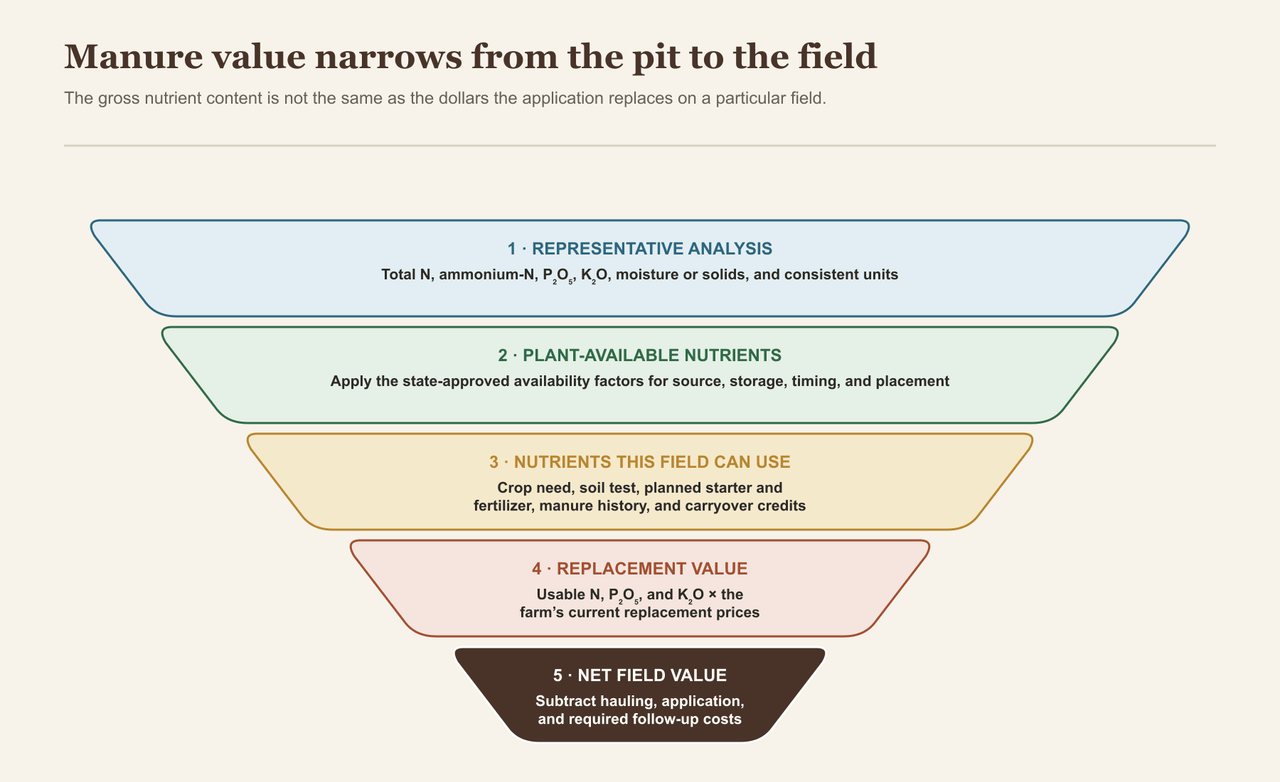
To estimate what manure is worth on a field, start with the fertilizer it can actually replace. Add any application cost the manure truly avoids, then subtract hauling, application, incorporation, testing, and other required costs. Minnesota's manure-value calculator uses this field-specific approach instead of assigning the same value to every gallon or ton [4][5].
If a field needs N but already tests high in P, the manure's P does not create an immediate fertilizer saving there. It may instead limit the rate, require more acres, increase hauling, or make another field more valuable. USDA Economic Research Service notes the same structural problem: manure nutrient ratios do not necessarily match crop needs, and an N-based rate can apply more P than the crop requires [11].
The field-value calculation
| Step | What to enter | Output |
|---|---|---|
| 1. Nutrients applied | Tested lb/unit × planned units/acre | Total N, P₂O₅, and K₂O per acre |
| 2. Nutrients available | Current state factors for source, storage, timing, and method | Available nutrients by crop year |
| 3. Nutrients usable | Crop need minus soil, previous manure, starter, and other credited sources | The part that can replace a purchase |
| 4. Gross replacement value | Usable nutrient × current farm replacement price | Value before manure-specific costs |
| 5. Net field value | Gross value minus hauling, application, incorporation, testing, and required follow-up | Comparable dollars per acre, load, ton, or 1,000 gallons |
Choose the field before finalizing the rate
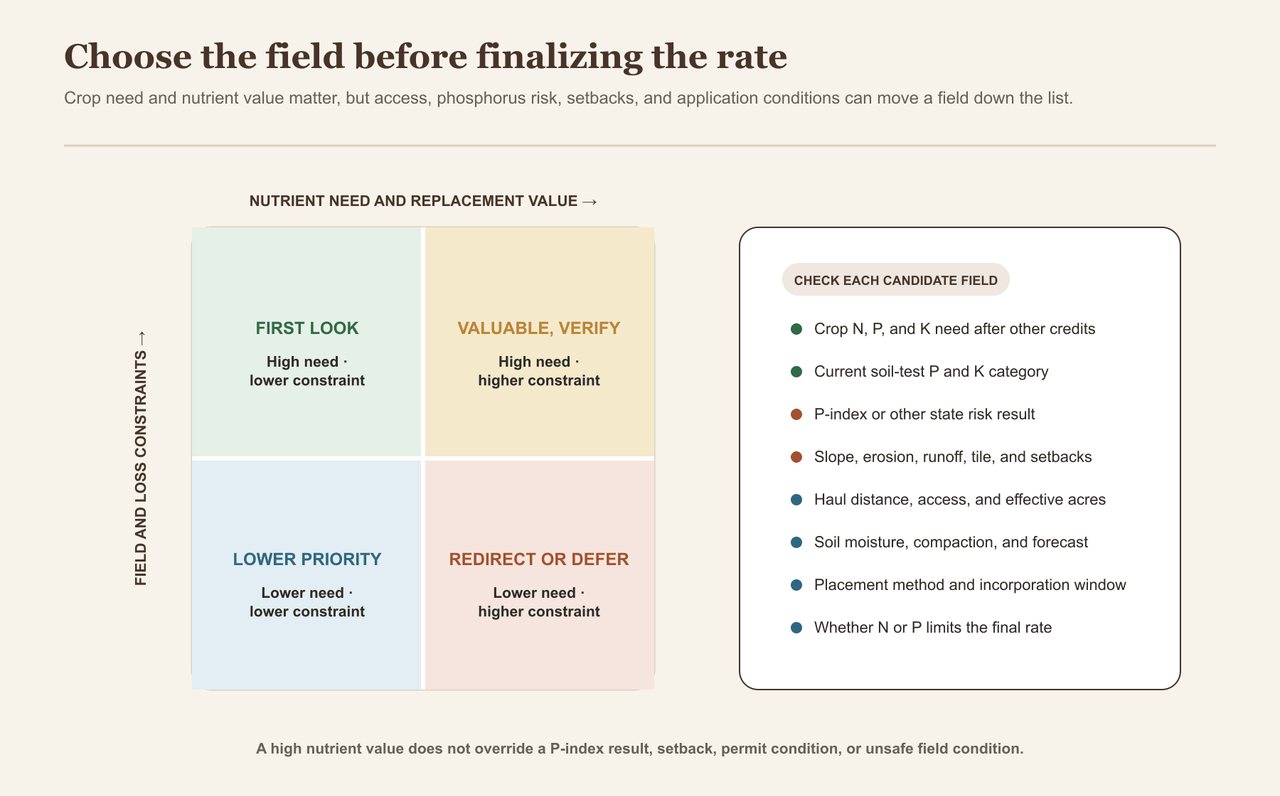
The closest field is not always the lowest-cost field once nutrient need and constraints are included. Compare two or three candidate fields before committing the storage volume. A farther field with real P and K need may retain more fertilizer value and avoid a P-limited rate; a nearby field with wet soil, high P, many setbacks, or poor access may require more acres, more loads, or no application.
A side-by-side field comparison
| Field factor | What improves priority | What lowers priority or stops application |
|---|---|---|
| Crop and nutrient need | A crop and soil test that can use the available N, P, and K | Little need for the nutrients that dominate the manure |
| Manure history | No uncredited residual nutrients or repeated loading | Uncertain history, uncredited carryover, or nutrient buildup |
| P risk | Applicable soil test and risk assessment support the plan | P-index, high soil-test P, or plan limitation controls the rate |
| Water and erosion | Lower runoff and erosion risk with required buffers in place | Concentrated flow, vulnerable slope, forecast concern, tile or water setback issue |
| Operation | Firm access, suitable moisture, efficient route, and enough effective acres | Compaction risk, difficult road, small effective area, or excessive loads |
| Placement | Available method protects nutrients and fits the residue and erosion system | Required incorporation cannot be completed or would create unacceptable disturbance |
Ask whether nitrogen or phosphorus controls the rate
An N-based rate uses enough manure to supply an accepted amount of crop N after availability and other credits. A P-based or P-limited rate supplies manure according to the crop's P need or the result of the applicable P-risk method. Because manure often supplies N and P in a different ratio than the crop removes them, these two rates can be far apart [11].
The field's soil-test P, manure history, erosion and runoff pathways, subsurface drainage, proximity to water, and planned rate and placement can all enter a state P-index or related assessment. Pennsylvania's P Index is one example of a state method that screens fields and can change the allowable manure strategy [12]. Its thresholds and worksheets belong to Pennsylvania; other states use their own methods.
What changes when P limits the application
| Decision | N-based plan | P-based or P-limited plan |
|---|---|---|
| Manure rate | Set from remaining accepted crop-N need and plant-available N | Set from accepted crop-P need, removal, or state risk criteria |
| Supplemental fertilizer | May need P or K depending on the balance | Often needs supplemental commercial N because the manure rate is lower |
| Acres and hauling | Fewer acres may receive the storage volume | More acres and loads may be needed to distribute the same volume |
| Records | Document N credits and P/K supplied | Document the P method, result, limiting rate, and supplemental-N plan |
Choose placement with both nutrient retention and the soil in mind
Surface-applied manure can lose ammonium N as ammonia gas, especially when high-ammonium manure remains exposed. Prompt incorporation or injection generally retains more ammonium N than delayed or no incorporation [1][3]. The same choice affects odor, horsepower, fuel, speed, residue, erosion, soil disturbance, compaction, and the distribution of nutrients in the soil.
Placement is a tradeoff, not a single ranking
| Method | Potential advantages | Questions to resolve |
|---|---|---|
| Surface broadcast | Faster, lower draft, may preserve residue and fit some solid manures | Ammonia loss, odor, runoff, forecast, residue coverage, and whether incorporation is required |
| Broadcast with prompt incorporation | Reduces surface exposure and can retain more ammonium N | Time between passes, soil moisture, erosion, fuel, labor, and tillage compatibility |
| Knife or coulter injection | Places liquid manure below the surface and reduces exposure and odor | Draft, speed, slot closure, compaction, band concentration, overflow, and residue disturbance |
| Sweep or broader injection | Can spread manure through a wider subsurface band | Higher horsepower, soil disturbance, trafficability, and equipment availability |
Do not solve one loss pathway by creating another. Incorporation may reduce ammonia loss and surface nutrient exposure, but aggressive tillage on an erodible slope can increase sediment loss. Heavy injection equipment on wet soil can compact the profile and increase later runoff. Match the method to the nutrient form, soil, residue system, erosion plan, and actual field moisture [3][7][8].
Time high-ammonium manure with the same care as other fall N
High-ammonium manure can follow the same ammonium-to-nitrate pathway described in the Fall Nitrogen guide. In states that use a fall soil-temperature threshold for the manure and system in question, waiting until the specified depth is near or below 50°F and trending colder can slow nitrification. This is a regional recommendation, not a national rule for every manure source or field [9].
Iowa research comparing early-fall, late-fall, and spring manure illustrates why time before crop uptake matters: later applications reduced nitrate exposure and performed better in the studied corn systems, while cover crops captured some residual N [9]. Treat the reported yield differences as results from those sites and years, not as a guaranteed return on another farm. The decision to delay still has to fit storage capacity, soil condition, and the applicable state plan.
A nitrification inhibitor can slow conversion of the manure's ammonium portion, but Minnesota trials found that yield and N-conservation responses were not automatic [10]. The product cannot protect organic N that has not mineralized, stop surface ammonia volatilization, correct a high-risk field, or replace timely incorporation where that is the chosen method. Check the active ingredient, label, compatible manure system, placement, research, and cost.
Carry the nitrogen credit into the next crop years
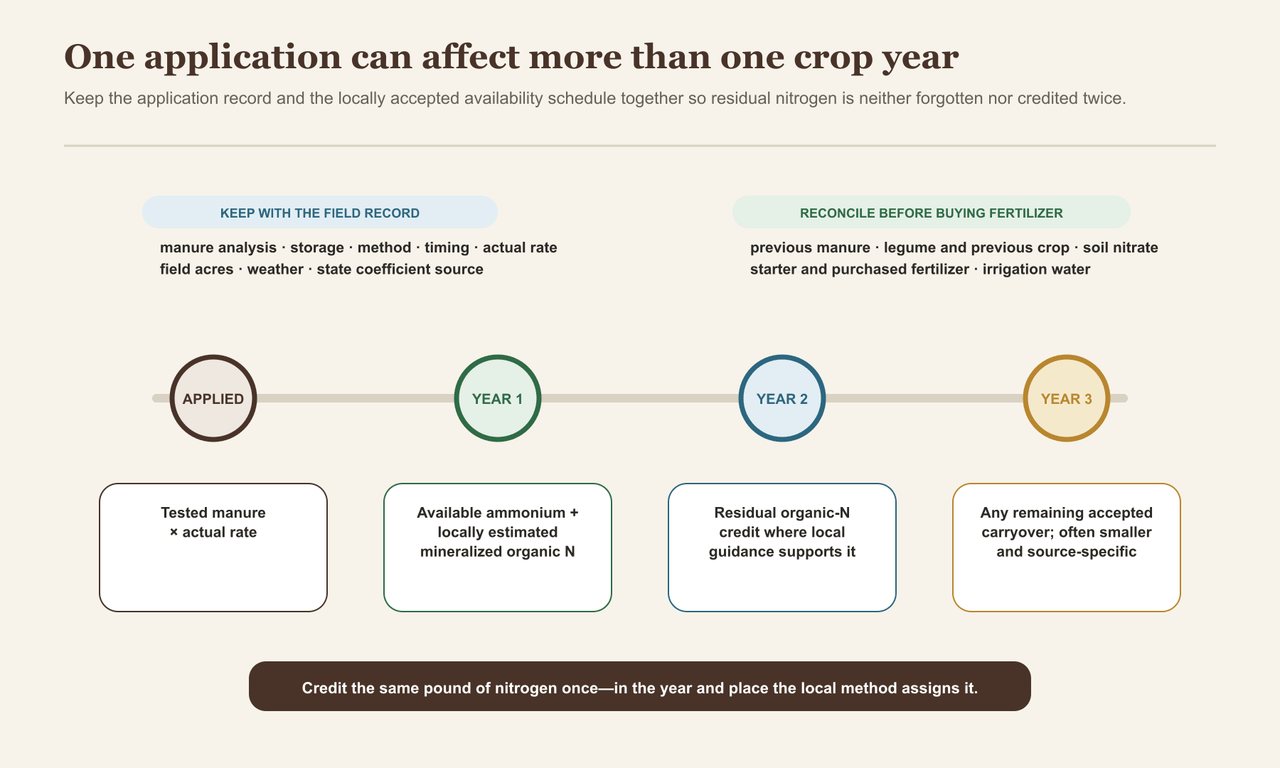
The application record should produce more than this year's available-N number. Organic N can mineralize in later years, and accepted residual credits vary by manure source and local method [2]. Store the year-one, year-two, and any later accepted credit with the field record. Then reconcile it with previous crop, legume, soil nitrate, irrigation-water, starter, and commercial-fertilizer credits before setting the next N rate.
Turn the plan into loads, acres, and stopping conditions
A calculated rate is not operational until it is converted into effective acres and loads. Subtract required setbacks and excluded areas from the field size, then use the applicator's actual capacity and calibrated output. Include travel, agitation, loading, unloading, incorporation, and cleaning time. This exposes whether the planned fields and weather window can actually empty the required storage volume.
The application-day sheet
| Keep visible | What to write down |
|---|---|
| Storage target | Volume or weight to remove, minimum reserve, and emergency contact plan |
| Field plan | Priority order, effective acres, rate basis, approved rate, setbacks, and excluded areas |
| Loads | Applicator capacity, target loads per field, expected hours, route, and road limitations |
| Conditions | Soil moisture and trafficability, forecast, wind where relevant, ground condition, and stopping thresholds |
| Placement | Method, depth or incorporation timing, required second pass, and responsible operator |
| Verification | Actual field, date, start and stop, loads, calibrated rate, exceptions, spills, and follow-up sample |
Check the state requirements before the first load
The current state NRCS 590 standard, state environmental rules, nutrient-management plan, permit, and conservation agreement may address different parts of the application. Check the sources that actually apply to the operation. NRCS uses the state Field Office Technical Guide for planning and describes a comprehensive nutrient management plan as part of the broader conservation plan [6][7].
The Soil Health Exchange Manure Calculator currently includes state-rule modules for California, Iowa, Illinois, Indiana, Kansas, Maryland, Michigan, Minnesota, Missouri, North Carolina, Nebraska, New York, Ohio, Pennsylvania, Texas, Virginia, and Wisconsin. For every state, the tool remains a planning aid rather than a permit or compliance determination. States outside those modules require especially careful local verification.
- Confirm the manure analysis, soil test, crop recommendation, and accepted nutrient-availability factors.
- Confirm whether an N-based, P-based, P-limited, or capped rate applies.
- Check the current P-index or other risk tool required for the field.
- Map wells, water, sinkholes or karst features, tile or inlets, property boundaries, roads, residences, and all applicable setbacks.
- Check saturated, frozen, snow-covered, forecast, seasonal, and emergency-application restrictions.
- Confirm calibration, recordkeeping, incorporation, notification, and plan-approval requirements.
- Document who made the final agronomic and compliance determinations.
Build the field comparison
Enter the current analysis, crop, soil-test method, timing, placement, state, field features, prices, acres, and applicator capacity in the Manure Calculator. Compare at least two fields. Then review the selected calculation, source documents, and application-day sheet with the farm's qualified nutrient-management or crop adviser before finalizing the field plan.