A field-by-field guide to deciding whether fall nitrogen should be used at all, how the long gap before crop uptake changes the risk, and when moving N to spring or in-season makes sense.
SH
By Soil Health Exchange Team||17 min read|34 reads
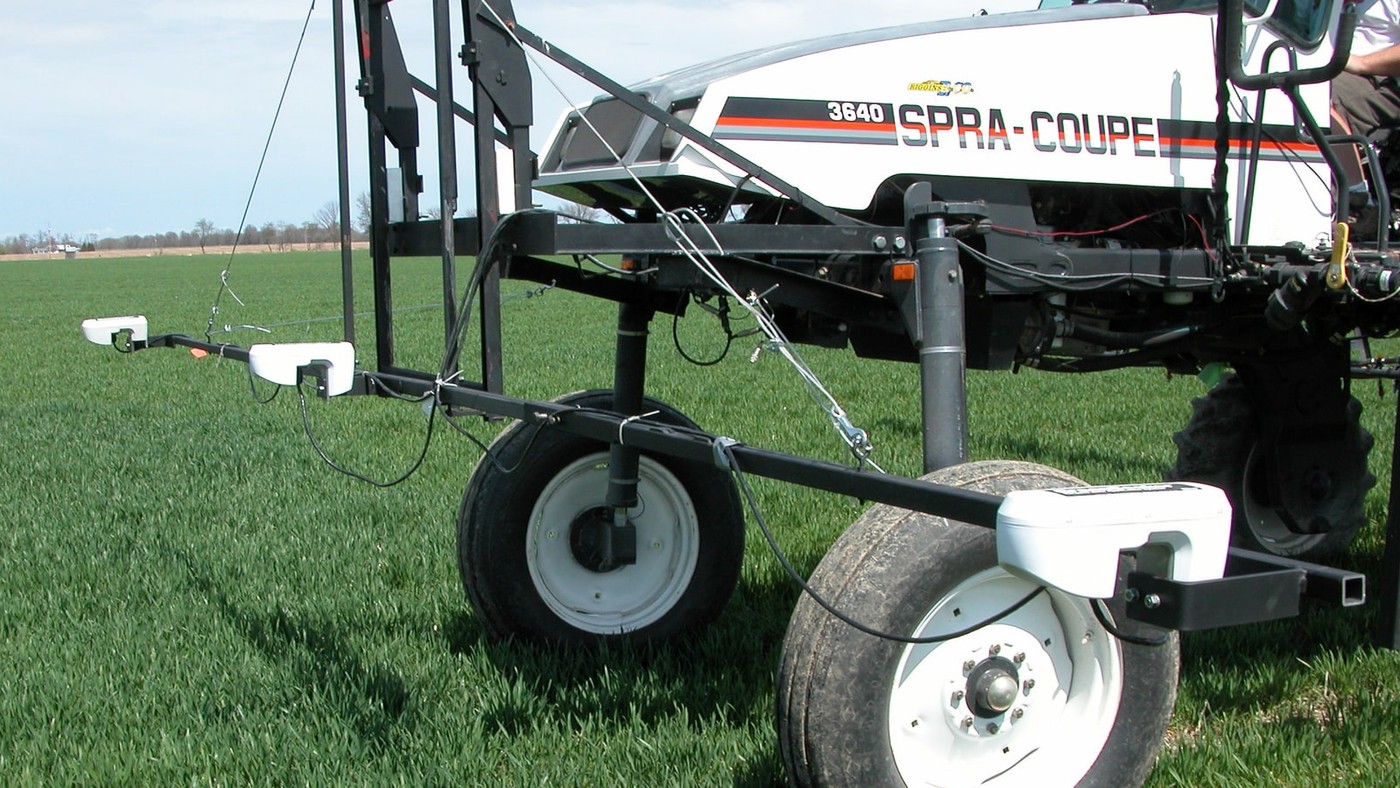
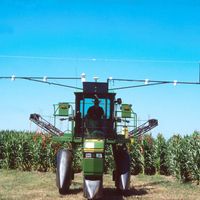
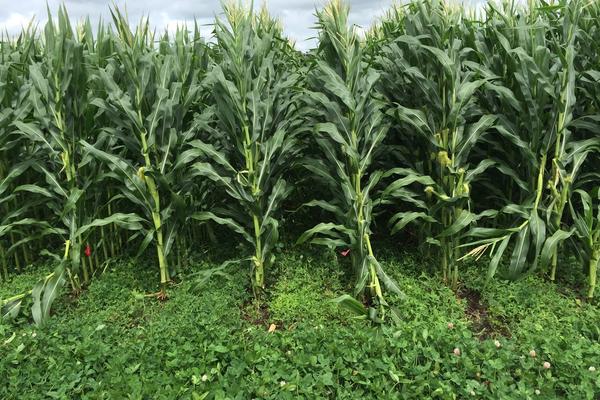
Nitrogen application is not one decision made at one time. Source, field condition, equipment, and the timing of crop need all shape how efficiently the nutrient is used. This USDA-ARS applicator uses crop sensors for variable-rate application; fall application requires a different field-readiness check. — Credit: Photo by Newell Kitchen, USDA Agricultural Research Service · Image D721-3
The bottom line
Corn planted next spring cannot use nitrogen applied this fall during the months in between. That long gap creates more time for ammonium to become nitrate and for nitrate to be lost if water moves through the soil or the field becomes saturated. Where the farm can apply N reliably in spring or in-season, moving it closer to crop uptake is generally the better direction. Reduce fall use gradually, beginning with fall urea or UAN and fields with high leaching or saturation risk. Keep late-fall anhydrous ammonia as a limited option only where current local guidance supports the field, source, timing, and conditions. Do not add extra N to cover an expected loss, and reserve spring or sidedress capacity before the fall window opens.
Fall nitrogen can solve a real workload or field-access problem, but it is not automatically the agronomic preference. Corn planted next spring cannot use that N during fall or winter. Begin by asking whether applying this far ahead of crop uptake creates a risk the farm can avoid. Then consider soil, drainage, source, equipment, and current state guidance.
How to use this guide
Work through the guide one field at a time. First ask whether the farm can apply N closer to crop uptake without creating an unmanageable spring or sidedress risk. Then use the current locally calibrated N recommendation and confirm whether the fall source, placement, timing, and field conditions meet local guidance and the farm's nutrient plan.
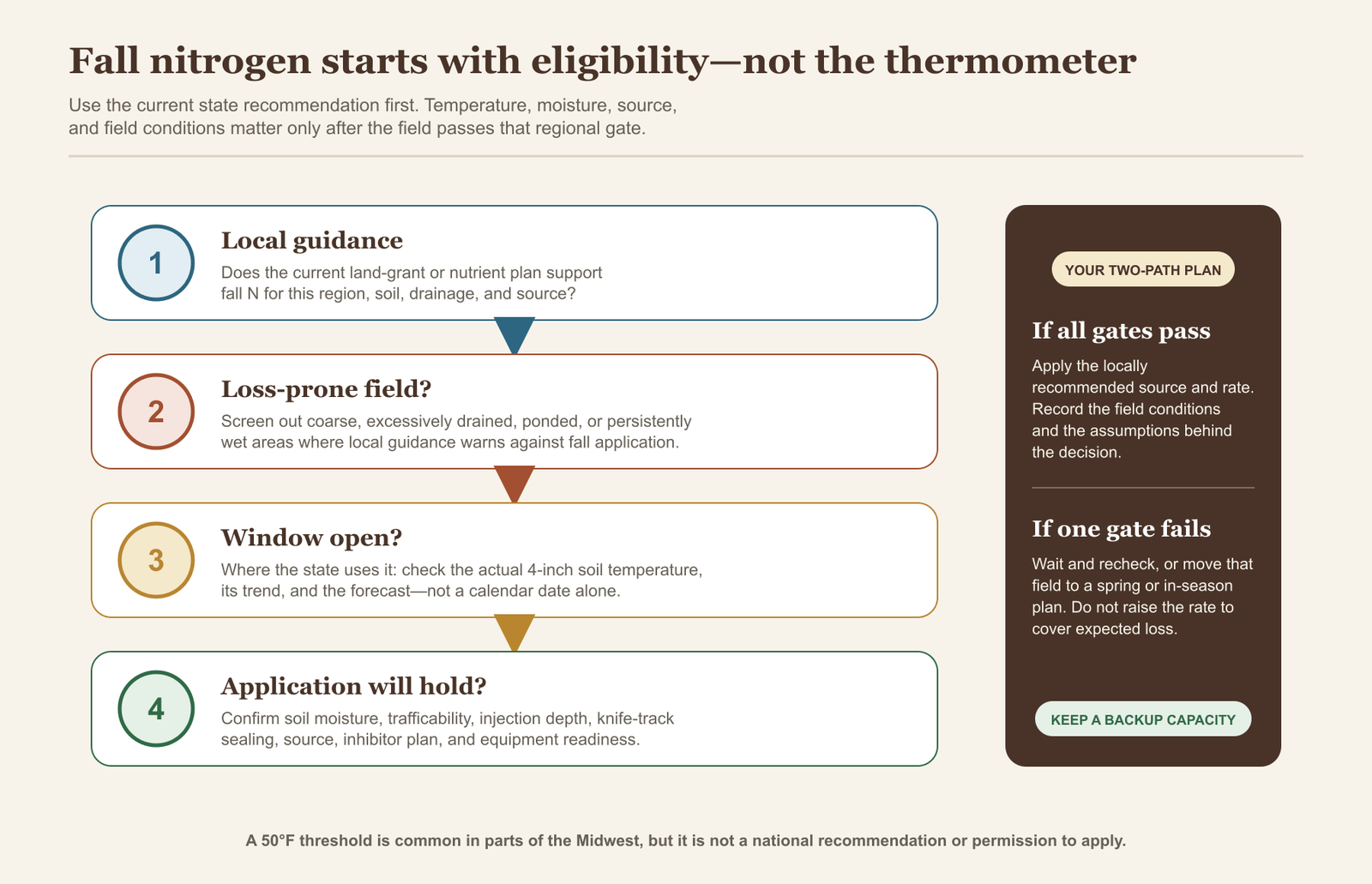
Start with eligibility, not temperature
Fall nitrogen guidance changes across state lines and sometimes within a state. Iowa guidance has long limited recommended fall fertilizer N to anhydrous ammonia, applied late in the fall on soils that are not prone to excessive wetness or leaching . Minnesota guidance excludes high-leaching-potential soils and warns against fields or areas that pond or remain wet for long periods . The Tri-State guidance for Ohio, Indiana, and Michigan has its own limits for geography, soil, source, and inhibitors . Check the recommendation for the field rather than relying on one rule for every location.
Start with the current land-grant recommendation for the state and production region. Use it to make the first field list, then check the state NRCS Conservation Practice Standard 590 in the Field Office Technical Guide and the farm's nutrient-management plan, conservation agreement, or other applicable requirement [8][9]. NRCS directs planners to the state standard for field-level decisions [8].
The questions that decide whether fall N is in play
Question
What to verify
If the answer is unfavorable
Is fall N supported here?
State, production region, soil and drainage class, previous crop, and planned source
Use a spring or in-season plan
Is the soil loss-prone?
Coarse texture, excessive drainage, shallow or karst features, ponding, prolonged saturation, or locally excluded soil
Move N closer to crop uptake
Is the timing window open?
The locally specified 4-inch temperature, a continuing cooling trend, and the forecast
Spring or sidedress labor, product, equipment, and field-access plan
Reserve backup capacity before committing
The exact answer must come from current local guidance. Sources: Iowa State [1][2], Minnesota Extension [4][5], Tri-State guidance [10], and USDA NRCS [8][9].
Swipe horizontally to inspect the full figure →
Click or tap to expand the figure
A soil-temperature threshold belongs inside a larger decision. Confirm regional and field eligibility first, then timing and application conditions [1][2][4][5][8][10]. — Figure: Soil Health Exchange figure
Start with the agronomic direction: closer to crop uptake
The next corn crop takes up no fertilizer N during the months between a fall application and planting. During that interval, ammonium can be converted to nitrate whenever soil conditions support nitrification. Once N is in nitrate form, rainfall, drainage, and saturated soil can move it below the root zone or convert it to gases before the crop can use it. Applying in spring or in-season shortens this period of exposure, although poorly timed spring N can still be lost in wet conditions [6][12].
The size of the timing effect varies by region, source, soil, and weather. In a 25-site-year Minnesota comparison, spring urea needed 28 fewer pounds of N per acre at the economic optimum and produced 9 more bushels per acre on average than fall urea [6]. In 18 central Illinois on-farm trials, fall and spring anhydrous ammonia reached the same optimum yield, but the fall treatment required 211 pounds of N per acre compared with 194 pounds in spring [12]. These results are not universal rate credits. They show why a fall application should solve a field or operational need rather than remain the automatic choice.
Follow the gap between application and crop demand
Period
Crop demand
What can happen to N
Management question
After harvest through winter
The next corn crop is not present
Ammonium can become nitrate during unfrozen or warmer periods; any nitrate formed is exposed to water-driven loss
Does this field need a fall application badly enough to accept the longer exposure?
Early spring before emergence
The crop is still absent
Warming soil can speed nitrification, while wet conditions can increase leaching or denitrification risk
Can N be applied now without delaying planting or damaging wet soil?
Emergence and early vegetative growth
Demand begins, and the young crop needs an accessible early supply
N must reach developing roots; delaying the entire program too long can limit the crop
Is enough early N available under the locally recommended system?
Rapid vegetative growth toward pollination
N uptake increases as the plant and root system grow
N applied in-season has less time for loss before uptake, but rain or access can delay the pass
Was the sidedress window, equipment, product, and weather backup planned in advance?
Crop development and field conditions vary, so use this as a planning sequence rather than a fixed calendar. Source: Illinois Agronomy Handbook [12].
Should fall nitrogen be phased down?
For many farms, yes—gradually and field by field. Begin with the sources and fields carrying the clearest loss risk, while building enough spring or sidedress capacity to protect planting and timely crop nutrition. The goal is not an immediate ban. It is to make routine fall fertilizer N the exception that must pass a local agronomic, environmental, economic, and operational check.
Where a gradual reduction should begin
Current practice
Why reconsider it first
Practical direction
Fall urea or UAN
These sources generally carry more fall loss exposure than anhydrous ammonia, and some states advise against their fall use
Move to an appropriate spring, planting-time, or in-season program
Fall N on coarse, excessively drained, ponding, or frequently saturated fields
The field has a stronger pathway for leaching or denitrification
Prioritize these acres for application closer to crop uptake
Application before the locally supported cold-soil window
More warm time allows more ammonium to become nitrate before crop demand begins
Wait for the full local window or defer to spring
Extra N added to cover an expected fall loss
The added cost does not correct the timing or field-risk problem
Keep the locally recommended rate and change the timing or field plan
Late-fall anhydrous on a locally supported, lower-risk field
It may still provide an operational benefit, but it remains exposed for months before uptake
Retain only where field conditions, economics, and backup capacity support it
The order matters more than adopting one percentage for every farm. Sources: Iowa State [2], Minnesota Extension [4][6], and the Illinois Agronomy Handbook [12].
Why the waiting period matters
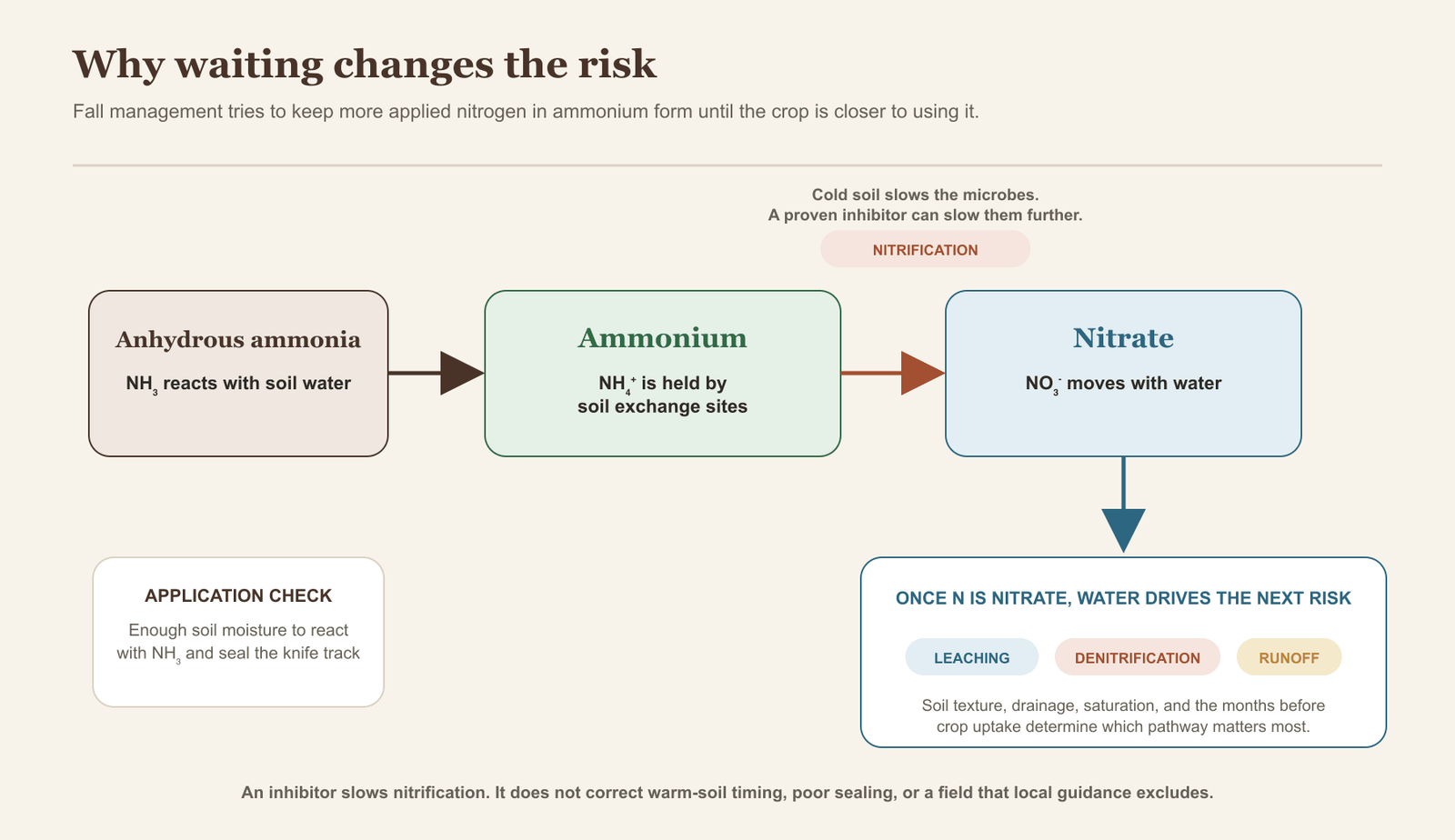
Anhydrous ammonia, NH₃, reacts with soil water and becomes ammonium, NH₄⁺. Ammonium carries a positive charge and is held on negatively charged soil exchange sites. Soil microbes convert ammonium to nitrate, NO₃⁻, through nitrification. Nitrate remains plant-available, but it also moves with water and can be lost by leaching or, under saturated conditions, denitrification [3].
Cold soil slows nitrification. That is the purpose of waiting: keep more of the applied N in ammonium form for longer, so less nitrate is present during the months before rapid crop uptake. Waiting does not eliminate loss risk, and temperature does not fix a field with high leaching or saturation risk [2][4][5].
Swipe horizontally to inspect the full figure →
Click or tap to expand the figure
Fall management tries to delay the ammonium-to-nitrate conversion. Soil temperature, moisture, drainage, and time before crop uptake determine how much protection that delay provides [2][3][4]. — Figure: Soil Health Exchange figure
Keep the nitrogen processes separate
Process
What is happening
What the fall decision can change
Ammonia retention
Injected NH₃ must react with soil water and remain inside a sealed soil band
Moisture, depth, closing, equipment condition, and rate per knife
Nitrification
Microbes convert ammonium to nitrate
Soil temperature, timing, and a proven compatible inhibitor
Leaching
Water carries nitrate below the root zone or into drainage water
Field eligibility, amount exposed, and moving application closer to uptake
Denitrification
Microbes convert nitrate to gases in saturated, oxygen-limited soil
Field eligibility, drainage context, amount exposed, and timing
Surface runoff
Dissolved or attached nutrients leave with surface water or sediment
Placement, residue and erosion management, setbacks, and forecast
The management response depends on which process is operating. Sources: Iowa State [1][2][3] and Minnesota Extension [4][5].
Measure the field, not the date
Where local guidance uses the familiar threshold, wait until the soil at a 4-inch depth is below 50°F and continuing to cool. The trend matters because a short cold spell followed by warmer weather can restart or extend nitrification [1][2][4]. The colder the soil within a suitable application window, the slower the biological conversion.
Measure representative fields directly. Soil color, residue, slope position, drainage, moisture, and time of day can make one field warmer than another. A regional map is useful for deciding when to begin checking; it is not a field-level green light [1][4]. Record the depth, location, time, temperature, recent trend, and forecast with the application record.
The 50°F guideline is not universal
It is a common threshold in parts of the Midwest, not a national recommendation. The current state source decides whether fall application is supported, where it is supported, which sources are eligible, and whether additional conditions apply [2][4][8][10].
Check moisture and sealing before anhydrous goes on
Soil temperature answers how quickly ammonium may become nitrate. Soil moisture answers whether anhydrous ammonia can be retained during application. NH₃ needs soil water to convert to ammonium, and the injection track must close. Very dry, cloddy, compacted, or otherwise poorly sealing soil can allow ammonia to move toward the surface. Soil that is too wet can also smear, fail to close properly, or carry equipment poorly [1][4].
Check moisture at the intended injection depth, not only at the surface.
Inspect knife tracks and closing performance across changes in soil and residue.
Use the depth, spacing, closing equipment, speed, and rate supported by the applicator and product guidance.
Stop if the band is not sealing or ammonia is escaping; correct the condition before continuing.
Do not treat an inhibitor as a substitute for moisture, depth, or sealing.
Anhydrous ammonia requires a separate safety plan
Follow the product label, equipment instructions, required personal protective equipment, water-supply requirements, transport rules, and emergency procedures. Never use odor as a routine inspection method or approach a suspected release without the training and equipment required for anhydrous ammonia.
Match the nitrogen source to local fall guidance
A temperature guideline developed for anhydrous ammonia does not automatically make every N source suitable for fall. Sources enter the soil in different forms, transform at different rates, and require different placement. Iowa State advises anhydrous ammonia as the only recommended fall fertilizer-N source in its system and advises against fall urea and UAN [2]. Minnesota guidance also treats source and region together rather than applying one rule statewide [4].
Source questions to resolve before purchase or application
Source
Key fall question
Important caution
Anhydrous ammonia
Is it an approved fall source here, and can it be injected and sealed under today's soil conditions?
Pressurized NH₃ presents severe safety hazards and can escape if the band is not retained
Urea
Does current state research support fall use on this soil and in this region?
A cold-soil rule for anhydrous cannot simply be transferred to urea
UAN solution
Does the state support exposing its urea, ammonium, and nitrate fractions this early?
Part of the N is already nitrate and immediately exposed to water-driven loss
DAP or MAP
How much N accompanies the planned P application, and when will it be applied?
The co-applied ammonium N can nitrify during a long, warm fall
High-ammonium manure
What does the manure analysis show, and what availability and timing method does the state use?
Manure also brings organic N, P, K, storage constraints, and state-specific application rules
This table explains why source matters; it does not replace the state's current source list. Sources: Iowa State [2][3], Minnesota Extension [4], and Tri-State guidance [10].
For manure, start with a representative analysis and the applicable state availability factors. The Manure Calculator can organize the three-year plant-available N schedule, P and K balance, state-rule context, setbacks, and nutrient value. Use its output as a decision aid and confirm the final plan locally.
Know what an inhibitor can and cannot protect
A nitrification inhibitor slows the microbes that convert ammonium to nitrate. It does not speed the conversion of NH₃ to retained ammonium, seal the knife track, stop ammonia volatilization, or prevent loss from nitrate already present. Iowa State notes that inhibitors slow rather than stop nitrification and work best as one part of a late-fall, cold-soil strategy [1][2].
Look past the word “stabilizer.” Check the active ingredient, product label, compatible fertilizer source, placement, rate, and independent evidence. Nitrification inhibitors, urease inhibitors, and controlled-release products act on different processes. A North Central Extension review separates products with demonstrated activity from additives that did not consistently slow the process they claimed to affect [11].
Before paying for an inhibitor
Which active ingredient is being used, which N transformation is it intended to slow, and does independent research support it with this source, placement, soil, and application window? If those details are unclear, the product has not yet earned a place in the plan.
Compare the whole cost of fall and spring
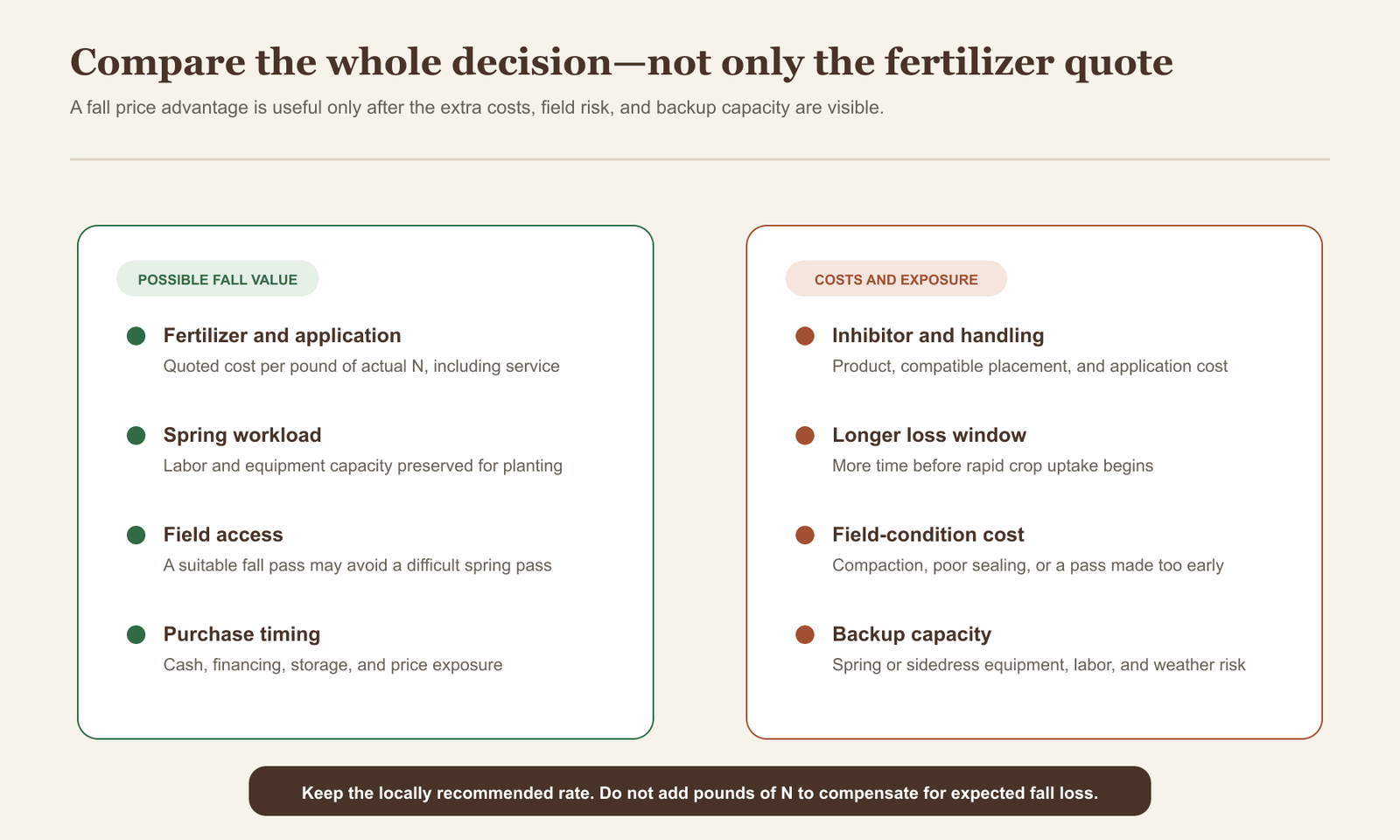
Fall application may offer a lower product or application price, better equipment availability, and fewer demands during planting [2][4]. Add the less-visible costs before comparing it with spring: inhibitor and handling costs, financing, possible field damage, the longer period before crop uptake, and the equipment capacity needed if part of the plan moves to spring or sidedress.
Swipe horizontally to inspect the full figure →
Click or tap to expand the figure
Compare the full operation, not only the fertilizer quote. Keep the rate from the applicable recommendation system rather than adding N to compensate for expected fall loss [2][4][6][10]. — Figure: Soil Health Exchange figure
Minnesota research published in 2025 helps put the tradeoff in perspective for that state. Across 25 site-years, spring-applied urea required less N at the estimated economic optimum and produced more grain on average than fall-applied urea [6]. Do not turn that result into a universal rate adjustment. It shows why the same pounds applied earlier may not provide the same economic return, and why raising the fall rate is not the recommended answer [4][6][10].
A farm-level cost check
Enter for each option
Fall plan
Spring or split plan
Product and application
$/lb actual N plus application service
$/lb actual N plus application service
Protection product
Compatible inhibitor and application cost
Any urease, nitrification, or controlled-release cost actually planned
Financing and timing
Cash date, interest, storage or contract terms
Cash date, interest, storage or contract terms
Field operation
Hours, acres per day, fuel, sealing, and compaction exposure
Hours, acres per day, fuel, planting conflict, and access risk
Backup capacity
Cost to preserve spring or sidedress capacity
Cost and feasibility of the planned pass
N-loss exposure
Field-specific months before rapid uptake
Field-specific timing relative to uptake
Use current farm quotes and capacities. Do not hard-code regional averages into the decision.
Reduce fall acres without creating a spring bottleneck
Moving N closer to crop uptake reduces the time available for loss, but the replacement plan must be workable. Spring traffic can compact wet soil or compete with planting, and a sidedress pass can be delayed by prolonged rain [12]. Reduce fall acres only as quickly as the farm can secure product, labor, equipment, and more than one suitable application window.
Map the fields where local guidance already rules out fall N or where leaching and saturation risk are highest.
Move fall urea and UAN acres before reconsidering eligible late-fall anhydrous acres.
Reserve spring, planting-time, or sidedress product and application capacity before removing acres from the fall schedule.
Make sure the crop will have an adequate early N supply under the local system; do not postpone the entire program beyond a reliable application window.
Compare total N applied, yield, application and inhibitor costs, financing, field conditions, and timeliness. Keep fall application only where it continues to provide a whole-farm advantage.
There is no universal phase-down percentage
A farm with dependable spring capacity can move faster than one with limited labor, custom-application access, or frequent wet springs. Track progress by moving the highest-risk acres first and reducing the amount of purchased N left in the soil months before crop uptake—not by forcing every farm into the same annual percentage.
Write a two-path plan before the window opens
A fall plan works better when “wait” is treated as a prepared outcome rather than a failed plan. Decide in advance which fields qualify, which conditions must be present, how much N—if any—will remain for spring or sidedress, and who has the equipment and labor to make that pass. Then the operation can respond to the field instead of forcing the field to fit the schedule.
The two paths to keep on one page
If the fall gate opens
If the gate does not open
Apply only on fields supported by current local guidance
Move the field to the spring or in-season list
Use the locally supported source, rate, placement, and inhibitor approach
Reserve product, tendering, labor, and equipment capacity
Document soil temperature, moisture, sealing, date, rate, source, and weather
Decide whether starter or an early small N amount is needed under local guidance
Keep any planned remainder visible in the N ledger
Set the latest feasible sidedress stage and a weather contingency
Record enough to review the decision later
Field and acres; soil texture, drainage, and excluded areas.
Recommendation source, version or publication date, rate, and credits already included.
Product, actual N analysis, rate, placement, applicator calibration, and operator.
Inhibitor active ingredient, product, rate, compatibility, and placement if used.
Application date and time, representative 4-inch soil temperature and trend where applicable, soil moisture, and forecast.
Knife depth, spacing, sealing observations, trafficability, and any stopped or skipped area.
Spring or in-season remainder and the capacity reserved to apply it.
Yield, tissue, soil nitrate, or other follow-up evidence only where the selected local method supports that interpretation.
Fall nitrogen checklist
A good fall nitrogen plan begins with an eligible field. Wait for the locally recommended window, confirm that the source can be retained under the actual soil conditions, keep the recommended rate and credits intact, and leave yourself a workable spring or in-season option if the window closes.
Where to take the field decision next
Use the current land-grant nutrient guidance for the field's state and region, then check the applicable state NRCS 590 standard and the farm's nutrient-management plan or other requirements [8][9]. If the base corn rate or credits are unclear, return to How to Read a Corn Nitrogen Recommendation before choosing the timing.
Soil Health Exchange Team (2026). Fall Nitrogen: Should It Go On This Fall?. Soil Health Exchange. https://soilhealthexchange.com/blog/fall-nitrogen-application-soil-temperature-timing-risk
More citation formats
MLA
Soil Health Exchange Team. "Fall Nitrogen: Should It Go On This Fall?." Soil Health Exchange, 2026-09-01, https://soilhealthexchange.com/blog/fall-nitrogen-application-soil-temperature-timing-risk.
Chicago
Soil Health Exchange Team. "Fall Nitrogen: Should It Go On This Fall?." Soil Health Exchange. Published 2026-09-01. https://soilhealthexchange.com/blog/fall-nitrogen-application-soil-temperature-timing-risk.

Discussion
No comments yet. Be the first to share your thoughts!