A neighbor plants cover crops. A buyer asks for certified organic grain. Another wants Regenerative Organic Certified ingredients. The work can overlap, but each conversation asks something different of the farm. Understanding those differences helps you choose practices, plan the paperwork, and decide which market to pursue.
The three terms at a glance
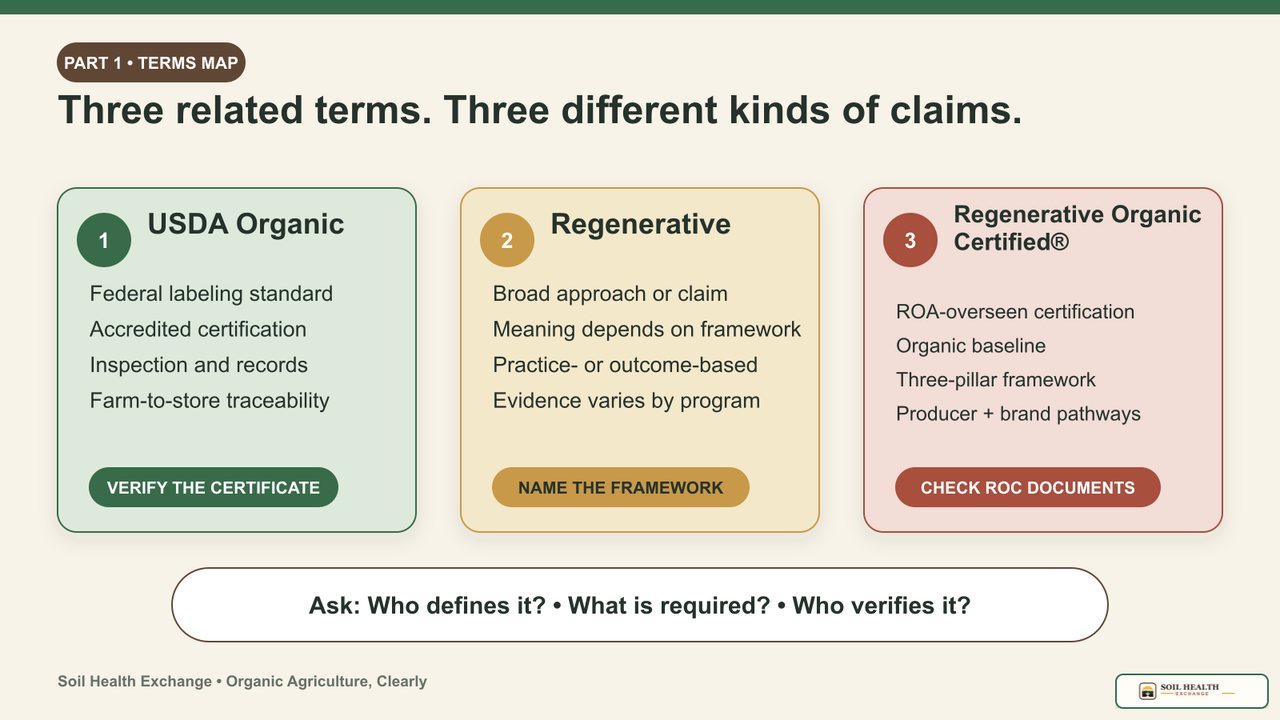
| Term | What it is | Who defines or controls it | What to verify |
|---|---|---|---|
| USDA Organic | A regulated labeling term for agricultural products produced and handled under USDA organic standards | USDA National Organic Program; certification by USDA-accredited certifying agents | Operation, certification scope, certified products, current status, and approved label |
| Regenerative agriculture | An approach to improving land and farming systems, defined through particular practices, outcomes, or programs | Meaning depends on the program, company claim, contract, or named standard | Named framework, required practices or outcomes, verification method, and public rules |
| Regenerative Organic Certified® | A specific certification and trademark program commonly shortened to ROC™ | Regenerative Organic Alliance | Eligible certified producer, applicable supply-chain licensing, product approval, and current governing documents |
What USDA Organic means
USDA describes organic as a labeling term for food and other agricultural products produced according to federal organic standards. Those standards address crops, livestock, wild crops, and handling. Organic production is intended to integrate cultural, biological, and mechanical practices that cycle resources, promote ecological balance, and conserve biodiversity [1][2].
USDA sets the rules, and USDA-accredited certifiers review farms and businesses against them. Certification brings an Organic System Plan, inspections, and records that connect production to sales. You can check a certified operation in the Organic INTEGRITY Database. Part 2 walks through that process [1][3].
Organic certification applies across grains, vegetables, orchards, vineyards, pasture-based livestock, processed products, and wild crops. The records should follow the way you manage the land: a field, orchard block, paddock, tunnel, or harvest area. Agroforestry and silvopasture fit within the relevant crop, livestock, wild-crop, or handling requirements [1][8].
Organic farming includes soil-building practices and input restrictions. Crop producers must manage soil fertility and crop nutrients, use rotations appropriate to the system, and prevent erosion. Tillage is allowed within those requirements, and certain pest-control materials are permitted under specified conditions. Review the exact product and use with your certifier [4][14].
What regenerative agriculture means
Regenerative agriculture describes approaches intended to improve soil function, biodiversity, water management, and the wider farming system. Common practices include cover crops, more diverse rotations, reduced tillage, and planned grazing. Some programs verify practices; others track outcomes or combine both. Oklahoma State University Extension’s overview explains this range of definitions [11].
Ask a program which practices it requires, what it measures, who checks the work, and what you will need to document. A regenerative program can include farms that use inputs prohibited under organic rules. Organic farms can also use regenerative practices, whether or not they join a separate program [1][11].
How the overlap looks in a field
Consider two farms planting rye ahead of a cash crop. An organic grower might terminate it mechanically and use cultivation for weeds. Another grower might use an herbicide to terminate the rye within a regenerative program that permits it. Both have planted a cover crop; their input rules, records, and market claims differ. This example is a useful starting point for asking a program how its rules fit your rotation [4][11][14].
What Regenerative Organic Certified adds
Regenerative Organic Certified® (ROC) is a specific certification overseen by the Regenerative Organic Alliance (ROA). It starts with USDA Organic certification or an accepted equivalent and adds requirements under three pillars: Soil Health and Land Management, Animal Welfare, and Farmer and Worker Fairness [6].
Farms, ranches, vineyards, and grower groups apply for producer certification. Brands making ROC product claims follow a licensing pathway. Part 3 explains the Bronze, Silver, and Gold levels, soil testing, fees, and the records that connect a farm’s certification to a finished product [6][7].
Connect the label to what is happening in your soil
Certification checks an operation against a standard. Soil-health monitoring shows how a particular field is functioning and changing. NRCS recommends looking at physical, chemical, and biological indicators together: water infiltration, soil structure, organic matter, nutrients, and biological activity each tell part of the story [12].
Start with a field question, such as why water ponds after rain. Record a baseline, sample consistently, and compare results alongside weather and management records. ROC has a defined lab and field-testing process, covered in Part 3. For any pathway, choose measurements that help you make the next management decision [12][13].
Give the field a record you can return to
Whichever pathway you choose, the useful record starts with the work: when the rye went in, how it was terminated, which inputs were applied, and when the soil was sampled. FieldLog, built by the Soil Health Exchange team, keeps those activities, notes, and photos connected to a field. The screenshot below uses a sample season.
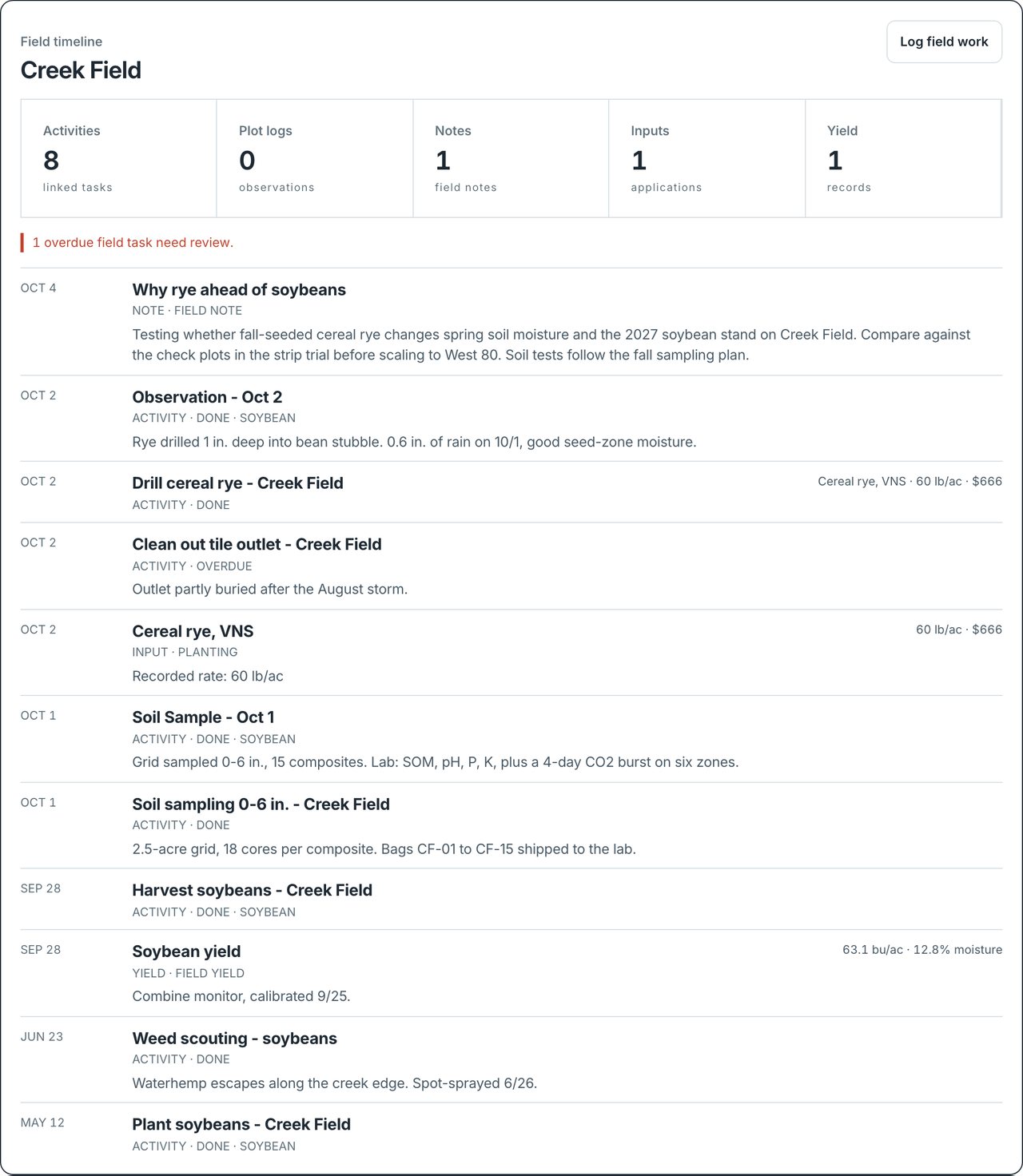
For organic certification, that history helps you assemble the management and input records your certifier reviews. For a regenerative program, it gives you dates and practices to compare with the measurements the program requests. Part 2 shows how to use FieldLog’s transition clock and input-log export; the FieldLog walkthrough follows a full season in the app.
USDA Organic by the numbers
Two official USDA snapshots
| Metric | Official figure | Date and scope |
|---|---|---|
| Certified organic farms and businesses | More than 28,000 | United States; USDA AMS webpage accessed August 11, 2026 [9] |
| Certified organic farms | 17,445 | USDA NASS 2021 survey, summarized by ERS in a page updated January 27, 2026 [10] |
| Certified organic cropland | 3.6 million acres | USDA NASS 2021 survey [10] |
| Certified organic pasture and rangeland | 1.3 million acres | USDA NASS 2021 survey [10] |
Choose the next step for your farm
- If your buyer needs USDA Organic: gather field histories, identify the crop or product, and talk with an accredited certifier. Use Part 2 to plan the application.
- If you are considering a regenerative program: ask for its written requirements, verification process, costs, and purchasing terms.
- If you are considering ROC: compare its additional requirements with your current organic system and the market you want to serve. Work through Part 3.
Start with the decision in front of you: the soil problem you want to solve, the buyer you want to supply, or the records you need to build. Then choose the practices and certification pathway that support that work.