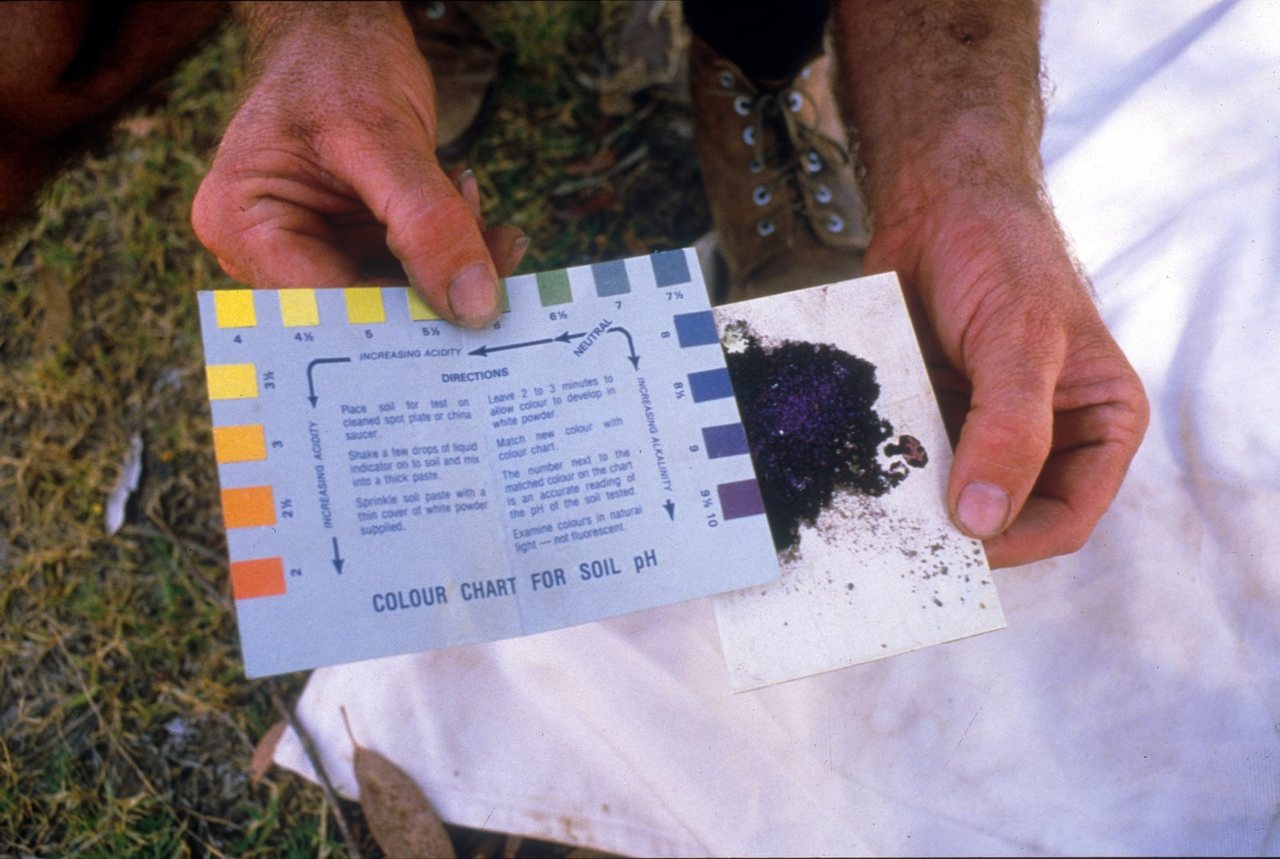
Two soil reports land on your desk before you book the lime spreader. Both fields test at pH 5.4. One has a Sikora buffer pH of 6.7. The other comes back at 6.2. Under the same Minnesota corn recommendation, the second field needs twice the neutralizing power. The first number tells you how acidic the sample is. The second helps the lab work out how much acidity you need to neutralize to reach the crop’s target. [1][2]
What soil pH tells you about the root zone
Soil pH measures the activity of hydrogen ions in a soil suspension. On the pH scale, 7 is neutral, values below 7 are acidic, and values above 7 are alkaline. The scale is logarithmic. A reading of 5.4 represents ten times the hydrogen-ion activity of 6.4 when both samples are tested by the same method. The amount of lime needed depends on how much acidity the soil supplies as the acidity in solution is neutralized. [1][3]
The practical question is how the reading compares with the target for the crop you intend to grow. In strongly acid soils, soluble aluminum can restrict rooting in sensitive crops. High-pH, carbonate-rich soils can make iron harder for soybeans to acquire. When the measured pH meets the crop target, skip lime for pH correction and use the rest of the report to judge nutrient needs. The University of Minnesota, for example, targets 6.0 for corn and 6.5 for alfalfa on its mineral soils. The same report can lead to a different decision when the crop changes. [1][2][7]
Check the method beside the number. Laboratories can measure pH in water or in a dilute salt solution such as calcium chloride. Two laboratories can report different pH values from the same soil if they use different methods. Compare a water pH with water-based targets, use the lab’s own interpretation for its salt pH, and keep the same method when comparing seasons. [1][3]
What buffer pH tells you about lime need
The soil water contains active acidity. Clay and organic matter hold or release additional acidity, including forms of aluminum that generate acidity as they react in water. As lime neutralizes acidity in the soil water, more acidity moves into solution from the soil. This reserve acidity is part of what lime has to neutralize. A finer-textured soil or one richer in organic matter can take more lime to reach the same target than a sand that starts at the same pH. The buffer test measures the sample’s response to a standard solution so the lab can estimate that lime requirement. [1][2]
The lab adds a buffer designed to resist a change in pH. Within a given buffer method, a soil that pushes the buffer pH lower generally has more acidity to neutralize. If your report says soil pH 5.4 and Sikora buffer pH 6.7, read 5.4 against your crop target. The lab reads 6.7 through its Sikora calibration. That 6.7 is the pH of the soil–buffer mixture. The crop target is a separate number. Adams–Evans, Sikora, SMP and Mehlich use specific calibrations, so ask the lab which recommendation applies before using a table from another state or method. [1][3]
Some labs use another way to estimate lime need. The University of Georgia reports lime buffer capacity, the milligrams of pure calcium carbonate needed per kilogram of soil to raise pH by one unit in its test. Read this with Georgia’s recommendation system. [9]
A blank buffer line can be routine. Minnesota generally skips the Sikora test on mineral soils at water pH 6.0 or above, yet still has guidelines for crops that need a target of 6.5. If your sample is below the crop target and the report gives neither a lime rate nor a buffer result, ask whether the lab can run a lime-requirement test on the stored sample. [1][2]
Work the numbers before calling the spreader
Same pH, different lime needs
The two fields below are illustrative Minnesota Area 1 mineral soils, both tested in water at pH 5.4 and interpreted with the University of Minnesota Sikora table for soils below pH 6.0. The lime requirements come from that table. ENP means effective neutralizing power. [2]
Two Minnesota fields with the same water pH
| Field | Water pH | Sikora buffer pH | Corn target 6.0 | Alfalfa target 6.5 |
|---|---|---|---|---|
| A | 5.4 | 6.7 | 2,000 lb ENP/acre | 3,500 lb ENP/acre |
| B | 5.4 | 6.2 | 4,000 lb ENP/acre | 6,000 lb ENP/acre |
Convert the recommendation into tons of product
The corn decision changes across fields because the buffer results differ. The rate also changes within a field if your next crop is alfalfa. If Field B is going into corn, take 4,000 lb ENP per acre to the dealer. With an as-delivered rating of 1,600 lb ENP per ton of product, the arithmetic is 4,000 ÷ 1,600 = 2.5 tons of product per acre. A product rated at 1,000 lb ENP per ton would take 4 tons per acre to supply the same neutralizing power. [2][4]
Get the dealer’s quality rating and delivered-and-spread price. In an ENP program, divide the price per ton by the pounds of ENP per ton to compare materials. Where the lab uses ECCE (effective calcium carbonate equivalent), ask for a product rating and recommendation on the same basis. If your report already gives tons of the specified grade of material, confirm what quality it assumes before adjusting it. When soil-test magnesium is low and lime is due, ask whether dolomitic lime can supply both needs. [1][4]
Turn the recommendation into a field plan
- Sample areas you can manage separately. Give a sandy rise, a heavier bottom, or an odd patch its own composite if you would treat it differently. Label each sample with its depth, zone and intended crop. Keep unusual spots separate from routine cores and use the lab’s recommended depth. [1][5]
- Check depth before setting a spread rate. In long-term no-till, the top few inches can acidify while a deeper composite looks adequate. Wisconsin Extension suggests taking a separate 0–2-inch sample if you suspect surface acidity. Label it clearly and ask your lab how to interpret it alongside the routine sample. For a surface application, confirm how much can go on in one pass and how to handle a larger recommendation. [1][5]
- Give lime time to react and record what went on. Talk through timing before planting an acid-sensitive crop. Keep the zone, product quality, actual tons applied and date with the soil report. Retest the same zone and depth, using the same test method and a similar time of year. Share any recent lime applications with the lab and ask when a follow-up sample will reflect the application. [1][4][5]
If your pH is already above the crop target
Start with the crop and symptom. For yellow soybeans on a calcareous patch, iron deficiency chlorosis is one possibility. Ask about free calcium carbonate and use the field pattern, cultivar history and local guidance to narrow the cause. Free carbonate can make whole-field acidification impractical. If the patch also crusts, ponds or has a salt problem, request electrical conductivity (EC) and ask the lab about sodium adsorption ratio (SAR) or exchangeable sodium percentage (ESP). That evidence can point to a different response than a pH adjustment. [6][7][8]
Write the zone, crop target, lab recommendation with its units, and tons per acre of the actual product on your lime order or in your field notes. If you are missing one, send the report and product tag to your lab or adviser before booking the spreader. Ask a field question if you want help figuring out what to ask.
If the same report lists CEC or base saturation, read the CEC field guide to see what those numbers tell you about nutrient retention and which soil-test results to use for fertilizer decisions.