If your farm is already organic, Regenerative Organic Certified brings another set of decisions: which practices to change, how much of the operation to enroll, what to document, and who will buy the crop. Work through those questions together. A certification plan is easier to carry through when it fits both the farm and the market.
The three ROC pillars
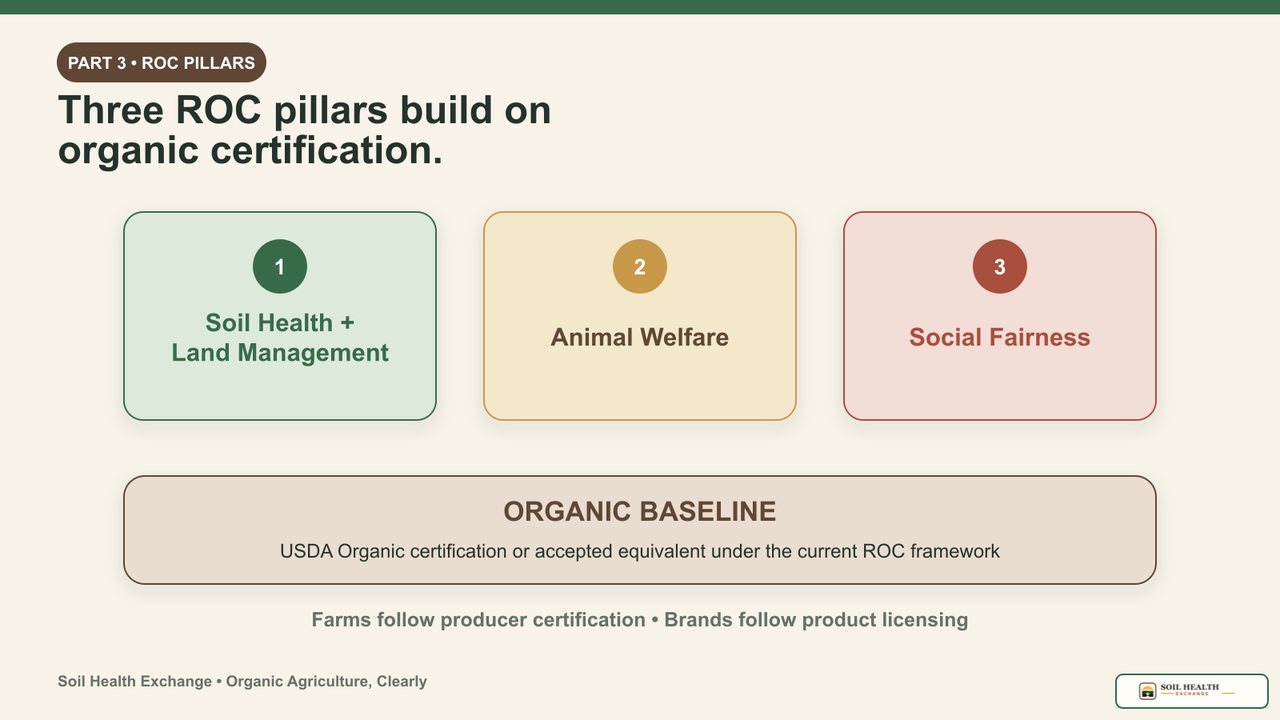
The three pillars connect land management with the people and animals involved in production. A crop farm will prepare different evidence from a livestock operation. Use the current framework to identify the criteria that apply to your farm; ROA also uses the name Social Fairness for the farmer and worker pillar [1][5].
What the three pillars mean on a farm
| Pillar | Work to review |
|---|---|
| Soil Health and Land Management | Rotations, cover, disturbance, biodiversity, fertility, and a soil-monitoring plan |
| Animal Welfare | Where livestock are involved: feed, pasture access, housing, handling, and health care |
| Farmer and Worker Fairness | Working conditions, pay, worker voice, safety, and fair relationships with buyers |
Producer certification and company licensing
Producers apply with organic certificates, their Organic System Plan, maps, operation details, and supporting records. Only certified organic land is eligible for ROC acreage. If you are still working toward organic certification, start with Part 2 [8].
Brands making consumer-facing ROC claims follow ROA’s licensing process. The application connects product formulas and suppliers with organic certificates, a brand Regenerative Organic System Plan, and proposed labels. A farm’s certification and a brand’s license each cover their part of the chain [9].
What changes from Bronze to Silver to Gold
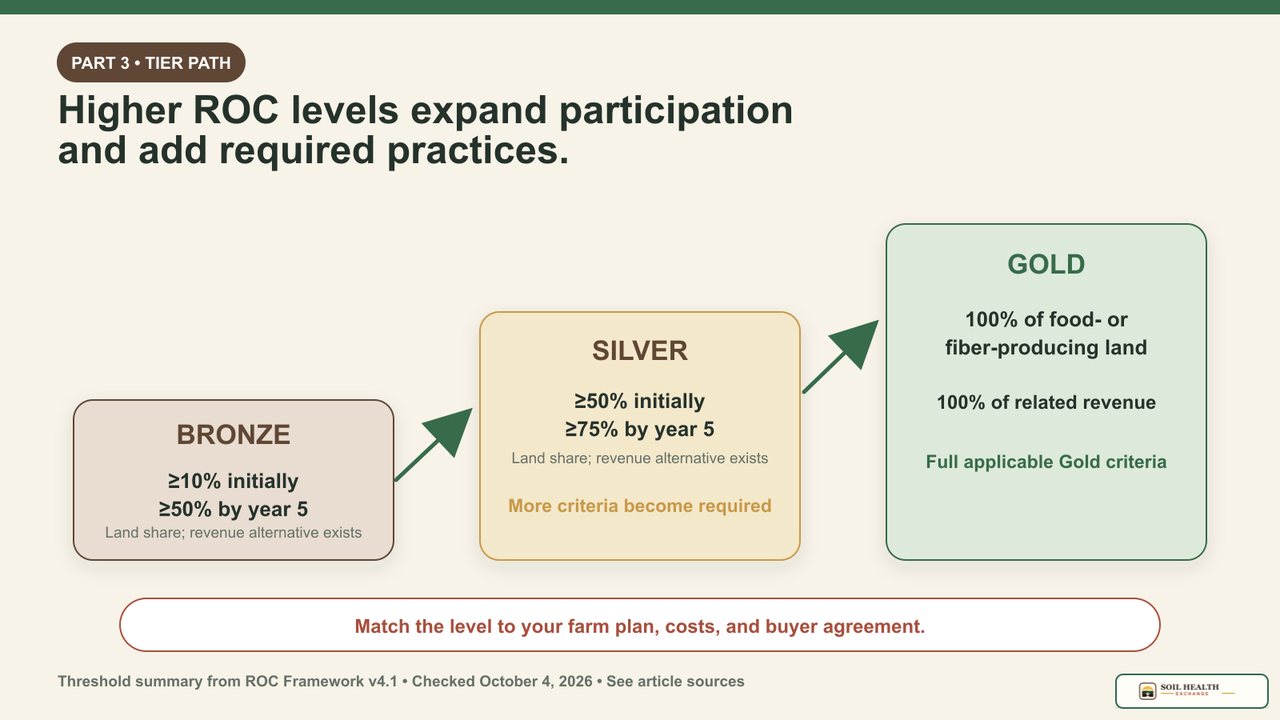
ROC Framework v4.1 defines Bronze as the beginning level and Gold as the highest, with Silver between them. Annual recertification audits apply at every level [1][5]. Each level changes both the share of the operation participating and the practices required. Criteria marked optional at one level can become required at a higher one, and the operation must meet all required practices for the level it claims [1].
Current ROC level structure
| Level | Operation share in the current Framework | What progression means | Product-claim consequence |
|---|---|---|---|
| Bronze | At least 10% of food- or fiber-producing land at initial certification, reaching at least 50% by year five; the Framework also provides a revenue-based alternative | Beginning level, but still requires USDA Organic or accepted equivalent, all Bronze required criteria, a ROSP, and annual recertification | Eligible certified product may support a Bronze or, where allowed, unspecified-level claim after all chain and licensing requirements are met |
| Silver | At least 50% of qualifying land at initial certification, reaching at least 75% by year five; the Framework also provides a revenue-based alternative | More of the operation participates and additional pillar criteria become required | Eligible certified product may support a Silver or, where allowed, unspecified-level claim |
| Gold | 100% of the operation’s food- or fiber-producing land and 100% of revenue derived from food or fiber production | Highest current level, with the full applicable Gold criteria and added implications for processing a Gold-claimed product | Gold claims must identify the Gold level; the chain cannot preserve a Gold claim by mixing in lower-level ROC material |
Bronze is an audited certification level. Choose the appropriate level based on site conditions, production system, workforce and livestock obligations, participating acreage, market demand, costs, and the capacity of the downstream chain.
Make soil testing part of the plan
ROA’s Soil Sampling Guidelines call for laboratory tests in the first certification cycle and repeat lab and field testing every three years. Arrange the lab, sampling locations, methods, and field observations with the certifying body before the first audit [11].
Keep the sampling locations and methods consistent so the results help you track change. The guidelines use the tests to understand soil condition; certification decisions are not based on improvement in the test results. That distinction matters when setting goals with a buyer: an audited practice and a measured soil response are different pieces of evidence [11].
Keep the soil record connected to the work
When the next soil report arrives, you will want to know what changed between samples. FieldLog, built by the Soil Health Exchange team, keeps cover-crop planting, tillage, input applications, sampling, and observations on the field’s timeline. The phone screens below use a sample season.
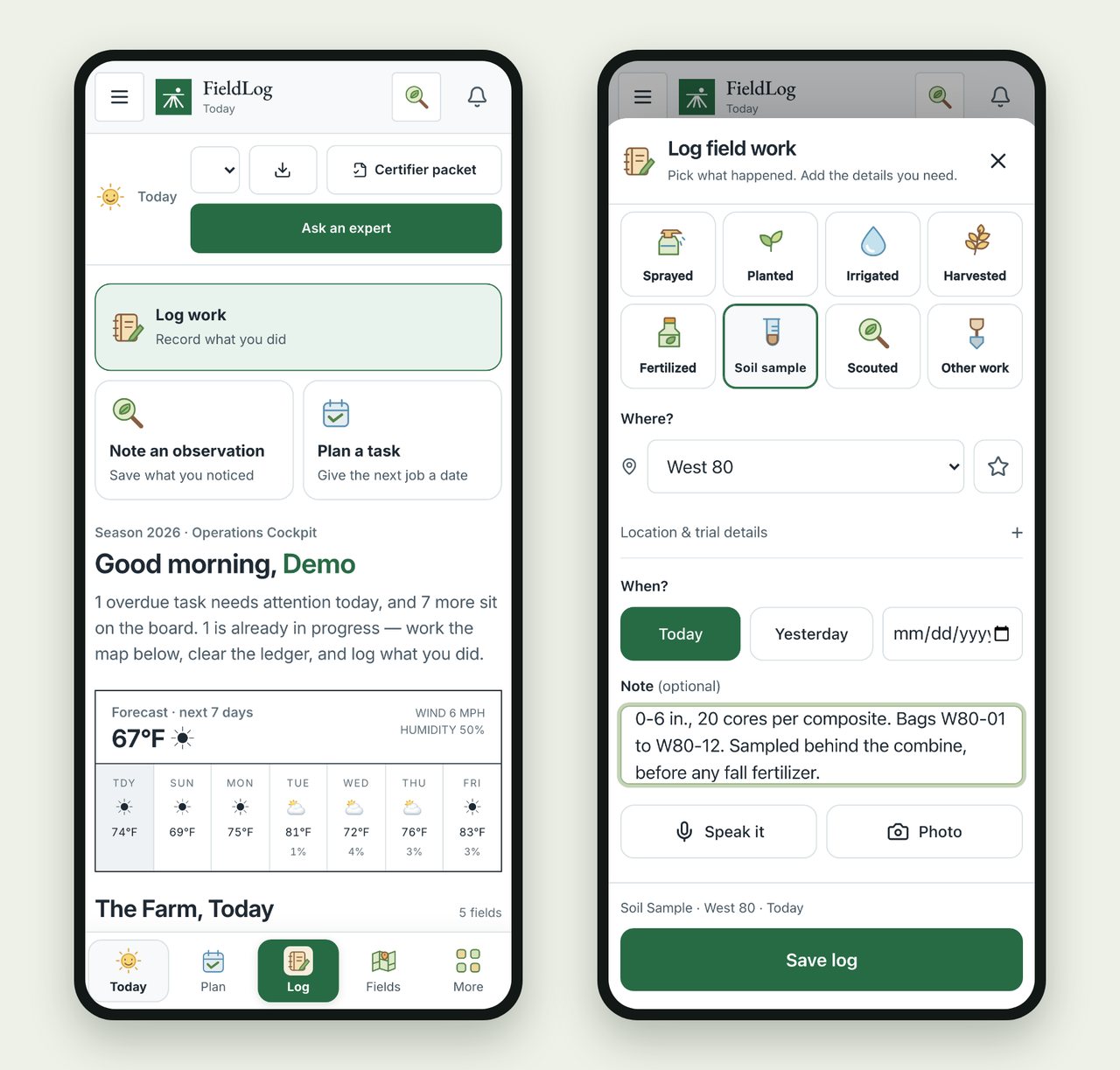
In Log work → Soil sample, select the field and date, then use the notes for sampling locations, depth, method, bag identifiers, and recent management. Add a photo when it helps you return to the same location. Keep the laboratory report under the matching field and sample identifiers in your ROC records. Follow the sampling plan agreed with your certifying body [11].
Before an audit, use FieldLog’s Pro full activity log to gather the recorded field work for the requested period. The organic certification guide explains the export. Complete the ROC file with the laboratory reports and the animal-welfare and worker-fairness evidence that applies to your operation [1][11].
Build the buyer agreement alongside the farm plan
Ask the buyer which crop, volume, and ROC level it needs, then put the price and purchasing period in writing. The governing documents define the certification requirements; prices and premiums are negotiated with buyers. Use that agreement to compare likely income with the work and costs your farm will take on [1][2].
Questions to settle with a buyer
| Decision | Put it in the agreement |
|---|---|
| Product and level | Crop, quality specifications, required ROC level, volume, and delivery window |
| Price and payment | Base price, any premium, payment dates, deductions, and price adjustments |
| Added costs | Who pays for audits, soil tests, recordkeeping, segregation, or new infrastructure |
| Length of commitment | Purchasing period, renewal terms, and how sourcing forecasts will be updated |
| Changes during the season | What happens if yield, certification level, product plans, or buyer demand changes |
The Framework’s buyer criteria address fair contracts, sourcing plans, pricing, payment, transparency, and capacity building. Use those expectations to have a concrete conversation about how the relationship will work for your farm [1].
Budget for the work as well as the fees
- Farm changes: identify the practices, equipment, workforce measures, and animal-welfare work needed for the intended level.
- Annual work: include the Regenerative Organic System Plan, records, soil testing, audits, and renewal.
- Product handling: price the storage, segregation, processing, traceability, and label work. Gold claims have additional processor social-fairness requirements [2].
ROA fee schedule effective April 2026
| Participant | Published ROA fee basis |
|---|---|
| Individual producer application | $350 with fewer than five distinct parcels; $550 with five or more distinct parcels |
| Grower-group application | $1,000 |
| Producer initial certification | $300 flat ROA fee after initial audit approval |
| Producer annual renewal | $250 below $1 million in prior-year ROC production value; $500 at $1 million or more |
| Initial business license | 0.05% of prior-year total gross revenue, with a $500 minimum and $20,000 maximum; optional expedited review adds $500 |
| Annual business license renewal | 0.10% of prior-year ROC product gross revenue from $0 to $100 million and 0.05% above $100 million, with a $500 minimum |
| Annual ROA membership | $1,000 flat fee, brand owners only — a recurring cost separate from the license |
| Claim and license revisions | $100 per claim review with three included each license year; $50 per claim revision; $150 per license revision, which may add up to three new products |
For an individual producer with fewer than five distinct parcels, the listed application and initial certification fees total $650. Add the certifying body’s charges, organic certification, soil tests, and any changes needed on the farm. ROA invoices use Net 30 terms; consult the fee schedule for late-payment and reinstatement provisions [4].
Ask which ROA-approved certifying bodies serve your region and production system, and request their audit and certification estimates. Those charges are additional to the ROA fees in the table [4].
Connect the certified farm to the finished product
The farm-to-product control chain
| Stage | Required connection | Check at the handoff |
|---|---|---|
| 1. Certified producer | Current organic baseline, ROC certificate, level, participating acreage or operation portion, eligible crop, and production records | Confirm the crop and participating land on the certificate and supporting records |
| 2. Certified lot | Harvest lot, quantity, crop, producer, certification level, sale, and shipping identity | Keep the farm of origin and level attached to the lot |
| 3. Supply-chain actors | Disclosed participants, applicable licenses, ownership and activity map, separation, transaction records, and origin documents | Check that every relevant participant and activity is disclosed |
| 4. Processor | Approved product flow, incoming lots, batch records, formulas, processing loss, inventory, sanitation, and outgoing lots | Reconcile incoming ingredients, processing losses, inventory, and outgoing batches |
| 5. CPG brand or claim owner | Appropriate ROA license, Brand ROSP and product documentation, verified suppliers, approved claim, and approved artwork | Match the brand’s license and product records to the approved claim |
| 6. Finished product |
The current Labeling Guidelines describe ROC as farm-level certification: product claims refer back to the certified status of the source farm. Brands must hold an approved license for ROC marks and product claims, in addition to any USDA organic handler obligations described in the certification guide. When different ROC levels are mixed, the claim defers to the lowest level or uses an unspecified level where permitted. Gold claims must identify Gold, and labels or marketing using ROC marks require prior approval [3].
Check the finished-product claim
For ordinary food products, ROA’s labeling guide distinguishes 100% ROC content, at least 95% for the ROC product claim and seal, and 70% to under 95% for a “made with” claim without the seal. Below 70%, identification is limited to qualifying ingredients on the information panel. Water and salt are excluded from these calculations. Wine and textiles have separate provisions, and every proposed use of the marks goes through ROA approval [3].
Keep the lot and its documents together
Choose a shared way to link the producer, harvest lot, quantity, level, transaction records, processor batches, and approved finished-product claim. Give each partner access to the records it needs while protecting confidential farm information. The following checklist can organize that work:
- Link the certified producer’s legal name, organic certificate, ROC certificate, current level, crop, participating acreage, and effective dates.
- Issue a stable lot identity with crop, harvest, quantity, tier, origin, and transaction documents.
- Map every supply-chain actor, activity, ownership transfer, facility, applicable license, and disclosure status.
- Connect processor receiving, batch, formula, loss, inventory, finished-lot, and shipment records.
- Connect the CPG SKU to its formulation, claimable percentage, lowest input level, approved claim, approved artwork, and license.
- Notify affected parties when a certificate, level, supplier, formula, facility, license, or label changes.
- Give the producer control over confidential farm data while allowing auditors and authorized partners to access the records needed for verification.
A practical ROC readiness review
- Confirm that the relevant production land and scope hold an accepted organic certification and that the certificate, addenda, OSP, and maps are current.
- Read the current ROC Framework and every applicable governing document rather than relying on a summary or old checklist.
- Map which soil-health, animal-welfare, and worker-fairness requirements apply to the operation and what evidence already exists.
- Identify gaps, responsible people, audit timing, corrective-action capacity, fees, and ongoing renewal work.
- For products, map every producer, ingredient, processor, handler, broker, contractor, and brand role under both organic and ROC requirements — Part 2 covers the USDA organic side of that map.
- Submit product and label claims through the required review and licensing process before marketing.
ROC by the numbers
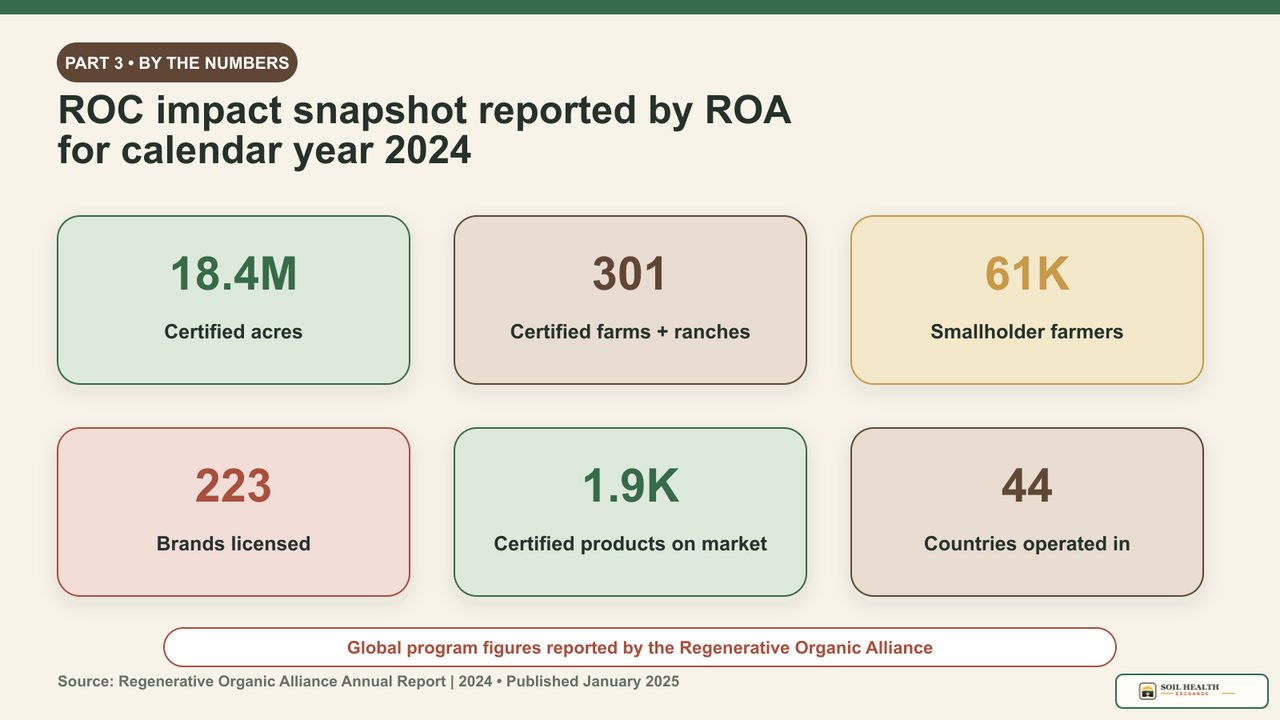
ROA's 2024 annual report, published in January 2025, reported 301 certified farms and ranches, 61,000 smallholder farmers, 18.4 million certified acres, 223 licensed brands, 1,900 certified products on the market, and activity in 44 countries [7]. These are global program figures, not U.S.-only counts.
Use the farm and ranch directory and current certification documents to check a particular producer, level, and crop before contracting [10].
Decide what would make ROC worthwhile
Put the proposed level, farm changes, testing plan, full costs, and buyer terms on one page. Assign the next step to a person and a season. That gives you something concrete to discuss with your certifying body and buyer.
The right starting level is one your farm can sustain and your market will support. You can value the soil, animal-welfare, and worker-fairness goals in their own right while making a clear plan to pay for the work.
Source check — October 4, 2026: ROA’s Resource Library links Framework v4.1 (June 27, 2023), Supply Chain Guidelines v4.0 (March 22, 2023), Labeling Guidelines v3.4 (July 2, 2025), and Cost & Fee Structure v6.0 (April 1, 2026). The framework-revision page presents a consultation draft. Check the Resource Library for updates when applying or preparing labels [1][2][3][4][5][6].