- Location
- Iowa
- Crop
- Corn
- Acres
- 2,000
The challenge
“[Timeline: Planning ahead / not urgent] I farm clay loam in central Iowa with a corn-soy rotation. What cover crop species or mix should I plant after corn harvest in mid-October, and will it establish before freeze-up?”
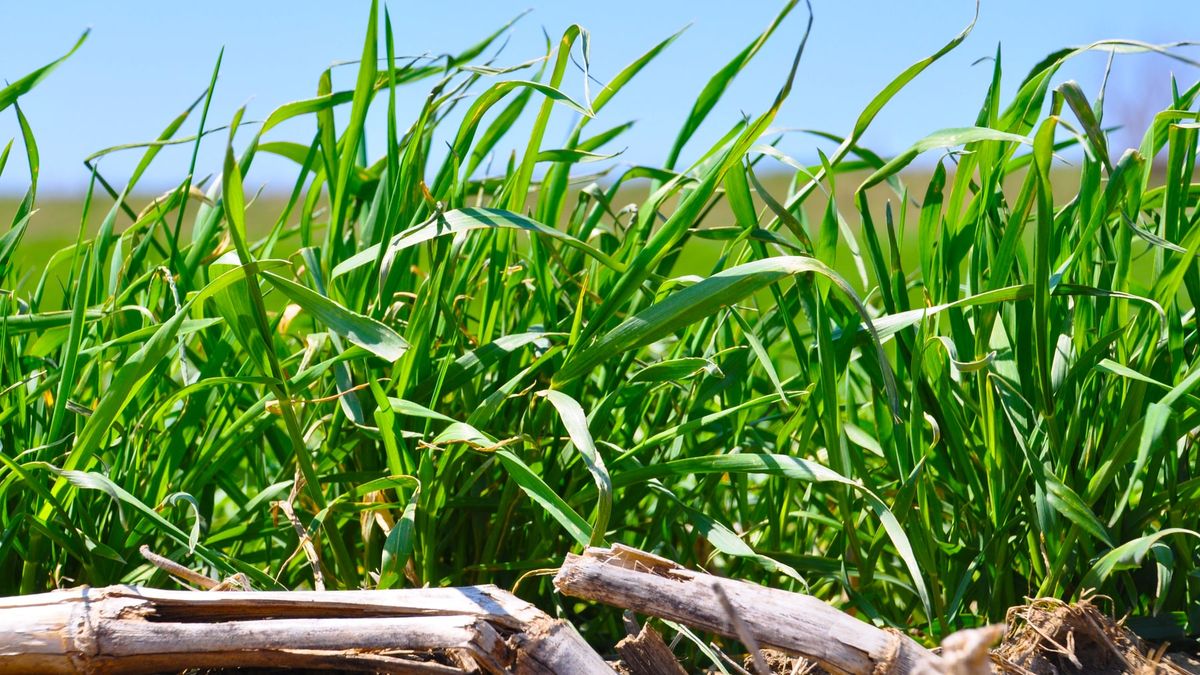
Short version: cereal rye is the right species for clay loam, central Iowa, corn off mid-October, soybean next year. The species call is easy and well supported. The main planning problem on 2,000 acres is getting the seed established reliably across that many acres inside a short window — so this answer leads with logistics, then covers the agronomy. Drilling behind the combine is your most reliable method; aerial-into-standing-corn is a fallback only for acres you can't drill in time.
Seeding logistics: drill where you can, fall back to aerial only where you can't
Drilling behind the combine gives the best seed-to-soil contact and the most reliable stand, so make it your default. As a rough planning figure, a 15-ft no-till drill at ~5 mph and ~60-70% field efficiency covers on the order of 55-70 ac per 8-hour day, but that number swings widely with drill width, speed, and field conditions, and the drill competes with the combine for the same tractors and operators (and an acre can only be drilled after its corn is off). On 2,000 ac, work out before harvest how many acres your drill(s) can realistically cover by the central-Iowa Oct 28 deadline given how the harvest schedule frees up fields. If your usable drill-days fall short, the fix is more drilling capacity — a second drill or a custom seeder — not switching the whole operation to aerial.
Aerial (or high-clearance broadcast) seeding into standing corn is a moisture-dependent contingency, not a default. It depends on a timely rain after seeding and is higher-risk on cool, dry, or cloddy clay loam late in the window — aerial rye into standing corn frequently fails in central Iowa when the fall rains don't arrive. Reserve it for acres you genuinely cannot drill before the deadline. If you do use it, target around 50% corn leaf drop — typically late September to early October — and increase the rate to about 1.25-1.5x the drilled rate (~70-85 lb/ac) to offset poorer seed-to-soil contact; this rate bump is a general extension rule of thumb, not a figure from the MCCC recipe. Book any applicator weeks ahead, as slots are limited.
Why rye, and why not a mix, in this exact slot
Cereal rye is the most common cover crop in Iowa because it can be planted late into fall and overwinters reliably. Oats and radish (and radish-containing mixes) are the other common choices, but they winterkill and need an earlier window — by mid-to-late October they produce almost nothing before a hard freeze (ISU Extension). For a single late-October seeding ahead of soybean, single-species rye is the cost-effective, winter-hardy choice. (Note: the original draft cited a 'Tennessee 5-species mix' study and a peer-reviewed weed-science paper to rank species by biomass-per-seed-dollar; those claims could not be verified — the cited weed-science paper is from Ohio, is about rye seeding rate, and found rate had minimal effect on weed suppression — so we are not asserting a sourced biomass-ROI ranking here.)
Will it establish before freeze-up? Mostly, with honest expectations
MCCC's deadline for cereal rye in central Iowa is before October 28, set two weeks after the average hard-frost (28F) date — i.e., the window closes right as fall growth effectively stops, not because there is comfortable runway. Realistically, acres seeded by about Oct 20-25 (or earlier by air) will get meaningful fall establishment; acres seeded in the final days before Oct 28 behave more like dormant seedings that carry germination into spring, and a fall stand is not guaranteed. Rye germinates at soil temps near 34F and is the most winter-hardy small grain, so it overwinters reliably in Iowa once established (SARE; note SARE does not state a specific sub-zero survival temperature — we have dropped the 'survives below 0F' figure from the original draft).
Be realistic about fall biomass. The Practical Farmers of Iowa on-farm trial (7 farms, replicated) found earlier seeding and full rate increased fall groundcover, but only one farm measured groundcover and the early/late dates there were Oct 21 vs Nov 2 — so treat 'low, often well under 20%' as the expectation rather than the specific 18%/8% figures in the original draft, which are not stated in the source. Importantly, the trial found that reducing the rate (to 28 lb/ac) and planting later did not reduce soil health and had no effect on corn yield or seedling-root disease — so a modest late stand is still worth having.
Seeding mechanics
- Drilled: 55 lb/ac (45 lb/ac cost-share floor, assumes >85% germination). Broadcast with shallow incorporation: 61 lb/ac. Aerial/broadcast into standing corn (no incorporation): bump to ~70-85 lb/ac to offset poor seed-soil contact (a general extension rule of thumb, ~1.25-1.5x drilled, not from the MCCC recipe).
- Depth (drilled): 0.75-1.5 in.
- Drilling gives the best, most reliable establishment and should be your default. Aerial-into-standing-corn around 50% leaf drop (late Sept-early Oct) is a fallback for acres you can't drill before the deadline; it depends on timely moisture and is higher-risk on clay loam as soils cool.
Spring termination ahead of soybean
Glyphosate is the most consistent option ISU lists for terminating rye, but the right rate is conditions-dependent. The cited 2023 ISU Cover Crop Termination Review moved the baseline down to about 0.75 lb a.e./ac for small (<18 in), actively-growing rye under favorable conditions, and calls 1 lb a.e. a 'generous' rate. So plan on ~0.75 lb a.e. for small rye on a warm, sunny day (air temps above ~60F, per the MCCC recipe), and step up to ~1 lb a.e. — optionally adding clethodim — only for cooler conditions or larger/jointing rye where kill can be incomplete. Avoid burndown tank-mix partners that antagonize glyphosate, and check the glyphosate product label for the rate and maximum annual use. For soybean, exact termination timing is less critical than for corn (kill before soybean emergence); the original draft's '6-12 in' height and 'at least 10 days before planting' figures are not in the cited ISU review and have been dropped. 'Planting green' is workable ahead of soybean if your operation is no-till and your planter cuts residue and gets good seed-soil contact — but confirm your tillage system and your county's crop-insurance rule first.
Crop-insurance termination zones (confirm yours)
Per RMA/NRCS Cover Crop Termination Guidelines, Iowa spans two zones and the line runs through central Iowa, so confirm exactly which one your farm is in: Zone 4 (eastern ~2/3): terminate within 5 days after planting (the original draft's added 'but before emergence' is not part of this zone rule and has been removed); Zone 3 (western ~1/3): terminate at or before planting. A no-till management allowance can add up to 7 days in either zone, but that allowance applies only if your operation is actually no-till. Confirm your tillage system, your zone, and the current rule with NRCS/RMA or your crop-insurance agent before planning to plant green.
Costs and cost-share
Seed runs roughly $11-$22/ac at 55 lb/ac, using the $0.20-$0.40/lb range from ISU's cost sheet — but that sheet is from 2016, cereal-rye seed prices have risen since, and aerial seeding uses more seed, so get a live quote. Cost-share can offset part of the cost: IDALS state rates (as of 2024) are about $30/ac first-time and $20/ac repeat, capped at ~160 ac per participant. NRCS EQIP cover-crop payments are also available; ask your local office for the current rate. Minimum 45 lb/ac rye to qualify for state cost-share. Re-confirm all rates and sign-up with your local NRCS/SWCD office — these figures move year to year.
What you'll get
Rye's fibrous root system is well documented for nitrogen scavenging, erosion control, and soil-structure benefits — real strengths on clay loam. Spring biomass at termination relates to weed-suppression benefit, though note the cited Ohio weed-science work found rye biomass alone was not enough to replace a postemergence herbicide, so plan rye as part of, not a replacement for, your weed program. On yield safety, the PFI trial found no negative effect on following corn yield, and terminating appropriately ahead of soybean protects the bean crop.
Topics
Cite this
Reference this work
Soil Health Exchange Team (2026). Cereal rye is the right species for this late, pre-soybean slot. Soil Health Exchange. SHE-FA-2026-0039. https://soilhealthexchange.com/cite/SHE-FA-2026-0039
Soil Health Exchange assigns a stable identifier to every published answer and article. Citations keep working even if the URL changes later.
Keep exploring
Similar questions
From the blog

Discussion
No comments yet. Be the first to share your thoughts!