Beneficial Insects: Identify Them, Support Them, and Check Their Work
Flowers can bring useful insects to a farm. Learn which life stages attack pests, how to design habitat around farm work, and how to check for crop protection.
Editor's Note
Research checked September 13, 2026. This guide distinguishes observed insect abundance from demonstrated pest control. The shared field plan and example scouting route are Soil Health Exchange planning aids, not validated treatment or sampling protocols.
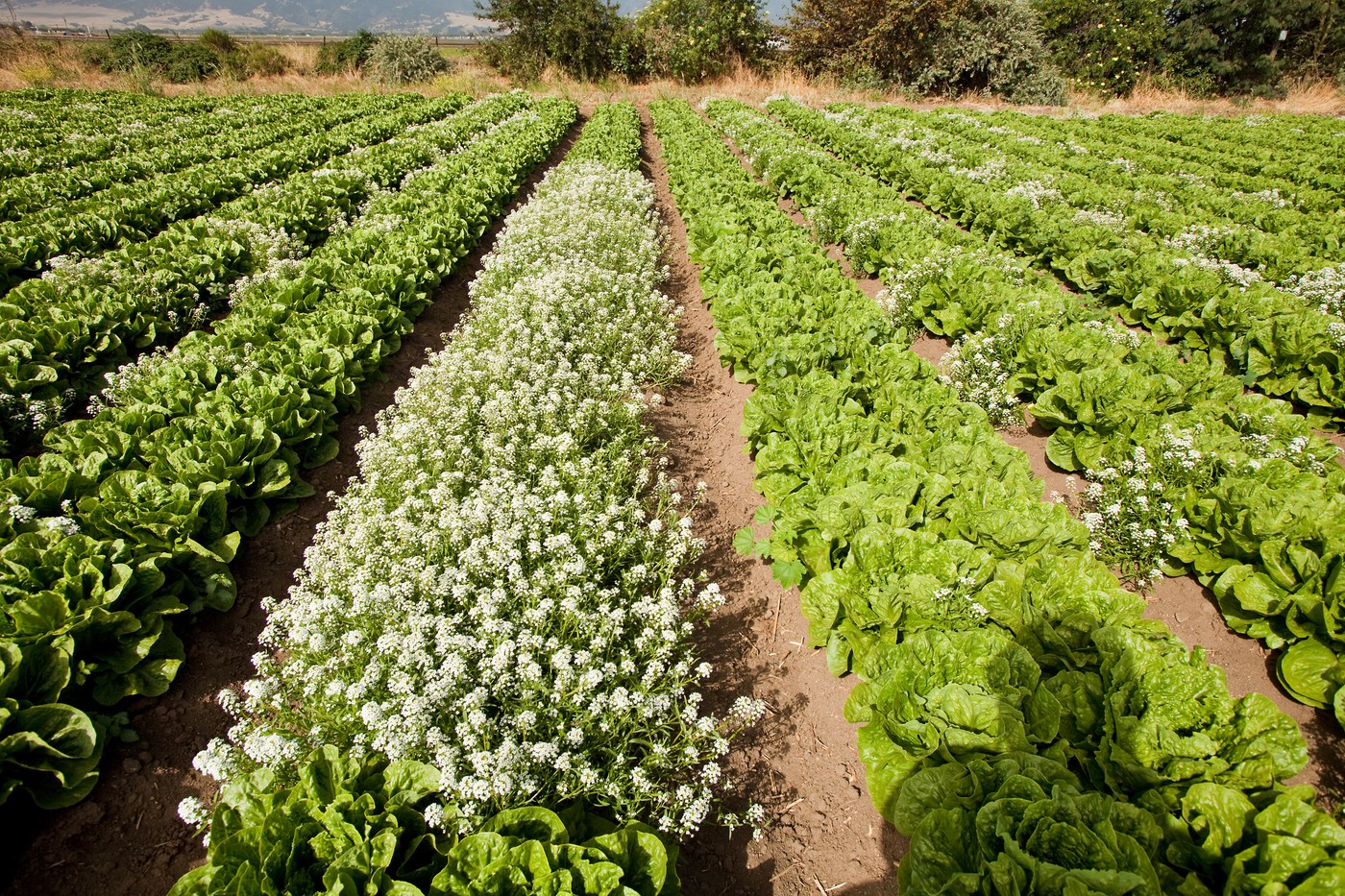
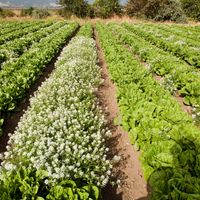
Sweet alyssum among organic romaine lettuce in Salinas, California. The flowers support adult hoverflies; aphid-eating larvae do their work in the crop. Plant arrangement must also leave room for a marketable lettuce harvest. — Photo: Stephen Ausmus, USDA Agricultural Research Service (public domain)
The bottom line
Start with a crop and a recurring pest, then learn which natural enemies attack that pest and which life stage does the work. Keep suitable food and refuge available, protect them during farm operations, and scout inside the crop. More insects on flowers is encouraging, but pest trends, new damage, marketable harvest, and costs tell you whether the arrangement is helping the farm.
You can stand beside a flowering strip and see plenty of activity without knowing whether the crop is better protected. A fly visits an alyssum flower. A beetle disappears into the mulch. A wasp moves through the canopy. The useful next step is to connect each observation to a pest, a crop stage, and a result you can check.
Conserving natural enemies can make a farm less dependent on repeated rescue treatments. It can also disappoint when flowers arrive too late, the wrong insects respond, or a pest damages the crop faster than its enemies can suppress it. Start with one recurring crop problem and build a manageable plan around it. You do not need to identify every insect on the farm before you begin.
This is Part 4 of Soil Health Across the Whole Farm. Part 3 builds a season-long organic weed plan. Here we connect that work with habitat and crop scouting. The examples emphasize diversified outdoor farms; purchased biological controls in greenhouses and tunnels need additional planning for that production system.
Start with a pest and the life stage that can control it
“Beneficial insect” covers several jobs. Bees are important pollinators, but their presence does not show that aphids or caterpillars are being controlled. Predators consume prey; parasitoids develop in or on a host and eventually kill it. Many are selective about what they attack. Identify the pest first, then learn the natural enemies relevant to that pest and crop.
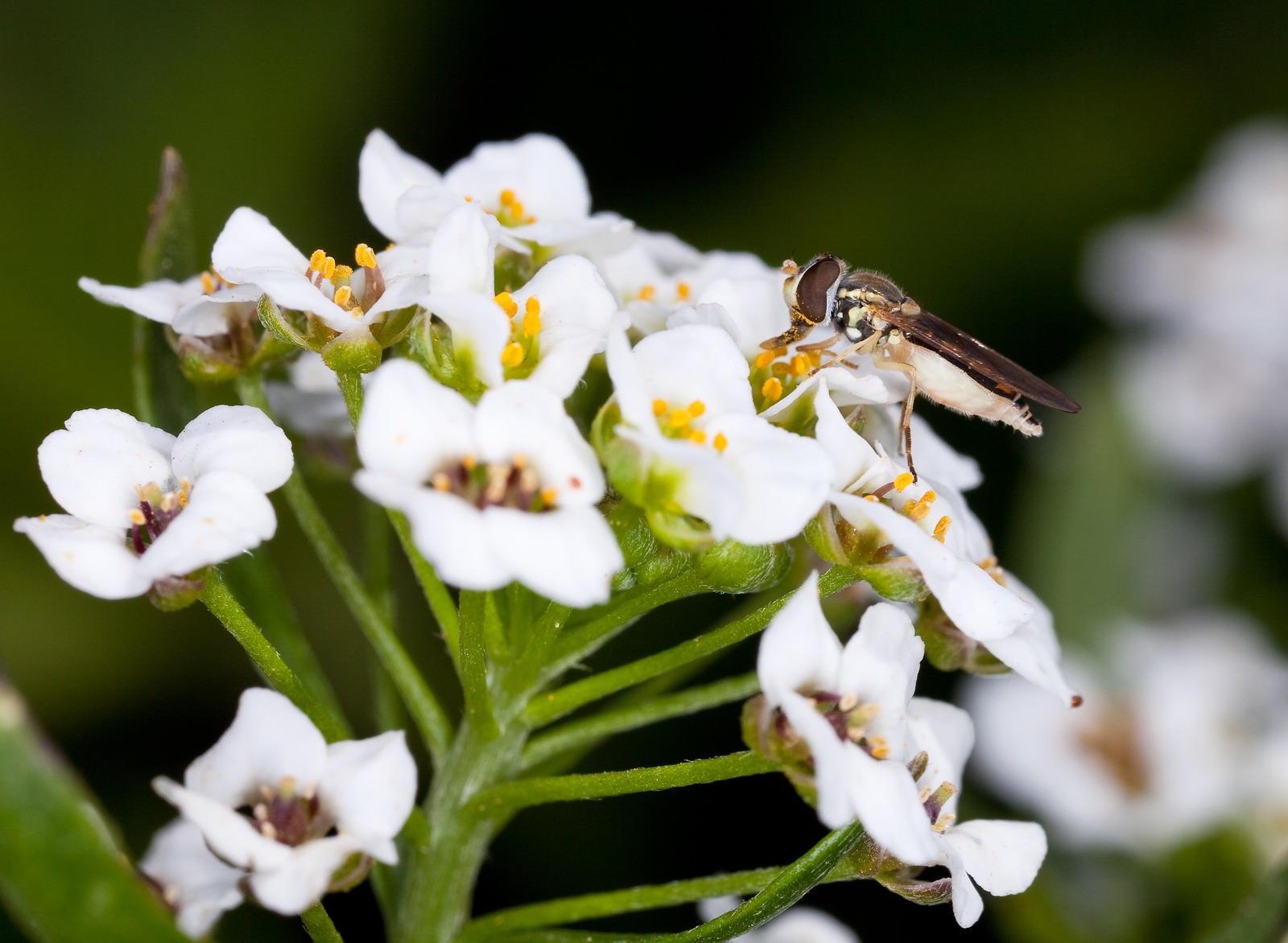
Life stage matters. An adult hoverfly visiting flowers is using a food resource; in aphid-feeding species, its larvae are the predators you want to find near aphid colonies. Those larvae look very different from the adults and can be mistaken for pests. Watch what an unfamiliar organism is doing, photograph it closely, and include its location on the plant when asking for help. [2]
A short field-recognition guide
Group
What to look for
What the observation can tell you
Lady beetles
Rounded adults; many predatory larvae are elongated, dark, and marked with orange.
Adults and larvae of common predatory species eat aphids. Confirm the species; not every lady beetle feeds on pests.
Aphid-feeding hoverflies
Adults hovering or feeding at flowers; tapered, legless larvae among aphids.
Larvae near colonies are more direct evidence of aphid predation than adults on flowers.
Green lacewings
Delicate adults; eggs on slender stalks; larvae with prominent curved jaws.
Larvae attack small prey. Adult diets differ among species, so adult counts alone say little about current predation.
Aphid parasitoid wasps
Swollen aphid mummies, sometimes with a round exit hole.
Parasitism has occurred. Mummies reflect earlier attack and do not by themselves show that today’s outbreak is controlled.
Minute pirate bugs
Very small dark-and-pale adults; smaller wingless nymphs, often in flowers.
They can attack thrips and other small prey. A hand lens and an identification guide help.
Ground beetles and spiders
Active ground-dwelling beetles, webs, or spiders in vegetation and litter.
Potential predators are present. Diets and effects vary; some ground beetles also eat weed seeds.
Recognition cues are a starting point, not a species diagnosis. Photograph both the organism and the crop injury.
Use photographs in the UC IPM Natural Enemies Gallery to compare life stages. Its guides to lady beetles, hoverflies, lacewings, aphid parasitoids, pirate bugs, and ground beetles support the distinctions above. Species and seasonal timing vary by region. [2][3][4][5][6][7]
Click to expand
An adult hoverfly on alyssum. To assess aphid control, also inspect the crop for predatory larvae, aphid colonies, and fresh damage. — Photo: Stephen Ausmus, USDA Agricultural Research Service (public domain)
What flower strips have actually delivered
The evidence supports trying well-designed habitat, while measuring the crop response. A 2020 synthesis of studies from North America, Europe, and New Zealand found that flower strips improved measured pest-control services by 16% on average. Crop-yield responses were variable. That figure is an average across different measures of pest control; it does not mean every farm should expect 16% fewer pests, 16% more yield, or a particular return on seed. [8]
Three field results worth holding together
Study and setting
What happened
What limits the conclusion
Swiss winter wheat; Tschumi et al., 2015
Tailored flower strips reduced cereal leaf beetle larvae by 40% and crop damage by 61%.
A specific pest, crop, flower mixture, and landscape; these are not expected effects for any strip beside any crop.
Swedish cereal fields; Rodríguez-Gasol et al., 2026
Perennial strips supported more natural enemies, but did not increase measured aphid predation. Thrips were more abundant in crop tillers near strips.
Ten pairs of margins and adjacent fields, sampled in one season; outcomes differed among insect groups.
South Carolina collards; Ghani and Bilbo, 2026
Alyssum plus selective Bt sprays had the lowest diamondback moth pressure and higher marketable yield; another caterpillar pest exposed a trade-off.
There was no Bt-only treatment, so the experiment cannot isolate the added benefit of alyssum or prove synergy.
Results summarized from sources 9–11. Different crops and outcome measures should not be combined into a predicted farm-wide percentage.
The wheat study compared ten fields with flower strips and fifteen controls. Its result is a strong example of targeting a particular pest, rather than evidence for a universal seed mixture or strip spacing. In the Swedish study, movement of natural enemies into the crop still did not produce better aphid predation in the measured test. [9][10]
The collard study also found high parasitism without a treatment difference. Cross-striped cabbageworm became an important additional pest, and the results suggested a disadvantage from alyssum for its management. Small plots and insect movement between treatments complicate interpretation. This is a reason to scout the whole pest community and keep a compatible backup, not to plant alyssum beside every brassica. [11]
Check three things separately
Are the plants providing the intended habitat? Are relevant natural enemies active inside the crop? Is crop damage staying acceptable? A positive answer to the first question does not establish the second or third.
Choose the job before you choose the flowers
Write a simple objective: “I want to support aphid predators during spring lettuce,” or “I want overwintering shelter for ground-active natural enemies near this field.” Then check what is already present. A suitable existing margin may need better protection or selective weed management before it needs new seed. Habitat planning guidance distinguishes floral food, alternative prey or hosts, shelter, and overwintering sites; a short-lived flower planting cannot supply all of them. [12]
Mark likely pest arrival and the crop’s vulnerable stage on the calendar. Compare those dates with actual bloom on your farm. A planting that becomes useful after the susceptible crop is harvested may still support insects, but it has missed the job you assigned it. Ask a local extension specialist or conservation planner about plants suited to your soils, climate, pest complex, and equipment.
Choose a habitat option you can manage
Option
Potential role
Check before committing
Small patches of sweet alyssum
A floral resource for adult hoverflies in suitable vegetable systems
Local survival and bloom; crop competition; flea beetles and other brassica-related concerns.
Buckwheat, flowering cilantro, or dill
Seasonal floral resources that can fit some gaps in bloom
Days to flower in your climate; seed production; volunteers; compatibility with nearby crops.
Locally appropriate perennial forbs
Bloom across multiple periods once established
Establishment-year weed work, long-term maintenance, invasive status, and water needs.
Bunchgrass refuge or a beetle bank
Shelter and overwintering sites for ground-active arthropods
Species suited to the region, field access, weeds, and relevant crop pests.
An existing mixed margin or hedgerow
Potential food and refuge with little new land conversion
What it already supports, crop-pest hosts, shading, access, and maintenance needs.
Plant examples are candidates for local evaluation. They are not a recommended universal mix.
In New Hampshire trials during 2017–2018, alyssum, buckwheat, cilantro, and dill attracted hoverflies, with performance changing through the season. Alyssum had a long flowering period, but also hosted flea beetles; calendula had more visits by adult imported cabbageworm butterflies. The trials measured attraction and bloom, not a demonstrated reduction in crop losses. That distinction matters when using the plant list. [13]
A beetle bank serves a different purpose from a bed of flowers. Xerces describes banks of appropriate perennial bunchgrasses as shelter for ground beetles, spiders, and other natural enemies. Its practical guidance emphasizes establishment and management, including weeds. A bank is habitat infrastructure to maintain and evaluate, rather than a guaranteed weed-seed disposal system. [14]
Give habitat room without losing sight of the crop
There is no single flower-strip width or spacing that works across farms. Movement depends on the organism, crop, landscape, and season. A large synthesis covering 132 studies and 6,759 sites found inconsistent relationships between surrounding noncrop habitat and pest abundance or crop damage. Farm-scale design needs local observation as well as the broader habitat picture. [15]
Start at a scale that fits your planting and maintenance capacity. Leave room for irrigation, harvest access, cultivation, and turning. Look at plant size at maturity, not just the size of the transplant. Compare crop growth next to the habitat with growth farther away, and note whether shade, roots, or irrigation patterns offer another explanation for any difference.
A two-year USDA study in Salinas compared ways to arrange alyssum among organic romaine lettuce. Adding flowers while retaining the lettuce plant population did not eliminate competition: lettuce dry matter was lower in additive arrangements, and marketable size and yield depended on arrangement. Keeping every lettuce plant is therefore not the same as keeping the same saleable harvest. [16]
For budgeting, include plants or seed, preparation, irrigation, weed control, mowing, and any displaced crop contribution. Also record benefits that matter to your farm but may not appear as pest-control revenue, such as useful pollinator habitat. Keep those goals explicit so a planting is not judged only by a benefit it was never designed to deliver.
Put habitat maintenance on the weed-control calendar
Use the shared plan introduced in Part 3: distinguish the crop area, the ground being prepared between crops, and the habitat you intend to retain during that work. Write the next operation for each. This is our way of organizing established practices into one farm record; it has not been validated as a combined pest-management treatment.
Imagine a lettuce block beside a small insectary strip. The harvested beds need cleanup and tarping, while part of the strip still provides flowers. The plan can retain that useful section and maintain another section when suitable resources are available elsewhere. However, a serious weed going to seed, a relevant pest building up, or a crop sanitation requirement can change that decision. Habitat continuity does not require leaving a known problem untreated.
For a perennial planting, the question may be how to manage the alley without removing all useful shelter at the same time. For a larger annual field, it may be how the margin survives cultivation, mowing, and spray operations. Choose timing and retained areas with local habitat guidance, including any nesting-wildlife constraints. Record the crop response rather than assuming that staggered operations necessarily improve control. [12][14]
Scout the crop on a repeatable route
A short record made consistently is more useful than an occasional long list of insects. Before changing management, record your starting pest pressure and crop condition. Use the crop-specific sampling method and action threshold from your regional extension guide wherever one exists. An action threshold is the point at which intervention is recommended to avoid unacceptable loss; it depends on the pest, crop stage, market, and available control. [17]
When no practical routine is already in place, the following can help organize a first field walk. It is an example record-keeping route, not a statistically validated sample size: choose five marked locations spanning the crop edge and interior, and inspect four plants at each location. Keep the plant-selection rule and the plant parts examined consistent. Adapt the route with an adviser; large, uneven fields and clustered pests may require substantially more sampling.
At each visit, connect insects to a crop outcome
Record
Keep it comparable
Crop stage and weather
Note planting date, recent heat or rain, and irrigation changes.
Target pest
Use the same unit: for example, live aphids per specified leaf or larvae per plant.
Relevant natural enemies
Separate adults, predatory larvae, and evidence of parasitism. Do not pool every insect as a beneficial.
Fresh damage or contamination
Distinguish new injury from old injury; record whether the saleable part is affected.
Habitat condition
Record bloom, gaps, weeds, water stress, and crop pests using the strip.
Recent operations and next decision
Note sprays, mowing, cultivation, harvest, and when you will return.
Where an extension protocol specifies different plant parts, units, or sampling frequency, follow that protocol.
Start with a regular scouting day, then shorten the interval when pests appear, crop sensitivity rises, weather favors rapid population growth, or your local guide requires it. A weekly visit is not sufficient for every outbreak. Do not wait for the next scheduled walk when fresh damage is accelerating. Take the earlier observations with you: a population trend is easier to interpret than an isolated count.
Look for predators or parasitism where the pest is feeding. Adult activity on flowers is one observation; pest suppression on crop leaves is another. Record aphid mummies separately from live aphids and avoid treating the mummy fraction as a reliable current parasitism rate without a suitable protocol. There is a delay between parasitoid attack and visible mummification. [4]
Decide whether to watch, investigate, or act
Use the crop’s action point to guide the next move
Situation
Next step
Pests stable or declining; fresh damage acceptable
Continue the crop-specific monitoring schedule and protect useful natural enemies.
Flowers busy, but target enemies absent from the crop
Check identification, bloom timing, pest suitability, barriers, and recent disturbance.
Natural enemies present, but pests or damage rising
Compare with the crop’s action threshold; their presence is not a reason to delay needed control.
New pest concentrated near habitat
Identify it and compare the crop edge and interior; adjust the habitat or crop protection if needed.
Crop vulnerable to virus transmission or market rejection
Use the specific crop-pest guidance promptly; tolerance may be much lower than for cosmetic leaf injury.
This decision guide has no universal predator-to-pest ratio. Use local thresholds and the condition of the saleable crop.
When you cannot identify the organism or interpret the pattern, send clear photographs and the short scouting record to an extension specialist or Ask an Expert. Include the crop, location, life stage, recent treatments, and whether the problem is spreading. That information is more useful than a photograph of an insect with no field context.
Protect natural enemies when intervention is necessary
Organic approval does not mean an insecticide is harmless to beneficial insects. Risk depends on the active ingredient, formulation, exposure, residue, and species or life stage. Broad-spectrum materials can disrupt natural enemies; even soaps and oils can harm exposed insects they contact. Caterpillar-active Bt products are more selective for that target group, but they are not harmless to every nontarget caterpillar. Use a currently labeled product for the actual crop and pest. [18]
When treatment is justified, consider a more selective effective option and a more limited treatment area where the label and pest distribution allow it. Follow label directions, including bloom restrictions, reentry and harvest intervals, and resistance-management guidance. Keep applications and drift away from habitat as required. Check the exact formulation with your organic certifier. Planting flowers does not make an incompatible spray compatible. [18][19]
Also investigate disruption that does not come from the sprayer. Honeydew-tending ants can protect aphids from natural enemies; dust and unsuitable crop irrigation or nutrition can complicate pest management. Seeing predators beside an expanding aphid colony is a reason to examine those conditions, not simply to buy more flowers. [1]
When purchased insects make sense
Releasing commercially produced natural enemies is a separate management decision from conserving the ones already present. Success depends on matching the species to the pest, release timing, conditions, product quality, and compatible pesticide residues. Greenhouse programs can coordinate those pieces closely. Outdoor releases may disperse and should not be treated as a dependable rescue for an established outbreak without a suitable crop-specific program. Work with an experienced adviser or supplier and retain the scouting record. [20]
Test a useful combination without claiming more than it shows
Choose one question you can answer this season. For a lettuce grower, it might be whether a modest insectary planting fits the harvest system and is followed by useful larval activity in the crop. For a brassica grower, it might be whether a locally appropriate habitat planting can coexist with the scouting and selective controls already needed. In a perennial block, it might be whether revised alley management preserves useful habitat without increasing crop competition or pest damage.
Keep an area under your usual practice where feasible, with similar crop, planting date, soil, and initial pest pressure. Record habitat costs, control applications, scouting time, damage, and marketable harvest in both. Natural enemies move between areas, so adjacent beds are not independent experimental replicates. A simple comparison can reveal costs or operational problems, but cannot cleanly assign every difference to the habitat. Repeat across seasons, or partner with extension on a replicated trial before making a strong efficacy claim.
The addition we can offer is a shared record: habitat condition beside weed-control operations, crop pest trends, and the harvest result. That can reveal a practical mismatch, such as removing flowers just before the vulnerable crop period, or spending heavily on a strip that needs a different pest target. It gives the farm a way to improve the arrangement using observations from its own fields.
Download the two-page field worksheet to plan one crop area and record weeds, habitat, pest pressure, labor, and harvest results. You can type into the PDF or print it. The worksheet is our planning aid, not a validated sampling protocol.
Begin with one crop, one recurring pest, and one manageable habitat change. Learn the relevant life stages, set the next scouting date, and decide in advance what would make you intervene. The result to work toward is a crop-protection plan that uses natural enemies where they help and responds promptly when the crop needs more.
Soil Health Exchange Team (2026). Beneficial Insects: Identify Them, Support Them, and Check Their Work. Soil Health Exchange. https://soilhealthexchange.com/blog/beneficial-insects-farm-habitat-scouting-guide
More citation formats
MLA
Soil Health Exchange Team. "Beneficial Insects: Identify Them, Support Them, and Check Their Work." Soil Health Exchange, 2026-09-13, https://soilhealthexchange.com/blog/beneficial-insects-farm-habitat-scouting-guide.
Chicago
Soil Health Exchange Team. "Beneficial Insects: Identify Them, Support Them, and Check Their Work." Soil Health Exchange. Published 2026-09-13. https://soilhealthexchange.com/blog/beneficial-insects-farm-habitat-scouting-guide.
Discussion
No comments yet. Be the first to share your thoughts!