Beyond Monocrops: How to Design Diversity Across the Whole Farm
A farm does not need dozens of crops to become more diverse. Explore practical ways to add useful diversity through rotations, intercrops, livestock, perennials, and habitat.
Editor's Note
This article was prompted by reader feedback asking for more coverage of diverse farms at different scales. No business paid for or reviewed it.
SH
By Soil Health Exchange Team||15 min read|26 reads
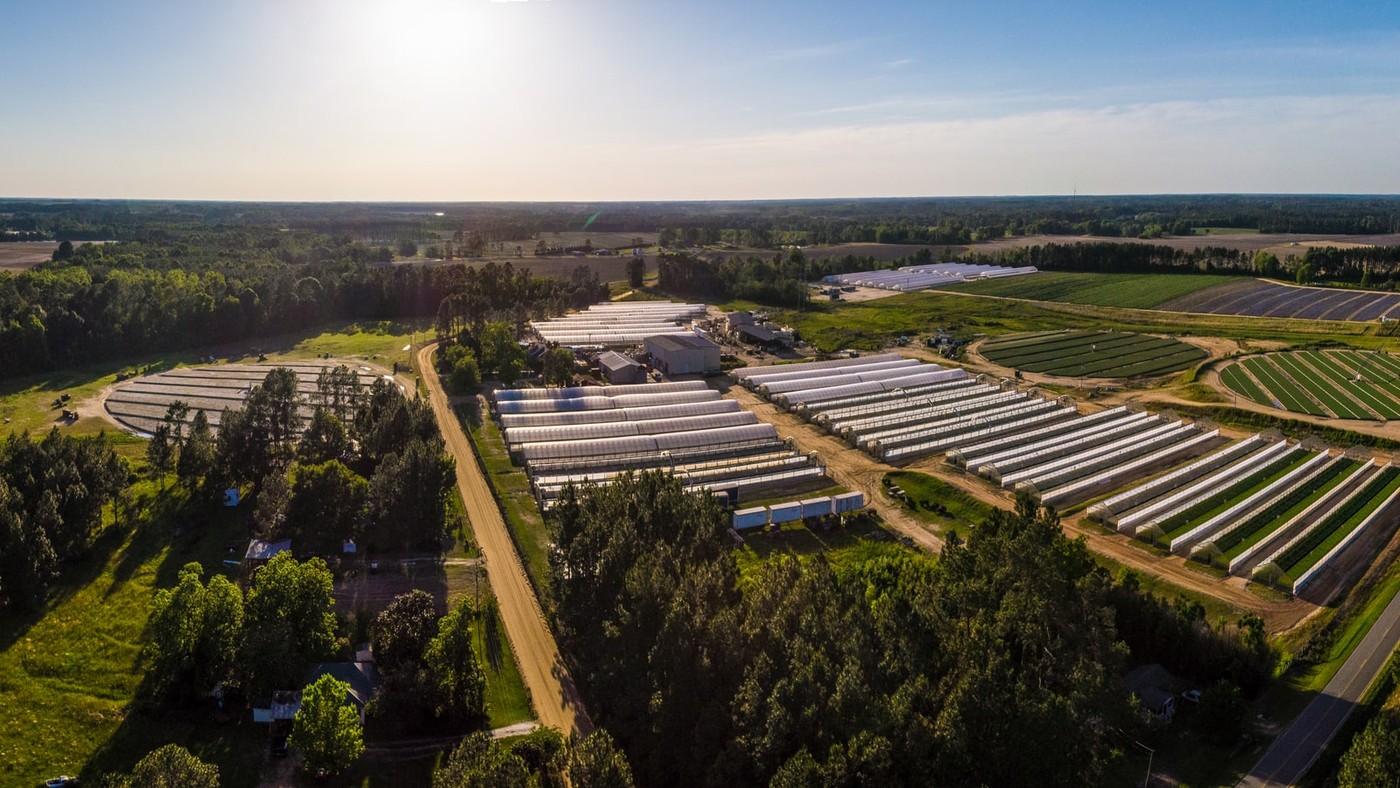
An aerial view of Lewis Taylor Farms in Georgia shows greenhouse production, vegetable blocks, field crops, longleaf pine seedlings, and wooded edges sharing one working landscape. — Credit: Lance Cheung, USDA (public domain)
The bottom line
A field can contain one crop while the farm around it is highly diverse. You do not need to redesign the whole operation at once. Start with one opportunity or repeated pressure, choose a manageable change that adds a useful function, and try it at a scale you can observe. Then measure the whole result—including production, labor, economics, soil, water, and risk—not just the yield of one crop.
Farm diversity can take more forms than we sometimes imagine. A forty-acre vegetable farm may grow dozens of crops. A two-thousand-acre grain farm may plant one species in a field while using a long rotation, cover crops, livestock, prairie strips, wetlands, and perennial buffers across the operation. Both farms have opportunities to add useful diversity. Acreage and crop count are only the beginning of the story.
One crop in a field is not the same as one function on a farm
A sole-crop stand may be part of a diverse rotation or landscape. Continuous monoculture repeats the same crop on the same ground over years. Name the scale and time period before calling a system a monocrop.
Start by naming the kind of diversity you want
“Monocrop” is often used for several different conditions. The word is easy to understand, but it can blur important differences. A more useful starting point is to ask what repeats, where it repeats, and for how long. That answer shows where a practical change might fit.
Five systems that are often collapsed into one word
System
What it means
What it does not tell you
Continuous monoculture
The same crop is grown repeatedly on the same ground
Whether cover crops, manure, tillage changes, or habitat are also present
Sole crop
One crop species occupies a field at one time
Whether that field is one phase of a diverse multi-year rotation
Simplified rotation
A short sequence repeats similar crop families, seasons, roots, or control tactics
Whether the farm has diverse enterprises or noncrop habitat elsewhere
Simplified landscape
A large share of the surrounding area offers similar crop cover and few noncrop habitats
Whether individual farms use diverse rotations below the landscape scale
Diversified whole farm
Several complementary production and conservation functions are distributed through time and space
Whether every addition is profitable, well managed, or beneficial in that location
Field, rotation, farm, and surrounding landscape are connected, but each offers a different place to work.
Diversity has more than one address
Farm diversity can be temporal, spatial, ecological, or economic. That is good news: you can work on the layer that matches your goal instead of trying to change everything at once. A cover crop may fill a bare-soil window. A hedgerow may add season-long habitat. Livestock may create a use for forage and another source of revenue. Each option brings a different opportunity and a different set of practical needs.
Slow establishment, long commitments, different cash-flow timing
A farm does not need every layer. Begin where one manageable change can add the most useful function.
Give every new layer a job
A useful diversity move has a clear purpose: interrupt a named pest, cover a vulnerable soil window, use a different water or nutrient niche, provide season-long habitat, spread labor, or create a marketable second output.
The potential is real—and it can build over time
Two large research syntheses give farmers good reason to explore diversification. A 2020 second-order meta-analysis combined 98 meta-analyses, 5,160 original studies, and 41,946 comparisons. Across many practices and systems, diversification improved biodiversity, pollination, pest control, nutrient cycling, soil fertility, and water regulation without reducing crop yield on average. Results varied by practice and place, which is why a local trial still matters. [1]
A 2026 synthesis added a valuable long view. It analyzed 184 meta-analyses and 6,741 effect sizes from studies lasting as long as 120 years. Model estimates for financial profitability, biodiversity, pollination, soil quality, and carbon sequestration grew over time; the reported 20-year increases ranged from 37% to 189%, depending on the outcome. Crop yield, pest control, and climate regulation did not show significant long-term changes in the overall model. [2] The encouraging lesson is that well-chosen benefits can build with time, even when every measure does not move together.
What four real-world examples can teach us
Design move
Observed result
Why it matters
Keep in mind
Diversified Iowa rotation
In a nine-year experiment, corn and soybean yields were about 4% and 9% higher in three- and four-year systems; long-term profit was similar, manufactured N and herbicide use were lower
A coordinated rotation can maintain profitability while changing inputs and labor
The longer systems also used legumes, manure, cultivation, and more labor; crop count alone did not cause the result. [3]
Maize–soybean intercropping
Across 90 studies, mean land equivalent ratio was 1.32
The combined intercrop output used land efficiently
LER compares combined output with sole crops. It does not mean each component yielded more or that the system fits U.S. mechanical harvest and markets. [4]
Strategically placed perennial habitat can deliver several functions from a small area
Results came from small Iowa catchments with defined slopes, soils, placement, and management; harvested area declined by the land converted. [6]
U.S. riparian forest buffers
Among 2,433 surveyed buffer users, 96% reported wildlife habitat, 93% erosion control, and 91% bank stabilization
Producers value buffers for multiple functions
These are self-reported experiences, not a randomized causal comparison; 46% also reported added labor or management complexity. [7]
Each example shows a different possibility. Keep its practice, scale, baseline, and outcome attached when considering it for another farm.
1. Rotate function through time
A rotation becomes more useful when it changes the conditions faced by the next crop. You might alternate grasses and broadleaves, warm- and cool-season growth, shallow and deep roots, high- and low-residue crops, or early and late planting windows. Treat those contrasts as options to explore. The best fit will also work with the field's pest history, water balance, herbicide restrictions, residue, buyer, and labor calendar.
Our guide Crop Rotation Is a System, Not a List walks through the full process. Its central idea is simple: name the pressure first, then choose a crop or cover that changes it. Sometimes a thoughtful three-crop sequence creates more useful contrast than four crop names that share the same planting window and weed-control tactic.
2. Stack crops when their growth and harvests work together
Intercropping, relay cropping, strip cropping, and living mulches bring diversity into the same field at the same time. The opportunity is complementarity: crops may use light, space, time, and nitrogen differently. In a maize–soybean meta-analysis, the average land equivalent ratio was 1.32. In plain language, 1.32 hectares of the corresponding sole crops would have been needed to match the combined output from one hectare of intercrop. The advantage grew when the crops occupied more distinct growth periods. [4]
Combined output can rise even when one crop yields less, so decide what success means before planting. A short planning check should cover row spacing, fertility, crop-protection compatibility, cultivation, harvest timing, product separation, insurance, and buyers. If a permanent understory interests you, our living mulch in row crops guide explains how to plan for competition for water and nitrogen.
3. Put field edges and waterways to work
Not every diversity move needs to occupy a cash-crop row. Prairie strips, hedgerows, beetle banks, grassed waterways, windbreaks, and riparian buffers can add perennial roots and habitat in targeted places. Start with the job, then choose the placement. A strip across a runoff path serves a different purpose from a flowering border beside a pollinator-dependent crop.
The Iowa STRIPS experiment shows the potential of thoughtful placement. Replacing 10% of a corn–soybean catchment with prairie vegetation reduced water runoff 37%, retained 20 times more soil and 4.3 times more phosphorus, and improved several insect, pollinator, and bird measures relative to all-crop catchments. [6] A local plan will still need to account for slope, concentrated flow, tile drainage, vegetation, neighboring habitat, pesticide exposure, establishment, and maintenance.
Good habitat works across the season and fits the crop-protection program around it. A global synthesis across 89 studies and 1,475 locations found that the richness of pollinators and natural enemies supported pollination and biological pest control independently of their abundance. Landscape simplification reduced those services partly through richness loss. [5] Local Extension, NRCS, conservation-district, or crop-adviser guidance can help select plants, avoid problem hosts, plan bloom continuity, and reduce pesticide exposure.
4. Let livestock and perennials open new options
Forage phases and well-managed grazing can create a market for rotation crops, return nutrients, use cover-crop biomass, extend living cover, and distribute income. Trees or shrubs can add wind protection, shade, riparian function, fruit, nuts, timber, or browse. NRCS lists crop rotation, cover crops, integrated grazing, and more time in perennial crops among ways to increase biodiversity in soil health systems. [8]
The opportunity works best when the support system is ready. Livestock need fencing, water, handling, animal-health skill, daily care, and a plan for wet-soil compaction and crop-food-safety intervals. Perennials may take years to produce revenue and may need a different harvest system. In the 2026 national agroforestry survey, riparian-buffer users reported wildlife and erosion benefits; added labor and management complexity was also their most common challenge. [7] Plan the capacity alongside the biology, and the new enterprise has a much better chance to last.
5. Organic farms have many paths to diversity
Organic certification creates an important production framework. Within it, every farm still has its own starting point for rotation, living roots, habitat, erosion control, and business diversity. An organic farm may be highly diversified or specialized and tillage-intensive. A conventional farm may also be simplified or highly diversified. Looking at the practices themselves helps us recognize the options available to farms of every type and scale.
A six-year USDA-ARS organic vegetable experiment in Salinas, California, helps show that range of choices. Frequent winter cover cropping was the primary driver of differences in microbial biomass and community measures among five high-input, tillage-intensive systems. Compost was more strongly associated with soil organic carbon differences. [9] NRCS also presents rotations, covers, nutrient management, and conservation tillage as complementary tools organic growers can combine around their goals. [10]
Make room for the management, too
Every new crop, animal, or habitat also brings tasks: water and nutrient planning, pest scouting, harvest timing, storage, food safety, maintenance, or marketing. Plan those needs alongside the benefits so the new layer can strengthen the farm instead of stretching it.
Match the next move to the opportunity
Where might diversity earn its keep?
Opportunity or repeated pressure
A move to consider
What to measure
What to plan for
The same weed cohort survives each year
Change planting and harvest windows; add a competitive forage, cover, or crop phase; rotate control tactics
More enterprises create more total workload and small inefficient batches
Use these as conversation starters. Local guidance can help verify species, timing, labels, food-safety rules, contracts, conservation standards, and economics.
A seven-question whole-farm diversity audit
What repeats? Name the crop family, planting window, harvest window, root zone, residue level, nutrient demand, pest host, disturbance, or market exposure that rarely changes.
Where does it repeat? Mark the field, rotation, farm zone, waterway, labor week, or sales channel—not simply the farm as a whole.
Which function is missing? Choose one: non-host time, soil cover, living roots, nitrogen supply or capture, deeper rooting, floral continuity, runoff interception, another harvest window, or another revenue stream.
What is the smallest move that adds that function? A border, field zone, one rotation phase, split planting, contract crop, or grazed cover may answer the question before a whole-farm redesign.
What support will it need? List seed, equipment, labor, water, fencing, storage, buyer, processing, insurance, technical skill, and maintenance.
How would it perform in a hard year? Test the design on paper under drought, wet spring, early frost, low price, labor loss, herbicide drift, or failed establishment.
What result tells you the next step? Set a review date and numerical rules for production, margin, labor, weed seed return, cover, erosion, water, or habitat.
Measure what matters across the whole system
A diversity trial may improve more than one part of the farm. Perhaps annualized land output rises, labor spreads across the season, input exposure falls, or a vulnerable field edge begins protecting water. One crop may also yield less, or the new system may ask for more management than expected. Keep both the benefits and the costs visible. Record saleable production, price, variable costs, added labor and capital, and the soil, water, pest, or habitat function you set out to change.
A minimum scorecard for a diversity trial
Ledger
Core records
Useful optional records
Production
Saleable yield from every crop or enterprise; area and time occupied
Land equivalent ratio for intercrops; yield stability across years
Some soil responses are seasonal, slow, or easier to see in microbial composition than in a broad soil-health score. A four-year western Tennessee experiment compared continuous corn or soybean with rotations and a five-species winter cover mix. Microbial community composition and some fungal groups responded by treatment and season, but microbial diversity did not rise and overall soil-health indicators changed little during the study. [11] Early measurements are still useful when they match the intended mechanism. Keep the sampling method and season consistent, and give slower indicators enough time.
Start small, learn, and build what works
Whole-farm diversity is not a contest to accumulate the most species or enterprises. It is a chance to share important functions across more than one crop, field, season, input, or market. Your first step might be a longer rotation, a prairie strip across a known flow path, a cover crop after an early harvest, a forage phase with a dependable user, or a flowering edge that fills a seasonal habitat gap.
Write down the job before choosing the practice. Try it at the smallest scale that can give you a useful answer. Track the land, labor, equipment, market, and maintenance that come with it. If the new layer does its job and fits the farm, build from there. That is how diversity becomes a durable part of the operation—one purposeful, learnable step at a time.
Soil Health Exchange Team (2026). Beyond Monocrops: How to Design Diversity Across the Whole Farm. Soil Health Exchange. https://soilhealthexchange.com/blog/beyond-monocrops-diverse-farm-systems
More citation formats
MLA
Soil Health Exchange Team. "Beyond Monocrops: How to Design Diversity Across the Whole Farm." Soil Health Exchange, 2026-09-09, https://soilhealthexchange.com/blog/beyond-monocrops-diverse-farm-systems.
Chicago
Soil Health Exchange Team. "Beyond Monocrops: How to Design Diversity Across the Whole Farm." Soil Health Exchange. Published 2026-09-09. https://soilhealthexchange.com/blog/beyond-monocrops-diverse-farm-systems.
Discussion
No comments yet. Be the first to share your thoughts!