Certification and supply are different problems
Organic certification establishes whether an operation and product meet the applicable organic requirements. It does not guarantee the right variety, yield, contracted acres, harvest timing, pack style, processing characteristics, transportation, price, or delivery reliability. A sourcing program must solve both compliance and commercial fit.
The minimum organic demand brief
| Demand field | Questions to answer |
|---|---|
| Product | Crop, ingredient, variety or cultivar, intended use, and acceptable alternatives |
| Geography | Production radius, climate or soil constraints, receiving plant, and freight assumptions |
| Quantity | Annual volume, minimum lot, acreage estimate, ramp schedule, and tolerance |
| Timing | Planting decision date, harvest or delivery window, contract date, and program duration |
| Quality | Processing, food-safety, maturity, moisture, solids, grade, residue, packaging, or storage specifications |
| Organic status | Certified supply only, transitional relationships, land eligible before harvest, and required certifier documentation |
| Economics | Base price, organic premium, payment timing, volume commitment, crop-failure treatment, transition support, and input or technical-assistance support |
| Delivery chain | Aggregation, packing, processing, warehousing, transportation, ownership, and certification responsibilities |
Separate current supply from future potential
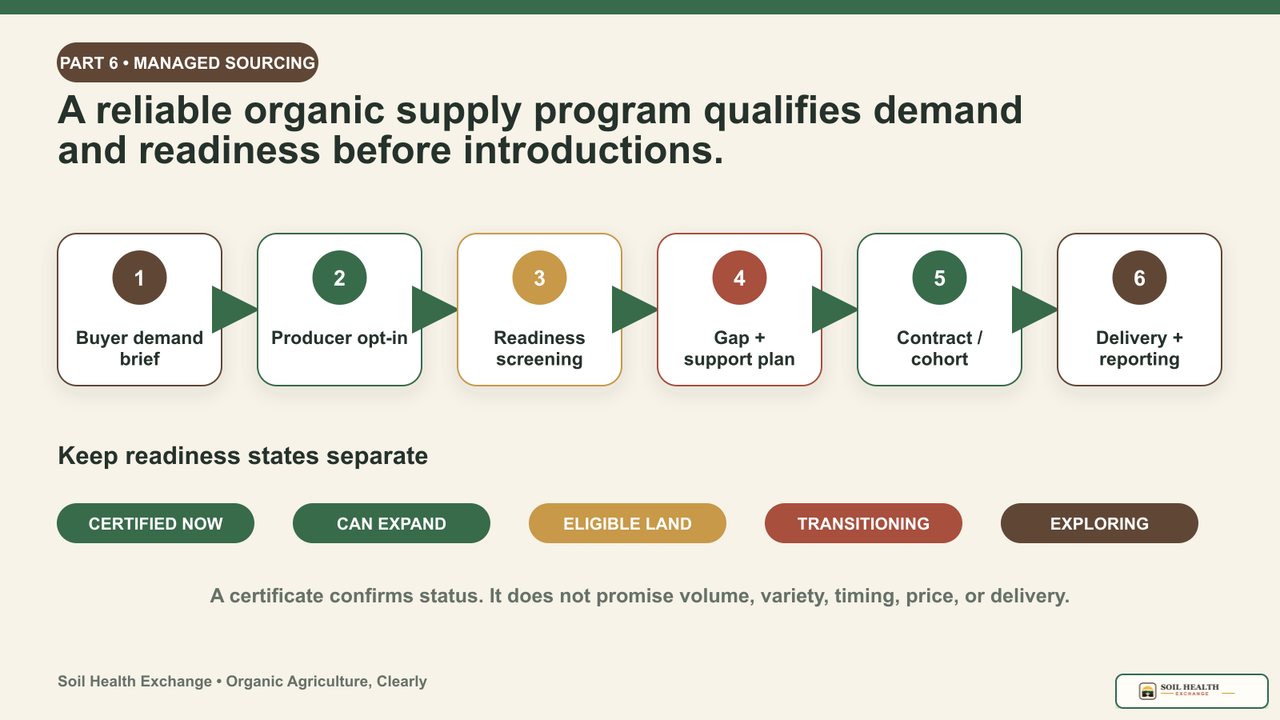
A single producer list can make the opportunity look larger and closer than it is. Use readiness states that reflect evidence and timing. A useful early map distinguishes certified product available in the required window, certified producers who could add acres, land that may be eligible but is not yet certified for the crop, actively transitioning land, and producers who are only exploring.
Supply readiness states
| State | What is known | Next evidence needed |
|---|---|---|
| Certified and available | Current certificate, applicable product, capacity, timing, and commercial interest | Contract, lot and delivery controls, continuing certification verification |
| Certified, expansion possible | Certified operator with potentially suitable additional capacity | Crop plan, seed or planting material, acreage, economics, infrastructure, and updated product listing |
| Potentially eligible land | Records may support the required prohibited-substance history | Certifier review, OSP, inspection, certification decision, and crop fit |
| Transitioning | Organic practices and documentation are underway | Eligibility date, transition plan, market bridge, certification application, and buyer commitment |
| Interested | Producer is willing to evaluate the opportunity | Land, agronomy, economics, risk, certification, processing, and delivery assessment |
Verify supply before counting it
USDA’s Organic INTEGRITY Database is the authoritative public starting point for checking certified operations. USDA’s Organic INTEGRITY Database is the authoritative public starting point. Verification should also examine the current certificate and product details, the applicable crop or handling scope, operation and facility names, certifier, status, expected harvest or inventory, and the chain of required certified handlers [1][2].
Diagnose the actual bottleneck
- Land eligibility: Was a prohibited substance used within the relevant three-year period? See the history requirements in Part 3.
- Agronomic fit: Can the crop, variety, rotation, fertility, pest management, water, and harvest system work in the target geography?
- Transition economics: Who carries reduced yield, learning, certification, recordkeeping, or segregated-handling costs before organic revenue arrives?
- Market confidence: Is there a credible purchase term, floor, premium, volume range, or multi-year relationship?
- Infrastructure: Are transplants, approved inputs, harvest crews, storage, transport, packing, and certified processing available?
- Compliance capacity: Can the producer and downstream operations maintain the OSP, records, inspection, traceability, and label controls?
- Organizational ownership: Who inside the buyer is accountable for procurement, quality, organic compliance, product development, finance, and supplier support?
Build a managed sourcing program before an open marketplace
When supply is thin, a public listing board can attract many unqualified leads while exposing producer information and disappointing both sides. A managed program begins with the demand brief, invites producers to opt in, screens readiness, protects confidential data, connects the right experts, and shares producer identity with the buyer only at the agreed stage.
- Confirm that the buyer’s demand, budget, decision owner, and timeline are real.
- Recruit through producer, certifier, Extension, processor, and adviser networks using one consistent brief.
- Screen certification status, production fit, capacity, timing, economics, and willingness without promising a contract.
- Report aggregate potential first; share farm-level information only with producer consent.
- Design technical assistance, transition support, price structure, and contracting around the discovered bottleneck.
- Track qualified acres or units, forecast volume, contracted volume, certified delivered volume, shortfalls, and causes.
Design the whole handling chain
A brand’s sourcing plan must include every relevant handler, processor, warehouse, broker, importer, exporter, and co-manufacturer—not only the farm. Most entities in organic trade need certification unless a specific exemption applies. Map ownership, physical product movement, transaction facilitation, certificates, lots, labels, and records before the first delivery, following the role map in the certification guide [3][4].