A Nebraska visit opens a conversation about combining water, forage, soil cover and livestock management, with research and a practical trial idea for next season.
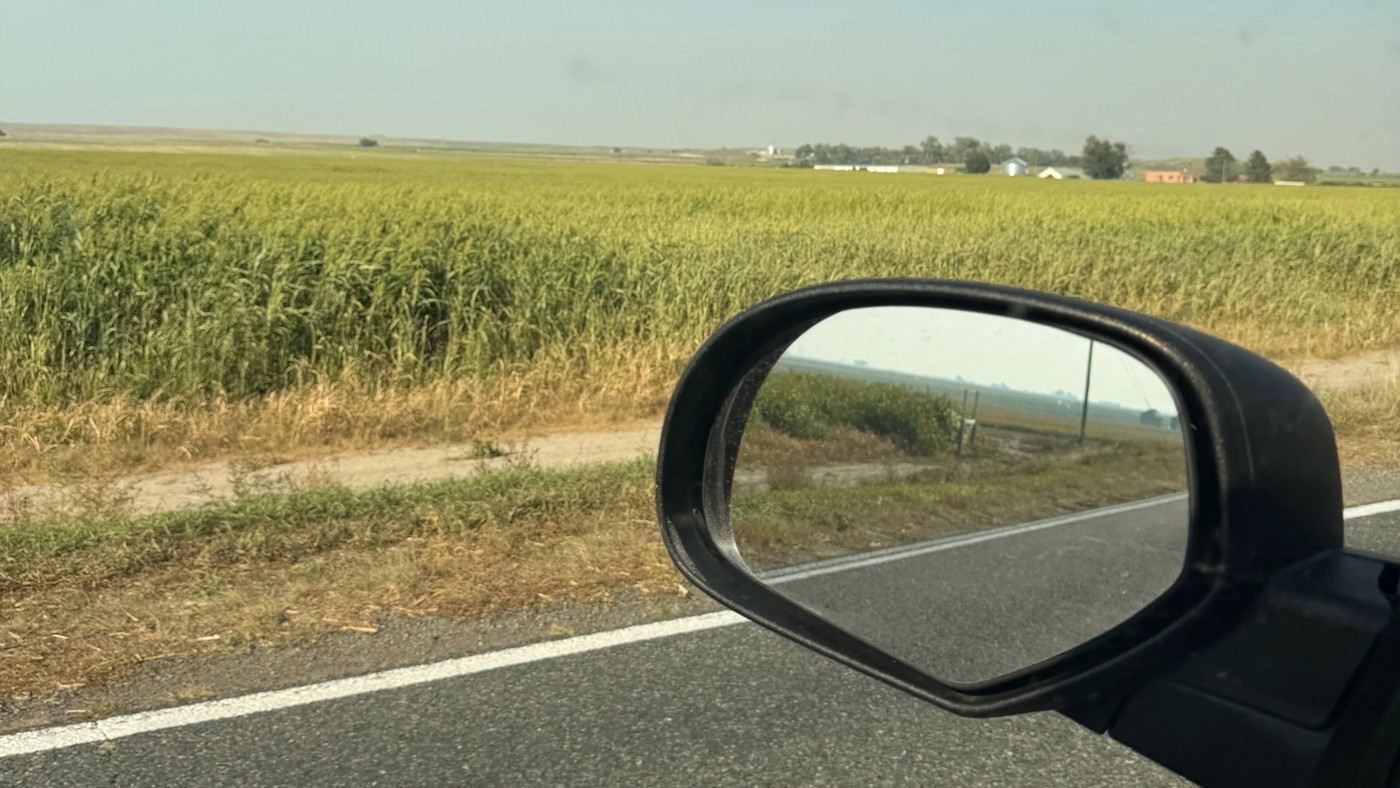
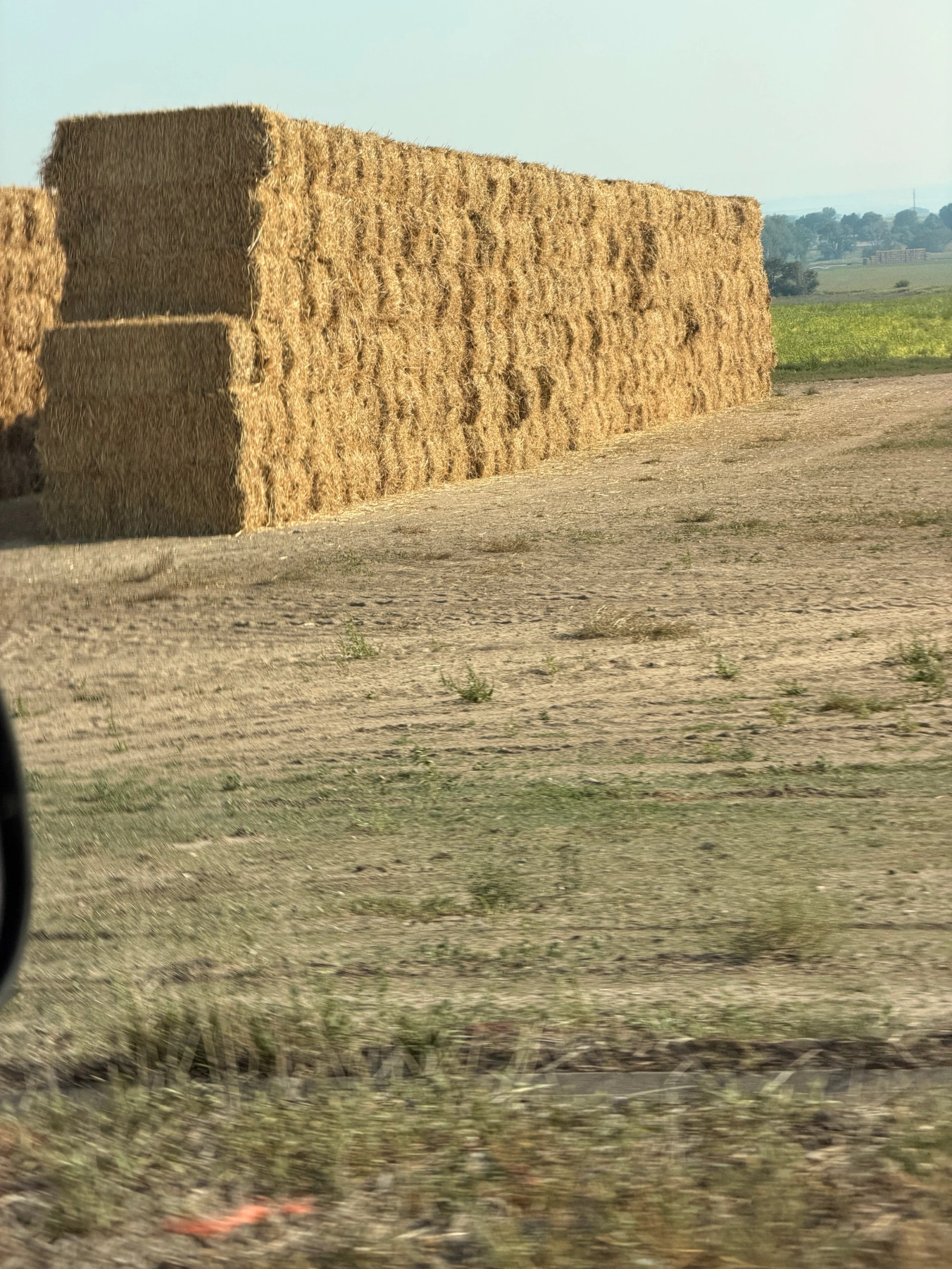
From the truck window: the fields that started this conversation. — Photo: Saurav Das
The fields looked a little different through the truck window this time.
I was back in Scottsbluff visiting friends and family. Along the roads we took, I noticed less corn than I remembered, more sorghum-sudan and alfalfa, and people busy haying and stacking bales. The farmers I spoke with had put up good hay this year. I wanted to understand what had worked, and what they were thinking about for next season.
When I started talking with farmers, precipitation kept coming up. There hadn’t been enough. What people could grow, how much they could harvest, and what they would feed later all depended on how far the available water would stretch.
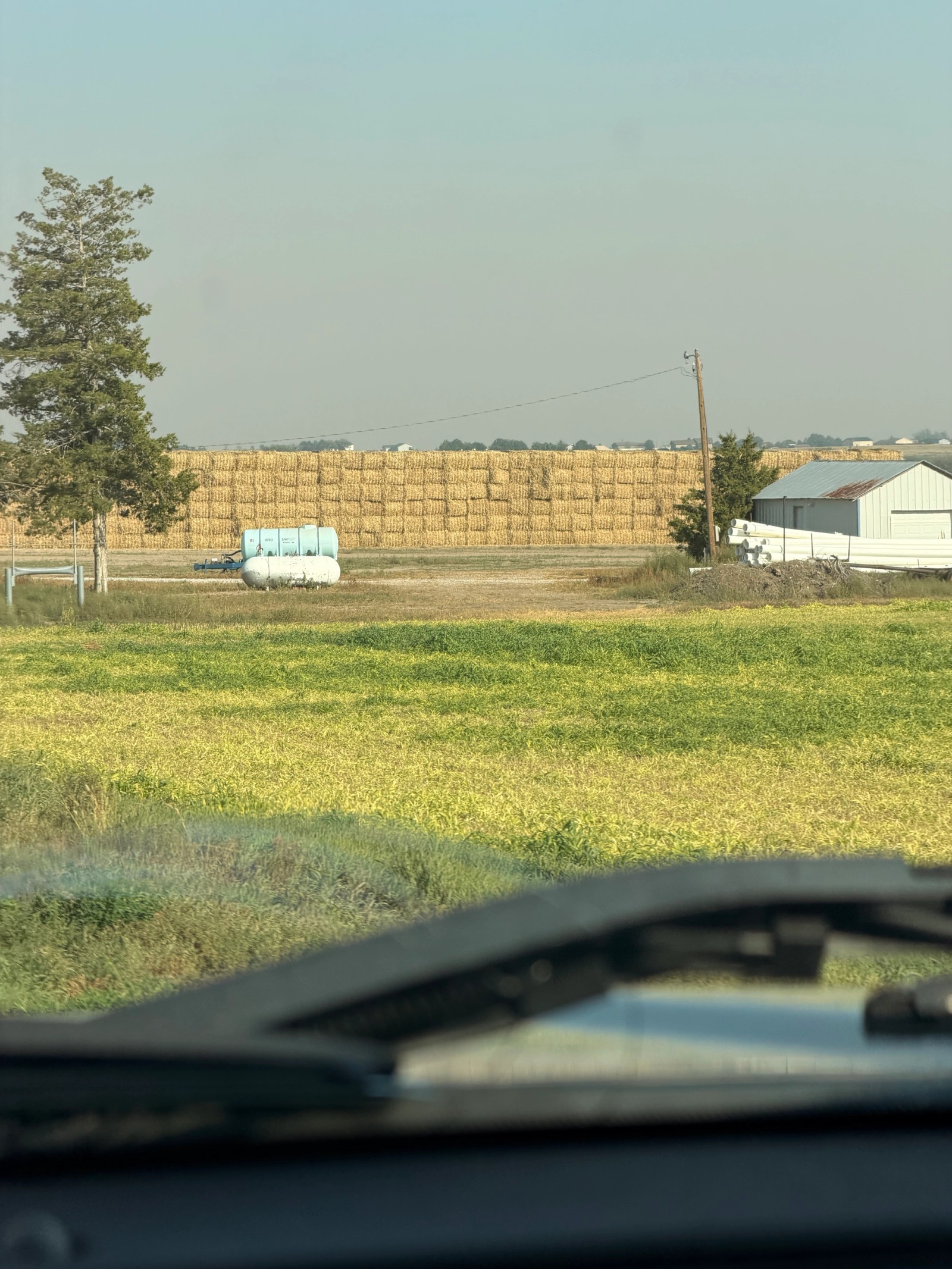
I also saw the main irrigation canal dry during my visit. I wondered how its delivery schedule had lined up with planting and cutting. That is a detail I still want to follow up on. In the fields around it, those hay stacks told another part of the story: people had found ways to bring a harvest home.
The rain was only part of the water story
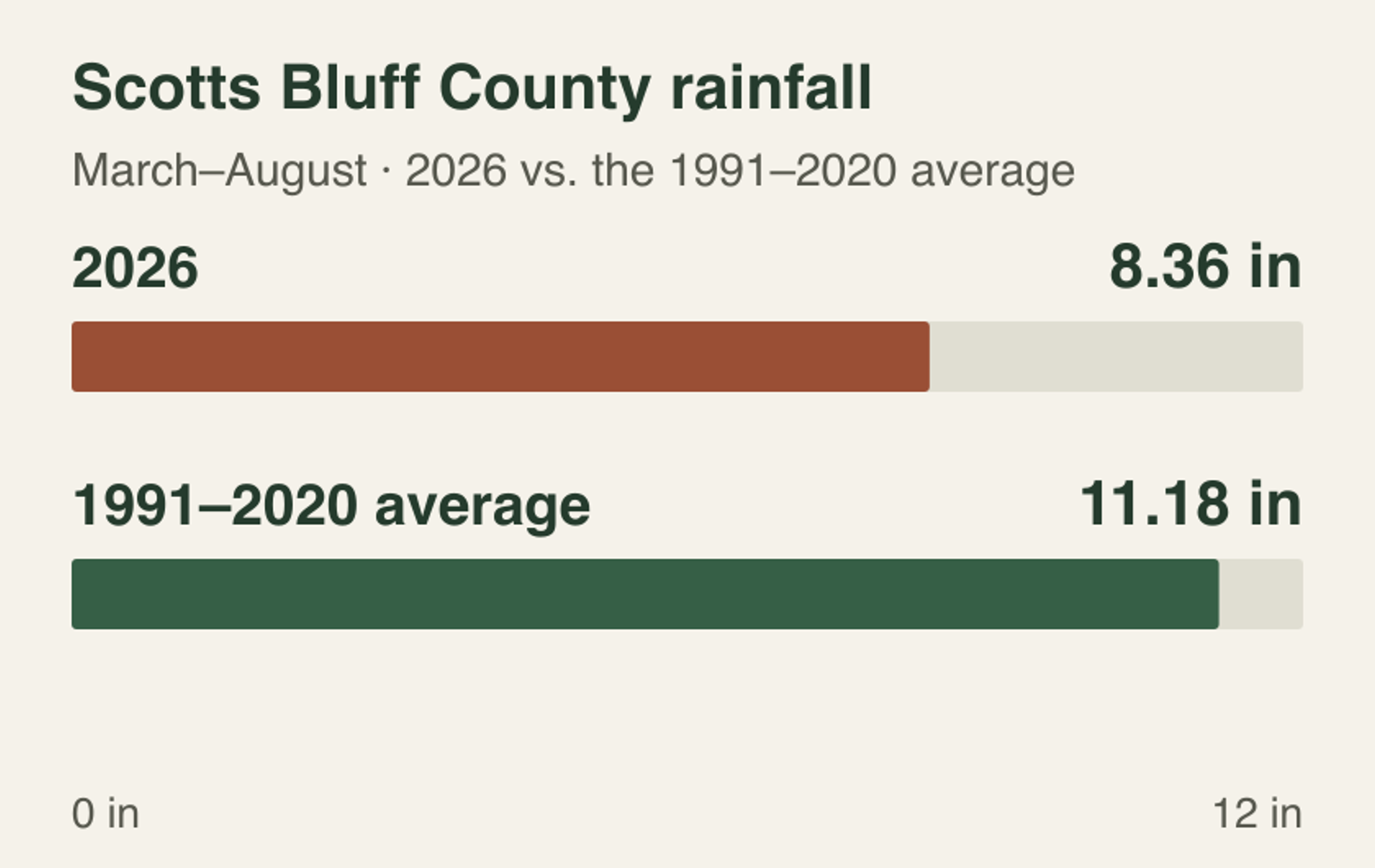
Back at my desk, I looked up the rainfall. NOAA’s county estimates put March–August precipitation in Scotts Bluff County at 8.36 inches, against a 1991–2020 average of 11.18 inches. That leaves 2.82 inches missing, with about 75% of the usual total received. Explore the NOAA source data.
Swipe horizontally to inspect the full figure →
Click or tap to expand the figure
NOAA NCEI Climate at a Glance, retrieved September 13, 2026. March–August precipitation estimates for Scotts Bluff County.
Those numbers gave the conversations some context. Water in the soil, supplies in the river system and the timing of irrigation deliveries also shape a growing season. For a farmer planning the next cutting, when that water arrives matters a great deal.
UNL had described the wider problem before planting: western Panhandle growers were entering 2026 with both dry soil and a severely constrained surface-water supply. Farmers were making crop and irrigation decisions with that combination in mind. Read the Panhandle Research, Extension and Education Center’s account.
The State Climate Office’s September 10 outlook offered better rain prospects, especially in eastern Nebraska. Around Scottsbluff, making the available water count was still very much on people’s minds. Read the rainfall outlook.
A good harvest, and the ground underneath
The hay stacks made me curious about the decisions behind them. Which fields had irrigation? When had the crop gone in, and when was it cut? How much useful feed did it provide? Those details would help explain what worked and which parts another farmer might try.
Click to expand
Haying and stacked bales were part of the view along the roads we took.
Start with the job the crop needs to do. Sorghum-sudan can provide substantial summer forage. Pearl millet offers another hay or grazing option; foxtail millet fits a shorter, usually single-cut hay window. Established alfalfa has perennial roots and its own rhythm of cutting and recovery. UNL’s summer-forage guide and alfalfa guidance help connect those choices to the farm’s needs.
Purpose matters here. A forage crop is grown to feed animals; a cover crop is planted primarily to serve the soil and cropping system, and may also provide forage. Residue is the material left on the surface. The same species can play more than one role, but harvesting it changes how much cover and plant material remain.
Living plants use water. Their canopy shades the ground, and stubble and residue can reduce evaporation and erosion after harvest. Water use and soil protection belong in the same conversation, with the next crop’s water supply kept in view. NRCS explains soil cover and how harvest management affects what remains. For me, that brings the question into focus: what can this field provide now, and what will it carry into next season?
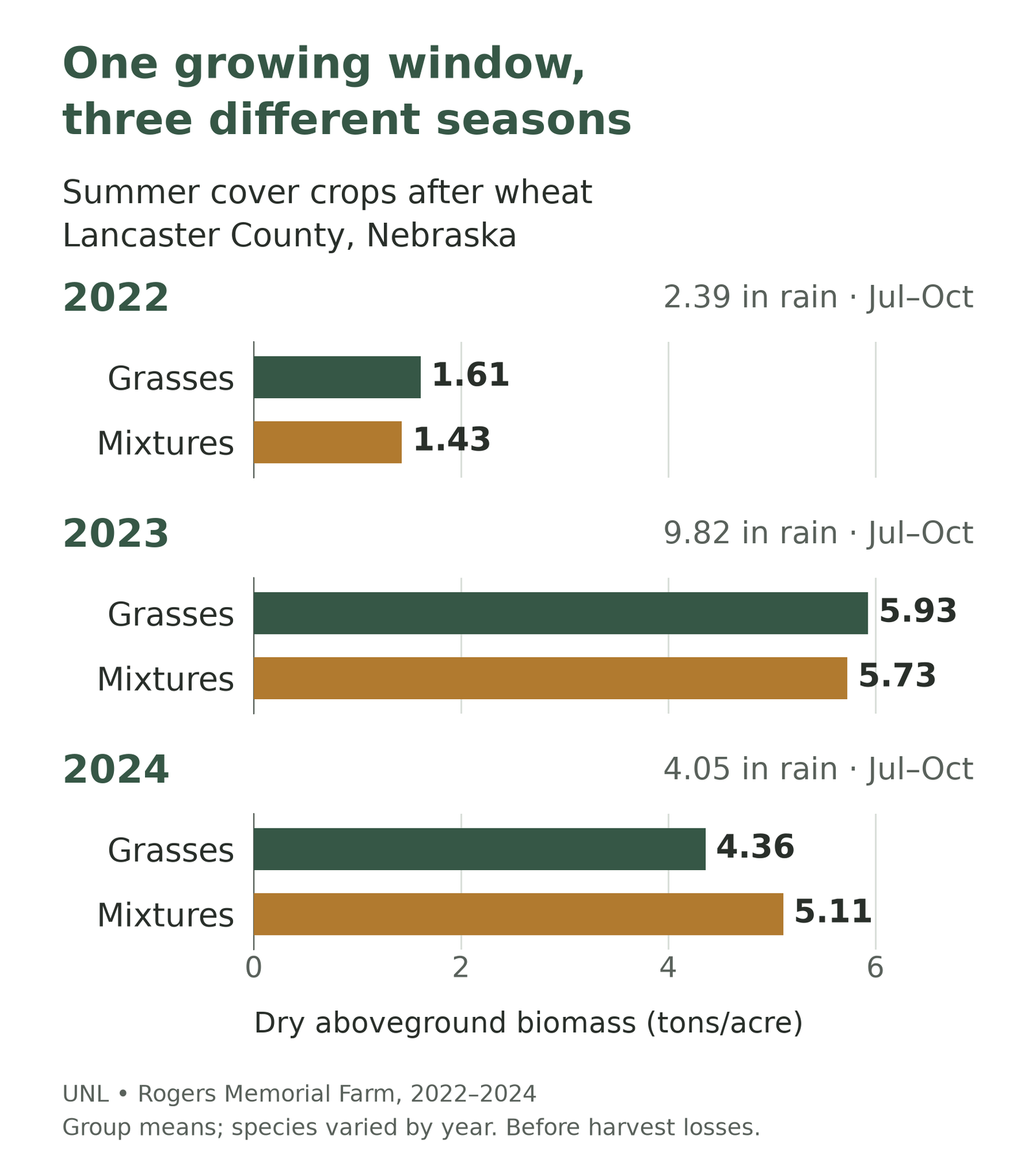
A recent Nebraska experiment gives some perspective on how much the season can change the opportunity. At Rogers Memorial Farm in Lancaster County, summer cover crops were planted after wheat and sampled in October over three years:
Swipe horizontally to inspect the full figure →
Click or tap to expand the figure
Source: UNL’s 2022–2024 summer cover crop study. Reported treatment-group means; dry aboveground biomass, before feeding or harvest losses. Species within the groups changed in some years. These are eastern Nebraska observations, where climate and soils differ from the Panhandle.
The range catches my attention. Both groups produced much more in 2023 than in 2022, while 2024 brought useful biomass with considerably less rain than 2023. Stored water, rainfall timing and the plants themselves help shape the outcome. I would plan around a conservative harvest and keep a use in mind for extra feed or cover when conditions allow.
There is another useful lesson closer to the Panhandle. In a 1999–2002 Sidney experiment, subsequent wheat averaged 29.9 bushels/acre after fallow and 23.2 after oat–pea forage. Yet oat–pea forage and proso millet were economically competitive with fallow under that study’s conditions. The harvested crop had value of its own. UNL’s account of the study makes the case for looking across the rotation.
That wider account—feed value, costs, ground cover and the following crop—is what I would want to follow on the farms I visited.
From having enough water to knowing what is in it
As we talked, another concern kept returning: nitrate. It came up in discussions about household water and about livestock feed.
For families in nearby Bayard, the concern was close to home. News Channel Nebraska reported a “Do Not Consume” notice on September 8. The city’s notice recorded a nitrate result of 61.6 mg/L and said further sampling was underway. Residents can follow the city’s updates for instructions on their water supply. Read the local reporting and the city’s notice.
Nebraska’s wider investigation included nearly 3,500 returned private-well test kits. People want to understand the water their families and animals rely on. Testing a household well or livestock supply brings that question down to the place where a decision has to be made. Nebraska’s study announcement and resources offer a starting point.
Nitrate can move through soil into groundwater. It can also accumulate in drought-stressed forage. Sampling the water and feed lets a farmer look at both sources of exposure with a veterinarian or nutritionist. For drinking water, boiling does not remove nitrate and can increase its concentration. EPA explains why.
The worry in the hay stack
For ranchers and livestock producers, a good harvest brought a practical question: how could they feed that hay with confidence after such a dry season?
Click to expand
A closer look at the hay stacks along the route.
Nitrate toxicity is well studied. In cattle, nitrite formed during digestion can interfere with the blood’s ability to carry oxygen. Severe poisoning can be fatal. UNL’s livestock guide explains why the feed concentration, intake and water supply all matter when planning a ration.
The concern has a history. A March 2019 University of Missouri report described more than 200 cattle deaths from nitrate poisoning diagnosed by its veterinary laboratory in the preceding month. Rapid or difficult breathing, tremors, staggering or collapse after feeding need an immediate call to a veterinarian.
One farmer told me her hens had stopped laying and wondered whether nitrate was involved. Her observation stayed with me. What would water and feed tests show alongside the timing of the change and the flock’s daily records? I would like to hear from farmers who have followed a similar question and researchers who could help investigate it. Extension’s laying-flock guide offers a starting point for those records.
Farmers noticing a change can help identify where to look more closely and which research questions matter on the ground.
What I would want to know before feeding—or buying
I would start with a sample that represents the hay being fed. UNL recommends a hay probe and 15–20 bales per representative lot for feed analysis. Suspect bales or field areas may need separate toxin sampling. Ask the lab for nitrate testing alongside moisture, protein and energy. UNL’s sampling guide explains the process.
Sorghum-family forage also needs attention to a separate prussic-acid risk and the laboratory’s sample-handling requirements. Pearl millet does not produce prussic acid, but it can accumulate nitrate. UNL’s May 2026 guidance is useful here. Nitrate can persist in stored hay, while ensiling can reduce it; silage still needs testing. Tennessee Extension discusses storage.
Then the report needs to become a feeding plan. Nitrate and nitrate-nitrogen are different reporting units; dry-matter and as-fed results also differ. A veterinarian or nutritionist can interpret the feed and water results together for the animals involved. UNL describes management options, including dilution with low-nitrate feed and gradual adaptation. The feed available, equipment, labor and cost determine what is workable on a particular farm.
Sometimes disposal enters that discussion. Oklahoma State Extension discusses burning or burying forage with extremely high nitrate concentrations. A test result and local advice on handling the material should guide that decision. After paying to grow, cut and bale a crop, that is a difficult possibility to face. It is also a reason to bring testing into the plan early.
The report matters to buyers, too. In his August 3, 2026 guidance, Nebraska Extension’s Aaron Berger recommends requesting a feed analysis before purchase, inspecting hay when uncertain and testing annual forages for nitrate. A grower with good hay to sell can use those results to explain its feeding value.
Prices give that conversation another dimension. USDA’s September 10, 2026 Nebraska report listed western-region good alfalfa in 3×4 large squares at $285/ton, FOB farm/ranch, and good/premium at $330. Grade, freight and feeding losses matter when valuing another lot. Check the dated USDA report. For silage buyers, UNL’s September 9 example values standing silage at $38.25/ton at about 65% moisture, using an illustrative $5/bushel corn price, before harvest and storage costs. Comparing feeds means putting them on the same dry-matter and feeding-value basis.
That brings me back to next season: how could management make more of the harvest useful, protect the field and leave a margin for the farmer?
Putting the practices together for next season
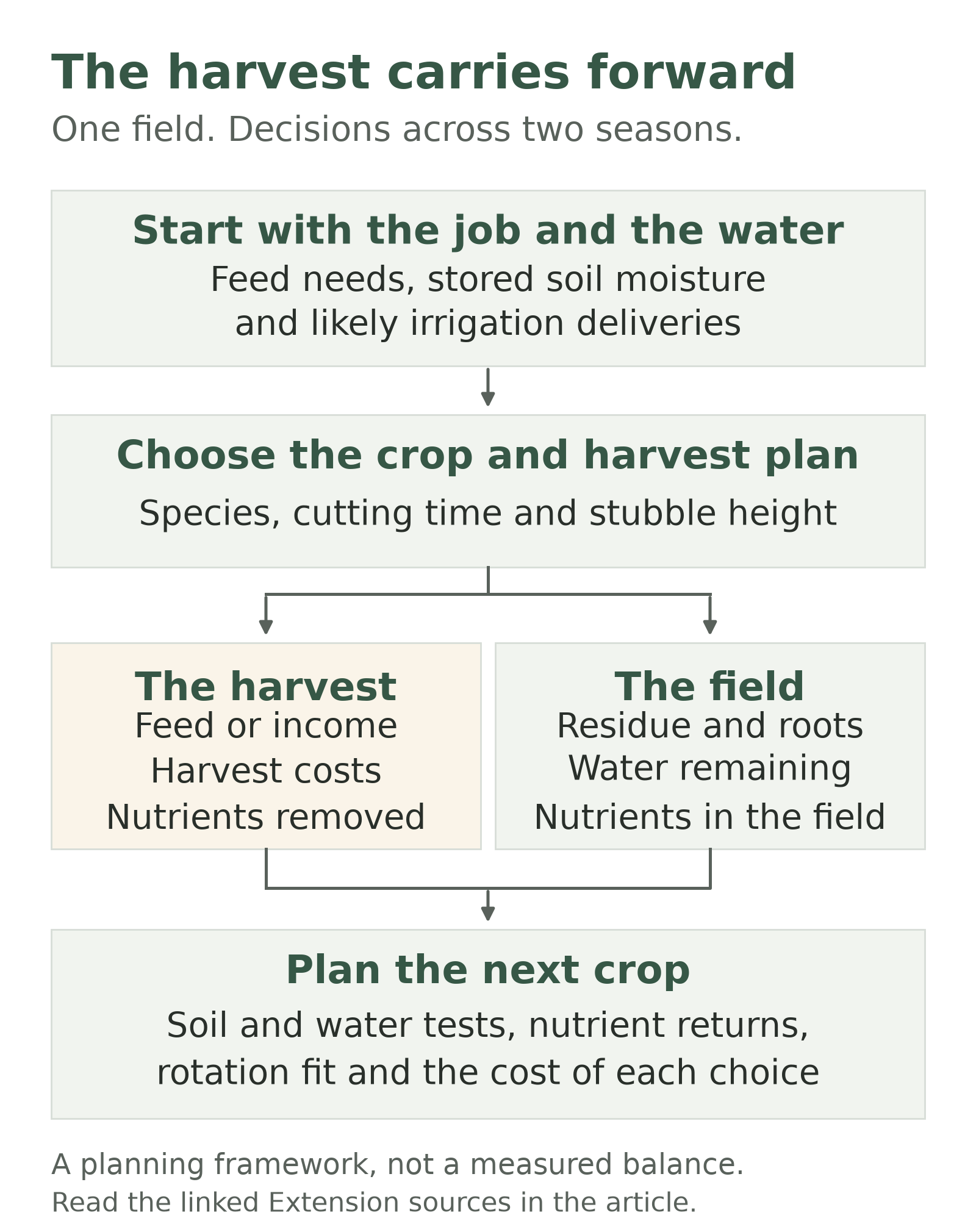
This is where the pieces start to fit. Crop choice, harvest timing, ground cover and nutrient management all affect what the farmer takes home and what the field has left. A useful combination gives each practice a job and checks how it affects the others.
Swipe horizontally to inspect the full figure →
Click or tap to expand the figure
A way to think across two seasons, drawing on the linked Extension and NRCS guidance. The arrows show connected decisions; this is a planning framework rather than a measured water or nutrient balance.
For a farm growing sorghum-sudan for hay, that might mean planting into retained residue, matching nitrogen to a realistic crop demand, choosing a suitable harvest stage and stubble height, and testing each hay lot. An alfalfa grower might put more attention into stand condition, irrigation timing and recovery between cuttings. A dryland field going into wheat needs a plan for the water carried forward.
Before ordering seed, check the previous crop’s herbicide records against the current labels for planting, haying and grazing restrictions. That can determine which options will fit. UNL explains what to check.
Combining management choices for next season
Starting point
Practices to consider together
When to change the plan
Limited irrigation
Match crop and acreage to likely deliveries; time water to crop need; retain residue.
If deliveries shrink or arrive late, revisit acreage and priority fields before committing more inputs.
Summer annual hay
Match species, cutting stage and stubble height to feed needs; plan nitrogen; test each lot.
If regrowth or drying conditions deteriorate, reassess the next cutting and its costs.
Established alfalfa
Assess the stand; coordinate irrigation with cutting and recovery.
If water or stand vigor cannot support another profitable cutting, reassess harvest timing with local advice.
A forage window before the next crop
Choose species for the available window; set planting and termination decisions around soil water.
If establishment moisture or the usable window is inadequate, retain existing residue and conserve water.
Cattle available to graze
Combine suitable forage, feed testing, fencing and water access; set an exit point that retains cover.
Move cattle when soil conditions or remaining cover reach the limits agreed before grazing.
Planning choices to adapt with local Extension or an adviser, drawing on the forage, water and soil-cover sources in this article. Each row is a possible combination for a particular situation.
A mixture can give species complementary jobs: forage, persistent residue or a legume contribution. Each addition still has to earn its seed cost and fit the planting and harvest window. For a farm already equipped to make hay, a change in cutting management or residue retention may be a manageable place to begin. Grazing would need its own budget for fencing, water and animal care, including any arrangement with a neighbor or custom grazier.
There is research behind a flexible planting decision. A 2013–2018 Garden City, Kansas study tested forage during fallow only when soil moisture and the seasonal outlook met its criteria; the flexible treatments were planted only in 2016. The useful idea is to agree beforehand on conditions for planting and for conserving existing residue and water. A Panhandle farm would set those limits for its own soil, crop and rotation. Read the flex-fallow study.
Grazing offers another way to make the pieces work together. A 2023 research review found no subsequent crop-yield effect from grazing compared with ungrazed cover crops in eight of 13 studies. Compaction indicators increased in six of 11 studies, generally below the cited root-restricting level. That makes soil conditions and grazing management central to the opportunity. The authors identify wet ground and high stocking rates as concerns and call for more long-term work in water-limited regions. Read the review.
Nutrients travel through this story too. Every bale carries some away from the field, including phosphorus and potassium. If hay is sold, that export belongs in the soil-testing and fertility budget. If it is fed on the farm, where manure and urine return matters. Feeding in one place concentrates nutrients there; another field may still need them. Aaron Berger’s discussion of nutrients in hay connects feeding location with future forage production.
Water can bring nutrients in. Hypothetical irrigation water containing 10 mg/L nitrate-nitrogen, applied as 12 inches of effective irrigation, supplies about 27 pounds of nitrogen per acre, using UNL’s conversion. The fertilizer credit depends on the crop and timing. Soil tests, manure history and an irrigation-water analysis help account for what is already available before buying more. A Nebraska NRD explains the water-testing connection.
A small experiment I would like to see
Here is one question I would like to explore with a willing farmer: could a slightly earlier first cut, paired with more stubble left behind, deliver useful forage while improving cover and recovery through the rest of the season?
UNL’s summer annual forage guide links stubble retention with drying and regrowth, and describes how maturity changes feed quality and yield. That gives us a basis for a local comparison. The proposal below is an on-farm research idea; its combined effect would need to be measured.
On a small, representative part of a sorghum-sudan hay field, choose two acceptable cutting heights and two harvest stages with an Extension forage specialist. The earlier stage should stay within locally appropriate harvest guidance. Compare all four combinations:
A proposed comparison of harvest timing and stubble height
Comparison
First-cut timing
Stubble height
Current practice
Farmer’s usual acceptable stage
Farmer’s usual acceptable height
Timing change
Earlier suitable stage
Usual height
Height change
Usual stage
Higher retained stubble
Both changes
Earlier suitable stage
Higher retained stubble
Proposed comparison, not trial results. Set both stages and heights for the crop and growing conditions before starting.
The layout separates the effects of timing and height, including how they work together. Keep variety, seeding rate, fertilizer and planned irrigation consistent. The Nebraska On-Farm Research Network can help repeat and randomize comparisons across the field; UNL’s design guide explains the approach.
Weigh and moisture-test every cutting, sample the hay lots for feed quality and nitrate, and record harvest and handling costs. Follow regrowth, photograph or measure ground cover on common dates, and measure soil moisture at consistent depths through the next planting. Where the rotation allows, follow the next crop’s yield too. A feed test and an agreed feeding plan remain part of using any trial hay.
Then compare the value of usable feed or purchased feed avoided, counted once, after extra costs and any change in the following crop’s return. Put that result beside the cover remaining. An earlier cut may reduce first-cut tonnage while changing quality, drying and regrowth. The trial lets a farmer weigh those outcomes using their own prices.
Even a result that favors the current practice is useful. It identifies something already working and gives the next experiment a better starting point.
The questions worth following for longer
One season can teach us about a harvest. I would also like to see research that stays with the farm long enough to follow the soil, the rotation and the animals.
For water, that means measuring both crop use and what is left at the next planting. Which combinations retain more cover without drawing down the next crop’s water supply too far? How do the answers change between dryland fields and fields with dependable or delayed irrigation?
For feed, I would like to follow how variety, nitrogen supply, cutting height and growing conditions influence nitrate concentrations within a field and between cuttings. Alongside that, farmers’ water tests, feed records and animal observations could help researchers focus on exposure patterns and practical management questions. The hen observation is one invitation to that kind of work.
For farm economics, the costs of equipment, labor, nutrient replacement and a market belong beside production. Which combinations work with the resources a farm already has? The Nebraska cover crop research resources bring water, biomass and partial budgets into the same discussion.
Longer trials could follow soil carbon, infiltration and nutrient movement alongside production. A network of farms using shared measurements through wet and dry years would help show which improvements last and what needs adapting locally. Farmers’ observations can shape the questions and help explain the results.
What I brought home
I went to Nebraska to see people I care about. I came home thinking about the hay farmers had put up and the decisions behind it.
Those stacks give us something to build on. The next question is which parts of the season made them possible, and how farmers can carry that success forward while caring for the ground beneath them.
This fall, a useful start could be keeping hay-lot records and test results together. Before buying seed, review water, nutrients and the next crop’s needs. Then choose one manageable change, with a fallback if conditions turn dry. That could be a different cutting decision, a better place to return nutrients or a few strips set aside to learn from. The hope is in building on what already works, one season and one shared experience at a time.
And a hello from Lucky and Steel before I go.
Click to expand
Lucky, taking a quiet moment by the garden.
Click to expand
Steel, out in the sunshine.
“We come and go, but the land is always here. And the people who love it and understand it are the people who own it—for a little while.”
— Willa Cather, O Pioneers! (1913)
What worked on your farm this year, and what are you still trying to understand? Write to me at contact@soilhealthexchange.com. If you put up good hay, tell me the crop, whether it was dryland or irrigated, when you planted and cut it, and roughly what it yielded or provided for your animals. If you tried cover crops or changed a management practice, I would like to hear how that went too. Those details can help another farmer and shape the next research question. We’ll ask before sharing your story.
Source material for every claim in this article, plus a citation-ready record for reference managers and scholarly indexes.
Cite this
Reference this work
SHE-ART-2026-0050
Saurav Das, Ph.D. (2026). What the fields were telling me in Nebraska. Soil Health Exchange. SHE-ART-2026-0050. https://soilhealthexchange.com/cite/SHE-ART-2026-0050
Ph.D., S. D. (2026). What the fields were telling me in Nebraska. Soil Health Exchange. https://soilhealthexchange.com/blog/nebraska-water-crop-choices-nitrate
More citation formats
MLA
Ph.D., Saurav Das,. "What the fields were telling me in Nebraska." Soil Health Exchange, 2026-09-13, https://soilhealthexchange.com/blog/nebraska-water-crop-choices-nitrate.
Chicago
Ph.D., Saurav Das,. "What the fields were telling me in Nebraska." Soil Health Exchange. Published 2026-09-13. https://soilhealthexchange.com/blog/nebraska-water-crop-choices-nitrate.


Discussion
No comments yet. Be the first to share your thoughts!