- Location
- Nebraska
- Crop
- Corn
- Acres
- 5,000
The challenge
“I want to reduce glyphosate use for terminating cover crops. Can roller-crimping work at scale in my region? What about winterkill species?”
The decision is not “herbicide or no herbicide”
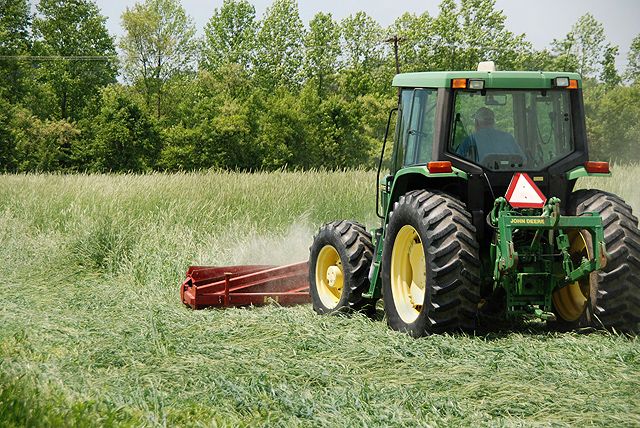
On 5,000 acres, the practical goal is to reduce routine herbicide use where biology, rotation, and field capacity make that reduction dependable—while keeping a rescue option where the cover or weeds do not cooperate. Nebraska data support three different lanes: roller-crimp mature cereal covers mainly ahead of soybean; use winter-killed covers after an early harvest; and treat early corn interseeding as a measured trial, not as the default for every acre.
Nebraska evidence at a glance
UNL recommends at least 8,000 lb/ac of dry cereal-cover biomass (about 4–5 ft tall), drilled at 100 lb/ac or more in mid- to late September in eastern Nebraska, and crimped at flowering. In 2020 interseeding trials, check corn averaged 214 bu/ac versus 209 bu/ac with interseeding. Across the 2019–2022 dataset, interseeding reduced corn yield in 6 of 12 site-years and reduced marginal return in 10 of 12; weather, herbicide carryover, irrigation, and canopy opening strongly affected those outcomes.
Lane 1: roller-crimp where the system can make a mat
The strongest first fit is a named cereal rye or triticale variety ahead of soybean. UNL’s Nebraska guidance calls for at least about 8,000 lb/ac of dry matter, or 4–5 ft of height, from a stand drilled at 100 lb/ac or more in mid- to late September in eastern Nebraska. Biomass makes the weed-suppressing mat; maturity determines whether the crimper can terminate the plant.
Crimp at anthesis—not merely when rye has headed
Anthesis is flowering: yellow anthers are visibly extending from the rye heads and shedding pollen. In the Zadoks cereal-growth scale, anthesis begins at stage 61. A peer-reviewed rye study found consistent roller-crimper control at this stage because mature reproductive stems are much less likely to stand back up and regrow after being crushed. Crimping at boot or heading can flatten rye temporarily but often allows recovery; waiting well past flowering improves maturity but increases the chance of viable seed. Because a field does not mature all at once, confirm that most of the stand—not just the earliest plants—has reached anthesis.
- Pilot one field with at least three paired strips: the farm’s current termination program beside crimping. Keep variety, population, fertility, and harvest method the same.
- Measure dry biomass before crimping, maturity stage, ground coverage, green regrowth 7–10 days later, weed escapes by species, rescue-treated acres, and moisture-corrected soybean yield.
- Set the rescue rule before planting. A targeted postemergence treatment is risk management, not a failed trial; its acres, product, application, and yield belong in the comparison.
Before scaling, use the acres per hour measured during the pilot—not a paper estimate—to confirm the crimper can finish the target acres while most of the cover is at anthesis without delaying soybean planting. Include turns, transport, refilling, a possible second pass, and available operator hours in that workload check.
Lane 2: remove spring termination after an early harvest
After wheat, silage, seed corn, or another early harvest, a winter-killed mixture can remove a planned spring burndown where it establishes well. The MCCC/UNL Nebraska recipe combines, per acre, 16–24 lb oats + 4 lb forage sorghum or sorghum-sudangrass + 2 lb pearl millet + 1 lb grain sorghum + 1 lb rapeseed + 4 lb buckwheat. Together those components make one 28–36 lb/ac mixed-species recipe; the rates are not six alternative monocrop rates. Oats also help carry the smaller seeds through the drill.
Here, 0.5 inch means planting depth
The recipe is drilled about one-half inch deep—not irrigated with one-half inch of water. Rapeseed is the smallest-seeded component, so it limits how deep the whole mixture should be placed; planting the mixture much deeper can reduce emergence of that component. Uniform wheat-residue spreading, seed-to-soil contact, and seeding immediately after harvest are still important, especially when the top half-inch is drying.
A farmer can use one winter-killed species instead of the full mixture, but should then use that species’ Nebraska-specific monocrop seeding rate and management—not the smaller component rate shown above. For example, 1 lb/ac rapeseed in this recipe is its contribution to a mixture, not a stand-alone recommendation. Use the MCCC selector or local Extension guidance to size a single-species rate and to check forage, herbicide, and wheat-curl-mite considerations.
Lane 3: interseed corn only where the farm can control establishment
UNL’s 2019–2022 on-farm work used a drill between rows at V3–V5. The result was not a simple success or failure. Corn yield was lower with interseeding in 6 of 12 site-years, and marginal return was lower in 10 of 12 after seed and seeding costs. The economic calculation did not include grazing, incentives, or unpriced future soil benefits. At the same time, seven of ten 2020–2021 corn sites were affected by a wind event, two 2022 sites were lost to hail, and two were abandoned because residual herbicide interfered with the covers. Those limitations make the data a warning about execution and risk—not proof that every interseeded acre loses money.
The clearest single-year signal was 2020: check corn averaged 214 bu/ac and interseeded corn 209 bu/ac (p = 0.001); four of six sites had significantly lower yield and five of six had lower net return. In 2019, two sites had no yield difference, although their interseeded treatments still had lower net return.
- Drill at V3–V4 where possible—UNL’s preferred target is V3—for seed-to-soil contact before the corn canopy closes. Select only fields whose preemergence products and plant-back restrictions fit every species in the mixture.
- Budget establishment water in a dry spring. In this section, a 0.5-inch pivot application means the depth of water applied after interseeding—not seed depth. UNL reported that one or two 0.5-inch applications may be needed to wet the shallow seed zone and support emergence when rainfall is absent; actual need still depends on soil moisture, texture, residue, and forecast.
- Record hybrid canopy, wind or hail opening, September cover and weed biomass, post-harvest grazing days, water applied, and any incentive actually received. These are the variables needed to explain the return.
- The three-year sampling did not detect differences between interseeded and check strips in the measured soil-health or nutrient indicators. Because treatment replications were composited within each site, small changes would have been difficult to detect. Interpret this as “no measured short-term change in this dataset,” not as proof that longer-term changes cannot occur; base the near-term acreage decision on establishment, yield, cost, grazing, and other benefits the farm actually measures.
Which species fit early interseeding into Nebraska corn?
A simple three-species starting point
UNL’s simplest recommendation is annual or Italian ryegrass + red clover + forage collards. The ryegrass provides fibrous roots, nitrogen scavenging, and dependable overwintering in the Nebraska trials; red clover stays relatively low, fixes nitrogen, and can overwinter; forage collards emerge quickly, cover the ground, and can add grazing value. UNL did not publish one universal rate for this simplified mix, so set rates for the drill, seed lot, herbicide program, grazing goal, and acceptable seed cost rather than copying a research mixture blindly.
Add species only for a specific goal. Buckwheat, cowpeas, and brassicas provide quick early shade for weed suppression; cowpeas, beans, hairy vetch, and clovers add legumes; annual/Italian ryegrass and other grasses emphasize erosion control and N scavenging; collards, turnips, radishes, ryegrass, and clovers fit a forage goal. UNL cautions that red-ripper cowpea became too aggressive and set seed, yellow sweetclover was difficult to terminate, buckwheat can set seed in a corn–soybean rotation, and low-rate cereal rye had spotty winter survival. Every species must also fit the preceding herbicide label and the next crop.
Manage nitrogen by cover type and timing—not by one universal add-on
Cereal rye is a proven nitrogen scavenger—that is a benefit for reducing nitrate loss, and also the reason young corn may need protected access to starter N. Nebraska studies summarized by UNL found 1,312–2,073 lb/ac of rye biomass containing 34–54 lb N/ac. That N is held in rye tissue, not immediately lost, but mature high-C:N residue releases it slowly. In a decomposition study cited by UNL, rye released less than 10 lb N/ac during the first four weeks after corn planting. During that period, microbes decomposing rye can also compete with corn for soil N.
For corn following cereal rye, the clear starting recommendation is 30–50 lb of actual N/ac at or near planting, placed with an agronomically safe starter method such as a 2×2 band, and counted inside the field’s total seasonal N plan. Example: if the adjusted whole-season plan is 180 lb N/ac and 40 lb is placed as starter, about 140 lb remains for the planned later applications—not 180 plus an extra 40. A three-site Indiana study found that 50 or 75 lb starter N/ac increased yield by 18.3 bu/ac at one site but did not change yield at two sites. That variability supports protecting early N access while using Nebraska recommendations, soil and water credits, and in-field strips to decide total rate; it does not support increasing total N automatically on every rye acre.
Make the break-even visible
Net change/ac = yield difference × crop price + avoided herbicide and application + grazing or incentive value actually captured − seed, seeding, crimping, rescue treatment, added water, labor, and equipment ownership. Allowable yield loss (bu/ac) = net non-yield benefit/ac ÷ crop price. Calculate each lane separately; a whole-farm average can hide a practice that works only after early harvest or only ahead of soybean.
Use an expansion rule that can survive a difficult year
- Use at least three side-by-side repetitions and harvest treatments separately. One strip can be confounded by soil, drainage, or a yield-monitor lag.
- Predefine agronomic gates: acceptable stand, no unmanaged weed or volunteer-grain problem, completion inside the planting window, and no statistically or economically important yield penalty.
- Expand after two seasons only if net return is competitive once every rescue acre and labor hour is included. A grazing or conservation goal can justify a known cost, but label that payment or value explicitly.
- Stop or redesign a lane when the same failure repeats—for example, insufficient biomass for crimping, unavailable establishment water, incompatible residual herbicides, or a workload that delays planting.
Bottom line
- Ahead of soybean with a heavy rye or triticale stand: crimp when most plants are at anthesis and keep a rescue plan.
- After wheat or another early harvest: use the entire winter-killed mixture at its combined rate, drilled about 0.5 inch deep—or select one species and use its separate monocrop rate.
- Into V3–V4 corn: start with annual/Italian ryegrass, red clover, and forage collards, then add species only for a defined goal and compatible herbicide program.
- When corn follows cereal rye: place 30–50 lb actual N/ac near planting as part of the total seasonal N program.
Pilot each lane in replicated strips. Expand only the lanes that fit the planting window and protect crop stand, weed control, yield, labor, and net return on this operation.
Topics
Cite this
Reference this work
Soil Health Exchange Team (2026). Reducing Cover-Crop Herbicide Use in Nebraska: Three Lanes, Measured Before Scaling. Soil Health Exchange. SHE-FA-2026-0044. https://soilhealthexchange.com/cite/SHE-FA-2026-0044
Soil Health Exchange assigns a stable identifier to every published answer and article. Citations keep working even if the URL changes later.
Keep exploring
Similar questions

From the blog


Discussion
No comments yet. Be the first to share your thoughts!