- Location
- CA
- Crop
- Mixed
The challenge
“Has anyone done any studies on Aragonite calcium carbonate or do you know of anyone researching it? This is what our studies have shown. We are looking for any additional studies or someone who would do their own study if we provide the aragonite. Benefits - Improved drought resistance - Reduced irrigation demand - Enhanced microbial activity - Increased yield consistency - Reduced fertilizer usage (20–30% potential) Strontium Contribution Trace Sr enhances: - Cell wall strength - Stress tolerance - Root development (at controlled levels) AragoCor Minerals LLC”
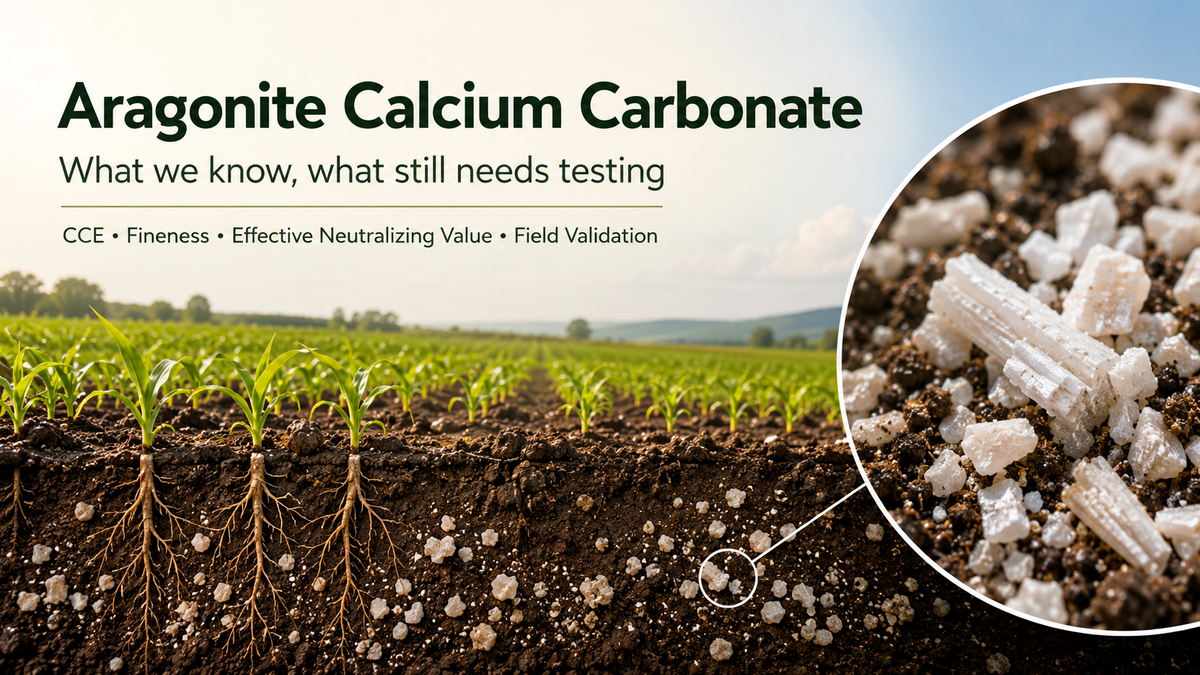
Aragonite calcium carbonate is worth studying, but I would separate the discussion into two parts: what we already know about calcium carbonate/lime materials, and what still needs to be proven specifically for aragonite under replicated field conditions/trials/studies.
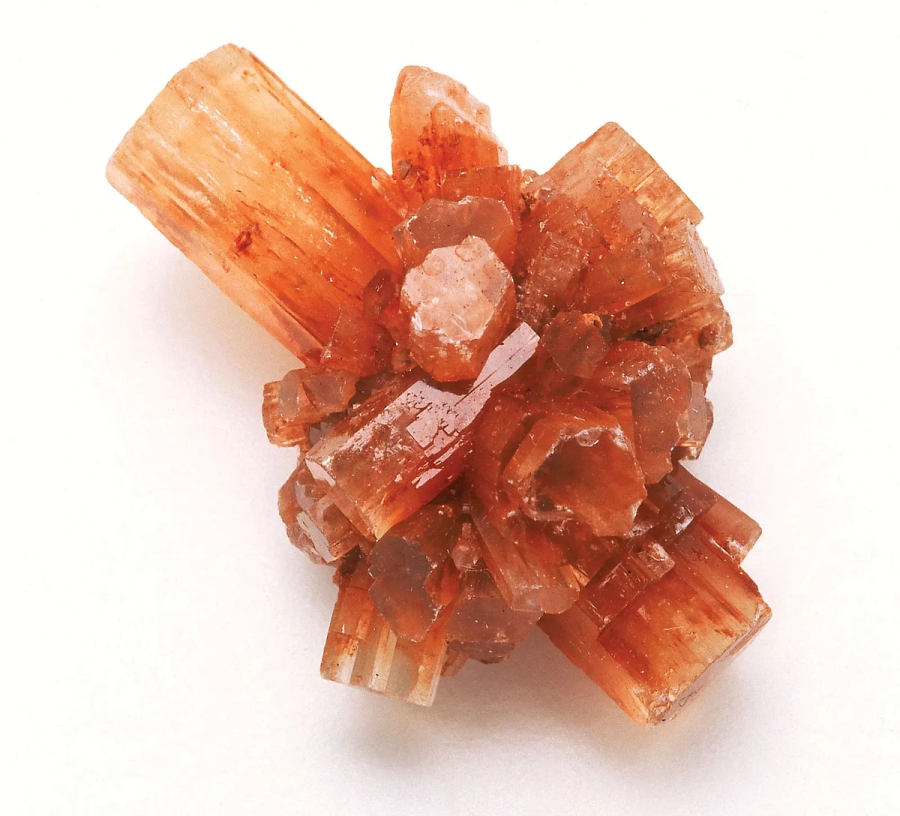
Aragonite is a crystalline form of calcium carbonate, chemically similar to calcite/limestone, but generally more soluble than calcite. That could make it react somewhat faster in acidic soils, depending on particle size, purity, soil pH, moisture, and buffering capacity. In agriculture, the most established benefit of calcium carbonate materials is correction of soil acidity.
The claims around improved microbial activity, drought tolerance, nutrient efficiency, and yield stability are biologically plausible in some contexts, but they need careful testing. If the soil is acidic, raising pH can improve nutrient availability, root growth, nodulation in legumes, and microbial processes. However, in neutral to alkaline or calcareous soils, adding more calcium carbonate may provide little benefit and can even aggravate micronutrient limitations such as iron deficiency in sensitive crops like soybean.
There is also emerging work on alternative or fast-reacting calcium carbonate materials. For example, recent research on fast-dissolving calcium carbonate particles showed rapid pH adjustment in a high-buffering Andisol using substantially less material than conventional lime, but that work was not specifically a broad field validation of aragonite across cropping systems. The University of Minnesota is also actively conducting lime-source trials comparing traditional ag lime, pelletized lime, and precipitated calcium carbonate, which shows that independent evaluation of calcium carbonate sources is a current research need. (Source: University of Minnesota Extension)
On strontium, I would be cautious. Strontium is chemically similar to calcium and occurs naturally in minerals, including some carbonate materials. It may interact with calcium-related plant processes meaning it may affect calcium uptake by plant (antagonistic effect), so I would not currently frame Sr as a proven agronomic benefit without crop-specific dose-response data. At low levels it may be benign, but at elevated levels it should be monitored through product analysis, soil testing, and plant tissue testing.
The best next step would be an independent replicated trial, not a demonstration alone. A good study could compare aragonite against standard calcitic lime, pelletized lime, gypsum where calcium without pH change is relevant, and an untreated control. The trial should be placed on soils where a response is expected, especially acidic soils with low to moderate pH and documented lime requirement. Key measurements should include soil pH, buffer pH, exchangeable Ca/Mg/K, CEC, micronutrients, microbial respiration or PLFA, infiltration or water-holding indicators, crop tissue nutrients, yield, and input-use efficiency. If drought-resistance claims are being evaluated, soil moisture dynamics and yield stability across stress periods should be measured directly.
So my answer would be: yes, there is a strong science behind calcium carbonate as a liming material, and there is a reasonable hypothesis that aragonite’s mineral form and particle characteristics may affect reaction rate. But the broader claims of reduced irrigation demand, enhanced microbial activity, 20–30% fertilizer reduction, and improved yield consistency still need independent, side-by-side field validation before they should be treated as general recommendations.
SHE would be very interested in seeing replicated data or helping connect this question with researchers who can test the material under transparent agronomic protocols. If AragoCor is offering to provide material for field trials, SHE could connect AragoCor with few agronomist from our expert list, who might be interested in testing some of the product for independent results.
Few specific results:
Strontium should be discussed carefully:
Some controlled studies suggest low-dose strontium can influence stress responses under specific conditions, such as cadmium stress in rice seedlings, where foliar Sr at 0.5 mg L⁻¹ reduced Cd toxicity effects (Liu et al, 2023). But other work shows that strontium can also become toxic depending on calcium status and dose (Qiu et al, 2021), so Sr should be treated as a trace element to monitor, not as a guaranteed agronomic benefit.
Calcium carbonate performance depends strongly on CCE and particle size:
Virginia Tech Extension explains that liming materials are evaluated by calcium carbonate equivalent, chemical composition, particle size, moisture, and handling properties. This is important because aragonite should not only be evaluated as “calcium,” but as a carbonate liming source with a measurable neutralizing value and reaction rate. (source: Virginia Tech)
To Elaborate:
Why Calcium Carbonate Equivalent matters
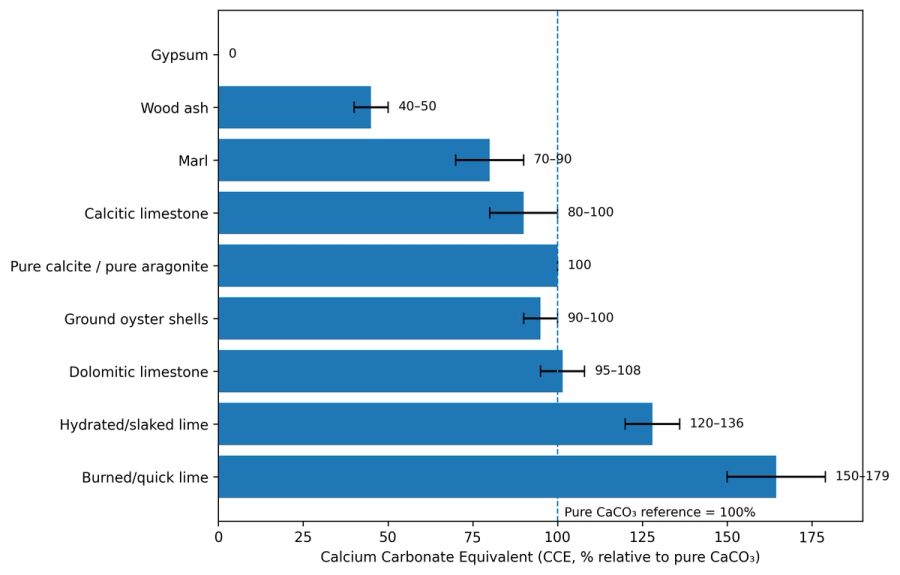
One useful way to evaluate aragonite calcium carbonate is through Calcium Carbonate Equivalent, or CCE. CCE measures how much acid a liming material can neutralize compared with pure calcium carbonate. By definition, pure calcium carbonate has a CCE of 100%. If a material has a CCE below 100, more material is needed to neutralize the same amount of acidity. If it has a CCE above 100, less material is needed. Virginia Tech Extension describes CCE as the acid-neutralizing value of a liming material relative to pure CaCO₃, with particle size, chemical composition, moisture, and magnesium content all contributing to lime quality.
The basic logic is simple:
Required product rate = recommended pure CaCO₃ rate × 100 / product CCE
So, if a soil test recommends 1 ton acre⁻¹ of pure CaCO₃ equivalent:
A product with 100% CCE requires 1.00 ton acre⁻¹.
A product with 80% CCE requires 1.25 tons acre⁻¹.
A product with 150% CCE requires only 0.67 ton acre⁻¹.
Where aragonite fits
This is where aragonite becomes interesting. Chemically, pure aragonite is still CaCO₃, just like pure calcite. Because of that, Extension guidance from Florida states that pure calcite and pure aragonite are both assigned a CCE of 100% (source: University of Florida) . That means aragonite should not be expected to have a higher neutralizing value simply because it is aragonite. Its advantage, if present, would more likely come from particle size, purity, solubility, dissolution rate, handling characteristics, and field reaction speed.
That distinction matters. CCE tells us neutralizing capacity, but it does not fully tell us how fast the material reacts in soil. Fineness matters because smaller particles have more surface area and react faster. Cornell/CCE guidance explains that CCE should be adjusted by fineness to estimate Effective Neutralizing Value, or ENV, which is the portion expected to react in the first year. Michigan State Extension makes the same point: fineness often affects reaction rate more than chemical composition because finer material has more surface area (source: Cornell University & Michigan State University).
So, if we connect all the dots:
CCE tells total acid-neutralizing capacity. Fineness tells how much of that capacity is expected to react fast enough in soil.
Effective CCE = CCE × Fineness factor / 100
CCE = 100%
Fineness factor = 90%
Then:
Effective CCE = 100 × 90 / 100 = 90%
What is Fineness?
Fineness refers to the particle size of a liming material. It matters because lime reacts at the particle surface. Smaller particles have more surface area, so they dissolve and neutralize soil acidity faster. Coarse particles may still have neutralizing value on paper, but they can react slowly and may contribute little to short-term pH correction.
Fineness factor = [(% passing 20 mesh − % passing 60 mesh) × 0.40] + [(% passing 60 mesh − % passing 100 mesh) × 0.80] + [(% passing 100 mesh) × 1.00]
Then:
ENV or Effective CCE = Fineness factor × CCE / 100
Example for an aragonite material:
Suppose the lab analysis shows:
CCE = 100%
95% passing 20 mesh
75% passing 60 mesh
55% passing 100 mesh
Then:
20–60 mesh fraction = 95 − 75 = 20%
60–100 mesh fraction = 75 − 55 = 20%
<100 mesh fraction = 55%
Now apply the reaction credits:
20–60 mesh contribution = 20 × 0.40 = 8
60–100 mesh contribution = 20 × 0.80 = 16
<100 mesh contribution = 55 × 1.00 = 55
Fineness factor = 8 + 16 + 55 = 79%
Now combine with CCE:
Effective CCE = 79 × 100 / 100 = 79%
If a soil test recommends 2 tons acre⁻¹ CaCO₃ equivalent, then:
Required product rate = 2 × 100 / 79 = 2.53 tons acre⁻¹
Aragonite should not be evaluated only by its calcium content. It should be evaluated by CCE, fineness, and effective neutralizing value. Pure aragonite and pure calcite are both CaCO₃, so their theoretical CCE is about 100%. The key question is whether the aragonite product has a higher effective value because of purity, particle size, solubility, or handling characteristics. A fine aragonite material with high CCE could require less product per acre than a lower-quality coarse aglime, but that comparison must be made on an effective CCE or ENV basis.
Topics
Cite this
Reference this work
Soil Health Exchange Editorial (2026). Aragonite Calcium Carbonate: Promising Soil Amendment or Still an Open Research Question?. Soil Health Exchange. SHE-FA-2026-0011. https://soilhealthexchange.com/cite/SHE-FA-2026-0011
Soil Health Exchange assigns a stable identifier to every published answer and article. Citations keep working even if the URL changes later.
Keep exploring

Discussion
No comments yet. Be the first to share your thoughts!