- Location
- IL
- Crop
- Corn
- Acres
- 4,000
The challenge
“[Timeline: Needs help this week] What have people done for interseeding into corn?”
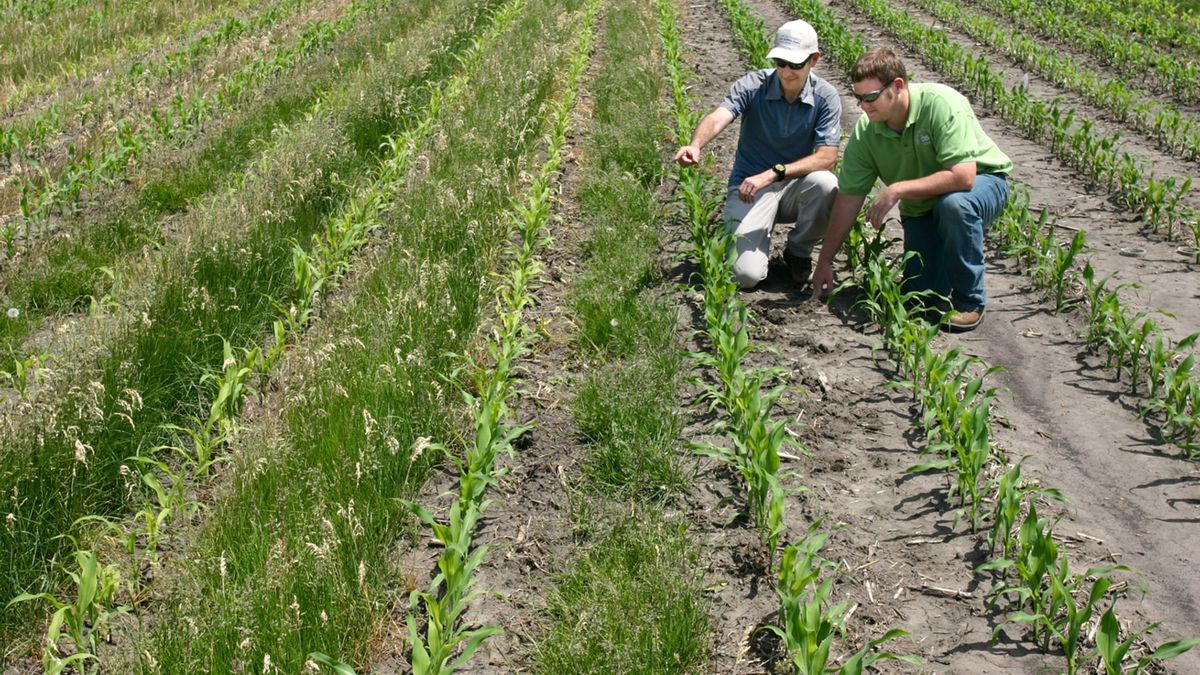
Short version: interseeding is the right tool for your geography, but for a 'this week' decision the honest framing is a go/no-go gate, not a green light. Two things are already partly locked for 2026 — your corn's growth stage and the residual herbicides in the soil — and the in-season logistics (seed + a specialized drill) are hard to assemble in days. Below is how to tell whether 2026 is still in play, what to attempt if it is, and how to set up a clean 2027 pilot if it isn't.
The two gates that decide 2026 vs. 2027
Gate 1 is growth stage. Count leaf collars: V4-V6 is roughly 8-18 inches tall. Don't use 'knee-high' as the trigger — knee-to-waist corn is often V7+ and past the cover-survival window. Gate 2 is the residual herbicide program you already applied this spring. At V4-V6 in mid-June, your pre-emergence residuals went down weeks ago and the post pass is happening now or is finished, so you cannot redesign the 2026 program. If long-residual corn products (atrazine, HPPD/mesotrione, acetochlor, isoxaflutole) are already in the soil, a 2026 cover is likely a write-off — pull every label you used and check the cover-crop/rotational restrictions to confirm. If either gate fails, the right move is to plan a 2027 pilot, not force a stand this week.
Why interseeding fits a central/northern IL corn operation
Your problem is the calendar. The median first killing freeze (28F) in central IL is mid-to-late October, shifting to late October/early November in southern IL (Illinois State Climatologist). By the time corn comes off, there aren't enough growing days for a post-harvest cover to establish, and it's worse the further north you are. Interseeding sidesteps that by planting the cover into living corn in June. One caveat: there is a north-south gradient in IL frost/harvest timing — if any of your ground is in southern IL, the post-harvest window there may be long enough that conventional drilling after harvest is the simpler, cheaper play. That north-south inference is mine, drawn from the state frost-date gradient, not from a single cited document — confirm with local Extension.
Timing — the variable you asked about
The consensus window is V4-V6 corn (GROW-IWM reports best weed suppression interseeding early at V3-V4; UW-Madison reports success across V3-V7; Penn State's commercial InterSeeder runs V5-V7). There's a genuine trade-off, not a single sweet spot: V4-V5 favors the COVER (more establishment and post-harvest ground cover), while delaying toward V6 is safer for the CORN but drops cover survival (SARE/UVM). The earliest timing (V1) cut corn yield in MSU interseeding work. So pick within V4-V6 based on whether you care more about the cover or about protecting the corn.
What actually survives under a corn canopy
Set expectations honestly: the cover frequently germinates fine, then sits or goes dormant under full canopy and re-flushes after the canopy opens or after harvest. Grass survival especially depends on light getting through (UW-Madison). That's why post-harvest ground cover — not what you see in July — is the metric that tells you whether it worked.
Species and rates (carried from comparable states)
- Medium red clover — the most widely used interseeded legume; 12 lb/ac drilled at 1/4 inch showed no grain-yield difference vs. a non-interseeded plot at V5 (UW-Madison). Your safest first species. Note it OVERWINTERS in IL and needs a planned spring burndown.
- Annual/Italian ryegrass — a reliable choice to establish in WI, but can be hard to kill in spring; plan termination (UW-Madison).
- Cereal/winter rye — less reliable interseeded (did not always survive to fall harvest in WI; UW-Madison). On-farm work outside WI has interseeded cereal rye successfully without corn yield loss, but as an overwintering grass it needs timely spring termination too — don't treat it casually ahead of soybeans.
- Daikon radish — establishes but makes very little below-ground root when interseeded into corn (UW-Madison); don't count on a taproot effect, and don't rely on it as a meaningful winterkill cover under canopy.
- Mixes and IL species — SDSU lists buckwheat, clovers, alfalfa, ryegrasses, radish and others as candidates but gives no specific lb/ac mix (SDSU notes buckwheat tended to reduce corn yield, so it is not a safe interseed pick); confirm any mix rate with Extension. The MCCC Illinois page gives general recipes (cereal rye after corn; oats+radish after soybean) rather than an interseeding species list — use the MCCC selector tool for IL-specific picks.
Method and the 4000-acre reality
Drilling produces better establishment and biomass and works better in dry soil; broadcasting is unreliable, especially when dry (GROW-IWM; UW-Madison; SDSU). But a purpose-built between-row interseeder (Penn State/InterSeeder Technologies plants three cover rows per 30-inch corn row, roughly 7.5-inch spacing) is too slow to cover meaningful acreage in the few-day V4-V6 window — even on a 100-200 ac pilot, let alone 4000. So the only method that fits this June window at scale is high-clearance or aerial broadcast, raising the rate ~15-25% over drilled to offset poor seed-to-soil contact (SDSU). But broadcast into a closing canopy depends heavily on timely rain within several days and frequently establishes poorly or fails on dry soil — treat it as a low-odds 2026 salvage attempt, not a dependable at-scale method. Reserve drilling for the small pilot where establishment quality matters most, and reserve a properly timed at-scale broadcast program for 2027. For 2027, the move is to contract seed and a drill/applicator ahead of season — InterSeeder launch coverage put rigs at roughly $22k for the base seed-planter unit and ~$30k fully equipped (InterSeeder/No-Till Farmer), but the current product page no longer lists pricing, so call for a quote before any buy-vs-custom-hire decision.
The herbicide trap — already mostly locked for 2026
This is where interseeding plans die, and the timing is unforgiving: many corn residuals (atrazine, mesotrione/HPPD, acetochlor) carry over and kill the cover, and by V4-V6 those products are already in the soil. You can't redesign the 2026 program now — you can only assess whether the cover has a realistic shot this year. Pull every label and read the cover-crop/rotational restrictions (UW-Madison). If the program can't support a living cover, accept 2026 as planning and redesign for 2027: shorter-lived residuals pre-emergence and no residual in the post pass (GROW-IWM).
Bottom line on corn yield
Interseeding itself doesn't cost you yield at V4-V7 in 30-inch rows — red clover at 12 lb/ac came in yield-neutral at V5 (UW-Madison). The big penalties in the literature come from widening to 60-inch rows to favor the cover, where reported losses span a wide, hybrid- and site-dependent range — from near-neutral in some site-years up to ~20-30% in unfavorable cases (determinate vs. flex-ear hybrids). Keep your 30-inch rows.
What I couldn't pin down for IL specifically
I couldn't find a U of I Extension document with IL-specific interseeding rates, so the rates above are from WI, SD, PA and NRCS — climatically close but not identical. Confirm species and timing with your local U of I Extension agronomist and the Midwest Cover Crops Council selector tool (which U of I points growers to). Legume N credit is real but wasn't quantified in these sources — treat it as a bonus, not a budgeted input, until you have local trial numbers.
Topics
Cite this
Reference this work
Soil Health Exchange Team (2026). Interseeding into corn. Soil Health Exchange. SHE-FA-2026-0023. https://soilhealthexchange.com/cite/SHE-FA-2026-0023
Soil Health Exchange assigns a stable identifier to every published answer and article. Citations keep working even if the URL changes later.
Keep exploring
Similar questions
From the blog

Discussion
No comments yet. Be the first to share your thoughts!