Living Mulch in Row Crops: Where It Fits, Why Corn Struggles, and How to Test It
Living mulch can protect soil and keep roots active, but the same companion crop can compete with corn or soybeans. This research-backed guide explains species fit, row-zone suppression, water and nitrogen tradeoffs, weed management, trial design, and break-even decisions.
Editor's Note
A research synthesis, not a universal prescription. Living-mulch performance depends on species, climate, soil water, cash crop, row suppression, fertility, and operational timing.
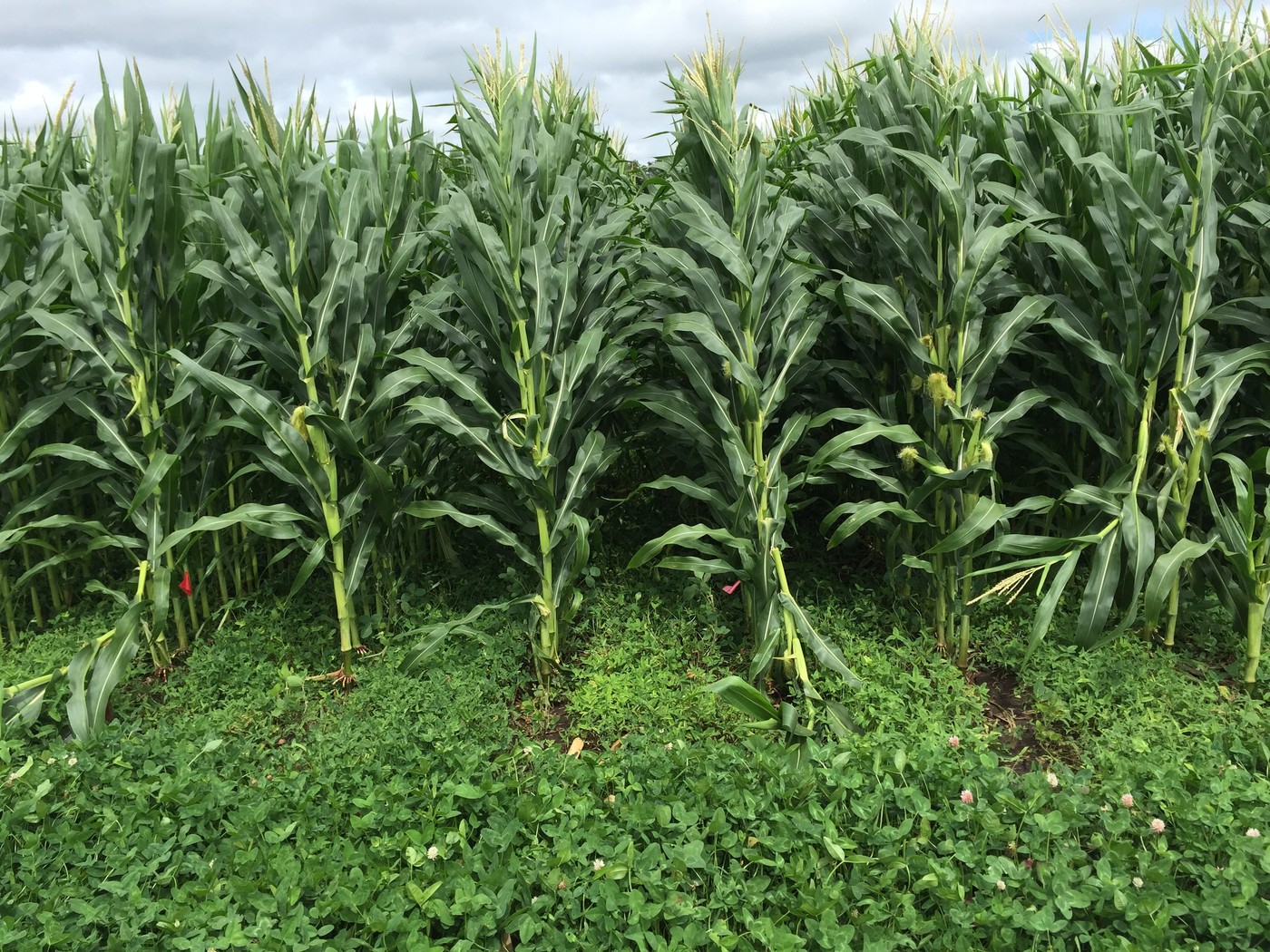
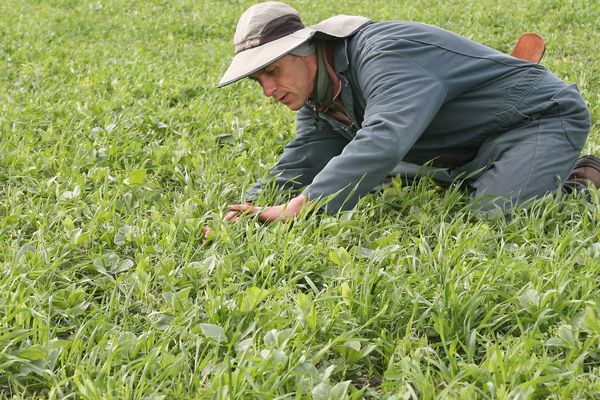
Corn growing in perennial kura clover at USDA-ARS, Minnesota. Kura is the most studied clover in this system; its results should not be transferred automatically to red or white clover. — Credit: USDA Agricultural Research Service (U.S. government work)
Living mulch is one of the most ambitious versions of continuous cover: a low-growing plant stays alive between cash-crop rows during the season and continues after harvest. That continuity can protect soil and keep roots active. It also means the companion crop is present when corn needs light, water, nutrients, and an unobstructed seed zone. [20]
The practical lesson across the research is simple: the protected cash-crop row is the system. A vigorous interrow can be an asset. The same vigor inside or immediately beside the row can become a yield-limiting competitor.
Bottom line for a first field
Do not begin with a whole-field conversion. Begin with replicated strips, a measured row-only suppression treatment, a terminated-cover or established farm benchmark, and a rescue rule written before planting. Judge the result on stand, weeds, moisture, yield, operations, living-mulch recovery, and net return for at least two seasons.
What living mulch is—and what it is not
Four systems that should not be treated as interchangeable
System
What is alive with the cash crop?
Main management question
Established living mulch
A perennial or persistent companion cover
Can the crop row be protected without losing the interrow?
Planting green
Usually an annual cover awaiting termination
When should termination occur relative to planting?
Interseeded cover crop
A cover established after the cash crop
Can it establish without competing or winter-killing?
Dead or rolled mulch
No living cover after successful termination
Will residue manage weeds and permit planting?
A yield result from one system is not automatically evidence for another. Species, termination timing, water use, and duration of coexistence differ.
This distinction matters most when people cite planting-green soybean trials to reassure a farmer about a perennial clover understory. Penn State found no soybean-yield difference across 14 site-years of planting into living annual cereal covers, but those covers were terminated; the trial did not test soybean growing all season in established clover. [16]
The evidence map: species and site are part of the treatment
Kura clover is the most developed perennial model in the Upper Midwest because its rhizomes allow it to recover after a strip is disturbed. USDA-ARS describes it as persistent and cold tolerant, but also flags slow establishment and limited seed supply. [19]
Red clover, white clover, kura clover, crownvetch, birdsfoot trefoil, and annual legumes do not share the same growth habit or recovery pattern. A tillage width that works in rhizomatous kura clover is a treatment to test in red or white clover—not a transferable recipe.
What the main clover evidence can—and cannot—tell a farmer
Living mulch
Strongest evidence here
Useful lesson
Do not assume
Kura clover
Long-running Minnesota/Wisconsin corn work
A protected row can improve emergence and sometimes yield while kura survives between rows
Kura response applies to every clover or climate
Red clover
Two Wisconsin corn seasons with organic-approved mechanical tools
Undercutting or flaming can protect the row, but response varied sharply by year
A large one-year gain is a stable expected return
White clover
Georgia corn water-use and soil-health studies
Continuous cover can improve measured soil properties yet worsen crop water competition
Irrigation fully removes competition
Other perennial legumes
Pennsylvania long-term corn comparisons
Legume and cash-crop competition changes with moisture and N rate
Every legume supplies a dependable corn N credit
Evidence summarized from studies [1]–[11]. Crop, climate, soil, species, suppression, and year all travel with the result.
Corn: protect the row before managing the interrow
In a two-year Wisconsin red-clover experiment using organically approved practices, corn averaged 4.61 Mg/ha—about 73 bu/ac—across all living-mulch treatments. Undercutting the row at roughly 5 cm increased yield by 3.15 Mg/ha, about 50 bu/ac, in 2021 but not in 2022 when suppression was inadequate. Post-plant flaming helped most where the row was not undercut. Interrow crimping and high-residue cultivation changed clover growth without increasing corn yield. [1]
That trial is unusually useful for organic growers, but it had no randomized corn monocrop control. Nearby organic corn yields reported in the paper are context, not a measured treatment comparison. The honest conclusion is that row suppression changed performance—not that the study established a universal living-mulch penalty or profit.
A USDA-ARS study compared a 30 cm, roughly 12-inch, rotary-tilled row zone with a narrower shank strip in established kura clover. The wider zone improved emergence and early development in both years. Grain yield did not differ in year one; it increased by 4.0 Mg/ha, about 64 bu/ac, in year two without reducing kura biomass. [2]
12 in
Kura row zone tested—not a universal optimum
1 of 2
Years with a red-clover undercutting yield response
1 of 2
Years with a kura row-zone yield response
Do not lead with the 50- or 64-bu/ac numbers
Both gains occurred in only one of two seasons, in different clover systems, with different comparisons. They identify a mechanism worth testing—row protection—not an expected yield response for another farm.
Earlier kura work reached the same broader conclusion: corn can coexist with living kura clover when suppression is sufficient, yet partially suppressed treatments still lost yield in some environments. The clover recovered after the cash crop, showing why the system can be durable once the row is managed. [6]
Water is the first veto
A living mulch can improve infiltration and still leave less water for the crop. In Minnesota, kura-clover living mulch reduced spring profile water storage by 37 to 50 mm—about 1.5 to 2 inches—and increased May evapotranspiration. The same experiment reduced nitrate leaching, illustrating the tradeoff: active roots captured resources, but corn began the season with less stored water. [4]
Drought changes which row treatment wins. In a later kura study, a site under severe drought had near crop failure, while a moderately dry site produced much better corn; the relative performance of band suppression and rotary zone tillage switched with conditions. [5]
White-clover corn work in Georgia also found lower water-use efficiency than annual-cover systems, including under irrigation, with the largest disadvantage in drought. [9]
Dryland red flag
Pause or shrink the trial when the profile is short of water at planting, the forecast is hot and dry, the soil has low available-water capacity, or the row cannot be suppressed promptly. In those conditions, more living cover is not automatically more resilience.
Nitrogen: a living legume is not an automatic credit
Nitrogen fixed by clover is held in living tissue, roots, and soil pools. Corn receives a usable credit only as tissue dies or turns over and mineralization overlaps crop demand. The amount depends on biomass, tissue N and C:N ratio, the fraction actually killed, soil temperature and moisture, and where decomposition occurs. [17]
In kura clover, first-year corn after two or three forage years showed little response to added N, but second-year corn required an N rate close to the regional recommendation for corn following soybean. The first-year benefit did not justify a permanent zero-N assumption. [3]
Zone-tillage work also found that active carbon and particulate organic matter differed between the disturbed row and living interrow. That spatial pattern supports a measurement-based approach: nutrient cycling can be concentrated where clover is suppressed, but the field does not deliver one uniform N credit. [12]
A safe nitrogen rule
Build the base corn program from current soil, manure or compost analyses and an achievable yield goal. If testing a clover credit, change only N rate or timing in replicated strips and pair yield with tissue or soil measurements. Do not subtract all clover biomass N from the corn requirement.
Yield, fertilizer N, and partial return: the clearest dataset
One Minnesota kura-clover experiment is unusually useful because it tested eight fertilizer-N rates and published grain yield, stover yield, economic-optimum N rate, differential management costs, and partial net return. First-year corn followed two or three years of forage management; second-year corn followed corn in the living-mulch system. The conventional comparison came from nearby hybrid trials rather than a randomized conventional treatment inside the experiment. [3]
Figure
Partial net return compared with nearby conventional corn
2017 · first-year KCLM
-26 $/ac
2017 · second-year KCLM
-8 $/ac
2018 · first-year KCLM
144 $/ac
2018 · second-year KCLM
113 $/ac
Study dollars converted from Table 6 of Alexander et al. (2019). Bar length represents the absolute difference; the displayed plus or minus sign and color show direction. These are partial-budget results, not a forecast. The four-treatment average was +$56/ac, but individual results ranged from −$26 to +$144/ac.
Click to expand
Figure
Fertilizer N rate that maximized economic return
2017 · first-year KCLM
0 lb N/ac
2017 · second-year KCLM
158 lb N/ac
2018 · first-year KCLM
0 lb N/ac
2018 · second-year KCLM
130 lb N/ac
Economic-optimum N rates converted from Table 4 of Alexander et al. (2019). The zero-N result applied to first-year corn after a multiyear kura-clover forage phase. Second-year corn required N near the regional recommendation for corn following soybean.
Click to expand
Yield, N rate, and return must be read together
Season and rotation position
Corn yield at EONR
EONR
Partial return vs. conventional
2017 · first-year KCLM
196 bu/ac
0 lb N/ac
−$26/ac
2017 · second-year KCLM
215 bu/ac
158 lb N/ac
−$8/ac
2018 · first-year KCLM
210 bu/ac
0 lb N/ac
+$144/ac
2018 · second-year KCLM
213 bu/ac
130 lb N/ac
+$113/ac
Converted from Tables 4 and 6 of Alexander et al. (2019). EONR means economic-optimum nitrogen rate. Nearby conventional hybrid trials—not randomized plots within the living-mulch experiment—provided the conventional comparison.
At the study's fertilizer price, first-year kura-clover corn reduced fertilizer-N cost by about $53/ac. That saving did not persist into second-year corn. Averaged across both rotation positions and both seasons, partial net return was about $56/ac greater than the nearby conventional comparison, but the year-specific results moved from losses in 2017 to gains in 2018. [3]
The favorable return depended on harvested stover
Kura-clover corn had lower grain value and higher differential management cost than the conventional comparison. Harvested stover supplied about $251–$341/ac of gross value at the study's assumed price and made the partial budget competitive. The established clover stand, specialized row-zone operations, stover handling, nutrient replacement, and transition risk mean this result should not be presented as a universal ROI.
When clover nitrogen arrived matters as much as how much
A later USDA-ARS study estimated that spring management of kura clover supplied 7–23 kg N/ha—about 6–21 lb N/ac—during the first six weeks of the corn season. Clover suppression under the developing corn canopy supplied another 59–84 kg N/ha, about 53–75 lb N/ac, from mid-June through mid-October. [21]
6–21 lb N/ac
Modeled during the first six weeks
53–75 lb N/ac
Modeled from mid-June to mid-October
Modeled N input is not a fertilizer credit
These estimates describe N released from clover biomass. They do not prove that corn captured every pound or that fertilizer can be reduced by the same amount. Later N can arrive after peak crop demand or cycle back into the living clover. Use an N-rate strip, crop or soil measurements, and the local corn-N recommendation before assigning a credit.
Weed suppression is a competition trade, not a free service
Across 34 studies of legume companion systems, weed biomass declined substantially on average, but the dataset combined living mulch, relay, and synchronized systems. Its overall crop-yield result therefore describes a broad family of companion legumes—not perennial clover alone. [13]
Reviews reach a consistent management principle: living mulches suppress weeds mainly through competition, and the same competition can reduce cash-crop growth. Species selection, delayed establishment, strip suppression, mowing, cultivation, and chemical suppression where permitted are ways to direct that pressure toward weeds instead of the crop. [15]
Weed communities can also shift rather than disappear. Record clover and weeds separately, identify dominant weeds, and compare the in-row zone with the interrow. Total green cover is not a weed-control measurement. [14]
Soil and water benefits: real, but not guaranteed on every metric
The strongest environmental case comes from continuous roots and surface protection. In one kura experiment, nitrate leaching fell 70% with no applied N and 35% with 90 kg N/ha compared with the conventional control. [4]
At two long-term kura sites, infiltration was 10 to 20 times higher than in nearby conventional corn–soybean fields. At a single 9% slope site, sediment loss fell 93%. Yet the same comparison detected no significant differences in soil organic carbon, cation-exchange capacity, or water-holding capacity. [11]
White-clover work in Georgia measured lower bulk density and greater porosity, infiltration, labile carbon, and nutrient indicators than annual-cover systems, while also reporting a crop-yield cost. [10]
A 10-year Pennsylvania experiment with several perennial legumes found little change in bulk density, soil organic carbon, or infiltration at one site and found that maximum corn yield still required full fertilizer N. Long duration alone did not guarantee improvement in every soil metric. [7]
Choose the benefit before choosing the metric
If the goal is erosion control, measure cover, runoff or sediment risk. If it is nutrient retention, measure N flows. If it is trafficability or water entry, use repeatable infiltration and field observations. A generic soil-health panel can miss the function the living mulch was installed to provide.
Soybean deserves its own evidence
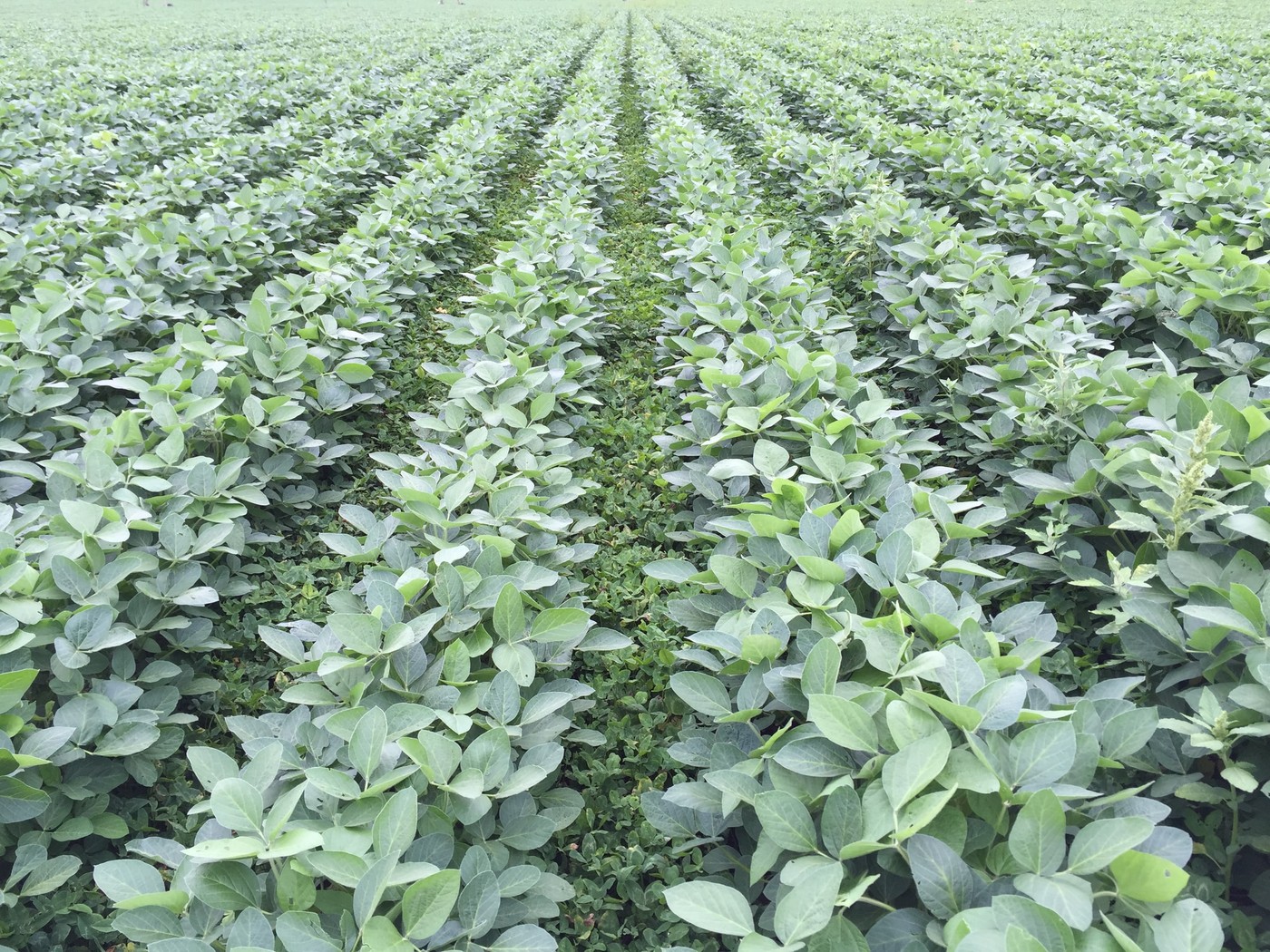
Soybean often tolerates planting green into annual cereal covers better than corn, but that pattern should not be transferred to an established perennial living mulch. In a randomized Iowa kura-clover experiment, soybean grown with the living understory yielded 36% less than soybean after the kura was killed and tilled. More suppression did not reliably remove the penalty. [8]
Click to expand
Soybeans in kura clover at USDA-ARS, Minnesota. This is an established perennial living mulch—not an annual cover awaiting termination. A separate Iowa trial reported a 36% soybean yield penalty in living kura clover [8]. — Photo: USDA Agricultural Research Service (U.S. government work)
The practical implication is not that soybean cannot work. It is that a soybean phase needs its own benchmark, suppression plan, and harvest data. Neutral planting-green results do not remove the need for a living-mulch control.
Where a living-mulch trial is most likely to fit
A field-level fit screen
Signal
Green: stronger candidate
Yellow: test narrowly
Red: pause or redesign
Water
Reliable rainfall, irrigation, or high available-water capacity
Variable summer moisture
Dry profile, drought forecast, shallow or droughty soil
Row equipment
Measured strip/zone tool with consistent depth and seed-slot closure
Tool needs calibration
No dependable way to suppress the row
Living-mulch stand
Uniform, mapped, and species confirmed
Patchy or recently established
Unknown species, heavy sod, or uncontrolled in-row regrowth
Weeds
Pressure that cover plus row tools can plausibly manage
Mixed community with uncertain shifts
Perennials or escapes beyond rescue capacity
Operations
Timely labor and rescue equipment available
Tight windows
Mowing/cultivation conflicts with planting or weed timing
Measurement
Replicated strips and separate harvest possible
One-year demonstration only
No benchmark or treatment boundaries
This screen converts the study-level tradeoffs into a conservative starting decision; it is not a validated scoring model.
A decision-grade strip trial
Confirm the starting condition. Record living-mulch species, stand age, uniformity, ground cover, dominant weeds, soil texture, drainage, slope, and plant-available water before planting.
Compare three treatments. Use the current row treatment; a stronger, measured row-only suppression treatment; and a terminated-cover or established farm benchmark. Include at least three replications.
Keep the rest constant. Use the same hybrid or variety, population, planting date, fertility program, and harvest method unless one of those factors is the planned treatment.
Map boundaries and exclude noise. Use strips long enough for representative harvest, mark each treatment, and keep headlands, wet pockets, and obvious soil changes out of the comparison or block for them.
Set a rescue trigger before planting. Examples include failed slot closure, living-mulch regrowth within the row, corn height or vigor falling behind the benchmark, measured water stress, or weeds approaching an irreversible stage.
Measure at decision times. Count stand at emergence and V3–V4; estimate living-mulch and weed cover separately in-row and interrow; record soil moisture or crop stress; document every pass and input.
Harvest each strip separately. Correct grain to common moisture and record lodging, harvestability, living-mulch recovery, and operational delays—not only yield-monitor color.
Break-even calculation
Net change/ac = yield difference × crop price + harvested stover or forage value + verified fertilizer-N savings + passes avoided − establishment, row-zone operation, mowing, flaming or cultivation, labor, harvest and handling, nutrient replacement, rescue work, and equipment ownership. Yield needed to cover added net cost = added net cost/ac ÷ crop price. Keep establishment and transition costs visible even when the research plot began with a mature stand.
Organic systems: plan the sequence and document the threshold
USDA organic rules require crop producers to begin with preventive practices, then use mechanical or physical methods, and use allowed substances only when those steps are insufficient. The organic system plan must document the management sequence and conditions for using a material. [18]
For a living-mulch trial, confirm seed treatments, fertility products, flaming, cultivation aids, and any pest-control input with the certifier before use. Keep the product label, approval, agronomic reason, threshold, rate, field, and date with the strip map.
Write the decision rules before harvest
Expand only when stand and harvestable yield are acceptable, weeds remain manageable, the living mulch recovers, operations fit the farm, and net return is competitive in at least two contrasting seasons.
Redesign when the trial identifies a correctable row problem: uneven seed placement, insufficient suppression, wrong timing, early N shortage, or an avoidable equipment conflict.
Stop scaling when the living mulch repeatedly wins the row, moisture competition appears before canopy closure, the yield penalty exceeds captured benefits, or rescue work erases the reduced-tillage advantage.
What the research still does not answer
There is no single row-zone width validated across clover species, soils, slopes, planters, and climates.
Organic living-mulch economics remain thin because many experiments lack a randomized farm-standard control or complete machinery and labor costs.
Short trials cannot show whether early establishment costs are repaid by forage value, erosion control, nutrient retention, or later soil function.
We need more replicated soybean work in established perennial mulches; planting-green evidence is not a substitute.
Few studies define real-time rescue thresholds using crop water status, living-mulch regrowth, or early crop vigor.
Bottom line
Living mulch is not a plug-and-play cover-crop practice. It is a managed competition system. The evidence supports a clear design principle—protect the cash-crop row and retain living cover where the crop is not being limited—but it does not support a universal species, strip width, nitrogen credit, or expected yield response.
The farmer-ready path is a small, replicated test with a real benchmark, a moisture and rescue plan, separate harvest, and full operational accounting. That design lets the field answer the question the literature cannot: whether continuous living cover earns its place on this soil, with this clover, this equipment, and this season.
Source material for every claim in this article, plus a citation-ready record for reference managers and scholarly indexes.
Cite this
Reference this work
SHE-ART-2026-0048
Soil Health Exchange (2026). Living Mulch in Row Crops: Where It Fits, Why Corn Struggles, and How to Test It. Soil Health Exchange. SHE-ART-2026-0048. https://soilhealthexchange.com/cite/SHE-ART-2026-0048
Exchange, S. H. (2026). Living Mulch in Row Crops: Where It Fits, Why Corn Struggles, and How to Test It. Soil Health Exchange. https://soilhealthexchange.com/blog/living-mulch-in-row-crops
More citation formats
MLA
Exchange, Soil Health. "Living Mulch in Row Crops: Where It Fits, Why Corn Struggles, and How to Test It." Soil Health Exchange, 2026-08-24, https://soilhealthexchange.com/blog/living-mulch-in-row-crops.
Chicago
Exchange, Soil Health. "Living Mulch in Row Crops: Where It Fits, Why Corn Struggles, and How to Test It." Soil Health Exchange. Published 2026-08-24. https://soilhealthexchange.com/blog/living-mulch-in-row-crops.
Discussion
No comments yet. Be the first to share your thoughts!