- Location
- WI
- Crop
- Corn
- Acres
- 1,000
The challenge
“Multi-species mixes are planted to enhance diversity. What is diversity and how are we measuring the impact diversity has?”
- Confidence
- moderate
- Cost
- varies
- Effort
- high
- Timeline
- Because the mix must be interseeded in June and the corn-yield answer comes the following fall, plan on roughly two seasons end-to-end: interseed/establish and capture biomass and ground-cover data in year one, then the following-corn yield in year two. Soil organic matter and microbial shifts take multiple years.
Quick take
"Diversity" in a cover crop mix means two things: how many species (and how evenly mixed) and — more importantly — how many functional groups (grasses, legumes, brassicas), each doing a different job. The best regional evidence says adding a new function moves the needle far more than adding more species of the same type, and that total biomass delivers most of the benefits. The catch for your WI grain-corn ground: UW Extension does NOT recommend legumes or brassicas drilled after grain-corn harvest — there aren't enough fall growing-degree days for them to establish. So the only realistic way to get a diverse mix on your acres is to INTERSEED it into standing corn around V5-V6 (mid-June). Prove an interseeded mix against a rye-alone control on strip trials before committing 1000 acres.
Good question — and an important one, because "diversity" gets used loosely in cover crop marketing. There are really two different things hiding under that one word, and telling them apart will save you money. There's also a hard WI reality about whether you can establish a diverse mix at all after grain corn, which I'll get to.
What "diversity" actually means
Species diversity is just how many species are in the mix and how evenly they're represented. Researchers boil this down to one number, the Shannon index, which blends richness (how many species) and evenness (how balanced they are). A 12-species blend has high species diversity.
Functional diversity is how many distinct *jobs* the mix covers — the functional groups. The three standard groups each do something different (SARE 2021):
- Grasses (e.g., cereal rye): dense fibrous roots that scavenge leftover nitrogen and build soil organic matter the fastest.
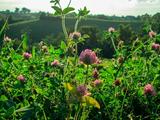
- Legumes (e.g., red/crimson clover, hairy vetch): fix atmospheric nitrogen and feed pollinators.
- Brassicas (e.g., radish, turnip): large taproots that create biopores and root channels and can improve infiltration (documented relief of measured compaction is variable) and pull up nutrients.
The whole point of mixing across groups is to capture several of those services at once and open up more niches for soil microbes.
The honest finding: function beats count
The most rigorous regional study on this (11 on-farm sites in SE Nebraska, mixes from 1 to 18 species drawn from six functional groups) found that bumping up species *count* alone gave only about a 2.3% biomass effect — not statistically significant — while adding functional *groups* gave roughly a 29% biomass increase. And critically, no mixture at any site produced more aboveground biomass than the most productive pure stand (Florence et al., PLOS ONE 2019). That 29% comes from a six-functional-group design, not the simplified three-group frame I'm using here to teach the concept — so read it as evidence that *function matters*, not as a number tied to a grass/legume/brassica trio. Penn State weed work agrees: cover crop richness reduced weed biomass, but richness explained only about 12% of the variation, and several mixes merely matched — didn't beat — the best single species (Baraibar et al. 2018, Weed Science, doi:10.1017/wsc.2017.59).
Translation: adding a 12th species of the same type buys you almost nothing. Adding a *different function* — a legume and a brassica alongside your rye — is what moves the needle, but a simple high-biomass mix can match a fancy diverse one. Biomass is doing most of the work; diversity is mostly a way to get reliable biomass and a broader set of services. One caveat to keep front-of-mind: those effect sizes come from SE Nebraska, where legumes and brassicas reliably establish in the fall. WI after grain corn is a different story.
How impact is measured
On the plant/agronomic side — the things a 1000-acre grower can actually capture (WSU CSANR 2019):
- Aboveground biomass (dry-matter lbs/ac, clipped from a known area like a 0.25 m2 quadrat) — the single most predictive metric; most benefits scale with biomass, not species count.
- Percent green ground cover — from photos via the free Canopeo app.
- Nutrient uptake — lab tissue analysis for N, P, K scavenged or fixed.
- Following corn yield — yield monitor or weigh wagon; the bottom line.
On the research/soil-biology side, you'll see Shannon and functional-group indices, plus slower lab metrics: microbial biomass and enzyme activity, arbuscular mycorrhizal fungi (AMF) colonization, and soil organic matter fractions. For example, a two-way rye-clover (legume-grass) cover crop increased the transfer of carbon from particulate (POM) into the more stable mineral-associated organic matter (MAOM) fraction more than rye or clover alone — but that came from a controlled greenhouse 13C tracer experiment, not a field-yield result (Soil Biology & Biochemistry 2025). These are valuable science but slow and lab-heavy — not where a producer starts.
What this means for your WI grain-corn ground
Here is the part that changes the practical answer. UW-Madison Extension explicitly does NOT recommend planting legumes or brassicas after corn grain in Wisconsin — there aren't enough growing-degree days left in fall for brassicas to provide benefit or for legumes to nodulate and fix N. After grain corn, cereal rye is the workhorse (the only reliable option in northern WI; rye or triticale in southern WI), planted by about late October. So a diverse mix *drilled after harvest* will largely fail — you'd pay for seed on two species that don't establish.
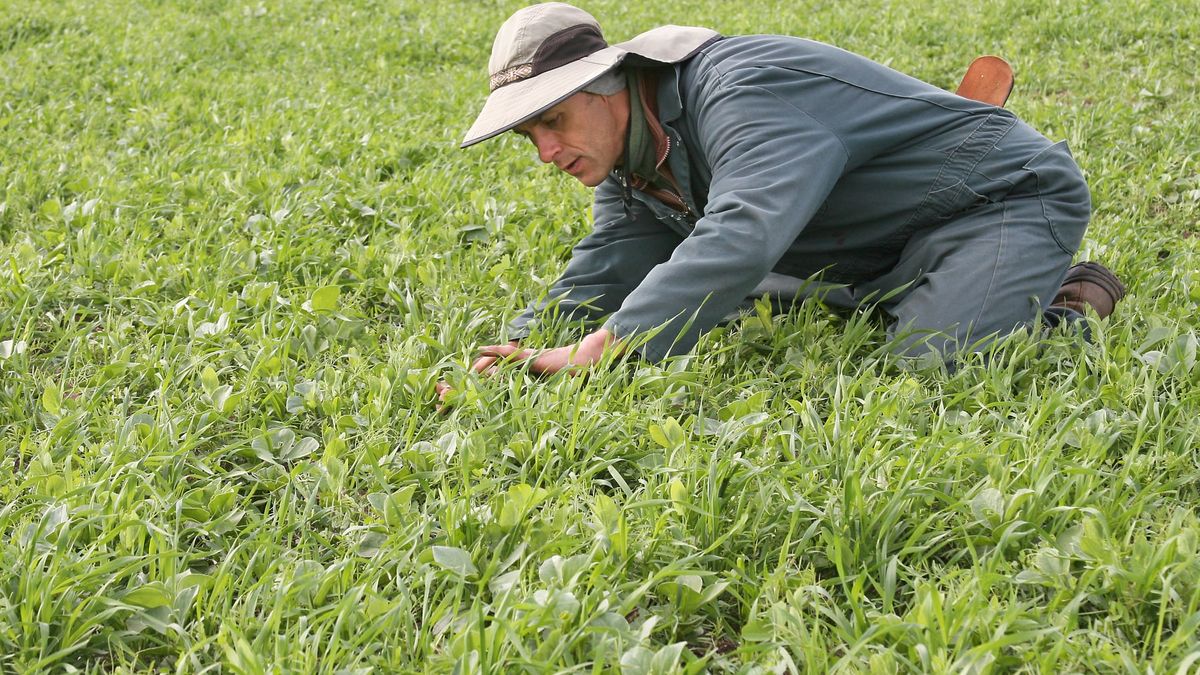
If you want functional diversity on grain-corn acres, the realistic route is interseeding into standing corn at about V5-V6 (mid-June). A single 2014 season at the Arlington Agricultural Research Station showed rye, red clover, and radish interseeded at V5 establishing without a measured corn yield penalty — but that's one site-year, and interseeded covers can compete with corn for water and light in dry years, so don't read it as an established "no yield penalty" result; your own replicated strip trial is the real test. Interseeding moves your binding constraint from the October harvest window to the June interseeding window — and it requires a modified grain drill or dedicated interseeder, which for 1000 ac is a buy/rent/custom-hire decision to make by spring, not at harvest. Before you commit, confirm your corn herbicide program is compatible (see below) — residual carryover is the usual reason interseeded stands fail.
One more caution worth respecting: WI annual-cropping research found cover crops didn't hurt soybean yield but some cover crops reduced corn yield (Agronomy Journal 2022) — which is exactly why a rye-alone control strip matters before you scale anything.
Bottom line
Don't chase species count. Cover the three functions only where you can actually establish them — which on grain-corn acres means interseeding, not drilling after harvest, and only with a herbicide program that won't kill the mix. Push for biomass, and let a replicated strip trial against rye-alone tell you whether the mix earns its keep on your fields before you scale equipment and seed to 1000 acres.
Decision support
Likely diagnosis
Not a problem to diagnose — this is a knowledge question. The producer needs to understand that "diversity" splits into species diversity (Shannon: count + evenness) and functional diversity (grass/legume/brassica groups), that impact is measured chiefly through biomass, ground cover, nutrient uptake, and ultimately corn yield (with function and biomass, not raw species count, driving benefits), and — critically for WI grain corn — that a diverse mix can only be established by interseeding into standing corn, not by drilling after harvest.
Recommended next steps
- 1
Separate the two kinds of diversity you actually care about
Species diversity = number/evenness of species (researchers use the Shannon index). Functional diversity = number of functional groups: grasses (rye — scavenge N, build organic matter), legumes (clover/vetch — fix N), brassicas (radish/turnip — large taproots that create biopores/root channels and can improve infiltration, though documented relief of measured compaction is variable; scavenge nutrients). Aim for functional groups, not a long species list — and only if you can actually establish them.
Timing: Now, while planning the 2026–2027 cover crop program
- 2
Decide your mix ESTABLISHMENT METHOD early — this is the real constraint
A legume/brassica mix will not establish if drilled after grain-corn harvest (insufficient fall growing-degree days, per UW Extension). The viable WI path is interseeding into standing corn at V5-V6 (~mid-June). That needs a modified grain drill or dedicated interseeder; broadcast or aerial seeding is a moisture-dependent contingency (it depends on timely rain to get seed-to-soil contact and germination), not a reliable primary method. For 1000 ac this is a capital/contractor decision — source, rent, or hire a custom interseeder by ~April, before the June window.
Timing: By April 2027, ahead of the mid-June interseeding window
- 3
Check herbicide compatibility BEFORE committing to an interseeded mix — this is a gating step
Residual corn-herbicide carryover is the most common reason interseeded legume/brassica stands fail. Pull your actual herbicide program and check each residual's cover-crop rotation restrictions and plant-back intervals. High-rate atrazine, HPPD inhibitors (e.g., mesotrione), and Group 15 chloroacetamides can suppress or kill an interseeded clover or radish even when applied weeks before a V5-V6 seeding. Compatible programs exist, but they constrain your herbicide choice — settle this before you buy seed or lay out strips.
Timing: By early spring 2027, before finalizing the mix and herbicide plan
- 4
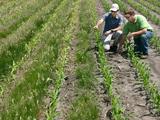
Set up a replicated strip trial: rye-alone control vs. interseeded 3-way mix
Treatments: (1) cereal rye drilled after harvest = business-as-usual control; (2) rye + a legume (medium-red/crimson clover) + a brassica (radish or turnip) INTERSEEDED at V5-V6. A single 2014 Arlington season showed rye, red clover, and radish interseeded at V5 establishing without a measured corn yield penalty — but that is one site-year; interseeded covers can compete with corn for water and light in dry years, so your own replicated, multi-year strip trial is the real test. Use 3–4 reps, strips at least 350 ft long, and keep fertilizer and herbicide identical across strips (using a herbicide program you have already confirmed is interseeding-compatible).
Timing: Lay out strips before the 2027 season; interseed mid-June
- 5
Measure impact with metrics you can actually capture
Sample fall (pre-killing-frost) and spring (pre-termination). For biomass, clip at ground level from two to three 0.25 m2 quadrats (or a known length of row) per strip, dry to constant weight, scale to lbs/ac — the single most predictive metric. Add percent green cover via the free Canopeo app, and pool subsamples into one nutrient (tissue N/P/K) sample per rep. Budget low-tens-of-dollars per sample; get a current quote from your lab (e.g., AgSource, Dairyland).
Timing: Fall 2027 and spring 2028
- 6
Plan termination deliberately — especially rye before corn
Terminate cereal rye well ahead of corn planting (commonly ~10–14 days prior) to limit allelopathy, nitrogen tie-up, and moisture competition — this interval matters more for rye-before-corn than rye-before-soybean. Later termination = more biomass and soil benefit but more risk to the corn. Treat the termination date as a managed variable, recorded for every strip.
Timing: Spring 2028, ahead of corn planting
- 7
Score the bottom line on the following corn
Capture yield on every strip with a yield monitor or weigh wagon. WI annual-cropping research found some cover crops REDUCED corn yield, so the rye-alone control and replicated strips are what protect you from scaling a yield drag to 1000 acres.
Timing: Corn harvest 2028
- 8
Use free technical help before scaling
Contact the UW soil-science cover-crop team (Matt Ruark / Dan Smith, UW-Madison Soil Science) and your county NRCS office for a Soil Health Assessment and possible cost-share on interseeding equipment. Only expand the mix farm-wide if your trial shows a clear, repeatable advantage over rye alone.
Timing: During the trial year, before any farm-wide scale-up decision
Applicability
- Where this applies
- Wisconsin continuous/rotational corn, no-till or reduced-till, ~1000 ac. Guidance is tuned to GRAIN corn's short fall window (rye-only after harvest; interseed for any diversity). After corn SILAGE or small grains the window is longer and a drilled multi-species mix becomes feasible — the diversity recommendation is much easier there.
- When to adjust
- Breaks down if you try to DRILL a legume/brassica mix after grain-corn harvest — UW Extension says it won't establish (insufficient fall GDD). It also doesn't apply unchanged to silage acres (longer window, drilling works). Don't expect a mix to out-yield biomass of the best single species, and don't credit "diversity" for gains that are really just more biomass. The strongest effect-size data is SE Nebraska, so WI climate/precip may shift the numbers.
- What to monitor next
- Track fall and spring dry-matter biomass (lbs/ac, quadrat-based) per strip, percent green cover via Canopeo, tissue N/P/K uptake, and following-corn yield by strip. Always compare the interseeded mix against the rye-alone control within each replicate so you isolate the diversity effect rather than the establishment-method effect. Also confirm the interseeded stand actually established (count/photo) before reading anything into biomass. Optional: free NRCS soil-health score.
- When to reassess
- After the year-two corn harvest (one biomass season plus one yield season). Re-run or expand the trial a second cycle before any farm-wide commitment, since single-year results swing with weather, establishment success, and termination timing.
Topics
Cite this
Reference this work
Soil Health Exchange Team (2026). Diversity = species count plus functional groups (grass/legume/brassica) — and in WI after grain corn, the binding constraint is the planting window, not the mix. Soil Health Exchange. SHE-FA-2026-0020. https://soilhealthexchange.com/cite/SHE-FA-2026-0020
Soil Health Exchange assigns a stable identifier to every published answer and article. Citations keep working even if the URL changes later.
From the blog


Discussion
No comments yet. Be the first to share your thoughts!