- Location
- Guilford, NC
- Crop
- Cotton
The challenge
“Red soil cracks after rain ? What the remedies we can do to fix it !”
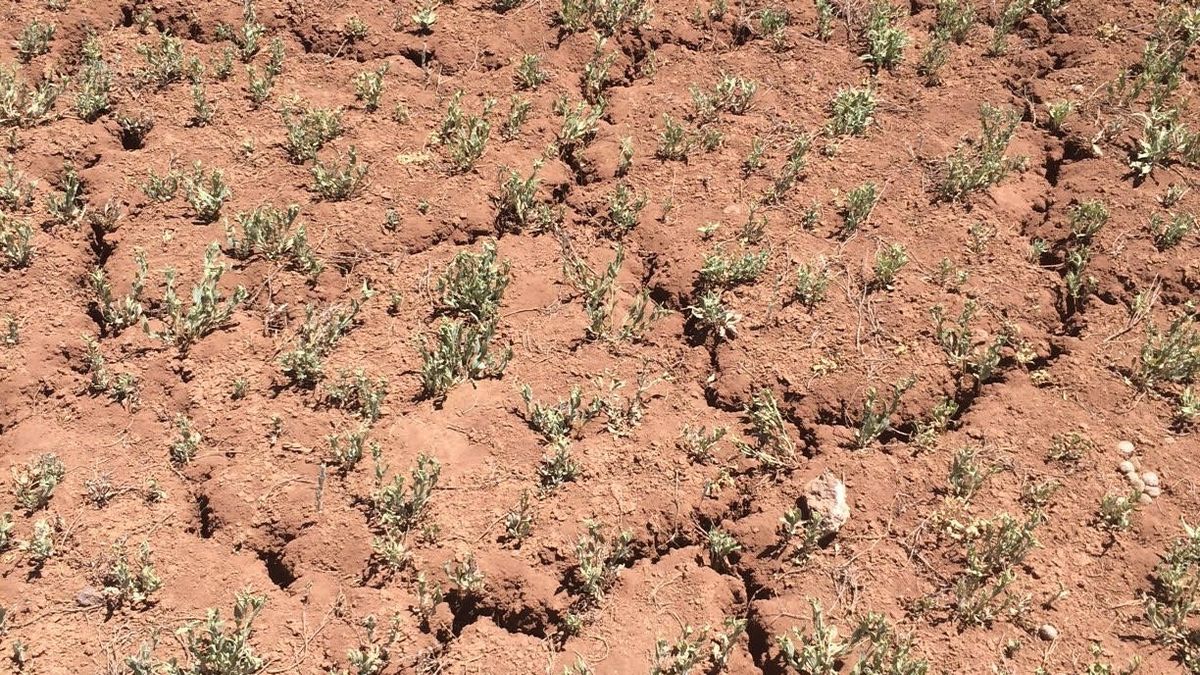
The cracks are evidence of drying; they are not yet a diagnosis
Red color, clay, and visible cracks do not by themselves prove a hardpan, a sodium problem, or a need for deep tillage. The key question is whether the limiting layer is at the surface, at a repeatable depth below the row, or not limiting roots and yield at all. In Guilford County’s Piedmont setting, that distinction matters because NC State notes that the classic crust-and-hardpan problem is found most often in the Coastal Plain.
Three observations should drive the decision
A structural surface crust is a hard, brittle plate over looser soil and can range from a few tenths of an inch to 2 inches thick. A compacted layer appears at a consistent depth, has high resistance when compared at the same moisture, and redirects roots. Shrink–swell cracking reopens with drying and closes on wetting; it may be normal behavior unless roots, infiltration, stand, or yield are impaired. More than one condition can occur in the same field.
What a true surface crust can do
USDA NRCS describes structural crusts as dense, non-aggregated surface layers formed when raindrops disperse exposed soil, fine particles seal pores, and the surface then dries. NRCS reports that a wet crust can reduce oxygen diffusion into the soil profile by as much as 50%, and a crust after planting can restrict emergence enough to require replanting. Those are seedbed effects; they do not mean that every crack in an established cotton field is currently reducing yield.
NC State cotton guidance says cotton cannot emerge through a thick crust and that planting deeper than 3/4 inch followed by a packing rain can sharply reduce emergence. The same guidance recommends 40,000–46,000 seed/ac as a general North Carolina balance, but warns that simply increasing seeding rate can backfire if emergence is good. If this crop is already uniformly established, use root and yield evidence rather than treating an earlier emergence risk.
A side-by-side field diagnosis
- Mark at least five cracked/problem spots and five nearby normal spots. Map whether they follow wheel tracks, row middles, bare areas, slopes, depressions, or a soil-map boundary.
- After the surface dries, lift an intact plate and measure its thickness. A hard surface layer with loose, friable soil immediately below supports crusting. Photograph it with a ruler and record whether stand or water entry differs.
- Dig a 12- to 18-inch pit across the crop row. Look for roots that flatten or turn sideways at one depth, horizontal plates, smeared faces, standing water, and an abrupt dense layer. Roots crossing the profile normally argue against paying for deep ripping.
- Compare penetration resistance only between problem and normal spots at the same soil moisture; a dry clay can feel hard without being traffic-compacted. Repeat at several depths and locations rather than relying on one push.
- Use a fixed-depth ring or cylinder infiltration comparison in the paired spots. Repeat it; large cracks can initially bypass water and make one reading look better than the surrounding matrix really is.
- Identify the mapped soil in USDA Web Soil Survey and send separate NCDA&CS samples from problem and normal areas. Request a diagnostic soluble-salt/sodium assessment only if irrigation water, flooding, or another history makes sodium plausible.
Piedmont data favor surface protection over routine disturbance
Twenty-four years of harvest data from two NC Piedmont tillage studies found the highest long-term average corn and soybean yields with the least soil disturbance. No-till corn averaged about 10 bu/ac more than no-till plus in-row subsoiling; moldboard-plow treatments averaged as much as 40 bu/ac less than no-till. Infiltration in wheel-trafficked interrows was more than three times greater under no-till than moldboard plowing, and twice as great in nontrafficked interrows. The result does not mean subsoiling never works; it means a verified restrictive layer is needed before assuming the pass will repay itself.
The same NC State work reported average residue cover of 93% with no-till, 70% with in-row subsoiling, 48% with chisel, 24% with disk, 20% with chisel plus disk, and 10% with moldboard plow. Residue intercepts raindrop energy, slows runoff, reduces evaporation, and lowers repeat crusting risk. A cosmetic smoothing pass can therefore trade away the protection the field needs at the next intense rain.
For the standing cotton crop
If stand is established, roots cross the profile, and plants are not weaker in cracked areas, leave the surface protected and monitor. Avoid traffic while the soil is wet and plastic. Flag ponded or weak areas for a post-harvest pit and keep residue in place. If emergence is still occurring and a measured crust is blocking seedlings, contact the county field-crops agent quickly; NRCS notes that a shallow rotary hoe or cultivator can sometimes help while the crust is moist, but timing and crop stage determine whether that operation is safe.
If the evidence points to traffic compaction
NC State reports that most traffic compaction occurs on the first machinery pass. Tire pressure is roughly the pressure applied at the soil surface, and the agency recommends avoiding wet traffic, reducing passes, using controlled lanes where practical, and keeping axle loads below 10,000 lb. Another NC State guide notes that field operations can traffic up to 85% of the surface in one season. Prevention therefore starts with where and when the machine travels—not only with a corrective tillage pass.
Match the remedy to the measured limitation
- Surface crust: retain residue or a cover-crop mulch, minimize full-width disturbance, and tune the planter for residue and seed-slot closure. Use a shallow emergence aid only when an active crust is measurably blocking seedlings.
- Restrictive subsurface layer: after confirming the depth in several pits at comparable moisture, test in-row subsoiling in at least three paired strips. Set the shank just below the layer and harvest treated and untreated strips separately.
- Shrink–swell cracking without root or yield loss: retain cover, avoid wet traffic, and monitor. The objective is water entry and root access, not a permanently smooth surface.
- Low pH: follow the NCDA&CS lime recommendation. Gypsum supplies calcium and sulfur but does not neutralize acidity, so it is not a substitute for lime.
- Suspected sodium or a documented calcium/sulfur need: use the appropriate soil or water analysis before gypsum. NCDA&CS states that no North Carolina research supports applying gypsum merely to chase a preferred Ca:Mg ratio; routine soil-test crop needs are the better basis.
Build aggregation and moisture resilience over several seasons
Yes—adding and retaining organic matter can make this soil function better. Organic compounds, roots, fungi, and other biological activity help bind mineral particles into more stable aggregates. The resulting mix of pore sizes can improve infiltration, root access, and plant-available water while making the surface less prone to sealing. This management will not change the clay mineralogy or guarantee that dry-season cracks disappear; the agronomic target is smaller moisture swings, less crusting and runoff, and better root and crop performance.
- Cover crops: choose a locally adapted species or mixture that provides reliable roots and residue in the cotton rotation. Roots add carbon belowground and leave channels for water and later crop roots. Match species, planting window, biomass, and termination date to the field’s erosion goal and spring moisture supply; a living cover can use water while it is growing, so more biomass is not automatically better in every dry spring.
- Residue management: retain cotton stalks, previous-crop residue, and the terminated cover on the surface where practical. NC State notes that residue intercepts raindrop impact, slows runoff, reduces near-surface evaporation, and contributes to structure as it decomposes. Use planter adjustment or row cleaning to create the seed zone rather than burying protection across the full field.
- Compost: use mature, stable, analyzed material. NC State describes compost humic compounds as a “glue” for aggregates and links improved porosity with better infiltration and moisture conservation. Test a nutrient-budgeted rate on paired strips first; include dry matter, C:N ratio, electrical conductivity, total nutrients, hauling, spreading, and the yield response in the decision.
- Manure or litter: treat it as a nutrient source first and an organic-matter amendment second. Analyze each source, credit available N plus total P and K, and limit the rate using the most restrictive crop need, soil-test result, and applicable nutrient-management requirement. Do not apply manure solely to raise organic matter where phosphorus, salts, copper, or zinc are already accumulating.
- Track function, not crack appearance alone: measure residue cover, crust thickness, repeated infiltration, root depth, aggregate stability or a consistent slake test, soil organic matter sampled at the same depth and season, and treated-versus-untreated yield. A visible crack can remain while aggregation and crop access to water improve.
Expect different time scales
Surface residue provides immediate protection from raindrop impact and evaporation. Cover-crop roots and decomposition work over seasons. Compost may add stable carbon more quickly, but one application is not proof of a profitable soil-structure response. Expand only after the soil, crop, and nutrient records move together.
Price the affected area—not the whole field by default
Break-even yield recovery = full treatment cost/ac ÷ crop value per unit of yield. Multiply only by acres where pits, roots, infiltration, stand, or yield show the limitation. Include fuel, labor, implement ownership, and any lost residue protection, and leave untreated strips. A pass that changes soil appearance but not yield, trafficability, or water entry has not produced an agronomic return.
What success should look like
Use the same marked locations after major rains. Success is more uniform emergence, faster water entry into the soil matrix, roots crossing the former restriction, and a yield response large enough to cover the treatment—not necessarily the disappearance of every dry-season crack.
Bring evidence to the local visit
Ask Guilford County Cooperative Extension to review the mapped soil and a problem-versus-normal pit. Bring the surface photo with scale, root-profile photos, traffic history, paired infiltration notes, and separate NCDA&CS reports. That package is much more diagnostic than the red color or cracks alone.
Bottom line
The most farmer-protective recommendation is diagnosis before purchase. Piedmont evidence supports retaining residue and minimizing routine disturbance; it does not rule out targeted subsoiling where roots and paired measurements confirm a restrictive layer. Lime, gypsum, and deep tillage solve different problems, and none should be selected from the photograph alone.
Topics
Cite this
Reference this work
Soil Health Exchange Team (2026). Red Soil Cracks in the North Carolina Piedmont: Diagnose the Limiting Layer Before Treating It. Soil Health Exchange. SHE-FA-2026-0046. https://soilhealthexchange.com/cite/SHE-FA-2026-0046
Soil Health Exchange assigns a stable identifier to every published answer and article. Citations keep working even if the URL changes later.
Keep exploring
Discussion
No comments yet. Be the first to share your thoughts!