Apple Replant Disease: Why New Orchards Fail on Old Ground — and What Actually Works
Plant an apple tree where an orchard once stood and it often struggles. Apple replant disease — a soilborne pathogen complex — costs growers an estimated $70,000–$150,000 per acre over a new orchard's first four years. Here's what causes it, where it strikes, and which treatments actually restore yield, with data from WSU, Cornell, and global field trials.
SH
By Soil Health Exchange Editorial||11 min read|18 reads
Apple replant disease is a soilborne pathogen complex that stunts young trees replanted on old orchard ground — costing an estimated $70,000–$150,000 per acre in lost returns over a new orchard's first four years. There is no single cause and no single cure, but pre-plant fumigation, replant-tolerant Geneva rootstocks, and Brassica seed-meal amendments can each restore most of the lost productivity.
Plant an apple after an apple, and it struggles
Plant a young apple tree where an old apple orchard once stood, and it often falters — stunted, slow to come into bearing, and far less productive than the same tree on fresh ground. This is apple replant disease (ARD), and it shows up in essentially every major apple-growing region on Earth [1][1][2][2].
ARD is best understood not as a single infection but as a soilborne disease *complex*: poor establishment that occurs when an apple — or a close relative — is replanted on a site previously planted to the same or a related crop [2][2][3][3]. Researchers distinguish *specific* replant disease, the host-specific, biologically driven decline seen when apple follows apple, from broader *nonspecific* "replant problems" tied to soil chemistry and physical condition . The disease is common across the rose family (Rosaceae): apple, pear, cherry, peach, and even ornamental roses can all be affected .
A global problem wherever apples are grown intensively
Apple is one of the world's largest fruit crops — roughly 97 million tonnes a year, with China alone producing nearly half [18][18]. Wherever apples are grown intensively, replant disease follows.
Figure
Apple is a major global crop — and ARD threatens it everywhere
China
46 million tonnes (2023)
United States
5.1 million tonnes (2023)
Turkey
4.6 million tonnes (2023)
Poland
3.9 million tonnes (2023)
Top apple-producing countries, FAOSTAT-derived figures, 2023. World total ≈ 97 million tonnes [18].
Click to expand
ARD has been documented across North America, Europe, China, South Africa, and Australasia — it is, in the words of one major review, "common to all major apple growing regions of the world" [1][1][2][2]. In the United States, Washington grows roughly two-thirds of the crop [17][17]; New York, Michigan, and Pennsylvania are also significant producers, and all of them contend with replant decline [7][7].
Crucially, the dominant organisms differ from region to region. In Washington the complex centers on *Rhizoctonia*, *Ilyonectria*, *Pythium*, and *Phytophthora* [3][3][5][5]; across much of Europe, *Ilyonectria*/*Cylindrocarpon* fungi dominate [4][4]; in South Africa, *Phytophthora cactorum* is strongly associated [19][19]; and in China, a *Fusarium* species has been identified as the primary cause [2][2]. That regional variation is exactly why a treatment that works in one orchard may underperform in another.
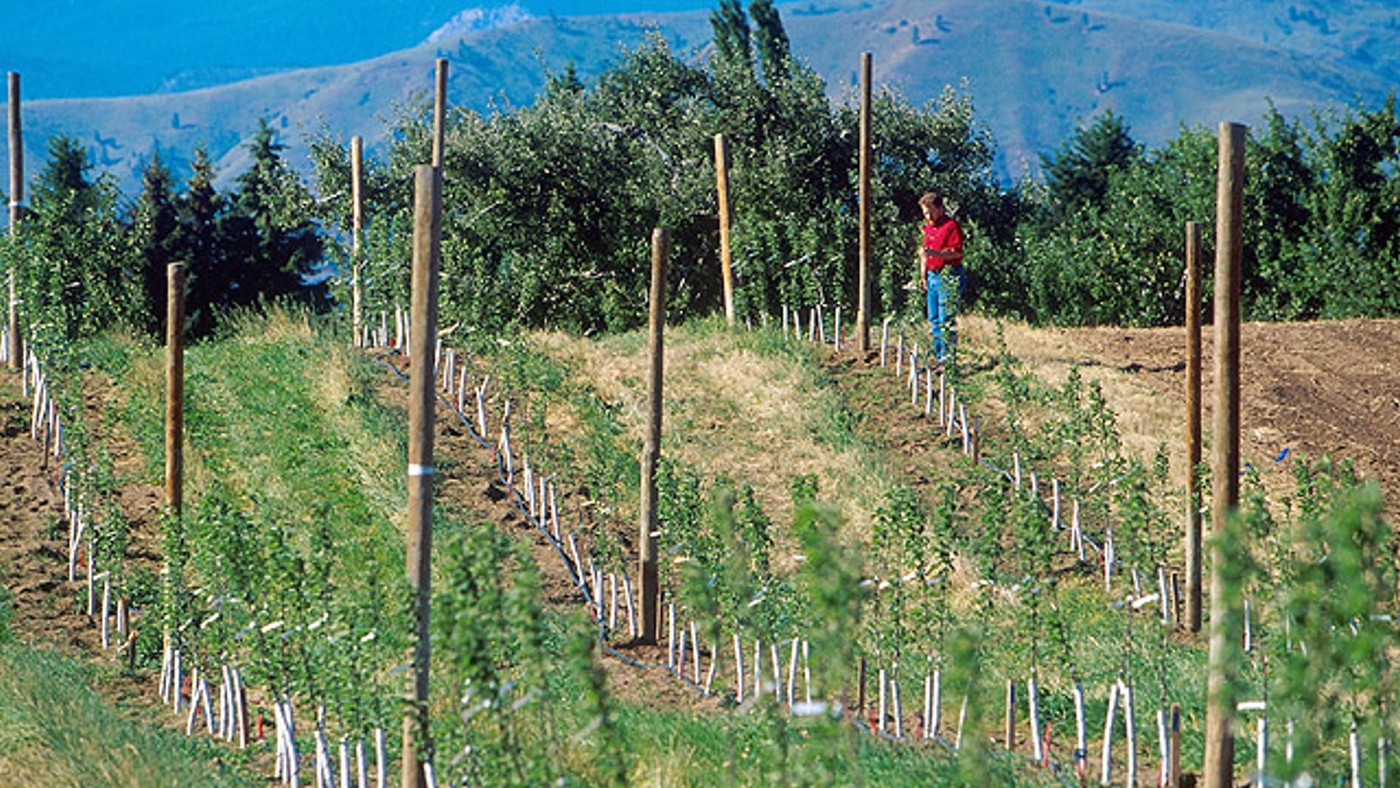
Growers rarely replant old ground by choice — they do it because the best site is usually the one already in production [23][23]. The economics of modern orchards make this unavoidable. High-density plantings on dwarfing rootstocks have gone from about a quarter of US apple tree sales in 1995 to roughly 85% today [21][21], packing 500 to more than 1,400 trees per acre on a 15-to-20-year cycle [21][21]. Shorter orchard lives mean replanting happens more often, on the same finite parcels of good land.
What it looks like
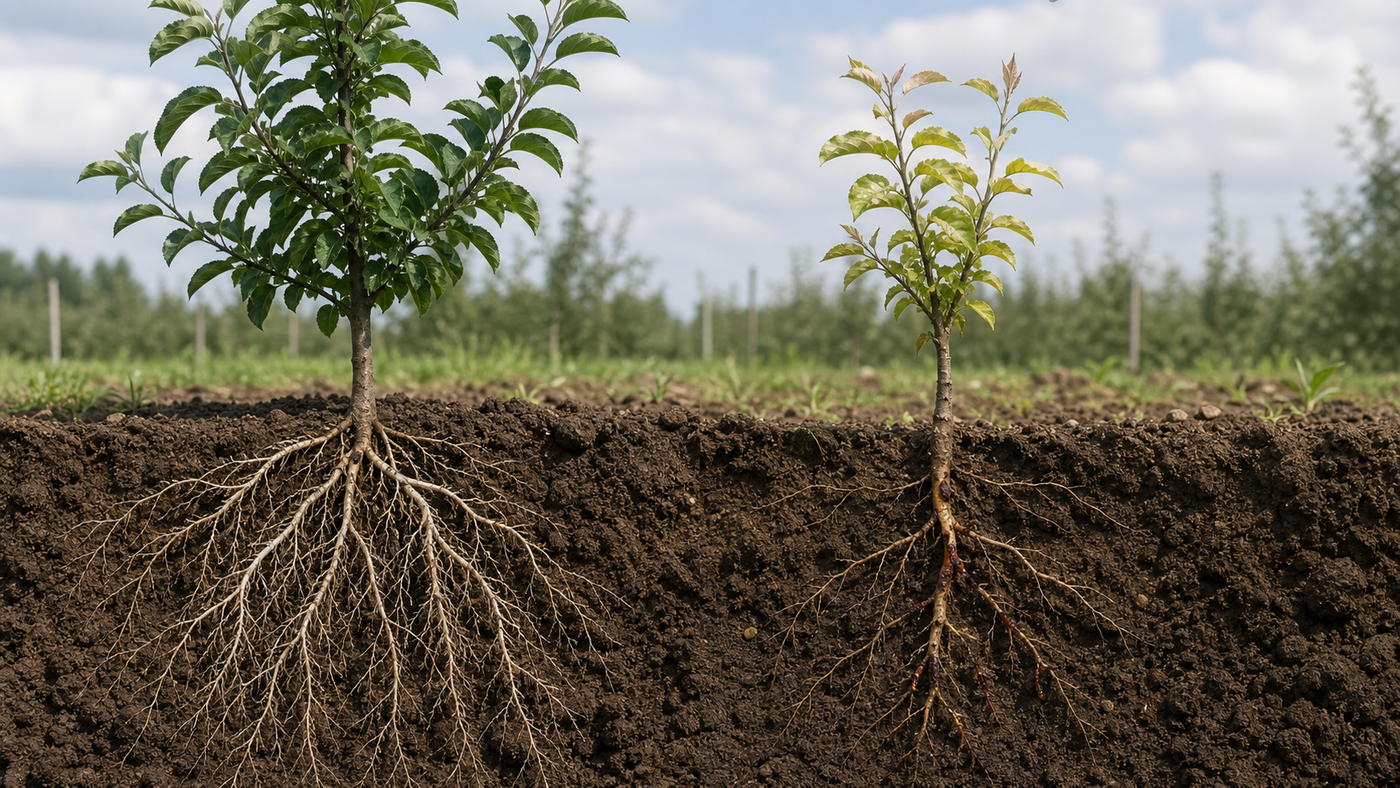
Above ground, ARD shows up as uneven, patchy growth across a block: stunted trees with shortened internodes, small and pale leaves, delayed bearing, and reduced yield. Severely affected young trees can die within the first year [3][3][7][7]. The clearest evidence is below ground — dig up an affected tree and you find dark, necrotic roots, few fine feeder roots, and far less root biomass than a healthy tree [3][3][6][6].
The effect is unmistakable in controlled trials. When German researchers grew apple seedlings in untreated replant soil and compared them to the same soil sterilized to kill its biology, shoot growth fell by as much as 70% [6][6].
Apple replant disease often appears above ground as weak, patchy growth while damaged roots show sparse feeder roots and dark lesions. — Photo: Generated editorial image
Figure
Sterilize the soil and growth returns — proof ARD is biological
Heidgraben (sandy)
70 % shoot-length reduction vs. sterilized soil
Ruthe (loam)
27 % shoot-length reduction vs. sterilized soil
Ellerhoop
26 % shoot-length reduction vs. sterilized soil
Apple seedling shoot-length reduction in untreated replant soil relative to the same soil sterilized by gamma irradiation, across three German orchard soils, 8-week greenhouse bioassay [6].
Click to expand
What causes it: a pathogen complex, not a single culprit
Sterilizing the soil — by fumigation, steam, or irradiation — restores normal growth. That is the clearest proof that ARD is fundamentally biological rather than a chemical or nutritional disorder [2][2]. But no single organism reproduces the full disease. Instead, a complex of fungi, oomycetes, and nematodes acts together, with the relative importance of each member shifting by site, region, and even year [1][1][2][2].
The apple replant disease complex
Organism
Type
Role in the complex
Pythium spp. (P. ultimum, P. sylvaticum)
Oomycete
Rot fine feeder roots; among the most virulent toward apple
Phytophthora cactorum
Oomycete
Root and crown rot
Rhizoctonia solani (AG-5, AG-6)
Fungus
Damage to the root cortex
Ilyonectria / Cylindrocarpon spp.
Fungus
Black root rot; dominant in many European orchards
Pratylenchus penetrans
Root-lesion nematode
Wounds roots, opening entry points for fungi and oomycetes
Fusarium spp.
Fungus
Weakly virulent in most regions; identified as the primary cause in China
Organisms repeatedly implicated in ARD; relative dominance varies by region [1][2][3][5].
The root-lesion nematode *Pratylenchus penetrans* plays an outsized role: by wounding roots it creates entry points for the fungi and oomycetes that do most of the damage [2][2]. The interaction is genuinely synergistic — and genuinely variable. In some soils it is not the classic plant-parasitic pathogens but free-living nematodes and their associated microbes that drive the decline [20][20], which is part of why pinning down a universal cause has proven so difficult.
A long-standing alternative hypothesis holds that apple roots effectively poison their own replacements through phenolic compounds such as phloridzin. The evidence is mixed: phloridzin itself does not inhibit the key pathogens, though some of its breakdown products do [4][4], and recent reviews argue that phenolic accumulation is more likely a *consequence* of replant disease than its fundamental cause [2][2]. Soil chemistry and pH can make ARD better or worse, but most researchers now treat them as modulators rather than the primary driver [4][4].
The economic stakes
The cost of doing nothing
Washington State University extension estimates that untreated apple replant disease costs $70,000–$150,000 per acre in reduced returns over a new orchard's first four years, and about $40,000 per acre over its full productive life. Against a pre-plant treatment cost of a few hundred to a few thousand dollars per acre, the return on intervention can be enormous.
Those figures [3][3] explain why replant management is one of the highest-leverage decisions a grower makes before a new block goes in. A modern high-density orchard represents a large up-front investment in trees, trellis, and irrigation that must come into full production quickly to pencil out. ARD attacks exactly that window — the first few years — by suppressing the early growth trees need to fill their space [13][13].
What actually works
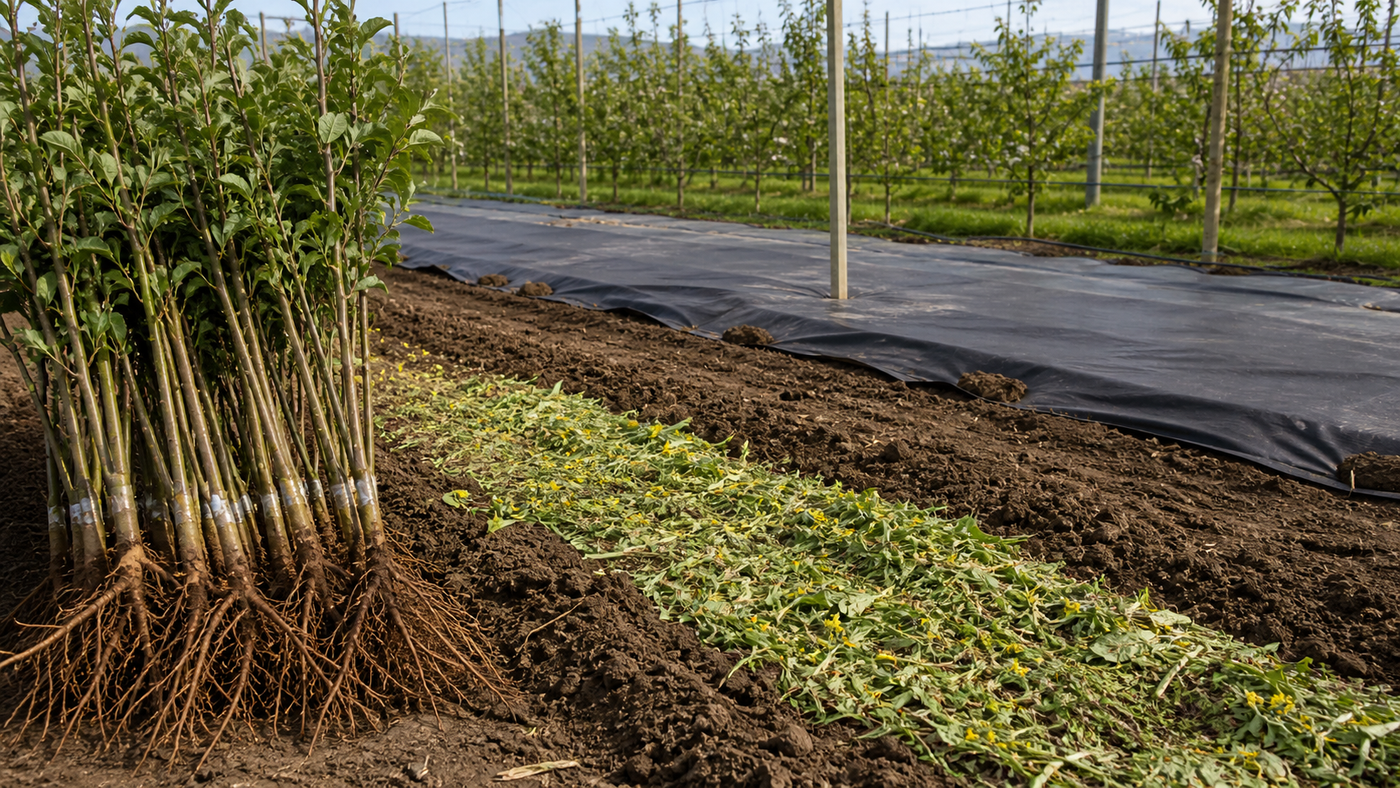
The strongest ARD programs combine tolerant rootstocks with site-matched pre-plant soil treatments such as fumigation, brassica seed meal, or anaerobic soil disinfestation. — Photo: Generated editorial image
1. Pre-plant fumigation — the benchmark, with caveats
Soil fumigation before planting remains the standard against which everything else is measured. In field trials by USDA-ARS and Washington State University, pre-plant 1,3-dichloropropene/chloropicrin fumigation raised apple yields by 56% to 161% over untreated replant soil [2][2][9][9].
Figure
Fumigation can more than double yield on replant ground
Low end of reported gains
56 % yield increase vs. untreated replant soil
High end of reported gains
161 % yield increase vs. untreated replant soil
Reported range of apple yield increases from pre-plant 1,3-D/chloropicrin fumigation across multiple field trials [2][9].
Click to expand
Fumigation has real limits, though. The benefit is front-loaded and fades as the soil microbiome reverts to its replant state within about two years [2][2]. It costs roughly $900 per acre [13][13], and it carries handler-safety requirements and buffer-zone restrictions. Methyl bromide, once the orchard standard, was phased out in the United States in 2005 under the Montreal Protocol — and orchard replant never received a critical-use exemption [16][16].
2. Replant-tolerant rootstocks — the most elegant fix
Because they require no extra field operation, replant-tolerant rootstocks are arguably the most elegant solution. Cornell and USDA-ARS's Geneva ("G.") series was bred specifically for replant tolerance alongside fire-blight and woolly-apple-aphid resistance [15][15].
Rootstock tolerance to apple replant disease
Tolerance
Rootstocks
Tolerant
G.935, G.30, G.210, G.41, G.214
Moderately tolerant
G.11, G.16, M.9 Nic29
Susceptible
M.7, M.9, M.26, MM.106, MM.111
WSU tolerance tiers; "G." denotes Cornell-Geneva rootstocks, "M."/"MM." the older Malling series [3][15].
The payoff can be dramatic. In an extreme-replant trial in southern Brazil — replanted just 60 days after the old orchard came out, with no fallow period at all — the tolerant rootstock G.210 produced roughly double to triple the cumulative yield of the susceptible G.202 [8][8].
Figure
A tolerant rootstock can double or triple yield on replant ground
G.210 — São Joaquim
77 t/ha cumulative yield
G.202 — São Joaquim
38 t/ha cumulative yield
G.210 — Vacaria
56 t/ha cumulative yield
G.202 — Vacaria
23 t/ha cumulative yield
Cumulative yield of tolerant (G.210) vs. susceptible (G.202) Geneva rootstocks at two southern Brazil sites under extreme replant conditions, no fallow [8].
Click to expand
One important caveat: Geneva tolerance is driven by the soil microbiome and does not protect against root-lesion nematodes, which damage tolerant and susceptible rootstocks alike. On sites with high nematode pressure, a tolerant rootstock alone may not be enough.
3. Brassica seed meal and ASD — building a suppressive soil
Brassica seed meal — mustard-family seed residue worked into the soil before planting — can match or even beat fumigation. In WSU trials led by Mark Mazzola, a *Brassica juncea*/*Sinapis alba* seed-meal blend performed as well as 1,3-D/chloropicrin for disease control and yield [10][10][11][11], and unlike fumigation it builds a durable, disease-suppressive microbiome rather than a temporary reset [12][12]. The catch is cost: roughly $6,135 per acre, several times the price of fumigation [13][13].
Anaerobic soil disinfestation (ASD) — saturating the soil under an impermeable tarp with an added carbon source to starve pathogens of oxygen — beat the untreated control in three of four WSU field experiments, though it generally trailed fumigation and was highly site-dependent [12][12][13][13]. The choice of carbon source is decisive: grasses and seed meals suppress the pathogens while composted manure does not [14][14]. Its big advantage is cost: when the carbon comes from a cover crop grown in place rather than imported hay, ASD can run about $635 per acre — cheaper than fumigation [13][13].
Figure
Treatment cost per acre varies more than tenfold
ASD (carbon grown in place)
635 $ per acre
Fumigation (1,3-D/chloropicrin)
900 $ per acre
ASD (imported hay)
2642 $ per acre
Brassica seed meal
6135 $ per acre
Approximate per-acre treatment costs, WSU 2021 estimates. For context, untreated ARD costs an estimated $70,000–$150,000/acre over a new orchard's first four years [3][13].
Click to expand
Other tools are weaker or less consistent. Compost amendments improved soil biology but did not raise tree growth or yield in replant field trials [22][22]. Biochar, mycorrhizae, and biocontrol agents such as *Trichoderma* show promise mainly in pots and greenhouses, with field results that have been hard to reproduce. And rotation or shifting the planting position into the old grass lanes between former tree rows helps susceptible rootstocks but only relocates inoculum rather than eliminating it — replant pathogens can persist far longer than a practical out-of-pome rotation [13][13][23][23].
Apple replant management options compared
Approach
Effectiveness
Approx. cost/acre
Notes
Pre-plant fumigation (1,3-D/chloropicrin)
High (+56–161% yield)
~$900
Benefit fades; microbiome reverts in ~2 years
Tolerant Geneva rootstock
High
Genetic (no field op)
Removes much of the replant penalty; not nematode-proof
Brassica seed meal
High (≥ fumigation)
~$6,135
Builds a durable suppressive soil; cost is the barrier
Anaerobic soil disinfestation (ASD)
Moderate–High, site-dependent
$635–$2,642
Cheapest when carbon is grown in place
Compost amendment
Low
Varies
No yield benefit in replant field trials
Rotation / position shift
Partial
Low
Helps susceptible rootstocks; relocates, not eradicates, inoculum
Effectiveness and approximate per-acre cost; costs are WSU 2021 estimates [3][9][12][13].
The bottom line for growers
There is no silver bullet for apple replant disease — but there is a clear playbook. Match the tool to the orchard: a tolerant Geneva rootstock as the foundation, fumigation or Brassica seed meal where disease pressure is high, and ASD or rotation where chemical inputs aren't an option. Because the dominant pathogens vary site to site, a soil bioassay or nematode count before planting is one of the cheapest ways to avoid an expensive mistake.
The research frontier is *suppressive soils* — using seed meals, carbon inputs, and microbiome management to make the soil itself hostile to the pathogen complex, so that the next orchard establishes without a chemical reset that washes out in two years [2][2][12][12]. For an industry replanting the same finite ground on ever-shorter cycles, building soils that resist the disease may matter more than any single treatment that merely suppresses it.
Source material for every claim in this article, plus a citation-ready record for reference managers and scholarly indexes.
Cite this
Reference this work
SHE-ART-2026-0022
Soil Health Exchange Editorial (2026). Apple Replant Disease: Why New Orchards Fail on Old Ground — and What Actually Works. Soil Health Exchange. SHE-ART-2026-0022. https://soilhealthexchange.com/cite/SHE-ART-2026-0022
Soil Health Exchange Editorial (2026). Apple Replant Disease: Why New Orchards Fail on Old Ground — and What Actually Works. Soil Health Exchange. https://soilhealthexchange.com/blog/apple-replant-disease
More citation formats
MLA
Soil Health Exchange Editorial. "Apple Replant Disease: Why New Orchards Fail on Old Ground — and What Actually Works." Soil Health Exchange, 2026-06-24, https://soilhealthexchange.com/blog/apple-replant-disease.
Chicago
Soil Health Exchange Editorial. "Apple Replant Disease: Why New Orchards Fail on Old Ground — and What Actually Works." Soil Health Exchange. Published 2026-06-24. https://soilhealthexchange.com/blog/apple-replant-disease.
Discussion
No comments yet. Be the first to share your thoughts!