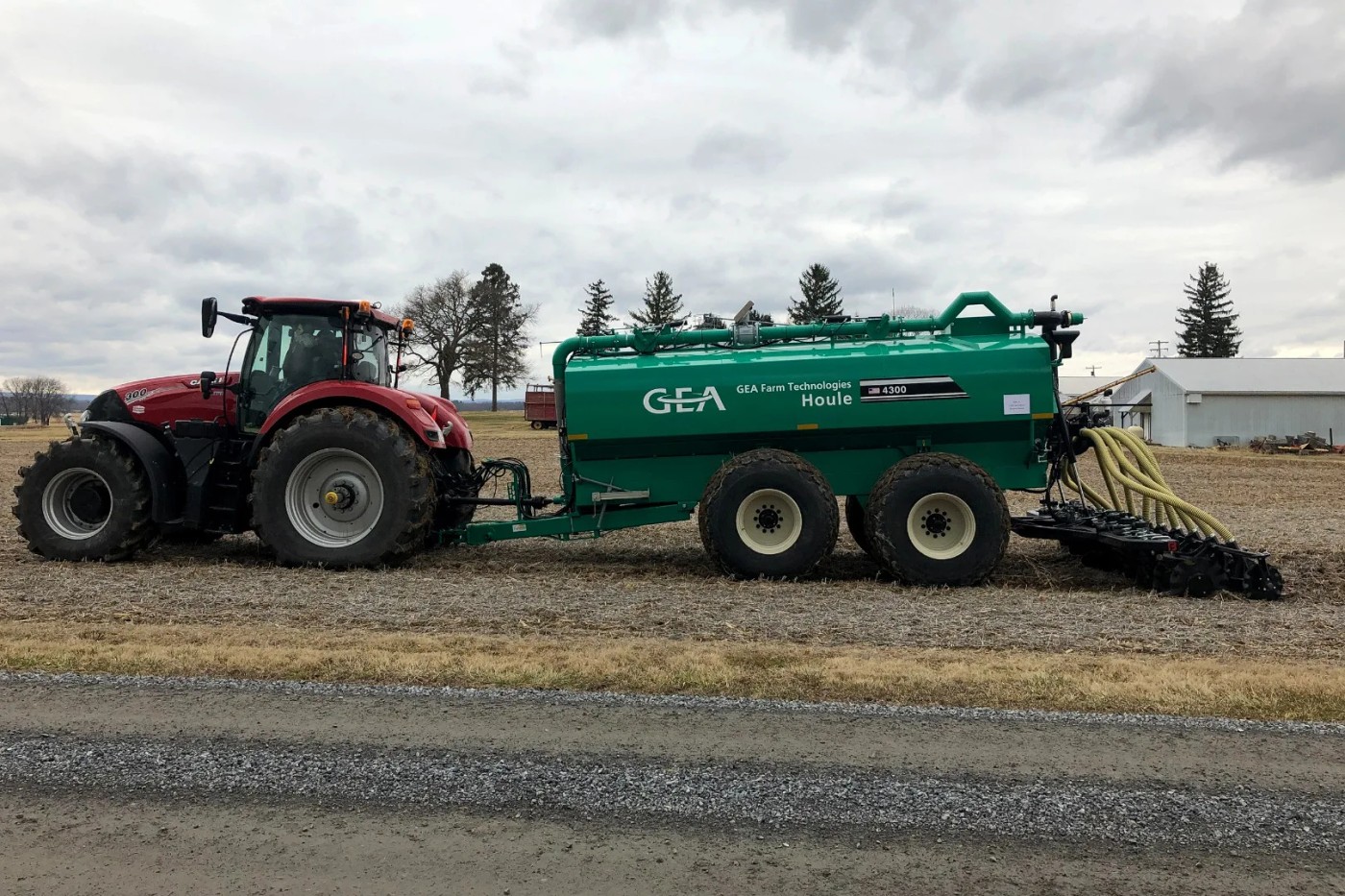
A tanker carries the same pounds out of the barn whichever way it turns, but where it stops decides how many of those pounds replace a fertilizer order. In the example below, the same load and the same application charge leave one field $19.60/ac ahead and the other $33.60/ac behind, and that $53.20 difference starts with two lines on the fertilizer bill.
Start with the fertilizer bill you can actually reduce
This liquid dairy manure example applies 4,000 gallons per acre and charges nothing for the manure at the source. The pounds in the table are plant-available amounts that replace planned commercial purchases, so they should come from a current manure analysis, soil test and nutrient plan, which also set the gallons you can apply. If phosphorus limits the application, run the budget at that lower volume and price the nitrogen or potash you'll still buy. Penn State Extension on fertilizer replacement value
Fertilizer value if those pounds replace planned purchases
| Fertilizer displaced | Usable lb per 1,000 gal | Assumed price | Value per 1,000 gal |
|---|---|---|---|
| N | 15 | $0.65/lb | $9.75 |
| P₂O₅ | 8 | $0.65/lb | $5.20 |
| K₂O | 18 | $0.45/lb | $8.10 |
| All three | — | — | $23.05 |
At Iowa State's average injection charge of $18.15 per 1,000 gallons, the field that uses all three nutrients saves $4.90 per 1,000 gallons after application, which comes to $19.60/ac at the example volume. The N-only field replaces just $9.75 per 1,000 gallons of fertilizer, so at the same volume and application charge it loses $33.60/ac. Both cases hold yield flat and start with no separate freight. Iowa State Custom Rate Survey, p. 4
The application quote can move the field past break-even
Injection quotes vary widely: Iowa State's 2026 survey received 16 expected rates for liquid injection, averaging $18.15 with a median of $17 per 1,000 gallons, and once the lowest and highest responses were dropped the reported range ran from $11 to $29. Applied to the same full-nutrient budget, the two ends of that range sit $72/ac apart. Iowa State Custom Rate Survey, pp. 1 and 4
Manure margin at four Iowa injection rates
| Comparison | $/acre |
|---|---|
| $11 · range low | +$48.20 |
| $17 · median | +$24.20 |
| $18.15 · mean | +$19.60 |
| $29 · range high | −$23.80 |
At the average charge, the full-credit field can absorb up to $4.90 per 1,000 gallons of separate freight, so a $5 surcharge uses up the margin and puts the field $0.40/ac behind. The N-only field, by contrast, is still $5/ac behind with no freight even at the reported $11 rate. Because a quote can bundle loading, travel, waiting and application, ask for the all-in charge for the specific route and volume. Iowa State Extension on manure value and hauling
The next table carries that freight test across three nutrient plans at the same 4,000 gal/ac and fertilizer prices. Its last two columns show the margin per acre at the average injection charge and at a $23.15 delivered quote, which adds $5 per 1,000 gallons.
What the field can afford to pay for manure delivery
| Nutrients displaced | Break-even $/1,000 gal | Margin at $18.15 | Margin at $23.15 |
|---|---|---|---|
| N, P and K | $23.05 | +$19.60 | −$0.40 |
| N and K | $17.85 | −$1.20 | −$21.20 |
| N only | $9.75 | −$33.60 | −$53.60 |
If the plan caps the application at 2,500 gal/ac, the full-credit field saves $12.25/ac at the average charge with no separate freight, assuming the same replacement value per gallon and no minimum job fee. The smaller application can still leave more fertilizer to buy for the same crop, and that purchase belongs in the same budget.
Pay for a change in management when it changes an outcome
In the fertilizer budget, better placement earns its cost through the extra pounds of purchased fertilizer it saves. If improved placement costs $3 more per 1,000 gallons and the nitrogen you would otherwise buy costs $0.65/lb, the operation has to displace about 4.6 more pounds of purchased N per 1,000 gallons to pay through N alone. Minnesota Extension's first-year planning factors for dairy manure show how much placement can matter, crediting 55% of total N with sweep injection, 50% with knife or coulter injection and 20% with broadcast incorporated after 96 hours. With an illustrative lab result of 27 lb total N per 1,000 gallons, sweep injection credits 9.45 lb more first-year N than the delayed incorporation. If all of those pounds reduce the fertilizer order, they are worth about $6.14 per 1,000 gallons, or $24.57/ac at the example volume. Because these are Minnesota's factors, the comparison should use the ones adopted for your own area and plan. University of Minnesota Extension, Table 1
Timing and calibration can move the yield line as well. In a two-year Minnesota corn trial, dragline-injected swine manure applied at the fourth leaf collar in 2018 produced yields and returns over sidedressing costs comparable to anhydrous ammonia and UAN. In 2019, however, the manure plots received about 45 lb/ac less plant-available N than targeted and had a 6% lower stand than the no-sidedress control, and grain yield fell 18% below UAN and 25% below anhydrous. Using the trial's measured yields and cost assumptions, manure applied within 1.2 miles of the barn returned about $400/ac over sidedressing and related costs that year, against $488 for UAN and $545 for anhydrous. A budget for in-season manure therefore needs the N concentration and delivered rate verified, and the stand checked, before it counts on matching commercial N. Pfarr et al., Table 4
Part of the value arrives next season
A first-year budget leaves some of the tanker's value uncounted. Phosphorus and potassium in manure behave like fertilizer and can stay in the soil for several years, which is why Penn State's worked example values those two nutrients directly. Whatever the current crop leaves behind is still there for the next one, and a soil test shows how much can come off the next fertilizer order. That carryover has a limit, though. Minnesota Extension notes that a rate set to meet the crop's full nitrogen need oversupplies P and K for that year, and if it is repeated too often, the excess phosphorus can reach waterways. Penn State Extension; University of Minnesota Extension
Nitrogen carries over too, as organic N that does not mineralize in the year of application but becomes available later, which UW–Madison Extension calls residual N. Minnesota's planning table credits dairy manure with another 25% of its total N in the second year, whatever the placement, so the illustrative 27-lb analysis supplies about 6.75 lb more per 1,000 gallons, or roughly 27 lb/ac at 4,000 gallons. When the following crop needs nitrogen, that second-year credit is worth about $17.55/ac at $0.65/lb, which the first-year comparison never counted. Other estimates run lower, including 12% of total N in the second year in a five-year series for solid dairy manure on the same UW–Madison page, so the credit should use the factor your own state adopts. University of Minnesota Extension, Table 1
Give storage, separation and digestion their own budgets
A separator creates two streams and two routes, so its budget compares the pump hours, electricity, dry matter and nutrient pounds delivered to each destination with your current handling. For compost, price the finished tons after shrink, and because a buyer pays for delivered material, count testing, handling and freight before crediting a sale.
A digester brings a longer investment horizon. Its budget needs the energy contract, downtime, process power, financing, interconnection and digestate handling, and if the original manure already replaces fertilizer, that existing value belongs in the baseline. Whole-farm cash flows give the fairest comparison, with changes in fertilizer value priced separately from changes in hauling and storage. EPA AgSTAR project planning and financing
When two farms share the work, keep a crop budget and a livestock budget. Fertilizer avoided goes on the crop ledger and storage or handling avoided goes on the livestock ledger, while a payment between the farms is revenue for one and an expense for the other, so it cancels in a combined budget.
Value the phosphorus that stays out of runoff
The fertilizer credit belongs to the crop budget, but the phosphorus that stays out of a stream can matter to a different buyer. In a four-year Pennsylvania field study, broadcast dairy manure produced 68% more annual total phosphorus in surface runoff than shallow disk injection in 2014, the one year with a statistically detectable difference in that outcome, while soil-test phosphorus built up over the study. A water agreement would therefore need the soil tests, manure rates, placement and measurements across several runoff seasons. Jahanzad et al., four-year runoff study
A buyer would pay for the pounds of phosphorus it accepts after accounting for the field baseline and how much runoff reaches the waterbody, so a phosphorus agreement needs both a phosphorus price and a verification method. For a storage or digester project, the climate side works the same way. Methane and nitrous oxide have to be assessed across storage, handling and field application, because a climate payment would rest on the verified net change in greenhouse gas emissions and the price in that agreement. EPA AgSTAR project planning and financing. A dairy-products buyer looking at the milk supply would need to trace any emissions claim back to participating farms. The watershed buyer would still need its own phosphorus record.
Start with two real destinations and put their soil tests, manure analyses, allowable rates and all-in delivery charges side by side. The field closer to the barn can be the more expensive stop when it has less use for what the tanker carries, and a field that will need nitrogen again next year can earn back part of a longer haul. Compare nutrient value in the SHE Manure Calculator.
Funding a haul, an injection pass or a storage upgrade
If hauling distance decides where the tanker goes, Maryland’s Manure Transport and Injection Grants help pay for eligible moves to fields with acceptable soil phosphorus levels. Injection assistance applies to liquid manure. Maryland’s fall 2026 round requires the work to be finished by December 15, 2026. Elsewhere, ask NRCS EQIP which nutrient-management or waste-storage practices are offered locally. A hauling grant, an injection payment and help with a storage structure cover different costs.
Under IRS Publication 225, part of a USDA-certified cost-share payment for a capital improvement, such as a waste-management structure, can be excluded from income under section 126 of the tax code, and EQIP is among the listed programs, while payments that aren't for a capital improvement are income. Ask your tax preparer how each payment will be treated before you count it in the budget. For support closer to the receiving field, see nutrient-management funding.
A second mile of hauling can look expensive from the barn and worthwhile from the reservoir. The next decision turns on a specific comparison. What fertilizer purchase will the receiving farm avoid, what phosphorus reduction will reach the water, and will anyone pay enough for that reduction to cover the extra mile and the monitoring?
Discussion
No comments yet. Be the first to share your thoughts!