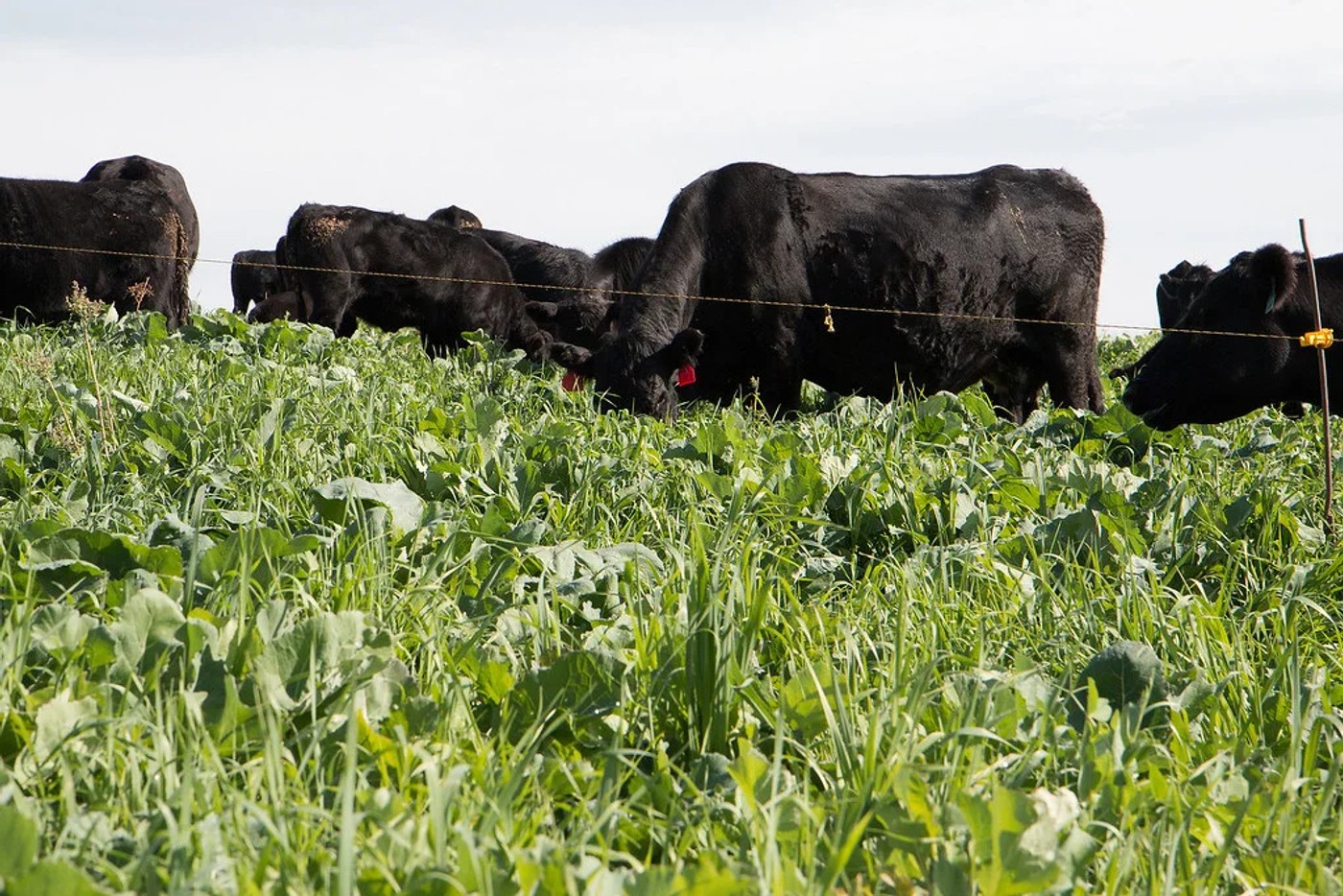
A crop field can take over part of the winter feed bill, and the return comes from the feed you would otherwise deliver, after paying for supplements, fence, water and moves. At $1.80 of net savings per cow per day, a field with $18/ac of setup costs has to replace 10 cow-days of delivered feed per acre before it pays.
Work in cow-days
A cow-day is one cow's feed for one day, which makes it the natural unit for this budget. In this example the herd would otherwise eat $3.10 per cow-day in delivered feed, while grazing costs $1.30 per cow-day in supplements and daily checks. The crop field carries $18/ac in seasonal fencing, water and move costs, with the crop residue already in place, so the saving to count is the feed the field replaces after whatever you still carry out to the herd.
Three grazing seasons with the same site costs
| Cow-days per acre | Feed savings after daily costs | Site costs | Net change per acre |
|---|---|---|---|
| 8 | $14.40 | $18.00 | −$3.60 |
| 10 | $18.00 | $18.00 | $0.00 |
| 20 | $36.00 | $18.00 | +$18.00 |
A forage measurement tests whether a field can reach that 10-day threshold. Suppose a field has 1,000 lb of forage dry matter per acre and cattle can use 35% of it after residue, trampling and waste. At 27 lb of dry matter per cow-day, that supports about 13 cow-days/ac, provided the forage can meet that part of the ration, and a herd of 40 cows on 80 acres would get about 26 days of grazing. If poor establishment leaves 700 lb of dry matter instead, the same assumptions give only about 9 cow-days/ac, just short of break-even. The grazing days you can actually get matter as much as the forage estimate, because mud, freeze-up or the cash-crop planting date can close the window early. UW–Madison Extension on grazing carrying capacity
First price the stalks, then price the cover
If the cattle can already graze stalks, the grazing budget credits a planted cover only with the extra feed it provides above the residue. Practical Farmers of Iowa's 2025 report drew on a 2020–21 survey and a 2022 pilot, using 40 field responses from 29 farmers in Iowa, Nebraska and Minnesota. In fields going to soybeans, the estimated grazing value after supplemental feed was $89.18/ac with cover across 20 responses and $45.53/ac with grazed residue across six, and that $43.65/ac difference exceeded the $31.83/ac average cover cost reported on 18 fields. In fields going to corn, by contrast, eight cover and six residue responses gave a $14.95/ac difference against $31.25/ac in cover cost. Practical Farmers of Iowa, Tables 2–4
What grazing added after paying for a cover crop
| Comparison | $/acre |
|---|---|
| Before soybeans | +$11.82 |
| Before corn | −$16.30 |
The two groups show how much the existing feed source matters. If the fence and water would be built in either case, the extra feed only has to pay for the added cover work, but when grazing requires new infrastructure, the comparison with feeding in the lot has to carry those costs too. The same survey reported $10.96/ac for temporary fence across 13 responses, so the budget should price annual use, installation and moves for the field you can actually graze. Practical Farmers of Iowa, Tables 1 and 5
What an extra $15 of cover needs to buy
The next example compares grazing with feeding in the lot. The break-even comes from dividing the $18/ac in fence, water and moves, plus any cover cost that arises only because of grazing, by the net feed saving per cow-day. The rows show added cover cost per acre, and the columns show dollars saved per cow-day.
Break-even cow-days per acre
| Added cover cost | $1.20 | $1.80 | $2.40 |
|---|---|---|---|
| $0 | 15.0 | 10.0 | 7.5 |
| $15 | 27.5 | 18.3 | 13.8 |
| $30 | 40.0 | 26.7 | 20.0 |
At $1.80/day, the extra $15 of cover needs about 8.3 more cow-days/ac. If the cover is already in the rotation and cattle can use it without extra seeding or termination costs, only the cost that changes belongs in the table. In either field, value the feed actually displaced after supplements and labor, because a feed saving is real only when a bale stays in storage or a mixer load gets smaller.
The first season carries the setup
Timing changes the answer as much as forage does. SARE's 2019 cover crop budget for corn shows a loss of $31.36/ac in the first year without grazing, because yield and fertilizer benefits build only gradually. Adding $49.23/ac of grazing income turns that first year into a $17.87/ac gain, and the grazed field reaches $67.13/ac by year five. Those figures assume portable electric fence and water are already on hand, and SARE notes that installing new fencing or a water supply would delay the grazing profit to year two or longer. Its grazing income also valued the hay replaced at $80 a ton, well below the hay values in the Iowa case that follows. SARE, Cover Crop Economics, Table 4 and pp. 9–11
The grower and the grazier can have very different margins
In a two-year Iowa case on 350 acres, cattle producer Nick Smith reimbursed crop farmer Tim Daly for half of the $37.85/ac average cover establishment bill. Practical Farmers of Iowa estimated that Smith avoided $200.79/ac in feed and feeding labor in 2019–20 and $116.14/ac in 2020–21, before the cost of grazing, with the hay replaced valued at $180 and $150 per ton in those years. Daly's side looked different, because half the establishment bill plus an extra $4.50/ac to terminate the cover came to $23.43/ac after reimbursement, before incentives or savings elsewhere in his crop budget. Practical Farmers of Iowa, Smith and Daly case, Table 1
Smith's feed and labor saving fell by about $85/ac between the two winters of the same arrangement, partly because hay was valued lower, so a grazing contract needs terms that still work in the weaker year. A contract that depends on program money in year one also needs a price for the year that money ends, and it should say who buys seed, moves fence, supplies water and pays when wet ground cuts the grazing short.
Owning the herd changes the scale of the budget
Poffenbarger and colleagues combined crop trial results and enterprise budgets for four modeled 1,000-acre systems in central Iowa over 2008–15. The two- and four-year rotations, with and without cattle, earned similar average annual returns to land and management, about $320/ac across all four. Excluding land and management, however, total costs ran four to nine times as high in the integrated systems as in the cash-crop systems. Compared with the two-year cash rotation, the two cattle scenarios more than tripled labor requirements, and their returns varied more from year to year. Because these budgets include cattle feeding and marketing, they are the place to start before buying cattle: budget the months you pay for feed and animals, when you sell them, and how much labor is free when crop and herd work overlap. Poffenbarger et al., 2017
Value the rotation beyond its feed bill
The feed displaced shows up this season, but changing a rotation can also change the water that leaves it. At Iowa State's Marsden Farm, spring drainage-water nitrate concentration under corn was 57% lower in the three- and four-year rotations than in the two-year corn–soybean rotation, and those longer systems combined forage legumes, occasional cattle manure and lower purchased inputs. What the longer rotations earn as a farm business is the subject of the crop rotation part of this series. For the water itself, a buyer paying for pounds of nitrogen kept out of drainage would also need the drainage volume and the downstream delivery estimate. Iowa State's Marsden long-term rotation study
Carbon follows a similar logic. In a 15-year USDA experiment near Mandan, North Dakota, topsoil carbon stocks in the top three inches increased both where residue was grazed and where it was left on the field. Both treatments also ended with more carbon in the upper six inches than the baled-residue plots. Because soil bulk density changed during the experiment, a carbon agreement for grazing would need a clear residue-management baseline, comparable soil sampling and the net greenhouse gas change for the system. Liebig et al., USDA Agricultural Research Service
A habitat or water agreement that spans several grazing seasons has to price the outcome alongside fence upkeep, water and monitoring. The lease has to cover that work too, including who receives the payment and who maintains the outcome if the herd moves. For example, a beef buyer could fund winter grazing on enrolled acres. A water buyer could ask what left those acres during spring drainage. The grower and grazier would have to agree whose records document the herd, the field and the change in management.
Three ways the next budget changes
- Stockpile pasture. Charge the grazing or hay you give up when you rest it in late summer, and credit the delivered winter feed you avoid after winter losses. UW–Madison Extension on stockpiling
- Bale graze. Compare placement, water, waste and labor with the existing feeding site, and keep any measured manure-handling or fertilizer savings on a separate line. UW–Madison Extension on bale grazing
- Share the grazing. Price each farm's alternative before setting a fee. The transfer cancels in the joint budget, but each farm still has to cover its own changed costs.
For pasture and rangeland budgets, see the grazing-lands part of this series.
Keep a simple record as the season runs: acres, dates, head count, the feed you still delivered and the hours spent moving cattle. Totaled after the season and set against the field costs, it becomes the budget for moving the fence to the next field, and a second season's record shows whether the first winter was typical.
Help with seed, fencing and water
In North Dakota, Ducks Unlimited’s Cover Crop and Livestock Integration Project shares the cost of cover crop seed and grazing infrastructure on cropland. For a field that needs a water point or fence, ask NRCS EQIP whether the improvements fit an approved grazing plan. If the cattle and ground have different owners, settle who applies, who maintains the installation and who keeps it at lease end.
Fence and water wells are capital improvements, so under IRS Publication 225 part of a USDA-certified cost-share payment toward them can be excluded from income under section 126 of the tax code, and EQIP is among the listed programs, while payments that aren't for a capital improvement are income. Ask your tax preparer how each payment will be treated before you count it in the budget. The grazing funding list is a place to look once the grower and grazier know which cost they need to share.
Count the grazing days first. They tell the cattle owner what the cover was worth as feed. If the same field can also improve spring water quality, the grower and grazier need a second agreement about access, monitoring and payment. A practice has a better chance of lasting when both people who make it possible can afford another season.
Discussion
No comments yet. Be the first to share your thoughts!