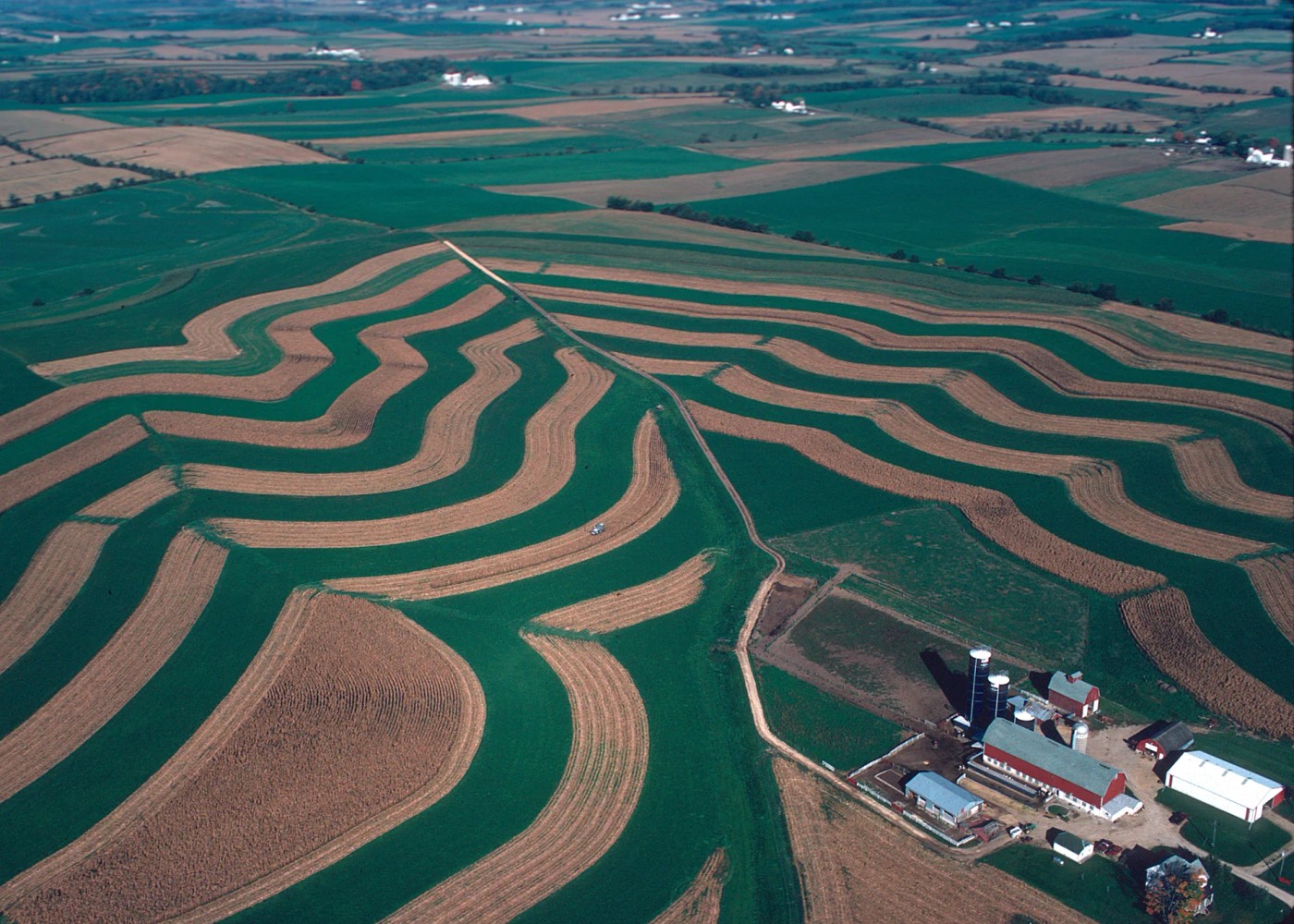
An oat crop doesn't get its own acre. It takes a season away from corn or soybeans, and at Iowa State's 2026 cost estimates and USDA's Nov. 10, 2026 price outlook, each of those seasons returns about $333 an acre over every cost except land. That is the bill an oat-and-clover year has to cover, with help from the nitrogen and yield it hands to the crops that follow.
A nine-year Iowa State trial found a more diverse rotation can match corn and soybeans on profit while buying far less fertilizer and herbicide. Whether it does on your farm depends on a handful of lines you can price before the seed oats arrive.
Lay out your rotation in the SHE rotation planner.
Same profit, fewer inputs: the Marsden result
From 2003 to 2011, Iowa State researchers compared three rotations at the Marsden Farm in Boone County. Alongside a corn–soybean rotation fertilized and sprayed at rates typical of nearby farms, a 3-year rotation added a small grain underseeded with red clover, and a 4-year rotation followed the small grain with a year of alfalfa hay. The longer rotations received composted cattle manure ahead of corn, banded herbicide over the row and cultivated between rows, and sprayed nothing on the small grain (triticale until 2005, oats after) or the forages. Net returns exclude land costs, management time and federal subsidies. Davis et al. 2012, PLoS ONE
Marsden Farm rotations, Boone County, Iowa, 2003–2011
| Measure | 2-year corn–soybean | 3-year with small grain and red clover | 4-year with small grain and alfalfa |
|---|---|---|---|
| Net return, 2003–05 start-up | $181/ac | $163/ac | $185/ac |
| Net return, 2006–11 established | $386/ac | $391/ac | $369/ac |
| Corn yield | 196 bu/ac | 202 bu/ac | 206 bu/ac |
| Soybean yield | 51 bu/ac | 57 bu/ac | 57 bu/ac |
| Synthetic N, rotation average | 71 lb/ac | 14 lb/ac | 10 lb/ac |
| Herbicide active ingredient | 1.70 lb/ac | 0.23 lb/ac | 0.18 lb/ac |
Davis et al. 2012, converted from metric units; yields at 56 lb/bu for corn and 60 lb/bu for soybeans.
None of the return differences was statistically significant in either period, so the longer rotations reached the same profit by a different route. They used 80–86% less synthetic N and 88% less herbicide. Corn yielded about 4% more and soybeans 9% more across the two longer rotations, while the 2-year system needed at least a third less labor. Weed biomass never exceeded 0.3% of harvested crop mass in any system, and once established, the longer rotations' profit swung less from year to year. Davis et al. 2012, PLoS ONE
Spring drainage water under corn in the longer rotations also carried 57% lower nitrate concentrations, a result the series' crop–livestock part covers. Iowa State University, Marsden long-term rotation study
Price the oat year on its own
An oat-and-clover season earns from grain, straw and the nitrogen it leaves for corn, and because Marsden's corn also drew on manure, this example counts the nitrogen from the clover alone. Iowa State's 2026 estimates have no budget for oats grown for grain, so the 80 bu/ac yield, the ton of straw, and the seed, nitrogen, insurance and straw-harvest costs come from its budget for alfalfa seeded with an oat companion crop. Most operations are priced at 2026 Iowa custom rates, which include the operator, and the oat year carries the same miscellaneous, lime and interest lines as the corn and soybean budgets. Iowa State 2026 crop cost estimates, pp. 3 and 9
Worked example: one acre of oats underseeded with red clover
| Line | Basis | $/ac |
|---|---|---|
| Oats | 80 bu at $3.35 | +$268.00 |
| Straw | 1 ton at $155 | +$155.00 |
| Tandem disk, one pass | custom rate | −$19.80 |
| Drill oats and clover together | custom rate | −$19.45 |
| Oat seed | 2 bu, ISU oat companion-crop line | −$35.18 |
| Red clover seed | 15 lb at $2.40 | −$36.00 |
| Nitrogen for oats, spread | 60 lb at $0.53, plus $8.15 to spread | −$39.95 |
| P and K removed in grain and straw | removal at Iowa State 2026 prices | −$57.02 |
| Crop insurance | ISU oat companion-crop line | −$4.10 |
| Miscellaneous and lime | Iowa State 2026 corn and soybean lines | −$17.42 |
| Interest on preharvest costs | 8 months at 7.47%, as in Iowa State 2026 budgets | −$11.40 |
| Combine small grain | custom rate | −$47.00 |
| Haul grain to farm storage | 80 bu at $0.095 | −$7.60 |
| Rake, bale and haul straw | ISU machinery estimate, excludes labor | −$34.81 |
| Return over listed costs | +$93.27 |
2026 prices, except clover seed at Missouri Extension's 2027 planning price. Oats at USDA's 2026/27 projection; straw at the Nov. 12, 2026 Rock Valley, Iowa, auction price. Operations from the 2026 Iowa custom rate survey; nutrient removal from Ohio State ANR-96.
Straw is what keeps that return positive. Wheat straw in round bales sold for $155 a ton at the Rock Valley, Iowa, hay auction on Nov. 12, 2026, in a market the report called too thin for accurate trends. Selling straw also sells nutrients, because a ton of oat straw removes about 51 lb of K2O, a replacement cost already in the P and K line. If the straw stays in the field, the oat year slips to about $3 below break-even, so line up a straw buyer or your own bedding use before the oats are drilled. USDA AMS Rock Valley Hay Auction, Nov. 12, 2026; Ohio State ANR-96, Table 1
Small-grain harvest is also a thinner custom market: only 13 respondents to the 2026 survey quoted small-grain combining, against 119 for corn, and swathing, which some food-grade growers use to protect test weight, drew five. If you will hire it, book an operator for mid-July before the oats go in. Iowa State 2026 custom rates, pp. 3–4; Practical Farmers of Iowa, 2023
The nitrogen the next corn crop doesn't need
The rotation effect works in both directions. In Iowa State's 2026 budgets, corn after corn needs 194 lb of N to grow 193 bu/ac, while corn after soybeans needs 159 lb for 211 bu/ac. Iowa State 2026 crop cost estimates, pp. 2–3
A legume ahead of corn lowers the rate further. University of Minnesota guidance credits red clover with 75 lb of N for the following corn and takes that credit off the corn-after-corn rate. At a price ratio of 0.10 (N price per pound over corn price per bushel), the guideline is 185 lb for corn after corn and 150 lb after soybeans. Corn after clover therefore lands at 110 lb, 40 lb below corn after soybeans, and the gap is the same at a 0.125 ratio; this example's prices fall between the two. At Iowa State's 2026 N price of $0.53/lb, those 40 lb are worth $21.20 per corn acre. University of Minnesota Extension, Tables 1 and 5
That credit depends on the clover establishing. PFI farmers and researchers report crediting at least 30 lb of N to corn after a successful 15 lb/ac interseeded clover stand. In seeding-rate trials PFI published in 2026, clover drilled along with oats gained biomass as the rate went up, while clover frost-seeded into winter wheat germinated poorly and patchily at every rate. Count the credit only where a good stand made it to termination, and credit less where the stand is thin. Practical Farmers of Iowa, 2026 report
The Corn Nitrogen Rate Calculator covers Illinois, Indiana, Michigan, Minnesota, Ohio and Wisconsin, and Iowa State's 2026 budgets use N-FACT, the Iowa Nitrogen Initiative tool. Both offer only corn or soybeans as the previous crop, so for corn after clover, run the corn-after-corn rate at your prices and subtract your state's legume credit.
Three seasons on one acre
Over three seasons, a 2-year acre grows corn and soybeans one and a half times each. A 3-year acre grows each crop once, so the oat year replaces half a corn season and half a soybean season, and the corn that remains follows clover and earns the $21.20 nitrogen credit. The clover also has to be killed before that corn goes in. Iowa State's corn-after-soybean budget has no pass for it, while its corn-after-corn budget adds a chisel pass, so this example adds one at the 2026 custom rate of $20.75/ac. Iowa State 2026 custom rates, p. 2
Worked example: three seasons on one acre
| Line | 2-year corn–soybean | 3-year corn–soybean–oat/clover |
|---|---|---|
| Corn seasons at $332.62 each | 1.5 seasons: $498.93 | 1 season: $332.62 |
| Soybean seasons at $332.99 each | 1.5 seasons: $499.49 | 1 season: $332.99 |
| Oat-and-clover season | — | $93.27 |
| Nitrogen not bought for corn after clover | — | +$21.20 |
| Chisel pass to kill the clover | — | −$20.75 |
| Three-season total | $998.42 | $759.33 |
Return over listed costs except land; the straw line excludes labor. Corn after soybeans (211 bu) and soybeans after corn (61 bu) from Iowa State's 2026 budgets, valued at USDA's Nov. 10, 2026 projections of $4.60 corn and $12.10 soybeans.
On those terms the 3-year acre trails by $239.09 over three seasons, about $80 a year. That is what the oat year still has to earn: spread over 80 bushels, the oats would need about $6.34/bu to tie, and each line the longer rotation might add brings that price down.
Worked example: what could bring the oat price down
| What the longer rotation might also earn | Three-season gap | Oat price to tie |
|---|---|---|
| Base case: straw, N credit and clover-kill pass | −$239.09 | $6.34/bu |
| If yields rise as in Marsden's 3-year rotation, worth $98.46 | −$140.63 | $5.11/bu |
| If the oats qualify for PFI's $20/ac 2027 cost-share | −$120.63 | $4.86/bu |
| If banded herbicide nets $30.60 | −$90.03 | $4.48/bu |
Each row adds to the one above. The yield row assumes Marsden's gains (corn about 3.3%, from the 3-year means; soybeans 9%, the paper's figure for both longer rotations, whose soybean means were equal) on Iowa State's 2026 yields at the same prices. The herbicide row supposes banding halves Iowa State's 2026 corn and soybean herbicide programs, less one cultivator pass on each crop.
The yield row carries the most weight because soybeans at $12.10 make every extra bushel valuable, and since Marsden's corn also received manure, it is the row to test on your own fields. Following Marsden's method, if banding halves Iowa State's 2026 herbicide programs of $56 for corn and $75 for soybeans, the savings each pay for a $17.45/ac custom cultivator pass and leave $30.60. Even with all three lines, the oats need about $4.48/bu, $1.13 above USDA's 2026/27 projection of $3.35, so on 2026 Iowa costs the last $90 has to come from a better price for the oats or the straw. Iowa State 2026 crop cost estimates, pp. 3 and 5; Iowa State 2026 custom rates, p. 2; USDA WASDE, Nov. 10, 2026, pp. 12–15
A premium market moves the most dollars
A premium bid can close the gap on its own, provided the oats make grade and the buyer stays. Near Byron, Minnesota, a consumer-packaged-goods company made a $7.30/bu oat bid in 2022, above competing offers. That market fizzled in 2023, and a $100/ac payment from the Olmsted County Soil and Water Conservation District for clover after oats, aimed at groundwater nitrate, made up the difference, helped by that year's high nitrogen prices. On that footing, Byron Area Farmers grew to 35 farms and 350,000 bushels of oats by the summer of 2023. "Oats spread my workload and my marketing risk," Byron-area farmer Martin Larsen told PFI. Practical Farmers of Iowa, 2024
Grade and distance decide how much of a premium reaches the farm. Most food companies require a test weight of at least 38 lb/bu before dockage, and with few buyers, freight adds up: hauling 80 bushels cost $16.00 for 25 miles at the 2026 Iowa custom rate and $32.40 for 100. Practical Farmers of Iowa's Cost-Share for Extended Rotations pays $20/ac in 2027 for one or both of two scenarios: a small grain harvested in 2027 and followed by a legume cover, or 2027 corn after a small grain and cover or leguminous hay. That corn must get 40 lb less N than your typical program, or no more than 100 lb. Enrollment runs through April 30, 2027, or until acres fill, in Iowa and eligible counties of Minnesota, Missouri, Nebraska and South Dakota. Practical Farmers of Iowa, food-grade oat trial, 2021; Practical Farmers of Iowa, Cost-Share for Extended Rotations, 2027
The extra work lands in March and July
Marsden's longer rotations needed more labor, and when it falls matters as much as how much. In a 2020 PFI trial near Dayton, Iowa, oats were drilled on March 30 and combined on July 17, so seeding came ahead of corn planting and harvest fell in the summer lull before fall work. After the oats come off, the clover grows quickly into a fall forage, and one PFI cooperator grazed an interseeded legume mix from Sept. 9 to Oct. 10, 2024. Practical Farmers of Iowa, food-grade oat trial, 2021; Practical Farmers of Iowa, clover seeding-rate trials, 2026
The custom rates in the oat budget pay an operator for every field operation except straw handling, an Iowa State machinery estimate with no labor in it. The example also leaves out your own time marketing oats and selling straw, which Iowa State's 2026 budgets value at $20.40/hr; if July work means hiring help, machinery operators averaged $22.95 to $24.45/hr in the 2026 custom survey. Iowa State 2026 crop cost estimates, p. 1; Iowa State 2026 custom rates, p. 5
What an oat buyer and a water utility see in the same rotation
For the oat buyer, the first questions are how many tons meet the mill’s specification and whether they can be traced to the contracted rotation. A water utility interested in the Marsden finding would ask a different question. To turn a lower nitrate concentration into pounds of nitrogen avoided, it needs drainage volume and a comparable field or baseline over the rotation. Keeping fertilizer invoices alongside delivery tickets lets both parties see what actually changed.
A mill can buy oats and support a growing practice while a utility considers a separate water agreement. The two need to spell out which claim each purchase carries.
What to price before the first oat crop
Your own numbers will move every line, and five of them carry the decision:
- The season the oats replace. Your corn and soybean returns over non-land costs set the bar.
- A written oat bid. Get the price, test-weight and dockage terms, and delivery point, then subtract freight.
- A home for the straw. At the November 2026 auction price of $155 a ton, it nets about $97 an acre after baling and nutrient replacement.
- Harvest and clover work. Confirm who will combine and bale in mid-July, and decide how you will kill the clover ahead of corn.
- The corn N rate after clover. Run the corn-after-corn rate, subtract your state's legume credit, and check the stand first.
Map the sequence in the SHE rotation planner to see which fields carry oats each year and where the March seeding and July harvest fall, then set each oat year against the season it replaces on that field.
Who can help with the small-grain year?
Practical Farmers of Iowa’s Cost-Share for Extended Rotations offers two routes for 2027. A grower can harvest a small grain and follow it with a cover containing a legume, or reduce applied nitrogen on 2027 corn following a qualifying small-grain and cover-crop sequence or leguminous hay crop. The program covers Iowa and designated counties in Minnesota, Missouri, Nebraska and South Dakota. For other locations, ask NRCS EQIP about Conservation Crop Rotation (328) and which sequence qualifies locally. A grower pricing that extra year can also check rotation and soil-health funding for their state.
The first signature a grower may need is the mill’s on an oat contract. The next conversation may be with the people who use the water draining from that rotation. The mill can say what a load of oats is worth this July. It takes several crops, drainage records and an interested water buyer to learn what else the rotation earns.
Discussion
No comments yet. Be the first to share your thoughts!