- Location
- Iowa
- Crop
- Corn
- Acres
- 2,000
The challenge
“[Timeline: Planning ahead / not urgent] I farm clay loam in central Iowa with a corn-soy rotation. What cover crop species or mix should I plant after corn harvest in mid-October, and will it establish before freeze-up?”
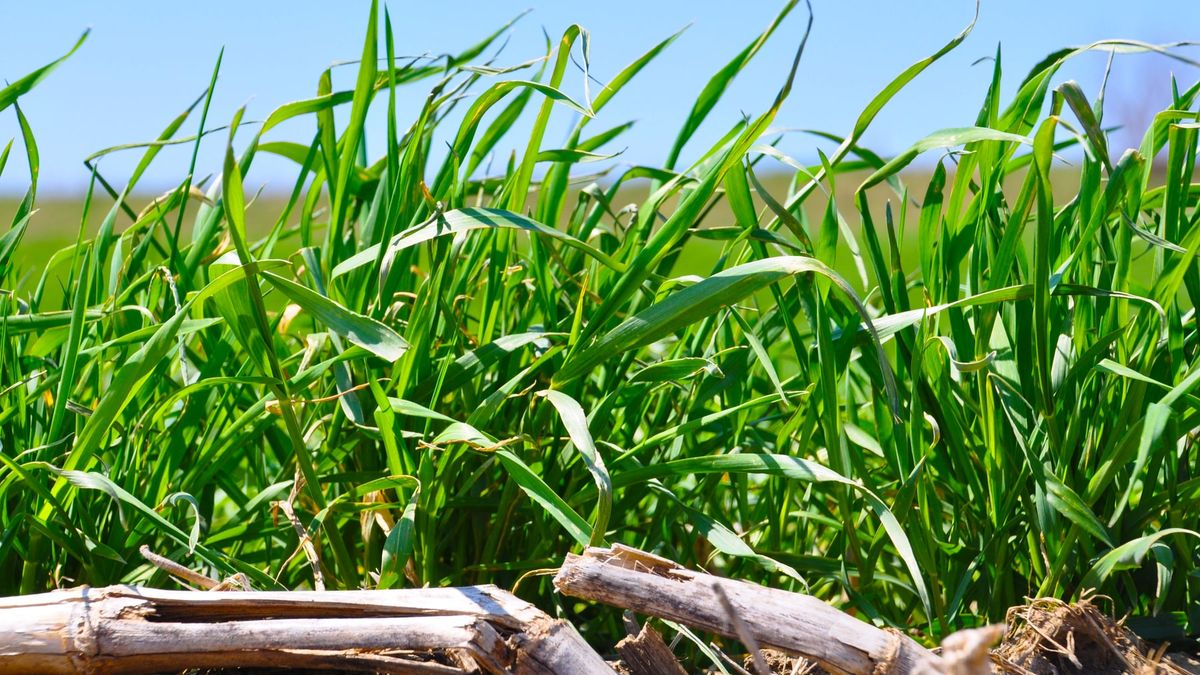
Why cereal rye fits a late slot ahead of soybeans
The Midwest Cover Crops Council's Iowa recipe for fields coming out of corn and going to soybean is cereal rye. Its seeding deadline is two weeks after the average 28°F hard frost: October 21 in northern Iowa, October 28 in central Iowa and November 7 in southern Iowa. Plant as soon after harvest as you can. Rye germinates in soil as cool as 34°F and is among the most reliable cover crops for overwintering in Iowa. Oats and radish are common too, but they winterkill, and Iowa State Extension advises shifting toward cereal rye the later seeding gets.
How much to expect before freeze-up
A late seeding gives a thin fall stand. In a 2018–2019 Practical Farmers of Iowa trial on seven farms, rye seeded after soybean harvest for the following corn crop made very little biomass overall because of late seeding and a cool, wet fall. Seeding later cut biomass at five of six farms, and cutting the rate from 55 to 28 lb/ac cut it at five of seven. Neither seeding date nor rate changed corn yield or the soil health test results. A modest late stand is still worth having, so seed your earliest-harvested fields first and give them the full rate.
Seeding rate, depth and method
- Drilled: 55 lb/ac at 0.75 to 1.5 inches deep, assuming better than 85% germination (MCCC). The minimum rate in the recipe is 45 lb/ac.
- Broadcast with shallow incorporation: 61 lb/ac, worked in less than 1.5 inches (MCCC).
- Aerial or broadcast without incorporation: less dependable than drilling. The NRCS–Iowa State fact sheet lists 55 lb/ac of pure live seed for aerial seeding, against 45 drilled.
- Overseeding into standing corn: Iowa State Extension advises seeding just ahead of a good rain, and switching to post-harvest seeding if the forecast stays dry.
On a large acreage, map your expected harvest order before the combine rolls and work out how many acres your drill can reach by October 28 as fields come open. If the numbers fall short, add a second drill or hire a custom seeder, and keep aerial seeding for the acres you cannot reach in time.
Spring termination ahead of soybeans
Iowa State's 2023 termination review found that 0.75 lb acid equivalent per acre of glyphosate should kill small rye, under 18 inches, in favorable conditions; the older 1 lb rate is generous. Spray on a sunny day above 60°F, ideally with a forecast that stays above 40°F for three to five days, and add clethodim for difficult conditions. Timing is less critical before soybean than before corn, but kill the rye before the beans emerge. For crop insurance, the NRCS termination guidelines split Iowa between two zones: in Zone 3, terminate at or before planting; in Zone 4, before crop emergence. No-till systems can delay termination up to seven days past the zone deadline. Confirm your zone and current rules with your crop insurance agent before planting green.
Cost-share helps with seed and seeding costs. For 2026, the Iowa Department of Agriculture and Land Stewardship offers $30 per acre for first-time cover crop users and $20 per acre for returning users, on up to 160 acres per participant, through county Soil and Water Conservation District offices. Ask the same office about NRCS programs, and get a current seed quote before you set your acreage.
Topics
Cite this
Reference this work
Soil Health Exchange Team (2026). What cover crop should I plant after mid-October corn harvest in central Iowa, and will it establish before freeze-up?. Soil Health Exchange. SHE-FA-2026-0039. https://soilhealthexchange.com/cite/SHE-FA-2026-0039
Soil Health Exchange assigns a stable identifier to every published answer and article. Citations keep working even if the URL changes later.
Keep exploring
Similar questions
Reducing Cover-Crop Herbicide Use in Nebraska: Three Lanes, Measured Before Scaling
Nebraska
Can feedlot manure replace all the commercial fertilizer on irrigated corn?
Clay County, Nebraska

How do farmers interseed cover crops into growing corn?
IL
Organic Corn in Clover Living Mulch: Protect the Row and Test the Yield Response
PA
From the blog

Discussion
No comments yet. Be the first to share your thoughts!