- Location
- Northwest Wisconsin
- Crop
- Multispecies Cover Crop With Brassicas
The challenge
“In lieu of AMF, what do brassica roots associate with below?”
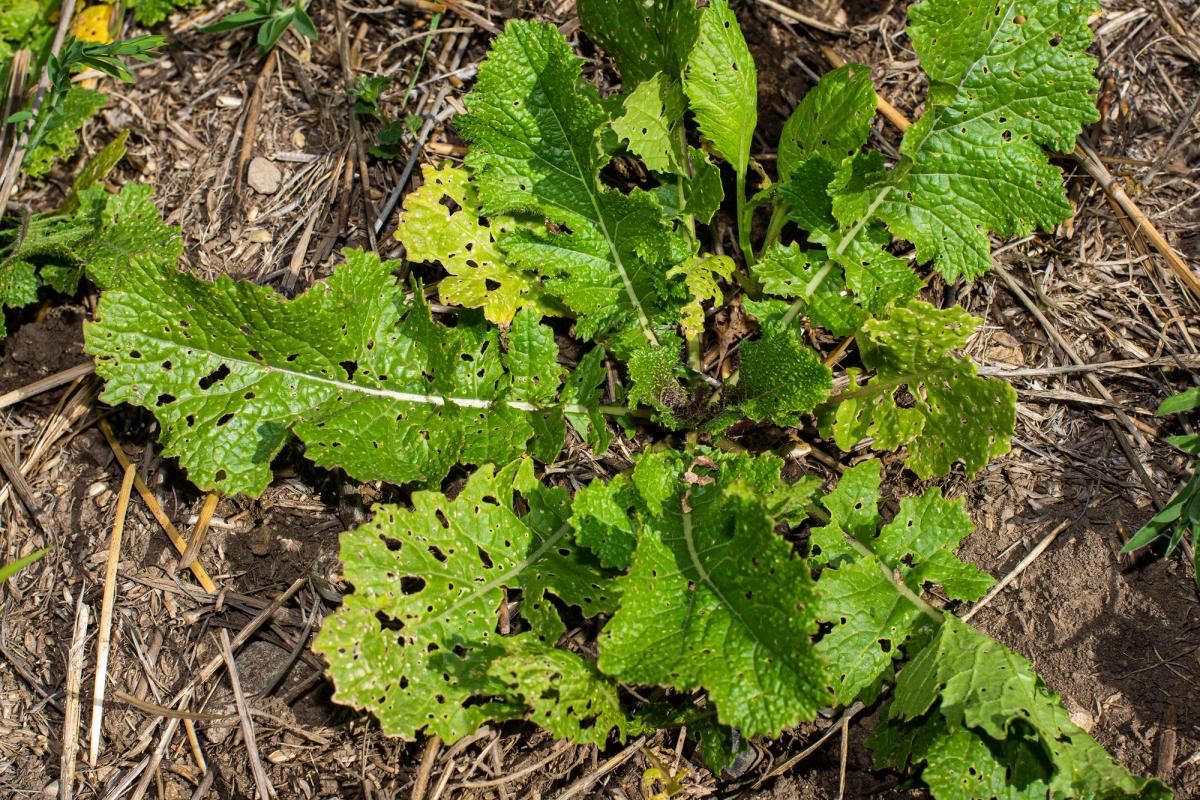
Question source: a Facebook cover crop discussion, collected by Saurav.
The grower who asked this puts turnips in a fall mix for what they do to soil biology, not to pad the species count. That is the right test for a brassica. Turnip, radish, canola, and mustard roots do host fungi, just not arbuscular mycorrhizal fungi (AMF). Their partners are a looser group of root fungi, and some of them move phosphorus into the plant much as AMF do.
Brassicas left the mycorrhizal partnership behind
The mustard family's ancestors lost the partnership before the family arose. When researchers tested 18 species from the family, none was well colonized. Many of the genes that host plants use to run the partnership were missing from the non-host genomes they compared, including Brassica rapa, the species that includes turnip (Delaux and colleagues, 2014).
AMF can still get into brassica roots, which is where reports of brassica mycorrhizae come from. In Brassica roots, the fungus grew only between dead cells of older roots and built no arbuscules, the structures where a mycorrhizal plant trades sugar for nutrients (Glenn and colleagues, 1985). When a neighboring host plant fed the fungal network, AMF colonized up to 43% of Arabidopsis root length and cut its growth by more than half (Veiga and colleagues, 2013). In a brassica, colonization means contact, not a working trade.
Helotiales: a real lead from a wild mustard
Helotiales is a large order of fungi. The study behind the interest followed Arabis alpina, a wild alpine relative of mustard, growing in soil with very little available phosphorus (3.7 mg/kg). One Helotiales fungus made up 45% of the fungal DNA in its roots one year and 23% the next. In sterilized native soil, an isolate of that fungus raised shoot biomass by 52% and shoot phosphorus concentration by 61% after 28 days. In split plates, its hyphae carried radioactive phosphorus across a barrier that roots could not cross and delivered it to the plant (Almario and colleagues, 2017).
That is mycorrhiza-like nutrient delivery, shown across a barrier in lab plates. Researchers writing alongside the study noted that the fungus looked sparse inside roots and that its value in natural conditions still needed testing (van der Heijden and colleagues, 2017). Six other root fungi from the same study's culture collection slowed root or shoot growth at one or both phosphorus levels (Almario and colleagues, 2017). The order also includes Sclerotinia, the white mold pathogen of canola. Helotiales names a branch of the fungal tree, not a group of helpers (Bruyant and colleagues, 2024).
Other root fungi that help when phosphorus is short
Colletotrichum tofieldiae, a root endophyte from wild Arabidopsis in Spain, moved phosphorus into shoots and increased growth and seed production only when phosphorus was scarce. At high phosphate it gave no benefit (Hiruma and colleagues, 2016). In 32-day pot trials with komatsuna, a leafy Brassica rapa, on a phosphorus-fixing volcanic soil, the fungus raised biomass by 53% at the lower dose and more at the higher dose. At low phosphorus, the higher dose nearly tripled phosphorus uptake (+181%); gains were smaller at the higher phosphorus rate (Sarkodee-Addo and colleagues, 2025). Strain matters: another strain of the same fungus severely stunts plants (Hiruma and colleagues, 2023).
Across these studies, the benefit was largest when phosphorus was short.
What actually lives in crop brassica roots
Field surveys of canola tell a different story. At three Canadian Prairie sites, the pathogen Olpidium brassicae was the only core fungus in canola roots and averaged about 70% of the fungal DNA sequences there (Lay and colleagues, 2018). Across 37 UK oilseed rape fields, Olpidium was the most abundant root microbe, increased with shorter rotations, and went with lower yields. A different root fungus, Tetracladium, tracked higher yields in the same fields (Hilton and colleagues, 2021).
Where Trichoderma fits
Trichoderma fungi colonize the roots of many crops, not brassicas in particular. Their link to brassicas is chemical. Brassica tissue releases isothiocyanates as it breaks down, and in a test of 40 Trichoderma isolates, most tolerated brassica seed-meal fumes better than Pythium, Rhizoctonia, and Fusarium. In the same study, seed meal combined with Trichoderma gave the best control of Pythium disease on sugar beet (Galletti and colleagues, 2008). That tolerance makes Trichoderma a workable partner for brassica seed meal.
What this means for your mix
Give the brassica the jobs it reliably does: fast fall growth, nitrogen capture after harvest, weed suppression through quick canopy, and large taproots that can open channels in the subsoil (SARE, Managing Cover Crops Profitably; see Do radishes and turnips really break up compaction?). Count fungal partners as a bonus, most likely on soils low in available phosphorus.
Keep a mycorrhizal host growing beside the brassica. Sunflower, barley, and red clover keep AMF fed through fall. A turnip among them may trim that benefit, but it doesn't erase it (Will a turnip or radish in my mix hurt mycorrhizae for next year's crop?). For how AMF work and which crops host them, see What Is AMF?
Give brassicas a break in the rotation. Shorter oilseed rape rotations carried more Olpidium in the UK survey. A brassica cover crop is still a brassica host, so count it when you plan the break between brassica cash crops.
Remember "Helotiales," and pair it with "low phosphorus." Check the field's soil test phosphorus. Where it is low, a turnip's underground company has its best chance to pay its way. Where it is high, expect the brassica's value to come from its growth, roots, and chemistry.
Topics
Cite this
Reference this work
Soil Health Exchange Team (2026). What fungi do brassica roots partner with if not mycorrhizae?. Soil Health Exchange. SHE-FA-2026-0061. https://soilhealthexchange.com/cite/SHE-FA-2026-0061
Soil Health Exchange assigns a stable identifier to every published answer and article. Citations keep working even if the URL changes later.
Keep exploring
Similar questions
Will a turnip or radish in my cover crop mix hurt mycorrhizae for next year's crop?
Northwest Wisconsin
Do radishes and turnips really break up compaction?
Northwest Wisconsin
Growing milling wheat without herbicides, fungicides, or synthetic fertilizer in western Wisconsin
Pierce County, Wisconsin
Soil Health Factors Impacting Yield Following Wildfire
Nebraska
From the blog
Discussion
No comments yet. Be the first to share your thoughts!