- Location
- Eastern South Dakota
- Crop
- Soybeans After Corn
The challenge
“An eastern South Dakota grower missed the fall opportunity to incorporate potash into corn stalks because the field was too wet. With CEC in the low 20s and soybeans next, should the grower broadcast after freeze-up or wait until spring?”
Start with soil-test K
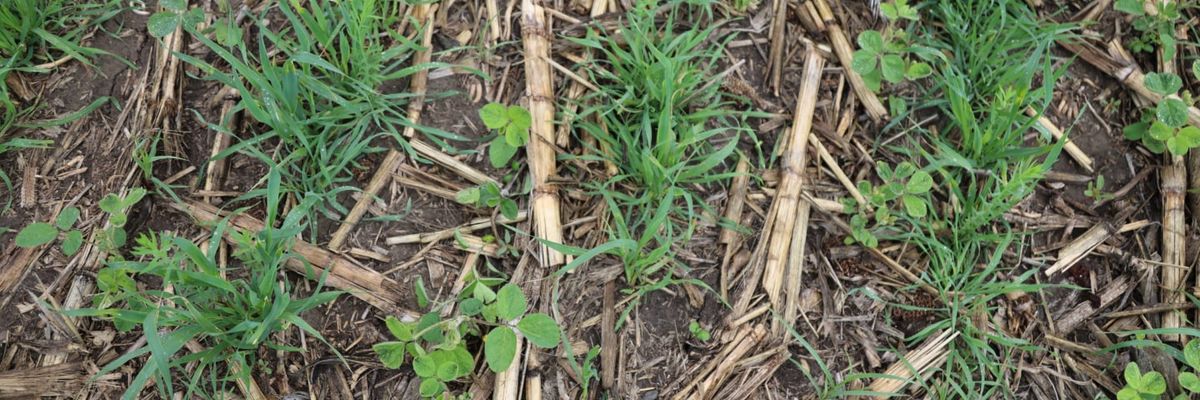
Use a 0–6 inch soil test for K and your yield goal with the South Dakota State University soybean rate calculator. CEC in the low 20s describes the soil’s capacity to hold exchangeable ions. The soil-test K estimates the supply available to this crop. Clay minerals and wetting and drying affect how much K moves between exchangeable and less available forms. Fall application alone gives little basis to predict how much K will be available by planting. Read the CEC field guide.
Spring potash will dissolve with moisture
Potassium chloride granules dissolve as they get wet. How fast the crop can use that K depends on moisture in the layer where it lands and whether roots are active there. In no-till, repeated surface spreading can concentrate K near the surface, where it can be harder for roots to reach during a dry spell. Spreading on frozen ground leaves fertilizer exposed to runoff during a thaw. Wait for unfrozen, trafficable soil and follow the local rate guidance.
Check the rate close to soybean planting
In a four-year University of Minnesota study spanning 24 site-years, spring potash averaged one bushel per acre below fall potash for soybeans. Yield declined when spring rates reached 80 lb K₂O per acre or more in those trials. Higher chloride in soybean tissue pointed to a possible cause. If your soil test calls for a large K application, discuss how much to apply for this crop and whether to shift part of the rotation’s K to the preceding corn crop in future years. Keep potash away from the soybean seed row.
If a dry surface repeatedly limits access, sample by depth to check for stratification while keeping the standard 0–6 inch sample for the recommendation. Compare equal-rate broadcast and a band away from the row in strips where you can measure the yield response.
Adapted from a public AgTalk Crop Talk question. Read the original discussion.
Topics
Cite this
Reference this work
Soil Health Exchange Team (2026). Will spring potash work for soybeans after a missed fall application?. Soil Health Exchange. SHE-FA-2026-0075. https://soilhealthexchange.com/cite/SHE-FA-2026-0075
Soil Health Exchange assigns a stable identifier to every published answer and article. Citations keep working even if the URL changes later.
Keep exploring
Similar questions
Can oats seeded into standing corn help carry a wet harvest?
Southwestern Ontario, Canada
What cover crop should I plant after mid-October corn harvest in central Iowa, and will it establish before freeze-up?
Iowa
Reducing Cover-Crop Herbicide Use in Nebraska: Three Lanes, Measured Before Scaling
Nebraska
Why did our best dryland field yield worse after we built terraces?
Hayes County, Nebraska
From the blog
Discussion
No comments yet. Be the first to share your thoughts!